
IGG Switzerland Events—Absolutely!
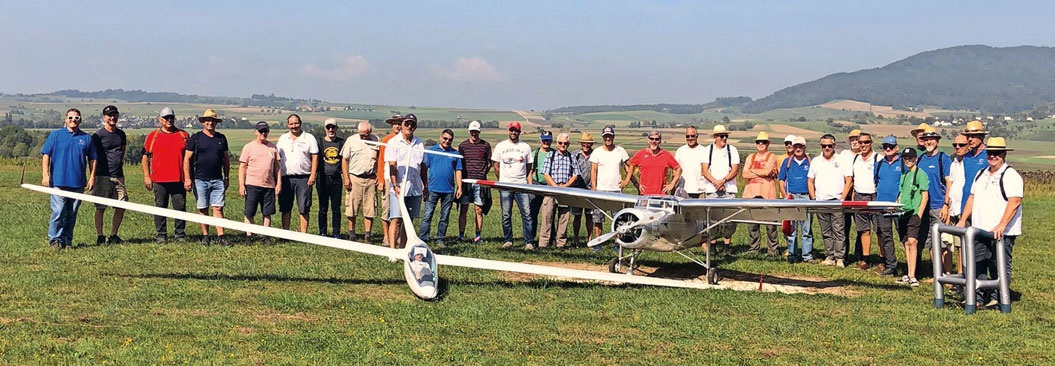
IGG Switzerland, with about 300 members, is an interest group that organizes various events in the lowlands and in the mountains. Large-scale events are usually a major organizational feat, and they always have one overriding goal: Safety comes first—we don’t want any accidents.
On the IGG board, responsibilities are divided between lowland flying and slope flying. This means there is one event coordinator per event. We’d be happy to introduce the most important areas of activity.
The briefing takes place at every event and is mandatory. No aircraft takes off before the briefing. Anyone who has paid the tow fee, attended the briefing, and understood it receives a “wristband” and is thus authorized to fly aircraft. At the same time, the wristband indicates that alcohol is prohibited. At events lasting several days, the color of the wristband changes each day.
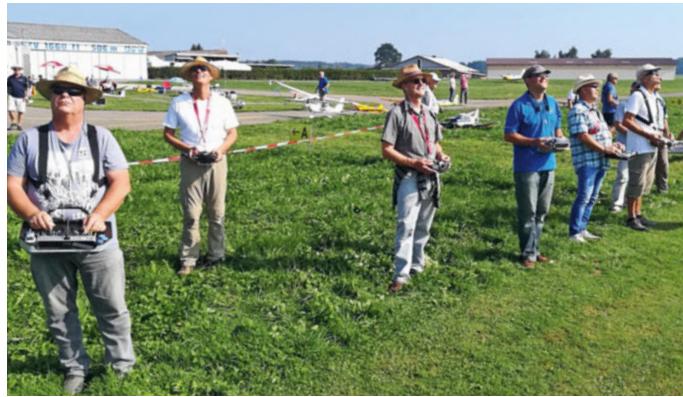
The event site will be divided into various zones and marked accordingly. The pilot area, waiting area, tow zone, and takeoff and landing zones—all of these will be announced and monitored during the briefing. There are also parking zones, setup and takedown zones, spectator zones for visitors, and a food service area.
Air traffic control ensures smooth flight operations. It enforces zone boundaries and coordinates takeoffs and landings. It provides assistance before takeoffs and after landings.
You shouldn’t mess with the flight control team. It doesn’t work without discipline from the participants. At this point, a big round of applause for the fact that we haven’t had to report any accidents so far. However, there have been—and continue to be—situations from time to time.
For example, a situation that still happens quite often: Two tow planes are towing at the same time. Tow Plane 1 has just landed, and the next glider pilot is walking onto the runway with his glider, but Tow Plane 2 is on final approach to the runway. Tow Plane 1 is aware of this because the pilot is paying attention and was informed in the pilot’s booth. The glider pilot, however, is not aware because he was chatting with another colleague about everything under the sun. The flight director recognizes the situation and reacts immediately. He instructs the tow pilot to abort the landing—
must and sends the glider pilot off the runway.
or
A new member gets towed up and is then quite overwhelmed by the unfamiliar situation of having multiple models in the air at the same time. Having to keep an eye on the model while also walking backward from the launch point to the pilot’s box is too much for him to handle. The flight director realizes that, despite being asked, the newcomer is having trouble getting to the pilot’s box and asks an experienced pilot who is not currently in the air to guide the newcomer to the pilot’s box and then provide some assistance with the rest of the flight. This means, for example, that the experienced pilot calls out a tow formation with right-of-way to him and suggests an evasion course, or, as the landing approaches, he takes over coordination with the flight director and the other pilots and can, for example, inform him that his altitude is more than sufficient to allow the two gliders flying lower ahead of him to land first.
Or on the launch slope
Two pilots we don’t know arrive at the slope, where several pilots are already flying—all of whom know each other. They move off to the side a bit and assemble their models.
Without warning, the first model is suddenly launched. A fast flyby from a high altitude, announced at the same time, is aborted thanks to the intervention of an attentive colleague to avoid a collision with the launching model. Our group urges the two pilots who arrived later to please join us so that clear coordination is possible, and we point out to them that it is customary and important on the slope to announce any maneuvers near the slope, takes off and landings, and to ensure that the flight path is clear. In this case, it would have been wise to welcome the two colleagues right at the start with a brief chat and invite them to join us.
Or
A pilot unknown to us comes across as quite arrogant on the ground and gives the impression that he flies a lot and often on the slope, and therefore has a great deal of experience. What nobody knows is that the pilot has never flown on this slope before and, so far, has flown “only” a few foam models on other slopes. The all-FRP model he’ll launch shortly after arriving, he’s actually flown on flat ground first. The launch went well—albeit a bit wobbly—but that can happen even to the best pilots. However, when the pilot decides to land after a while, several pilots who aren’t flying at the moment notice that their colleague isn’t even near the landing field and seems a bit overwhelmed. There’s already some whispering among the group about how the “big shot’s” model is probably about to crash. A sensible colleague takes pity on him, recognizes the danger in the situation, walks over to him, and helps by guiding him to the landing field and instructing him on the landing procedure.
It now becomes clear that the pilot in question failed to familiarize himself with the conditions of this slope—specifically, where and how to land here—and was overwhelmed by the model. It would have been the right and important thing to do to simply ask the pilots present and to put aside his pride at now belonging to the class of full-shell glider pilots.
Fortunately, there are some attentive slope-flying pilots present who are willing to help even unfamiliar colleagues when necessary.
For example, at the Hahnenmoos hotel, there are signs outlining the regulations for the various slopes. These include no-fly zones, flight rules for many model aircraft, as well as restrictions on DS flying. There is generally no flight director at the various slopes. Here, pilots are expected to take personal responsibility and coordinate with one another. Even if no specific area is marked for pilots to gather, they always stay together to ensure communication. Takeoffs, landings, and flybys are coordinated and announced. If a pilot does not follow the guidelines, the other pilots will bring it to their attention.
IGG Switzerland is looking forward to many major events, especially in its anniversary year of 2022—but of course!!


TEAM MANAGER "THIS" BOSSHARD
 Rodito Nussbaumer

SUMMER FUN 2026 AT MG USTER
Martin Wunderli
52. 2026 ALPS CUP
 Emil Giezendanner

ATOM, THE NEW DOUBLE-DECKER FROM CPLR
 Matthias Bosshard

INSIGHTS INTO THE HISTORY OF SEAPLANES

34th HAHNENMOOS ALPINE MODEL AIRPLANE CAMP
Res Dauwalder
CORSAIR F4U – A WARBIRD WITH A MEMORABLE LOOK
Jürgen Rosenberger, Jürgen Prinz
SMALL, MODEL-LIKE SAILBOATS
Res Dauwalder
F3A EUROPEAN CHAMPIONSHIPS IN ST-MACAIRE, FRANCE
Matthias Bosshard
What's New at Leomotion.com

HORIZON HOBBY/LEMACO NEWS: MICRO OV-10 BRONCO 645 MM BY E-FLITE

PRIDE AND GOOD IDEAS
 Markus Nussbaumer

News from HEBU

BY YOUTH, FOR YOUTH
Lorena Betschen
YOU KNOW WHAT I MEAN? 125 YEARS OF THE SWISS AERO CLUB
Emil Giezendanner
TRY-OUT DAY AT MFV WETTINGEN
Urs Keller
FREE FLIGHT IN THE MIDDLE OF SUMMER
Urs Muntwyler
THE PC-21 STORY
Emil Giezendanner
TWIN TOWN PARTNERSHIP
Wolfgang Voeller
EURO CONTEST GLIDER ACRO TOUR AUSTRIA 2026

WELCOME, NEW MEMBER!
Andrea Bolliger
COUPE DES ALPES – OBSERVE AND LEARN
Rodito Nussbaumer
NEWS FROM HEBU
 Julia Bucher

FROM 0 TO 100
Markus Nussbaumer
MEMORIES
Wolfgang Völler
NOS REGION – A HUB FOR ELECTRIC AVIATION
Emil Giezendanner
Have you almost forgotten about aircraft that take off and land vertically?
Emil Giezendanner
70 YEARS OF THE NIDWALDEN MODEL AIRPLANE CLUB
Martin Barmettler