
Information from the SMV Regarding Future Regulations for Model Aviation in Switzerland
In June of this year, Matthias Jauslin, a member of the National Council and President of the AeCS, submitted a motion to the National Council aimed at exempting the operation of model aircraft from the bilateral air transport agreement between the EU and Switzerland and ensuring that the operation of model aircraft continues to be governed by Swiss law.
The SMV and the Aero-Club of Switzerland (AeCS) fully support this motion. Unfortunately, in its statement of September 5, the Federal Council has now recommended that Parliament reject the motion. The rationale for this rejection is questionable, to say the least. It seems to be based more on an instinctive fear of creating new “points of contention” in relations with the EU than on a thoughtful weighing of interests and risks.
We disagree with the Federal Council’s response, and Matthias Jauslin has already officially communicated this to the Federal Council. As a result, the motion will be placed on the National Council’s agenda and is expected to be debated there during the spring session of 2019.
To ensure a positive outcome for the motion, we must now lay the groundwork over the coming months. To do so, we first need media coverage that informs lawmakers about our cause and raises their awareness of it. Here, the SMV relies on the active support of regional model aviation associations, clubs, and individual members. At a later stage, we will need to approach lawmakers in a coordinated and personal manner. The background to the motion is that the EU is currently preparing a new legal framework for the operation of drones, which also covers the operation of model aircraft. The SMV is actively collaborating with associations in the EU to ensure that we can continue to practice our sport under appropriate conditions within this legal framework.
We have succeeded in securing a number of important changes in the latest drafts. The EU is currently revising its proposal, and a new draft is expected to be published shortly. However, despite the changes and exemptions we have achieved over the past year and a half, the EU framework will remain unnecessarily complex and will, incomprehensibly, restrict the practice of our sport.
For example, the upcoming EU legislation (see box) will limit the operation of model aircraft to a maximum altitude of 120 m. Exceptions to this limit are expected to be available only to members of federations and clubs. Furthermore, the exemptions may not cover all the locations where we currently fly and will require a cumbersome procedure. Furthermore, the upcoming legislation will require the registration and certification of all model aircraft pilots, thereby creating a practical—and likely financial—burden for current pilots and a barrier to entry for new pilots.
Our sport’s excellent safety record demonstrates how well the existing legal framework in Switzerland has served all stakeholders and that it does not require any significant changes. There is no reason or need to apply the new EU regulations to model aircraft operations in Switzerland.
In its rejection of the motion, the Federal Council insists on implementing all upcoming EU legislation in Switzerland, arguing that “this is the only way to ensure market access in Europe for the growing Swiss drone industry.” Furthermore, it argues that an exemption for model aircraft in Switzerland cannot be justified vis-à-vis the EU, “because the regulatory framework for model aircraft in Switzerland does not differ significantly from that in the EU member states.” Furthermore, the Federal Council argues that it is not possible to draw a “sufficiently clear line of demarcation between model aircraft flying and the operation of drones.” The Federal Council is of the view that “when weighing economic interests against recreational activities, the former must take precedence.” In this regard, the Federal Council also points out that the FOCA will work closely with us to ensure a “pragmatic implementation of the rules in Switzerland with minimal additional burden on model aircraft flying,” making use of the “numerous exemptions for model aircraft flying” provided by EU legislation.
The Federal Council’s assumption that the framework conditions for model aviation in Switzerland do not differ significantly from those in EU member states is incorrect. The fact is, rather, that most foreign model aircraft pilots envy us for our reasonable and liberal model aircraft legislation. It is no coincidence that many flight tests and trials with drones take place in Swiss airspace. While the new EU legislation represents only a slight tightening—or (e.g., in France) even a relaxation—for many EU member states, it constitutes a significant tightening for Switzerland. Furthermore, due to geographical conditions and a more open legal framework, model aviation in Switzerland is significantly more diverse and widespread than in many EU member states. In a number of EU member states, model aviation usually takes place at licensed airfields. In Switzerland, there are slope-launch sites and private airfields, or simply agreements with farmers, or people fly in remote areas.
Nor is the assertion that it is impossible to draw a “sufficiently clear line of demarcation between model aircraft flying and the operation of drones” convincing. The SMV has drafted a specific proposal on this matter and submitted it to the FOCA. The motion by National Council member Candinas (see below), which is supported by the Federal Council, also calls for this distinction. The Federal Council is therefore contradicting itself on this point.
Furthermore, it is difficult to understand what the “economic interests” are when the Federal Council states: “When weighing economic interests against recreational activities, the former must surely be prioritized.” Exempting only model aircraft from EU legislation does not in any way harm Swiss economic interests. Cooperation with the EU would continue to cover the operation of drones and enable the Swiss drone industry to access the EU market. Furthermore, the comparison is flawed in that it reduces model aircraft flying to a mere “recreational activity.” This fails to recognize the economic interest in a liberal regulatory framework for model aircraft. As National Council Member Jauslin explicitly states in his motion: “Model aircraft flying is much more than a hobby and recreational activity: First and foremost, it offers young people access to aviation and technology. Furthermore, it contributes significantly to innovation in aviation, as the development of environmentally friendly electric motors and improvements in aerodynamics are largely attributable to experiments and insights gained from model aircraft construction.”
The SMV continues to work with the FOCA to steer EU legislation in a reasonable direction and, to the extent possible, ensure its pragmatic implementation in Switzerland. However, the Federal Council’s expectation that a “pragmatic implementation of the rules in Switzerland with minimal additional burden on model aviation” is possible is very optimistic based on the current EU drafts.
It is important to emphasize that the SMV recognizes the need for robust rules governing the operation of drones, particularly in light of the increasing number of incidents and concerns regarding privacy protection. Such rules were called for, for example, in the Candinas motion. However, this motion—which was adopted by both the National Council and the Council of States and, interestingly, was also supported by the Federal Council—made it clear that the EU’s approach of treating traditional model aircraft and drones equally should be avoided, and that Switzerland’s current liberal regulations should be maintained.
The Federal Council must clearly define its priorities. Switzerland has nothing to lose but much to gain by exempting model aircraft from the scope of the bilateral air transport agreement.
(based on the latest available draft)
The most important new requirements:
- Maximum flight altitude of 120 m above ground level
- “Visual Line of Sight” (visual contact)
- Permit required for all model aircraft weighing 25 kg or more
- Fly only where it can be expected that no bystanders will be endangered and at a safe distance from residential areas
- Online training and testing for pilots (valid throughout the EU)
- Mandatory registration for pilots of model aircraft weighing more than 250 g (valid throughout the EU)
Possible exemptions (to be granted by national authorities):
- “Operating permit” for activities “within the framework of model clubs or associations” (exceptions possible from: 120 m limit, 25 kg, training/exam)
- Airspace (“zones”) in which the operation of unmanned aircraft is exempt from restrictions (exceptions possible from: 120-meter limit, 25 kg, training/examination)
In addition, there is the option to exempt certain flights under so-called “standard scenarios.” These scenarios are developed by EASA, including the associated conditions and measures.

F3A EUROPEAN CHAMPIONSHIPS IN ST-MACAIRE, FRANCE
 Matthias Bosshard

News from HEBU

TEAM MANAGER "THIS" BOSSHARD
 Rodito Nussbaumer

YOU KNOW WHAT I MEAN? 125 YEARS OF THE SWISS AERO CLUB
 Emil Giezendanner

SUMMER FUN 2026 AT MG USTER
Martin Wunderli
TRY-OUT DAY AT MFV WETTINGEN
Urs Keller
52. 2026 ALPS CUP
Emil Giezendanner
BY YOUTH, FOR YOUTH
Lorena Betschen
CORSAIR F4U – A WARBIRD WITH A MEMORABLE LOOK
Jürgen Rosenberger, Jürgen Prinz
SMALL, MODEL-LIKE SAILBOATS
Res Dauwalder
What's New at Leomotion.com

ATOM, THE NEW DOUBLE-DECKER FROM CPLR
Matthias Bosshard
INSIGHTS INTO THE HISTORY OF SEAPLANES

34th HAHNENMOOS ALPINE MODEL AIRPLANE CAMP
Res Dauwalder
HORIZON HOBBY/LEMACO NEWS: MICRO OV-10 BRONCO 645 MM BY E-FLITE

COUPE DES ALPES – OBSERVE AND LEARN
Rodito Nussbaumer
PRIDE AND GOOD IDEAS
 Markus Nussbaumer

EURO CONTEST GLIDER ACRO TOUR AUSTRIA 2026

FREE FLIGHT IN THE MIDDLE OF SUMMER
Urs Muntwyler
THE PC-21 STORY
Emil Giezendanner
TWIN TOWN PARTNERSHIP
Wolfgang Voeller
WELCOME, NEW MEMBER!
Andrea Bolliger
NEWS FROM HEBU
 Julia Bucher

FROM 0 TO 100
Markus Nussbaumer
MEMORIES
Wolfgang Völler
NOS REGION – A HUB FOR ELECTRIC AVIATION
Emil Giezendanner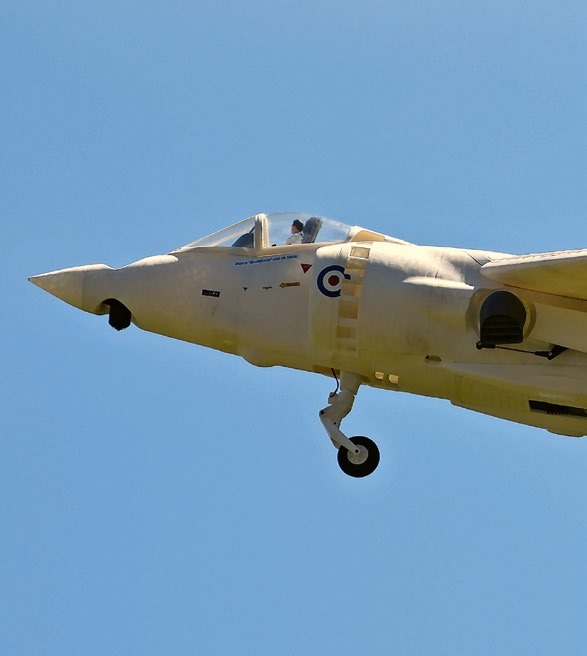
Have you almost forgotten about aircraft that take off and land vertically?
Emil Giezendanner
70 YEARS OF THE NIDWALDEN MODEL AIRPLANE CLUB
Martin Barmettler