
My Experiences
A little over a year ago, I was introduced to Thunder Tiger’s Innovator electric helicopter at the first Innovator Day 2009 (see the report in MFS). The warm relationship I was able to build with the Speed Model team, led by Stefan Raiser, has stayed with me ever since.
Following the reports on the MD 530 and Innovator Day 2009/2010, I’ll conclude with a few thoughts on my experiences with the “highlight” of this product line, the Innovator EXPERT. I tried to identify the differences from the MD 530 and test how it performs with “my” flying style, which doesn’t go beyond basic F3C maneuvers. I’m not in the least bit capable of keeping up with 3D flying. Back in May, I was able to get my hands on an EXPERT from SpeedModels. On top of that, it turned out that the first model I received must have been a problem unit—or, as they say, a “Friday or Monday product.” So during my first few flights, I experienced one or two “dives” that I couldn’t figure out and that made me feel uneasy. At the 2nd Inno-Day on the Degelsberg in Ibach, SZ, I took the opportunity to clarify the issue with the specialists. Jörk Henneck from Thunder Tiger Europe was there in person again, and after a brief analysis, they immediately provided me with a different model. So there are a few bad apples among the Innovators, but I found the support and assistance from SpeedModels to be very positive, accommodating, and generous. With the replacement model, I received the new “Sky-Master” transmitter; I had since purchased a control panel, since I’m a typical “control-panel pilot,” and was thus newly motivated. After another landing in the emerging cornfield near our model airfield, things finally started looking up. The suspicion and uncertainty that the 2.4 GHz iFHSS transmission method might have dropouts continued to linger. Even as I conclude this report, I still cannot answer that question.
So I started testing the EXPERT; specifically, I wanted to test how it behaved when switching from wooden to carbon blades using typical F3C settings. First, I wanted to check the flight behavior using one of the existing setups, so I selected the set “50 Swiss Expert Holz_outdoor.csv” from the existing database, which, upon measurement, yielded the following pitch values for flight phase 0 and flight phase 1, flight mode = F3C:
| Switch Position | Function 0 | Function 1 |
| Pitch Min. | –4 degrees | –10 degrees |
| Pitch Center | +1 degree | +/-0 degrees |
| Max. pitch | +9 degrees | +10 degrees |
| RPM | 2,200 rpm | 2,700 rpm |
I measured the pitch curve values listed in this table myself, since such information cannot be found in any description of the Innovator (at least not yet). There are a variety of setups available for download on the Innovator homepage at SpeedModels under “Downloads” (*http://www.innovator-rc.ch/frameset.htm*). I have
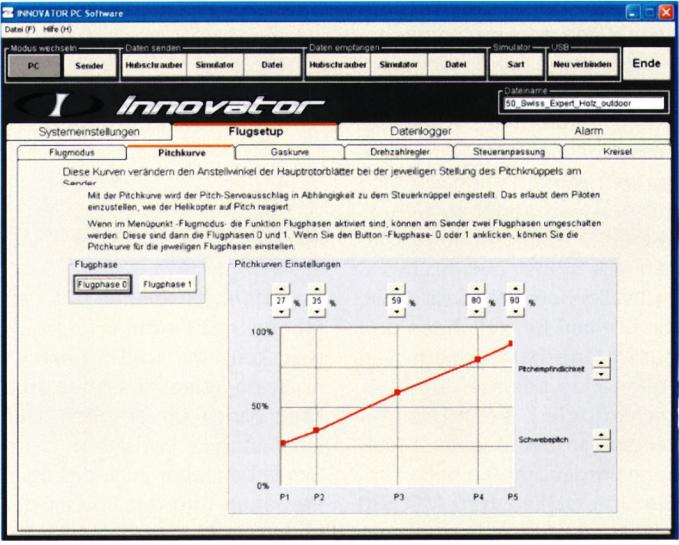
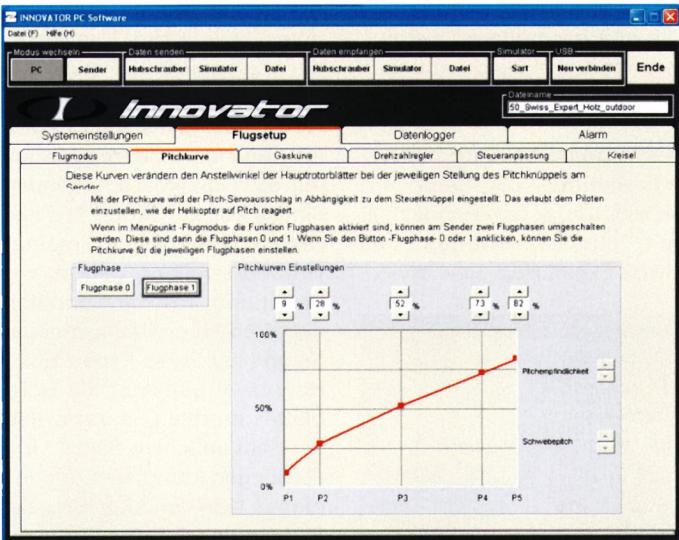
So I created them all in a file on my laptop, then chose one that suited me and reprogrammed, adjusted, and saved my values for pitch and RPM. The corresponding curves therefore match the existing setups, and anyone interested can recreate them on their own PC: have fun with it. I left the remaining settings and control deflections as they were for the first flight and only made adjustments after conducting further test flights with the same setup.
One thing that immediately stands out compared to the MD 530 is the higher RPMs found in the EXPERT’s setups. The simpler “fairing” and the noticeably higher performance, as described in the specifications for each model.
Next, I used this information to put together my F3C setup for wooden blades with the following values (“50 Swiss Expert Holz_Hew.csv”):
| Switch Position | Function 0 | Function 1 |
| Pitch Min. | –4 degrees | –10 degrees |
| Pitch Center | +1 degree | +/-0 degrees |
| Max. pitch | +9 degrees | +10 degrees |
| RPM | 2,200 rpm | 2,850 rpm |
This resulted in the following pitch curves for flight phase 0 and flight phase 1, flight mode = F3C:
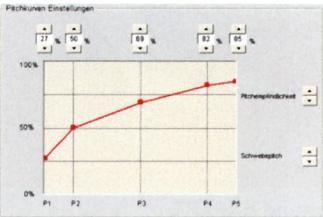
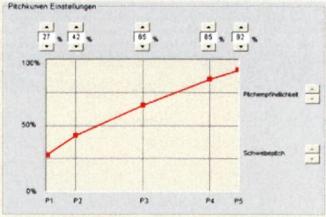
Since I haven’t had much success with the flights so far, I can’t say anything—positive or negative—about its flight performance. I was impressed right from the start by its very stable hovering performance, as well as its agility and the power this model packs. I exercised caution with the RPMs and stayed below 3,000 RPM. Those were the main test phases leading up to the 2nd Inno-Day10.
Starting on July 10, as mentioned, I had another model available with the “SkyMaster” transmitter, set to Mode 1 with pitch control, as is part of my default setup. For the next flight, I loaded my setup (“50 Swiss Expert Holz_Hew.csv”) again, mounted the wooden propellers, had to correct the alignment on one propeller by 2 revolutions, and off we went! So, yet another example of RTF: “Take it out of the box, load the appropriate setup (or have a specialist retailer load it for you), and fly!” Basically, a setup is always pre-programmed. With this setup, I had trouble maintaining my F3C flying style due to the flight characteristics and the wooden blades; especially during circular flight, I noticed frequent “undercutting.” So off to the workshop or the office to reprogram it. This little electric helicopter fits right on a desk or coffee table and can be easily programmed there via the PC. This is what I really like about the Innovator: everything can be displayed, adjusted, and saved to the model
(a must!) and saved to the hard drive as a backup. To do this, you need to organize your PC a bit—something young model airplane enthusiasts in particular are used to these days.
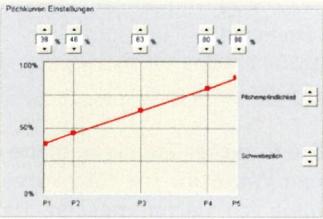
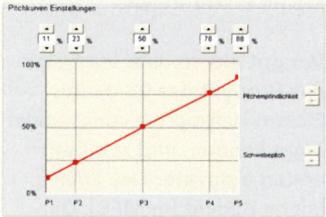
The next setup I used for the wooden blades was “11_EXPERT Holz outdoor.csv,” and I modified it to create “11_EXPERT Holz outdoor_Hew.csv” with the following settings in flight mode 0:
| Switch Position | Function 0 | Function 1 |
| Pitch Min. | –3 degrees | –8 degrees |
| Pitch Center | +4 degrees | +/-0 degrees |
| Max. pitch | +9 degrees | +8 degrees |
| Rotational speed | 2,300 rpm | 2,700 RPM |
For Flight Mode 1, I kept the existing settings and reset the flight mode to F3C. My underlying goal was to make progress in inverted flight, as I, too, would like to improve in this area.
This resulted in the following graphical pitch curves:
Testing at the airfield showed that it performed excellently in hover flight. When I then set out on a short sightseeing flight over the cornfield—which, unfortunately, was encroaching on our airfield—I lost the
The Innovator again! Fortunately, I was able to locate it very quickly, but unfortunately the battery was now stuck so tightly in the housing that it took a great deal of effort to remove it. That was very unusual for me. In the meantime, the electronics had already shut down, thus preventing further damage. After a thorough inspection of the model, I couldn’t find any other defects. In a case like this, you need to calibrate the model (found under System Settings in the Innovator’s software), and then you’re ready to go for more flights. That’s exactly what I did.
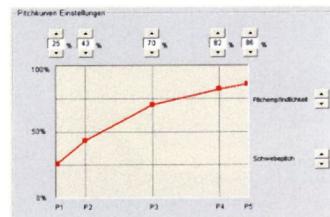
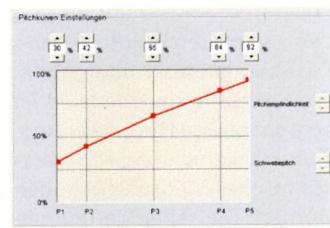
Now I wanted to see how the EXPERT performed when used with the carbon blades. To do this, I prepared the setup, “60_EXPERT F3C Carbon scharf_Hew.csv,” and adjusted both flight modes. I also switched the flight mode back from 3D to F3C and increased the RPM to over 3,000—specifically 3,600 instead of the 3,800 RPM in the “Sample” setup:
| Switch Position | Function 0 | Function 1 |
| Pitch Min. | –5 degrees | –5 degrees |
| Pitch Center | +4.5 degrees | +2.5 degrees |
| Max. pitch | +9 degrees | +10.5 degrees |
| RPM | 2,600 rpm | 3,600 rpm |
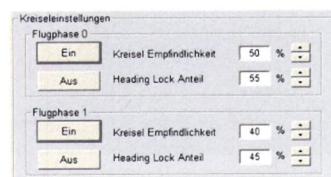
With this setup and the carbon blades, I was able to maneuver the EXPERT through all my maneuvers; whether hovering or flying a circuit, it was a blast to send this little “thing” soaring through the air! The fast pirouettes are still something that will require a few more adjustments and flights. Both in hover and in cruise flight, I was able to pull off a 540-degree
turn—even after significantly reducing the gyro sensitivity—couldn’t be executed satisfactorily.
Unfortunately, on November 6, 2010, during a sightseeing flight, I once again lost sight of the model from a distance. There was a moment when I felt like the model was flying me, not the other way around! Nevertheless, I managed to regain control, fly the EXPERT in a controlled manner within a close radius, and land it again.
I can confirm that the Innovator delivers on its promises from start to finish. SpeedModels recently announced its 1,000th sale! The completely new concept of a model helicopter with logic and intelligence built into the model itself—rather than in the transmitter—is truly impressive. Just unpack it, make a few minor adjustments, and it’s ready to fly. Initial setups are available for every flying style. Programming it on the PC is fun, and you don’t have to take the PC with you every time you go to the flying field—the PC, of course. Just like with other models, it’s best to make the basic adjustments in your hobby room. Fine-tuning doesn’t necessarily have to be done at the field. You’ll need to set up and adjust the Innovator as well, and then you can work your way up step by step to mastering the technology of a model helicopter. The Innovator offers everything from the MD 530 for beginners all the way up to the EXPERT for “power pilots.” So if you’re looking for a beginner’s model in the helicopter category—and there are plenty of them these days—you’ll find what you’re looking for in the Innovator. Following the price adjustments at the beginning of the year, it even offers excellent value for the money.
It’s an ideal model for the indoor flying hall this coming winter season. Indoor flying has, after all, gained immense popularity. For me, 450-class helicopters are classic indoor models. In my opinion, flying outdoors over longer distances or in windy conditions is too challenging; for that, I definitely use one of my large F3C helicopter models. In summary, I can say that the Innovator has ushered in a new era in model helicopter technology. Whether you choose foam, wood, or carbon blades, that’s entirely up to the buyer—the range includes options for every level of model pilot, allowing you to choose what best suits your skill level.
Check with your local retailer or search online to find out the latest about the Innovator:
http://www.innovator-rc.ch/
Have fun setting up and flying the Innovator.
*Walter Heller,
MFV Rapperswil-Jona*


News from HEBU

TEAM MANAGER "THIS" BOSSHARD
 Rodito Nussbaumer

SUMMER FUN 2026 AT MG USTER
Martin Wunderli
SMALL, MODEL-LIKE SAILBOATS
Res Dauwalder
TRY-OUT DAY AT MFV WETTINGEN
Urs Keller
What's New at Leomotion.com

52. 2026 ALPS CUP
 Emil Giezendanner

ATOM, THE NEW DOUBLE-DECKER FROM CPLR
 Matthias Bosshard

INSIGHTS INTO THE HISTORY OF SEAPLANES

YOU KNOW WHAT I MEAN? 125 YEARS OF THE SWISS AERO CLUB
Emil Giezendanner
34th HAHNENMOOS ALPINE MODEL AIRPLANE CAMP
Res Dauwalder
CORSAIR F4U – A WARBIRD WITH A MEMORABLE LOOK
Jürgen Rosenberger, Jürgen Prinz
F3A EUROPEAN CHAMPIONSHIPS IN ST-MACAIRE, FRANCE
Matthias Bosshard
HORIZON HOBBY/LEMACO NEWS: MICRO OV-10 BRONCO 645 MM BY E-FLITE

PRIDE AND GOOD IDEAS
 Markus Nussbaumer

BY YOUTH, FOR YOUTH
Lorena Betschen
FREE FLIGHT IN THE MIDDLE OF SUMMER
Urs Muntwyler
THE PC-21 STORY
Emil Giezendanner
TWIN TOWN PARTNERSHIP
Wolfgang Voeller
EURO CONTEST GLIDER ACRO TOUR AUSTRIA 2026

WELCOME, NEW MEMBER!
Andrea Bolliger
COUPE DES ALPES – OBSERVE AND LEARN
Rodito Nussbaumer
NEWS FROM HEBU
 Julia Bucher

FROM 0 TO 100
Markus Nussbaumer
MEMORIES
Wolfgang Völler
NOS REGION – A HUB FOR ELECTRIC AVIATION
Emil Giezendanner
Have you almost forgotten about aircraft that take off and land vertically?
Emil Giezendanner
70 YEARS OF THE NIDWALDEN MODEL AIRPLANE CLUB
Martin Barmettler