
ABOUT BULB-NOSED PILOTS, INSPIRING CRASHES, AND AN OFFICE IN A BROOM CLOSET ...
Here, we’d like to get to the bottom of things with MFS cartoonist Andreas Locher. The interview was conducted by Lutz Näkel, a journalist and model airplane enthusiast who has been friends with Andreas for many years.
Since 2013, Andreas Locher has been drawing regular cartoons for *Modellflug-sport*. With a sharp pencil and plenty of humor, he “exaggerates” the pitfalls and dramatic situations of model flying, occasionally taking aim at those who style themselves as the hobby’s great heroes but often end up looking quite sheepish. Clearly, anyone with such a keen and incisive eye for the craft must be part of it himself! In fact, Andreas Locher has been designing, building, and flying highly original model airplanes for many decades, and he has occasionally reported on them in *Modellflug-sport*. An anthology featuring a selection of model aircraft caricatures by the artist, born in 1952, is currently being published. Reason enough to ask Andreas Locher about his career and what drives him.
My father was actually “to blame” for both of these interests: he was an amateur pilot and model builder, and even when my brother and I were still in preschool, he always supplied us with scraps of balsa wood, glue, and the most important basic rules of model building. “Trim angle difference” was probably the first technical term I understood and put into practice. And he was also an exceptionally good artist; I traced my first “funny little figures” from his drawings back then. By the way, our Wilhelm Busch book was one of my favorites.
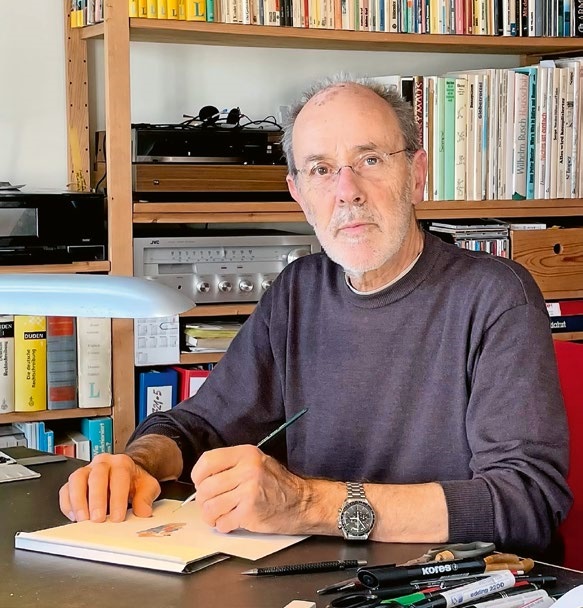
Actor. Back in school, I was often able to get myself out of tricky situations by playing humorous roles; but that was about it. I never got around to playing Hamlet or Faust. Later on, I could have seen myself becoming a journalist—but by then I was already a cartoonist.
The first cartoon that earned me a decent fee was a scene featuring a grumpy angel who longs for the good old clouds—but at second glance, you can see that he’s sitting with his harp on the plume of smoke from a factory chimney... That was in 1973, and the drawing appeared in the NZZ.
Yes, that was indeed a steep start. And the fact that I suddenly ended up in the NZZ was the result of a series of coincidences. To put it briefly: Together with a childhood friend, I designed a flyer listing the traffic light wait times in Zurich’s congested downtown area. The bottom line of this “waiting time chart”: Please turn off your engine! Various newspapers reported on our campaign, with the *Neue Zürcher Zeitung* being the most positive. I immediately wrote a postcard to the editorial staff and offered to provide a few cartoons to the newspaper “as a thank-you”... They actually accepted my offer and invited me to come to the newsroom with a few sample drawings—and from then on, I was “in”!
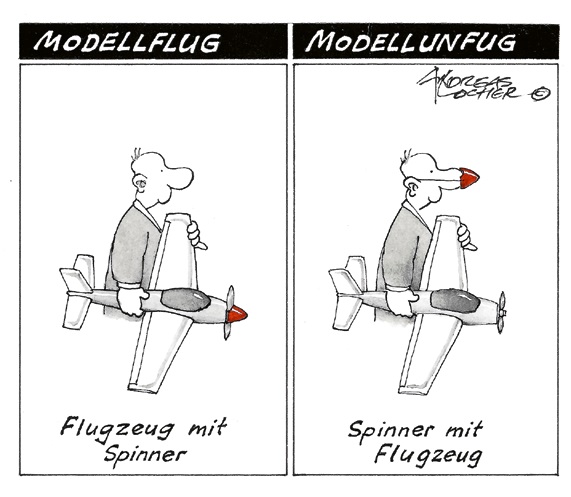
Yes, thanks to the regular cartoons in the weekend supplement of the *Neue Zürcher Zeitung*, many journalists and editorial offices took notice of me; I was soon able to choose from some great offers—I was, and still am, a lucky guy!
Well, I would never call myself an “artist”; Michelangelo, Haitzinger, or Sempé are artists. I’m pretty good at drawing, and I’m a caricaturist. Of course, it’s nice to be successful—but I’ve never aspired to be a “gallery opening star.” I’ve always enjoyed those moments when someone couldn’t help but laugh at one of my caricatures without realizing that the person across from them (say, in a train compartment) is the artist behind it...
Yes, for a short time I had a tiny “closet office” in the newsroom of a daily newspaper. That was at the newly launched TAT; an exciting time with many young, very dedicated journalists. Sometimes I was expected to produce a drawing on a current topic within an hour: that was enormous time pressure—something new for me, but it worked out. As a freelancer and independent contractor, however, I didn’t want to limit myself to just one newspaper, so I continued to work for other newspapers and magazines during that time as well.
Of course, the style has changed. But not fundamentally. A cartoon character from today would certainly recognize an ancestor in a cartoon character from 1973. More biting or milder? Hmm... maybe both. Sometimes you just have to bite back. On the other hand—you shouldn’t overestimate the impact of satire. You can’t change the world with cartoons.
At model airfields, Emil Giezendanner would occasionally bring up my work, saying, “We should really get together sometime…” —eventually, we got down to business and agreed on a test illustration for *Modellflugsport*. It was well received, and that’s how a pleasant collaboration developed with the magazine, to which I also occasionally contributed articles.
These are the issues and moments every model airplane enthusiast is familiar with. And anyone who builds their own models knows that awful feeling when the result of countless hours of free time lies in front of you in pieces. Looking back, though, some things seem so bizarre that you can actually laugh about them. My ridiculous crash happened about three years ago—it was my beloved F3K model: It flew past me on a steady, sloping trajectory, calm but completely uncontrollable—and then I saw something blue right at my feet. Once Mother Earth had swallowed up the plane at a 30-degree angle, my gaze returned to that blue thing: it was my transmitter battery, which had decided to take a hike from the battery compartment… It’s not far from being a caricature at that point.
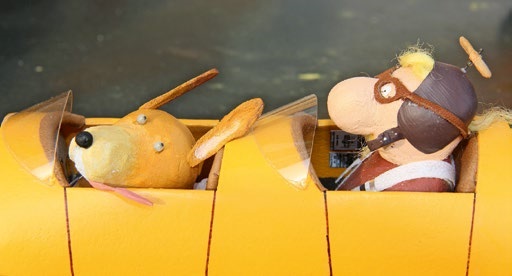
They just turn out that way. I probably couldn't build any realistic pilot figures; mine always end up with bulbous noses for some reason.
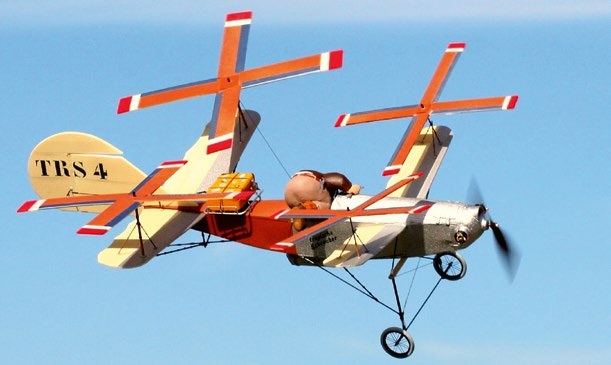
I have to disagree about “very scale”—I’d definitely add a “big” “semi-” in front of that. But “very light” and “very small,” sure. And it can be really fast, too—for that, I still have an older F5B model—something to get my heart racing. But really loud isn’t my thing—that’s when I run for the hills!
The appeal would certainly still be there. However, the print media is no longer living the high life; newspapers can no longer afford to hire cartoonists as freelancers. I was able to pursue my career during its heyday. As for despair: Indeed, when it comes to the “big” issues, there’s often a sense of despair behind many a punchline. And sometimes you have to admit: Reality surpasses fiction...
Maybe a model with a totally unconventional control system, even crazier than my “Verschieb-AIR” from back then, where the fuselage and wings shifted relative to each other... Or another veeeery light indoor glider with even less wing loading than my “Hover Beam” from 2014? But actually, my workshop and basement are already packed to the brim with models... As far as drawing goes, I’m happy with the commissions and opportunities I have now. I don’t have to do it anymore, after all. It’s fun, and model flying helps make it so.
Titled “The Dream of Flying,” Andreas Locher’s 104-page collection of cartoons is now available, complete with an entertaining “Model Flying ABC”—a specialized reference guide that no model flyer’s bookshelf should be without. See the box below for ordering information and the retail price.


News from HEBU

TEAM MANAGER "THIS" BOSSHARD
 Rodito Nussbaumer

SUMMER FUN 2026 AT MG USTER
Martin Wunderli
BY YOUTH, FOR YOUTH
Lorena Betschen
SMALL, MODEL-LIKE SAILBOATS
Res Dauwalder
TRY-OUT DAY AT MFV WETTINGEN
Urs Keller
What's New at Leomotion.com

52. 2026 ALPS CUP
 Emil Giezendanner

ATOM, THE NEW DOUBLE-DECKER FROM CPLR
 Matthias Bosshard

INSIGHTS INTO THE HISTORY OF SEAPLANES

YOU KNOW WHAT I MEAN? 125 YEARS OF THE SWISS AERO CLUB
Emil Giezendanner
34th HAHNENMOOS ALPINE MODEL AIRPLANE CAMP
Res Dauwalder
CORSAIR F4U – A WARBIRD WITH A MEMORABLE LOOK
Jürgen Rosenberger, Jürgen Prinz
F3A EUROPEAN CHAMPIONSHIPS IN ST-MACAIRE, FRANCE
Matthias Bosshard
HORIZON HOBBY/LEMACO NEWS: MICRO OV-10 BRONCO 645 MM BY E-FLITE

PRIDE AND GOOD IDEAS
 Markus Nussbaumer

EURO CONTEST GLIDER ACRO TOUR AUSTRIA 2026

FREE FLIGHT IN THE MIDDLE OF SUMMER
Urs Muntwyler
THE PC-21 STORY
Emil Giezendanner
TWIN TOWN PARTNERSHIP
Wolfgang Voeller
WELCOME, NEW MEMBER!
Andrea Bolliger
COUPE DES ALPES – OBSERVE AND LEARN
Rodito Nussbaumer
NEWS FROM HEBU
 Julia Bucher

FROM 0 TO 100
Markus Nussbaumer
MEMORIES
Wolfgang Völler
NOS REGION – A HUB FOR ELECTRIC AVIATION
Emil Giezendanner
Have you almost forgotten about aircraft that take off and land vertically?
Emil Giezendanner
70 YEARS OF THE NIDWALDEN MODEL AIRPLANE CLUB
Martin Barmettler