
That Pesky Bowden Cable
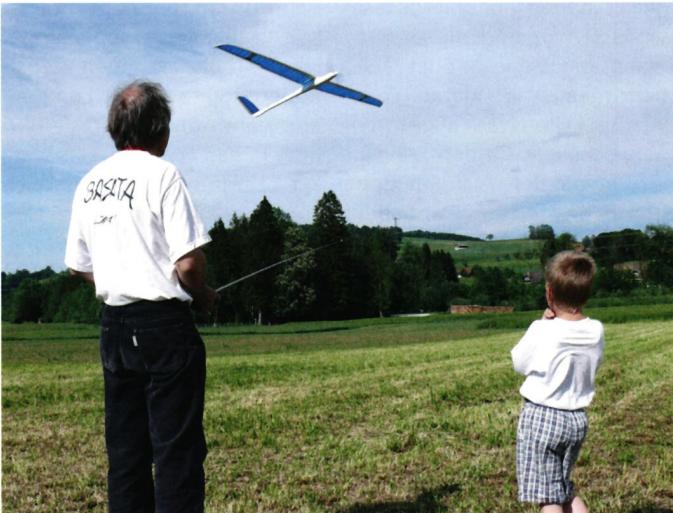
It's a hang gliding competition. My glider model (an electric glider with a replacement weight instead of a propeller) is just being launched into the air. Now things are getting hectic, because the elevator is completely out of trim. By the time I finally get the model under control and the trim is right again, a lot of launch altitude has been lost and the first run is ruined.
After several similar situations, I’m slowly figuring this out: The elevator’s neutral position is temperature-dependent—so much so that the transmitter’s trim range is barely sufficient between summer and winter. This is surely due to the cheap analog servo—finally a reason to buy a digital servo! But I was way off the mark: I blast the TS80 with a hair dryer on the hottest setting. The servo lever holds its position like a British guard in front of Buckingham Palace.
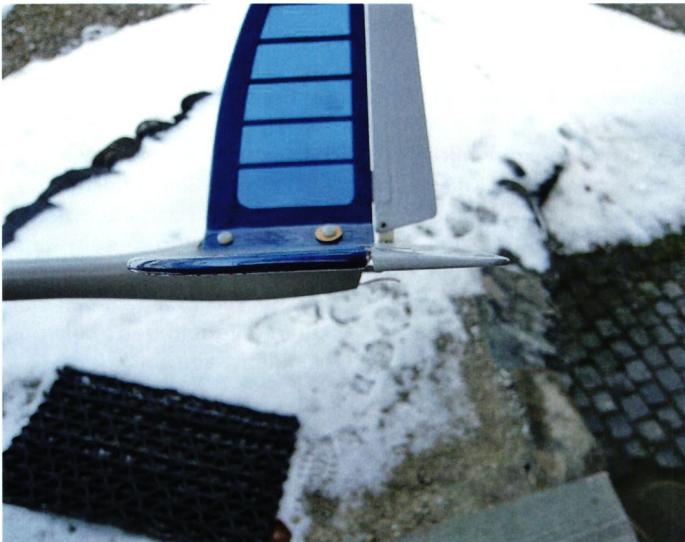
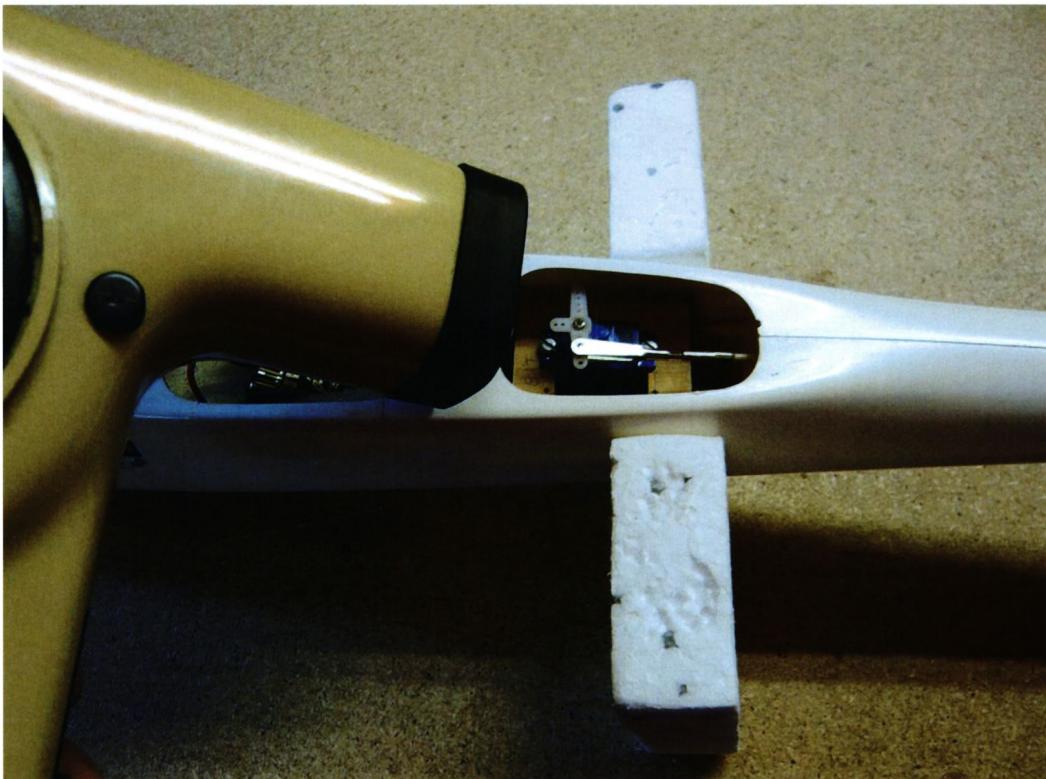
Now suspicion falls on the Bowden cable. And lo and behold: when I blow the hair dryer from the front through the fiberglass fuselage—which is open at the rear—I can see the aileron moving upward, and how! The trailing edge of the rudder drifts a full 5 mm upward when the fuselage is warmed from winter temperatures (2 °C) to 38 °C in the workshop. Converted to the 67-cm-long Bowden cable, that’s a 2-mm extension!
As is well known, most materials expand when heated. In the case of rods and tubes, this is referred to as linear expansion; as a first approximation, it is proportional to the increase in temperature:
| \(\Delta l = l_0 \cdot \alpha \cdot \Delta T\) | (Formula 1) |
| \(\Delta l\) | Elongation in mm |
| \(l_0\) | Initial length in mm |
| \(\alpha\) | Coefficient of linear expansion in 1/°C |
| \(\Delta T\) | Temperature difference in °C |
On Wikipedia, you can find several coefficients of linear expansion for materials that might be suitable for use as push rods or Bowden cables.
For a temperature range of 0 to 40 °C (allowing the pilot to operate without chattering teeth or sweating, while accounting for additional model heating due to direct sunlight) and a Bowden cable length of 1 m (a sailplane of reasonable size—rather rare these days), the following linear expansions result:
The values calculated using Formula 1 in the third column of the table clearly show that thermal expansion of plastics can indeed affect trim and cause (inexperienced) pilots to “struggle.” Steel wire, glass-fiber-reinforced plastics, or carbon-fiber-reinforced plastics perform better in this regard. Conversely, my initial (albeit imprecise!) measurement on the model can also be used to calculate the temperature coefficient \(\alpha\) of the installed inner Bowden cable section.
Rearranging Equation 1 yields: \(\alpha = \Delta l / (l_0 \cdot \Delta T) = 2 \text{ mm} / (670 \text{ mm} \cdot (38 \text{ °C} - 2 \text{ °C})) = 83 \text{ ppm} / \text{°C}\) This value lies between those of polycarbonate and nylon.
When I subsequently removed the troublesome part from the model, I found a milky-white, very flexible material, which suggests it is nylon. This gives me confidence—
1) ppm = parts per million; 8 ppm/°C = 8 * (10–6)/°C
According to the table, there are three options for a temperature-stable Bowden cable:
- Steel wire (or a steel cable firmly glued inside the Bowden cable’s inner tube)
- FRP rod (fiberglass)
- CFRP rod (carbon fiber)
The 35-MHz receiving antenna located in the rear fuselage rules out steel and carbon-fiber-reinforced plastic (CFRP) as materials, since these are electrically conductive and could interfere with reception.
So now there’s a GRP rod inside the Bowden cable guide tube, which is firmly glued into the GRP fuselage. GRP inside GRP!? At this point, at the very latest, it becomes clear that the fuselage itself can expand. But I like the idea of GRP in GRP—the already minimal thermal expansions should even cancel each other out.
The result is impressive: After the modification, neither cold nor heat can move the elevator from its trim position! So nothing stands in the way of flying into the top ranks at the next slope flying competition—or to put it another way: The excuse of a “trimmed” model as the reason
| Material | Coefficient of expansion \(\alpha\) (at 20 °C) | Expansion at \(l_0 = 1\text{ m}\) and \(\Delta T = 40\text{ °C}\) |
|---|---|---|
| Wood | 8 ppm / °C | 0.32 mm |
| Polycarbonate | 70 ppm / °C | 2.8 mm |
| Nylon | 120 ppm/°C | 4.8 mm |
| Soft PVC | 140 ppm/°C | 5.6 mm |
| Steel wire | 11–15 ppm/°C | 0.44–0.6 mm |
| FRP rod | 12 ppm/°C | 0.48 mm |
| CFRP rod | –0.5 ppm/°C | –0.2 mm |
Table 1.
It no longer matters for the poor competition ranking.
Speaking of “temperature-stable rudder linkage”: I’ve often wondered why modern F3A models from the Far East use steel cables to link the rudder—isn’t that Bücker-Jungmann technology from 1933? Now I think I’ve found the answer: The Chinese haven’t discovered the temperature-stable Bowden cable yet...
Ruedi Schmid, MG Thun
Model-building accessories to take off!
www.STEMOTEC.ch


TEAM MANAGER "THIS" BOSSHARD
 Rodito Nussbaumer

SUMMER FUN 2026 AT MG USTER
Martin Wunderli
52. 2026 ALPS CUP
 Emil Giezendanner

ATOM, THE NEW DOUBLE-DECKER FROM CPLR
 Matthias Bosshard

INSIGHTS INTO THE HISTORY OF SEAPLANES

34th HAHNENMOOS ALPINE MODEL AIRPLANE CAMP
Res Dauwalder
CORSAIR F4U – A WARBIRD WITH A MEMORABLE LOOK
Jürgen Rosenberger, Jürgen Prinz
SMALL, MODEL-LIKE SAILBOATS
Res Dauwalder
F3A EUROPEAN CHAMPIONSHIPS IN ST-MACAIRE, FRANCE
Matthias Bosshard
What's New at Leomotion.com

HORIZON HOBBY/LEMACO NEWS: MICRO OV-10 BRONCO 645 MM BY E-FLITE

PRIDE AND GOOD IDEAS
 Markus Nussbaumer

News from HEBU

BY YOUTH, FOR YOUTH
Lorena Betschen
YOU KNOW WHAT I MEAN? 125 YEARS OF THE SWISS AERO CLUB
Emil Giezendanner
TRY-OUT DAY AT MFV WETTINGEN
Urs Keller
FREE FLIGHT IN THE MIDDLE OF SUMMER
Urs Muntwyler
THE PC-21 STORY
Emil Giezendanner
TWIN TOWN PARTNERSHIP
Wolfgang Voeller
EURO CONTEST GLIDER ACRO TOUR AUSTRIA 2026

WELCOME, NEW MEMBER!
Andrea Bolliger
COUPE DES ALPES – OBSERVE AND LEARN
Rodito Nussbaumer
NEWS FROM HEBU
 Julia Bucher

FROM 0 TO 100
Markus Nussbaumer
MEMORIES
Wolfgang Völler
NOS REGION – A HUB FOR ELECTRIC AVIATION
Emil Giezendanner
Have you almost forgotten about aircraft that take off and land vertically?
Emil Giezendanner
70 YEARS OF THE NIDWALDEN MODEL AIRPLANE CLUB
Martin Barmettler