
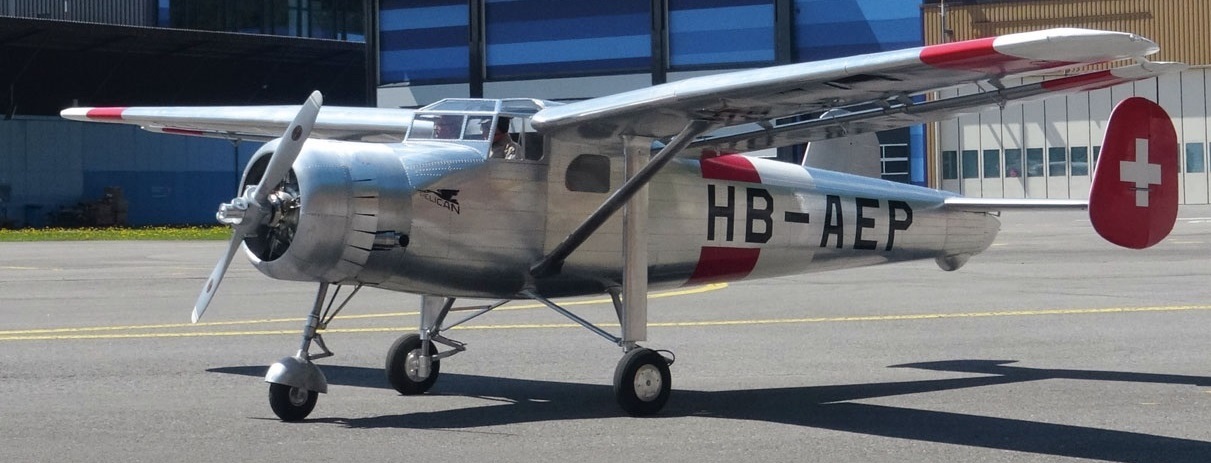
Pilatus SB-2 “Pelikan”
Pilatus SB-2 “Pelikan”
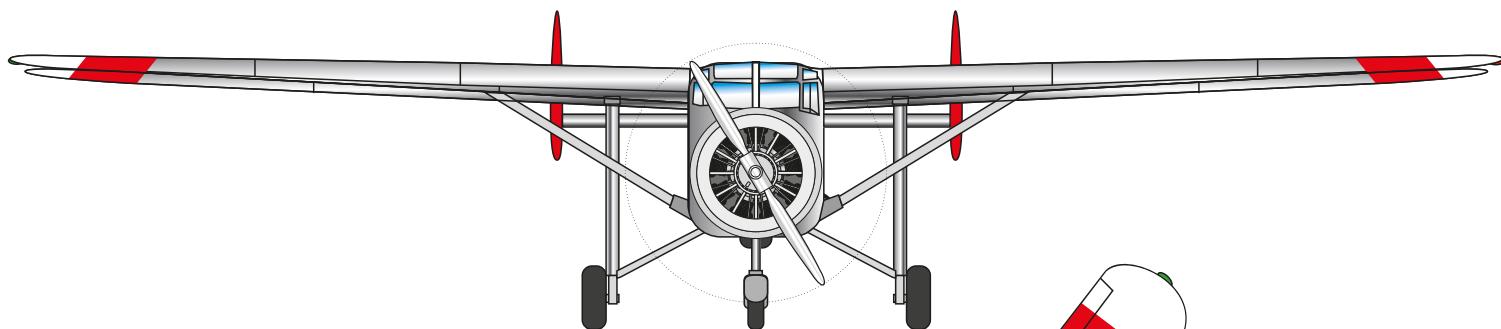
With a great deal of talent and hard work, Markus is bringing the Swiss mountain aircraft, the PILATUS SB-2, back into the public eye by building a model airplane of which not even a single original exists anymore!
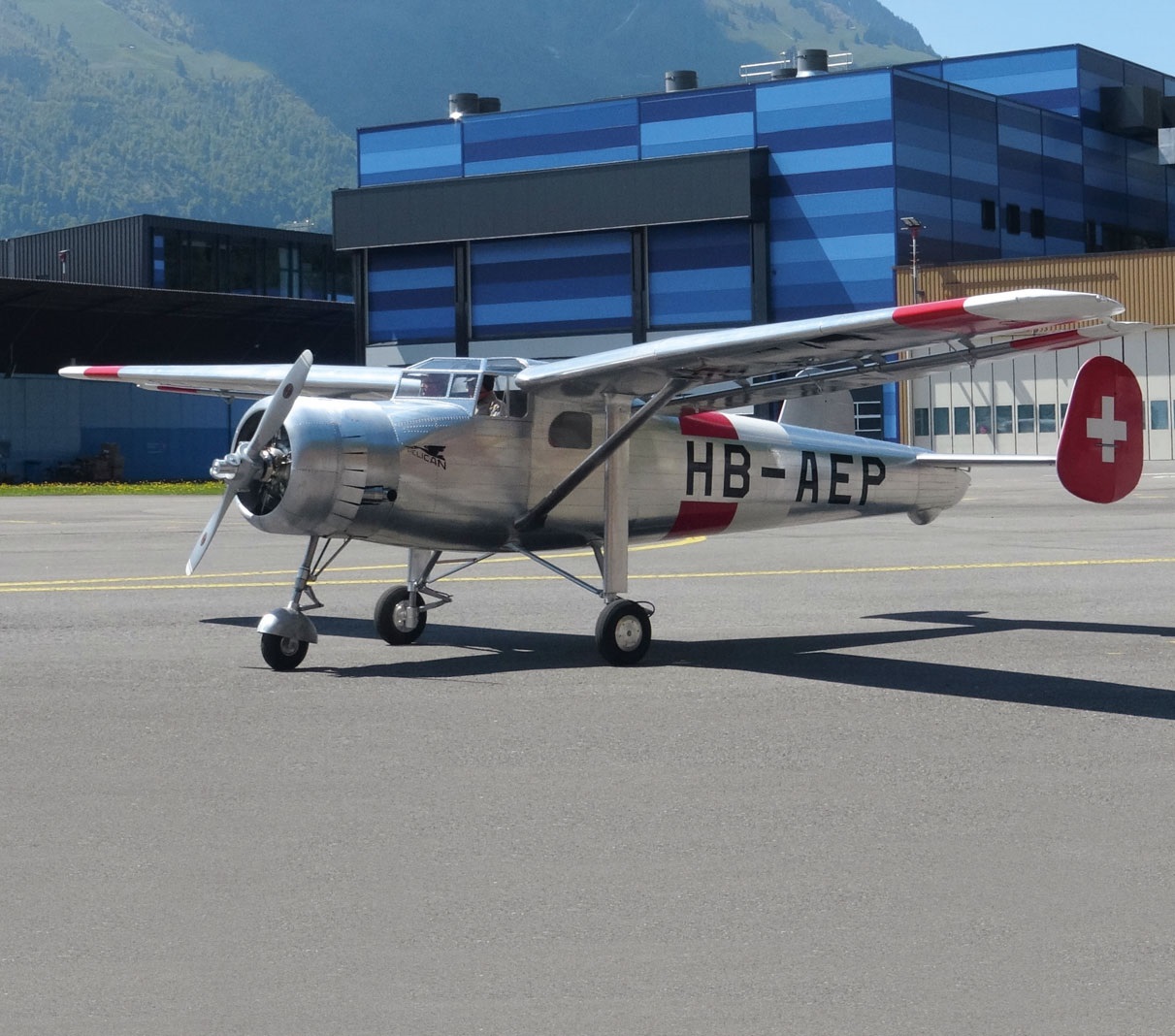
"Renaissance": On May 30, 2019—exactly 75 years after the original's maiden flight—Markus's model will be on display at the PILATUS site.
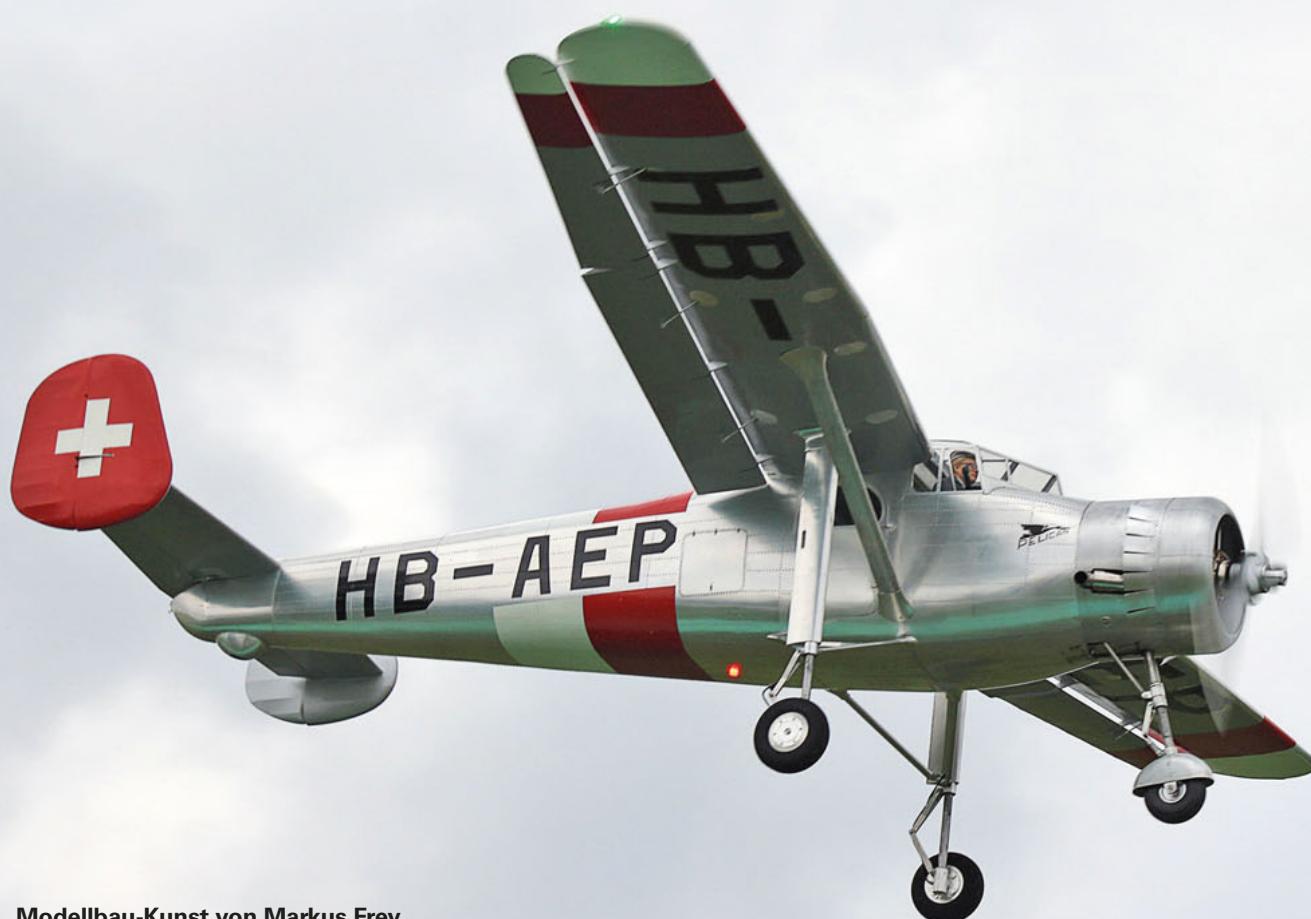
Model-making art by Markus Frey.
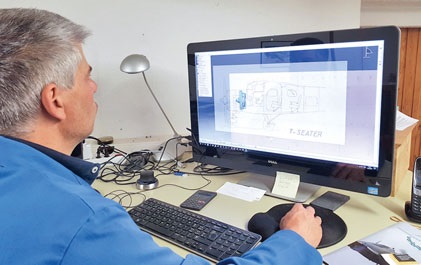
CAD by Rolf Fritschi.
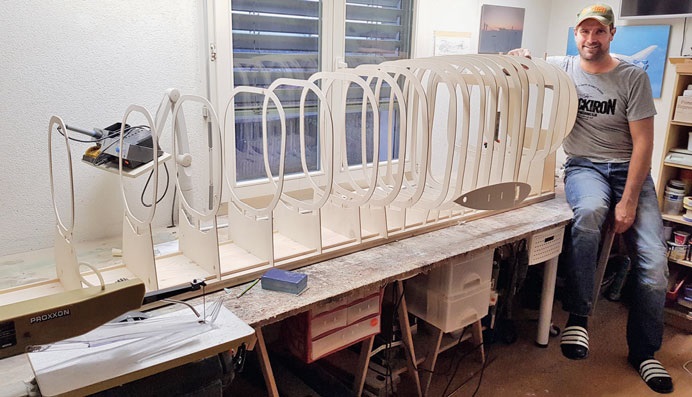
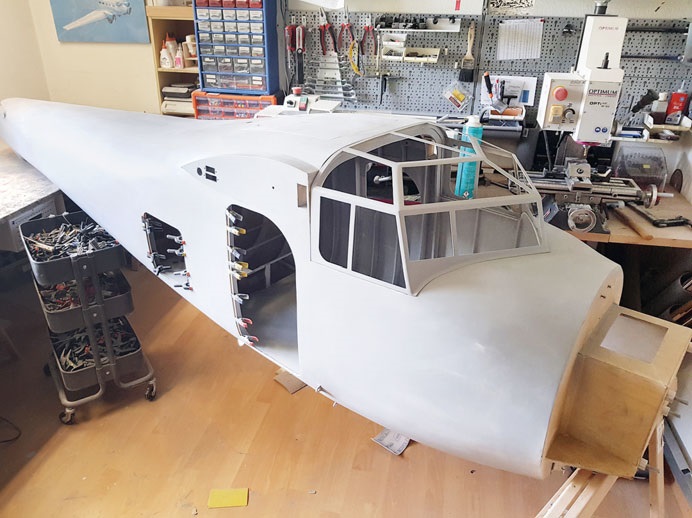
The installed frames give a rough idea of the hull's size.
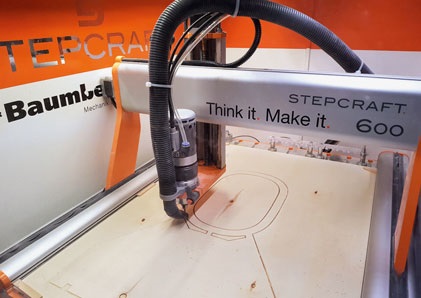
CNC milling machine in operation.
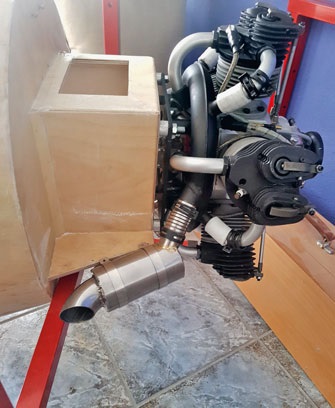
Valach VM R5-420 with tailpipes from Zimmermann Schalldämpfer.
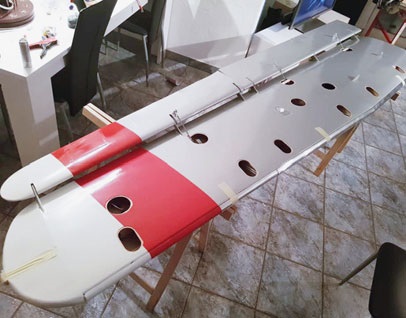
On the "Pelican," even the pilots had to board from the rear. The aircraft had only a single door on the right side.
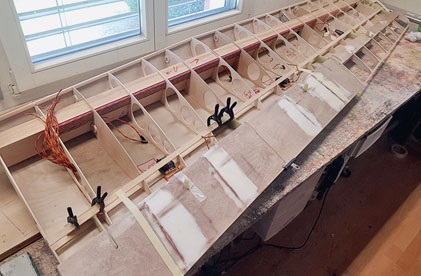
Wing structure under construction. You can still see inside the wing. Don't underestimate the weight of all those cables.
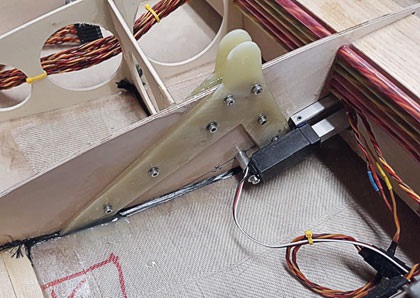
Slats Control.
Panel by Noll Modelltechnik.
Nose landing gear—a technical masterpiece.
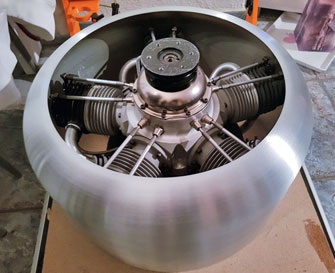
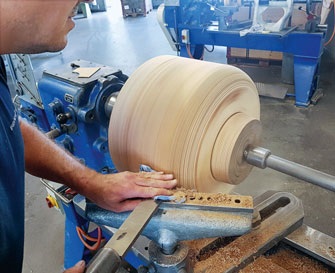
Bonnet pressed from a wooden model.
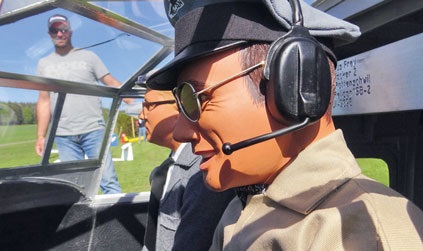
All "three" pilots are satisfied.
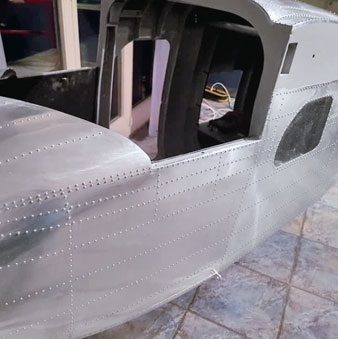
13,000 rivets!!! Just imagine if Markus had taken 5 seconds per rivet: He would have spent about 18 hours on this “varied” task.
Markus—A Life with the “Pelican.”
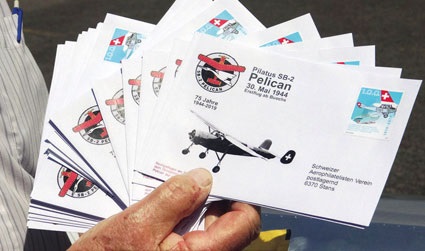
As a memento, these envelopes were on board during the flight.
| Scale | 1:2.8 |
| Wingspan | 5.5 meters |
| Weight | 73 kg |
| Engine | Valach VM R5-420 with 25 PS |
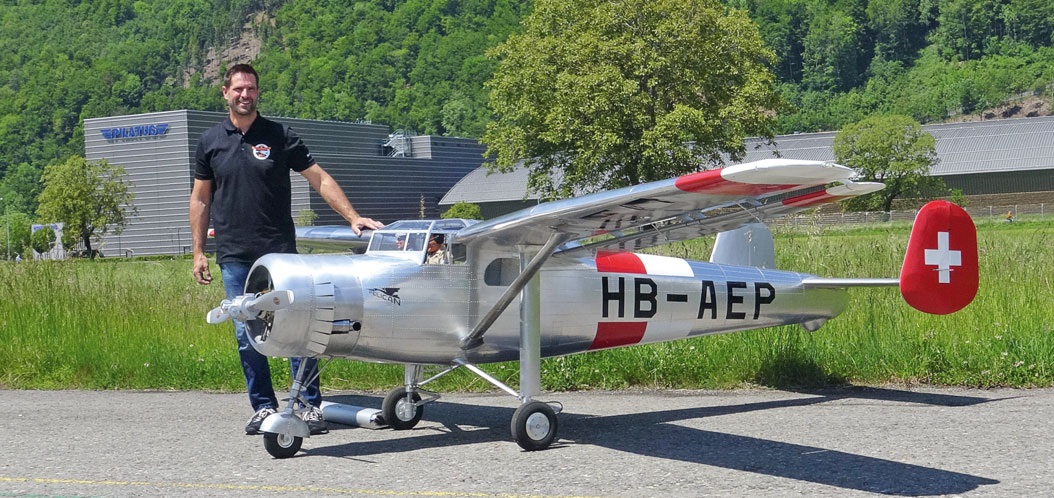
Markus with his “Pelican” at a historic site.
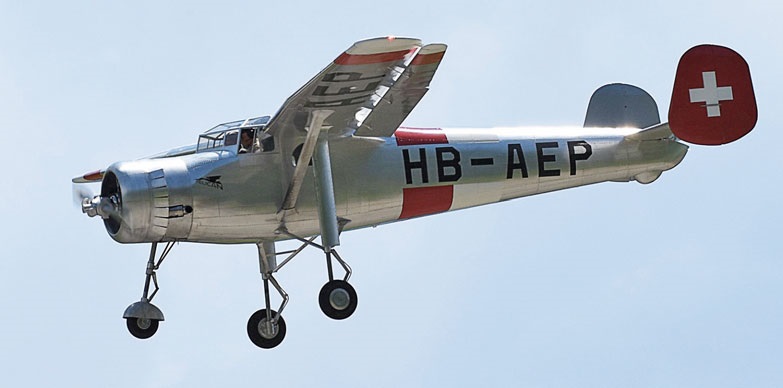
75 years after the original, the PILATUS SB-2 Pelican is flying again—this time as a large-scale model built by Markus Frey at a scale of 1:2.8.
What on earth made you decide to build this particular model?
Markus Frey: In 2017, I had three models on my shortlist: a Trojan T-28, a Westland Lysander, and the SB-2 Pelican. The only requirement was that it had to be an airplane with a radial engine. In the end, I decided on the SB-2 Pelican. (Anyone can do the ordinary—that’s Markus Frey as I know him.)
How did you go about the project?
The plans are probably pretty hard to come by, aren’t they?
Markus Frey: My first port of call was Pilatus Aircraft in Stans. But since they didn’t have any documentation, they referred me to the ETH Zurich University Archives. Over the course of several meetings, Monica Bussmann unearthed more and more documents—construction, test, and maiden flight records, photos, and even the original plans. We also found various plans and documents related to the aircraft at the Federal Archives in Bern.
How did you arrive at the chosen scale of 1:2.8?
Markus Frey: I was influenced by the size of the engine, a Valach VM R5-420. It now harmonizes perfectly with the full-scale model in terms of dimensions and performance.
What were the biggest challenges you had to overcome during construction? After all, you couldn’t use an original as a reference in a museum or anything like that, could you?
Markus Frey: The landing gear really put me to the test—it had to be as scale-accurate as possible while still withstanding the forces during takeoff and landing... Then it took a lot of patience to attach the 13,800 rivets. The whole project is very complex.
I actually thought the biggest problem with your project was the size of your apartment. When I look at the pictures of the “Pelican” sitting in your living room, I can imagine you often had to crawl on your knees toward the TV to turn it on. But luckily, there’s the remote control.
Did you receive any special support from anywhere else?
Markus Frey: Rolf Fritschi (CAD), ETH Zurich; Monica Bussmann, Julian Humml, Dr. Andreas Müller, Prof. Rösgen, and René Bolliger. Milling and 3D printing: Walter Gloor; minor painting work: Patrick Trauffer; jack-of-all-trades and workhorse (a 40-kg fuselage is hard to handle alone): Rolf Ritter and René Baumer.
What exactly did the doctoral students Julian Humml and Dr. Andreas Müller test in the ETH wind tunnel? And were you able to incorporate the findings into your project?
Markus Frey: We conducted various flow tests with the test wing section. During these tests, we varied the angle of attack and speed while testing different flap and slat positions. All in all, the tests gave me a good feeling, because the wing proved to be very forgiving. The test wing wasn’t discarded; instead, it was donated to ETH for future students.
How nervous were you during the maiden flight? After all, it’s a lot of money and a lot of construction time that’s taking to the skies. And how relieved were you after landing?
Markus Frey: After a few taxiing attempts, I gradually increased the speed until the “Pelican” took off on its own... ...then I briefly checked the control response—the plane does exactly what it’s supposed to, and when it recovered on its own after half a rotation during the stall test at slow-motion speed with advance warning, I was completely relaxed... just another brief moment of heart-pounding excitement when it first touched down....but then... you know the rest ;-)
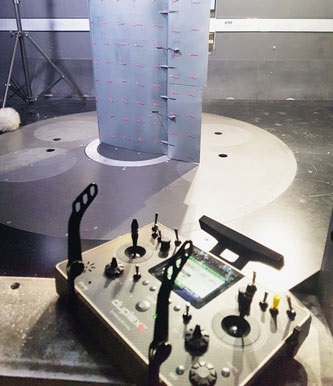
Test wing in the wind tunnel.
What have the reactions been to this unusual model? It’s kind of ugly-beautiful, isn’t it?
Markus Frey: Positive, without exception! Very few people know that the Swiss mountain aircraft ever existed; so there’s already a sense of awe surrounding a model like this. Plus, with a wingspan of 5.5 meters, the model is nice and big—and at 73 kg, it’s also quite heavy.
Would you build this plane again?
Markus Frey: (He smiles and says,) “I don’t think so.” Which, in our language, means “yes”!
Kuno Gross, a colleague of yours, has written a book about the history of the original Pelican SB-2. Your model is also described in it. How did the idea come about to write a book about the Swiss mountain aircraft?
Markus Frey: Somehow, Kuno—whom I hadn’t met until then—was also working on the SB-2 at the same time. While searching Google for more information on the SB-2 Pelican, he came across my project. After a phone call, it turned out that Kuno also came with me to ETH, where we obtained the valuable information and documentation. That’s when Kuno really got hooked! What was initially planned as a two-page report gradually turned into a 252-page book.
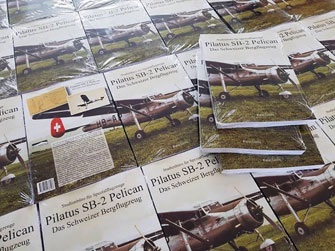
The book about the "Pelican."
Buy
the book at: www.desertstories.org or directly from me, if I have any in stock. 30 francs plus shipping.
Pilatus SB-2 Pelican: “The
Swiss Mountain Aircraft”
19 × 27 cm, softcover
, 252 pages, 43 of which are in color
; approx. 180 photos
; approx. 30 drawings and graphics
; language: German


TEAM MANAGER "THIS" BOSSHARD
 Rodito Nussbaumer

SUMMER FUN 2026 AT MG USTER
Martin Wunderli
TRY-OUT DAY AT MFV WETTINGEN
Urs Keller
52. 2026 ALPS CUP
 Emil Giezendanner

ATOM, THE NEW DOUBLE-DECKER FROM CPLR
 Matthias Bosshard

INSIGHTS INTO THE HISTORY OF SEAPLANES

34th HAHNENMOOS ALPINE MODEL AIRPLANE CAMP
Res Dauwalder
CORSAIR F4U – A WARBIRD WITH A MEMORABLE LOOK
Jürgen Rosenberger, Jürgen Prinz
SMALL, MODEL-LIKE SAILBOATS
Res Dauwalder
F3A EUROPEAN CHAMPIONSHIPS IN ST-MACAIRE, FRANCE
Matthias Bosshard
What's New at Leomotion.com

HORIZON HOBBY/LEMACO NEWS: MICRO OV-10 BRONCO 645 MM BY E-FLITE

PRIDE AND GOOD IDEAS
 Markus Nussbaumer

News from HEBU

BY YOUTH, FOR YOUTH
Lorena Betschen
YOU KNOW WHAT I MEAN? 125 YEARS OF THE SWISS AERO CLUB
Emil Giezendanner
FREE FLIGHT IN THE MIDDLE OF SUMMER
Urs Muntwyler
THE PC-21 STORY
Emil Giezendanner
TWIN TOWN PARTNERSHIP
Wolfgang Voeller
EURO CONTEST GLIDER ACRO TOUR AUSTRIA 2026

WELCOME, NEW MEMBER!
Andrea Bolliger
COUPE DES ALPES – OBSERVE AND LEARN
Rodito Nussbaumer
NEWS FROM HEBU
 Julia Bucher

FROM 0 TO 100
Markus Nussbaumer
MEMORIES
Wolfgang Völler
NOS REGION – A HUB FOR ELECTRIC AVIATION
Emil Giezendanner
Have you almost forgotten about aircraft that take off and land vertically?
Emil Giezendanner
70 YEARS OF THE NIDWALDEN MODEL AIRPLANE CLUB
Martin Barmettler