
About our properties: Aéro seminar on legislation
Legal aspects and the creation of platforms dedicated to model aircraft flying.
On February 25, 2023, nearly forty participants from a dozen clubs in French-speaking Switzerland attended this seminar organized under the auspices of the FSAM. The main issue of the day—namely, the long-term legal viability of our flying sites—appears increasingly critical for the future, given the ever-more-restrictive legislative framework dictated by the Spatial Planning Act (LAT). Other factors inherent to this issue stem from the broader evolution of our society and the perceptions of our elected officials regarding our recreational activities—all of which are reasons and potential concerns that largely explain the large turnout of club leaders from French-speaking Switzerland invited to this session.
After a brief overview provided by the main organizer, Roland Galley, the floor was given to:
- Jérôme Hugentobler (GAM Dizy), who outlined the full scope of the challenges involved in bringing the club’s operating permits (field + so-called “amenity” facilities) up to code at the municipal and cantonal levels. This experience demonstrated that bringing the club up to legal standards has made it possible to maintain and plan for the club’s future activities.
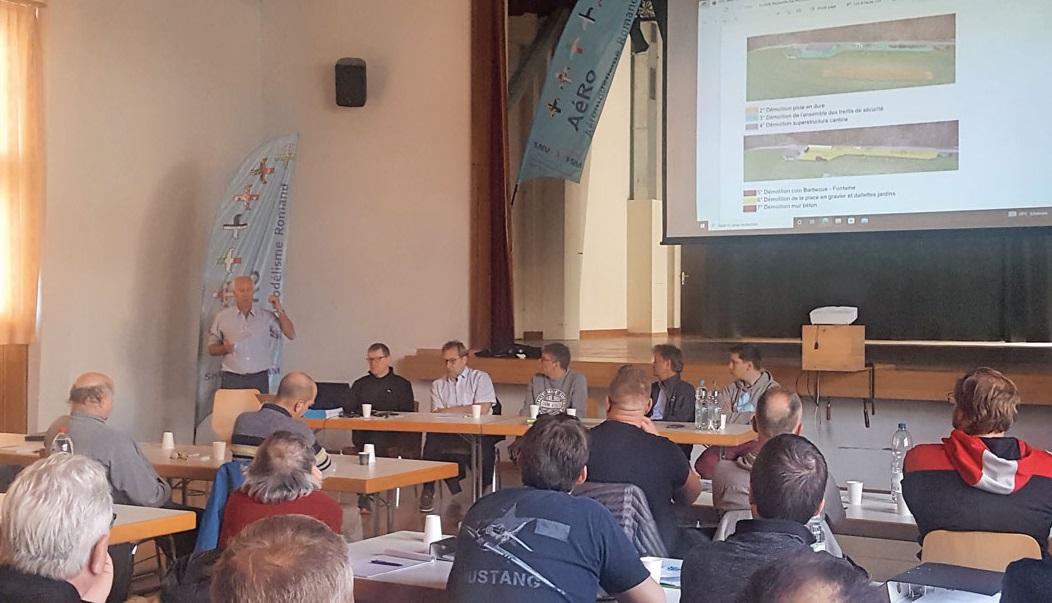
- Laurent Chappuis (GMR Bulle) provided a comprehensive overview of his club’s situation. The timeline of the challenges faced by GMR Bulle stems from the tightening of provisions under the Spatial Planning Act (LAT) (beginning in 1982) and its impact on the long-term viability of its facilities (a “hard” track and “amenity” facilities), which, over time, fell out of compliance with regulations. Furthermore, in
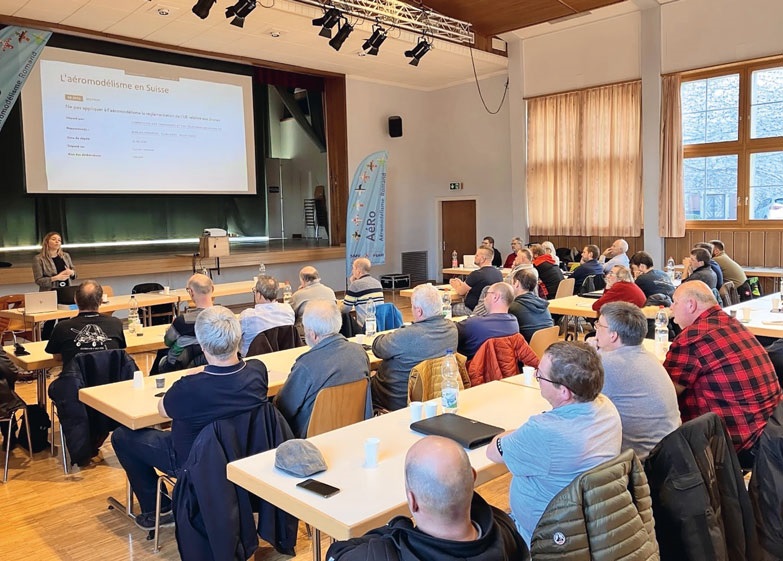
Amanda Boekholt of the OFAC took the opportunity to provide an update on the situation regarding drones.
Despite noise measurements conducted by an independent contractor proving that no noise standards had been exceeded, the six complaints from neighbors have significantly complicated the club’s situation. However, the GMR Bulle team remains undeterred, and now more than ever, the process is moving forward to secure the club’s future.
- Pascal Studer, the founder of the Air Chasseral club, told us about the various challenges and steps involved in establishing a model aircraft club, emphasizing the absolute necessity of obtaining sound legal advice from the very start of the project.
- Attorney Céline Hermann described the framework established by the Spatial Planning Act (LAT), its interpretations, and some valuable legal nuances. As a trusted advisor to the Air Chasseral Club, her insights—along with some points for further reflection regarding the practical realities of a model aircraft club in 2023—seemed to us both novel and interesting.
- Ms. Amanda Boekholt of the OFAC provided an educational and interactive explanation of the principles of the new Swiss legislation on model aircraft (OACS) and its implications for the model aircraft hobby.
- In the presence of FSAM President Adrian Eggenberger, Christophe Petitpierre gave a presentation on the FSAM, including a comprehensive overview of the various initiatives undertaken and the opportunities our Federation offers to clubs.
This day of information and practical discussions was a success in every respect. Our knowledgeable and dedicated speakers shared a wealth of valuable information, along with insights from their experiences and fruitful exchanges with the audience.
We would like to thank the speakers, the participants, and the main organizer, Roland Galley.
Laurent Beldame, Vice President of Aéro Romand and Infrastructure
You can find details of the presentations mentioned above via this link:
Review of the FSAM training day on February 25, links to the presentations (modellflug.ch)
- If a dispute arises, it is essential to have the support of the relevant authorities and the property owner.
- Good relationships are built informally by identifying the relevant authorities (who change with each election) and approaching them during community events (for example) over a friendly drink. If you meet with the authorities in too formal a manner, you run the risk of stirring up counterproductive animosity.
The lack of a building permit (and/or legalization in a “special zone”), which could be raised in a complaint, is a major obstacle to the survival of our dog-training grounds.
- No other “amicable” agreement can compensate for this lack. It is often a deal-breaker. We cannot rely on the land’s long-standing use or the fact that the local dog club or hornuss field in the vicinity appears to be exempt from these requirements.
- A building permit must be obtained from the municipality; an exemption from the canton (the so-called “special zone”) as well as a specialized report from the cantonal authorities are also required. It must be demonstrated that a facility is “required by its intended use” and that no overriding interest stands in its way. The only facility considered by the Spatial Planning Act (LAT) to be “required by its intended use” is the track itself...
In both of the above cases, it is advisable to seek the assistance of a professional to present a compelling case.
- Start small. According to the LAT, a limited application covering a plot of land, a flying area, and possibly a storage shed for equipment may be reasonable (see above). These elements constitute “a facility required by its intended use.”
- Applications for a shed, shelter, tents, or restrooms constitute amenities that do not meet the requirements of the Spatial Planning Act (LAT) and are therefore unlikely to be approved. One can attempt to circumvent these requirements through creative solutions, such as temporary and/or removable structures. It is advisable to seek professional assistance when drafting applications.
- Demonstrate concern for the local environment through verifiable measures to limit noise and/or operating hours. A measuring device is available within the AéRO region.
- Generate interest and goodwill among families, neighbors, and local authorities through festive activities. Host a small official “open house” flying event and invite local authorities...
- Promote activities to young people (elementary, middle, and high schools) that could also inspire future careers: vacation passport, JULA, We-fly.
- Remain flexible and open to the concerns of local residents. Communicate!
- Become involved in the community’s recreational organizations
Summary by: Thierry Ruef and Roland Galley


TEAM MANAGER "THIS" BOSSHARD
 Rodito Nussbaumer

YOU KNOW WHAT I MEAN? 125 YEARS OF THE SWISS AERO CLUB
 Emil Giezendanner

F3A EUROPEAN CHAMPIONSHIPS IN ST-MACAIRE, FRANCE
 Matthias Bosshard

News from HEBU

SUMMER FUN 2026 AT MG USTER
Martin Wunderli
TRY-OUT DAY AT MFV WETTINGEN
Urs Keller
52. 2026 ALPS CUP
Emil Giezendanner
BY YOUTH, FOR YOUTH
Lorena Betschen
ATOM, THE NEW DOUBLE-DECKER FROM CPLR
Matthias Bosshard
CORSAIR F4U – A WARBIRD WITH A MEMORABLE LOOK
Jürgen Rosenberger, Jürgen Prinz
SMALL, MODEL-LIKE SAILBOATS
Res Dauwalder
What's New at Leomotion.com

TWIN TOWN PARTNERSHIP
Wolfgang Voeller
EURO CONTEST GLIDER ACRO TOUR AUSTRIA 2026

INSIGHTS INTO THE HISTORY OF SEAPLANES

34th HAHNENMOOS ALPINE MODEL AIRPLANE CAMP
Res Dauwalder
HORIZON HOBBY/LEMACO NEWS: MICRO OV-10 BRONCO 645 MM BY E-FLITE

COUPE DES ALPES – OBSERVE AND LEARN
Rodito Nussbaumer
PRIDE AND GOOD IDEAS
 Markus Nussbaumer

FREE FLIGHT IN THE MIDDLE OF SUMMER
Urs Muntwyler
THE PC-21 STORY
Emil Giezendanner
WELCOME, NEW MEMBER!
Andrea Bolliger
NEWS FROM HEBU
 Julia Bucher

FROM 0 TO 100
Markus Nussbaumer
MEMORIES
Wolfgang Völler
NOS REGION – A HUB FOR ELECTRIC AVIATION
Emil Giezendanner
Have you almost forgotten about aircraft that take off and land vertically?
Emil Giezendanner
70 YEARS OF THE NIDWALDEN MODEL AIRPLANE CLUB
Martin Barmettler