
Outdoor Games
With a gentle jolt, the cable car cabin begins to move; in one corner of the cabin, model gliders, transmitters, and suitcases filled with repair supplies are piled up. Lively conversation reflects the great anticipation for four days of beautiful glider flights against a stunning backdrop.
In just a few minutes, we reach a “different world”—green meadows, clusters of fir trees, and alpine huts dotted throughout—the beautiful scenery accompanied by the babbling of a meandering mountain stream. It all sounds a bit cheesy, but in the Engstligental on this beautiful summer day in July, it’s reality....! The overall view is stunning, but the enclosed valley basin actually makes it seem like a poor spot for slope flying.
After stowing our gear at the mountain lodge, we head off, fully loaded, toward our flying area. The goal is to fly right away, and one model after another takes to the air. Our pent-up anticipation turns into action: for four days, things will be a bit noisier at our “Hängli”...!
The slope is small in every respect: only about 200 m wide, and the elevation difference to the bottom of the valley basin—about 80 m—isn’t overwhelming either! What’s astonishing—and actually inexplicable—is the fact that, under good conditions, we’ve already reached altitudes of over 300 m on this small slope! Of course, thermals are responsible; however, the topography and the direction of the valley wind don’t necessarily point to such favorable thermal conditions!
But perhaps it is precisely these unspectacular flying conditions that are the secret to our club event: the small size of the slope severely limits our choice of models: small, lightweight gliders with a flying weight of no more than 1.5 kg and a maximum wingspan of 2.5 m may seem like nothing but a drawback to many model glider pilots. Nevertheless, the variety of models is surprisingly large: lightweight thermal gliders, flying wings, small, lightweight vintage models, ARF all-around gliders, or even more racy, scale-accurate models provide plenty of variety on the slope. Occasionally, you can even marvel at small EPP gliders that, thanks to their RC equipment, take to the slope, The fact that all the model pilots present are flying similarly small models brings them together—it doesn’t matter who has the biggest, newest, or most beautiful model; just being there and having fun together is what it’s all about! →
Small, often homemade models—such as the numerous MUxys or the Ka-8—have other advantages as well: the focus is on experimenting with the aircraft, the topography, and weather conditions; you can also test your limits. Deliberately accepting the risk of a “crash” is no problem with these models—no large sums of money are at stake. And if things do go wrong, help is readily available; repair methods are sometimes a bit unconventional—the main thing is to get back in the air as quickly as possible!
On the other hand, once you’ve fought your way back up the slope to eye level, the joy is immense, and your confidence in your own abilities grows with every such success; if you see the model again from above an hour later, your heart rate doesn’t spike again—after all, the last such “exercise” went well. Your feel for the finer points of gliding grows with every success; even though the models are small, such personal “victories” are valuable—your flying skills and your sense of the updrafts continue to improve.
Please don't take this as a subtle dig: the game described here isn't half as fun or worthwhile with electronic assistance—which you end up relying on time and again, even when it isn't necessary!
For small glider models, slopes with extreme updrafts are often not well suited. The flights often feel more like a struggle for survival, and the enjoyment is limited. Playfully “skimming” the edge of the slope is perfectly possible with simple old-school free-flight models—which are, of course, remote-controlled today—at “our” little slope, and it’s a lot of fun. In good conditions, even formation flying is possible—who would have thought that 50 years ago, during the heyday of these Graupner models...!
But back to the next chapter of these cherished pastimes: Once you’ve got your model under control, you can take the spectacle up a notch! Formation flying, our favorite discipline, is enjoyed at every opportunity! In addition to your own model, the terrain, and the weather, you now also have to coordinate with others—as closely as possible, of course. Every now and then, things get a little tight, and not everything goes exactly as planned! And here, too, repairs on small, simple, and homemade models are quick and easy to carry out. A few minutes later, the next flight beckons; flight times are long, and as a result, the pilots make rapid progress.
And then, as the excitement builds, comes the ultimate event: the mass start!
The starting order is set. “Ready, set, go...!” Over 20 models first fly straight away from the slope for a short distance, then they all turn right and, with a bit of overshoot, make the right turn at the slope. Gliding in wide, sweeping figure-eights, the models trace the slope for over five minutes—things get a bit tight now and then. After a successful “mass loop,” the “Tannenschlugg” follows—where airspace becomes alarmingly tight. By the way: Surprisingly, glue consumption stays within reasonable limits—as long as everyone flies roughly in the same direction...!
Taking part in a mass launch of over 20 models—regardless of your own flying skills—brings people together! The spirit of “togetherness” is at the very heart of it, and when the cloud of models glides along the edge of the slope, all close together, it’s a “veeeery” special feeling!
Our shared sense of playfulness isn’t satisfied yet: despite the gathering “fog,” we’re testing the seaplane models in the nearby reservoir—always a thrilling challenge full of surprises for us. If things go wrong here—which is always a possibility—the fun continues: a real model steamboat pushes the “waterlogged” model plane back, which is also quite a playful spectacle...! A heartfelt thank you to the steamboat captain...! Afterward, nothing stands in the way of cooling off in the reservoir. I almost forgot one more thing; two points are very important to me for the success of this long-standing event:
1) Many family members are there, including those who don’t fly; they add a valuable “splash of color” to the event! And it’s especially the women who bring us back down to earth every now and then—which isn’t a bad thing; I’d like to take this opportunity to thank them for their invaluable support! Without this support, the event would hardly have lasted more than 30 years(!)...
2) Numerous beautiful nature photos and my description of the entire scene above prove it: The arena where our games take place is stunning and extremely valuable! It’s also not easily replaceable.
Four wonderful days filled with beautiful moments are coming to an end—as always, far too quickly! We’ll be back in 2024! And perhaps the more carefree and relaxing nature of playing on the hillside will attract interested spectators to our fascinating hobby...?!?

News from HEBU

TEAM MANAGER "THIS" BOSSHARD
 Rodito Nussbaumer

YOU KNOW WHAT I MEAN? 125 YEARS OF THE SWISS AERO CLUB
 Emil Giezendanner

F3A EUROPEAN CHAMPIONSHIPS IN ST-MACAIRE, FRANCE
 Matthias Bosshard

52. 2026 ALPS CUP
Emil Giezendanner
PRIDE AND GOOD IDEAS
 Markus Nussbaumer

CORSAIR F4U – A WARBIRD WITH A MEMORABLE LOOK
Jürgen Rosenberger, Jürgen Prinz
SUMMER FUN 2026 AT MG USTER
Martin Wunderli
TRY-OUT DAY AT MFV WETTINGEN
Urs Keller
BY YOUTH, FOR YOUTH
Lorena Betschen
ATOM, THE NEW DOUBLE-DECKER FROM CPLR
Matthias Bosshard
SMALL, MODEL-LIKE SAILBOATS
Res Dauwalder
What's New at Leomotion.com

HORIZON HOBBY/LEMACO NEWS: MICRO OV-10 BRONCO 645 MM BY E-FLITE

COUPE DES ALPES – OBSERVE AND LEARN
Rodito Nussbaumer
TWIN TOWN PARTNERSHIP
Wolfgang Voeller
EURO CONTEST GLIDER ACRO TOUR AUSTRIA 2026

INSIGHTS INTO THE HISTORY OF SEAPLANES

34th HAHNENMOOS ALPINE MODEL AIRPLANE CAMP
Res Dauwalder
WELCOME, NEW MEMBER!
Andrea Bolliger
FREE FLIGHT IN THE MIDDLE OF SUMMER
Urs Muntwyler
THE PC-21 STORY
Emil Giezendanner
NEWS FROM HEBU
 Julia Bucher

FROM 0 TO 100
Markus Nussbaumer
MEMORIES
Wolfgang Völler
NOS REGION – A HUB FOR ELECTRIC AVIATION
Emil Giezendanner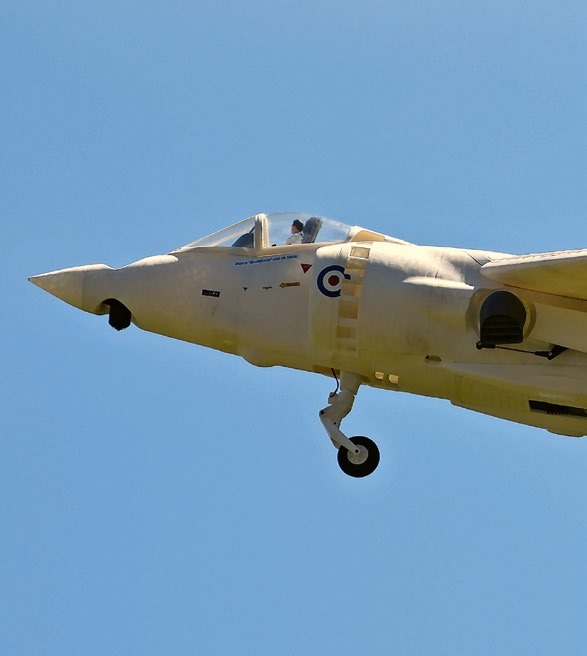
Have you almost forgotten about aircraft that take off and land vertically?
Emil Giezendanner
DO YOU KNOW WHAT I MEAN IN THE LAND OF SMILES?
Emil Giezendanner