
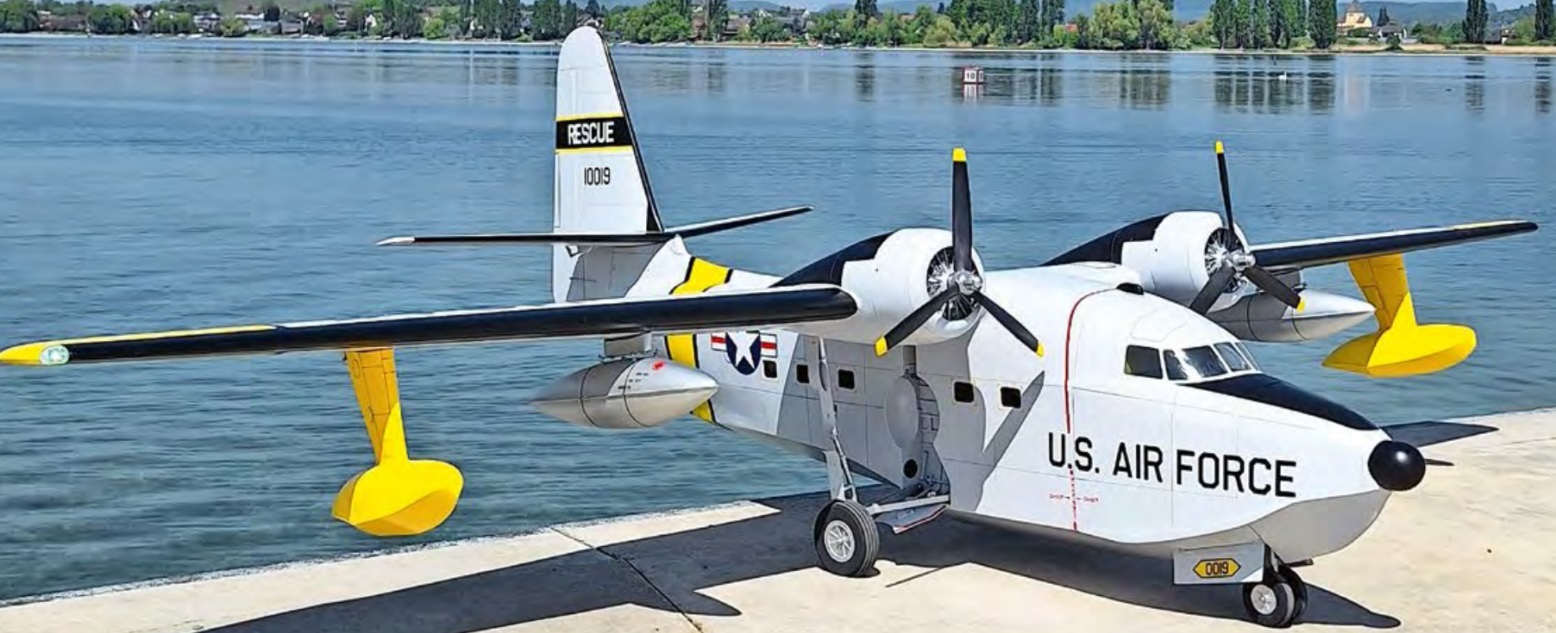
Grumman Albatross
Grumman Albatross
Designed as an amphibious flying boat for transport, search, and rescue missions, the aircraft was produced as the SA 16 A with a wingspan of 24.5 meters. During its service, many of them were retrofitted to a 29.5-meter wingspan and larger tail units. These modifications were also incorporated into series production, now designated as the SA 16 B.
From 1949 to 1961, 464 aircraft were manufactured and deployed in many countries around the world. For example, the German Bundeswehr operated a total of 8 aircraft from 1959 to 1971, stationed in Kiel for operations over the North Sea and the Baltic Sea, while the Italian Air Force operated 12 Grumman SA 16 A aircraft. The 12 SAR flying boats, painted in silver, bright red, and yellow, were distributed among various bases after being decommissioned and, as a result, some still exist today as piles of scrap, gate guards, or museum exhibits. Of the approximately 140 remaining Grumman Albatrosses, an estimated 15 to 20 are currently airworthy.
When I first built my first models on floats in the early 1980s,
When I started seaplane flying, I quickly found myself longing for a Grumman Albatross. So back then—when this seaplane was still relatively unknown among aviation enthusiasts and model aircraft builders, and the Internet didn’t exist—I began searching for documentation to build a model replica. Scale reference material was scarce, and usable model-building plans were unavailable. I collected whatever
literature I could find, and during the summer vacation of 1987, I traveled to Italy to the Vigna di Valle Museum in Bracciano, where, fortunately, the museum director granted me access to the military compound so I could view an original up close. Afterward, I planned to build a model with a 4.2-meter wingspan and bought a 1.25 × 2.7-meter board at a hardware store to trace the fuselage. At the time, I envisioned using two Super Tiger 25-cc hot-ignition engines as the power source.
The thrill of seaplane flying in places like Lugano, Lutry, Schongau, or on the shores of Lake Garda never left me, and over the years I took great pleasure in attending many gatherings. Nevertheless, the Albatross project kept getting postponed, even after a plane that had traveled all the way from the U.S. left an unforgettable impression at the 1998 air show in Altenrhein. In 2013, I picked up that large drawing board and my pencil again, but quickly realized that designing the model using CAD would offer many advantages. The effort required to draw this in 2D CAD was enormous, but in retrospect, it paid off with the
determined with sufficient accuracy.
Now, something a bit smaller and electric: My considerations led me to a 1:9 scale model with a wingspan of 3.27 meters and propellers in scale sizes of 16 inches in diameter. A Bellanca with a 2-meter wingspan, which I purchased specifically for this purpose, served as a test bed and helped me select the propeller and three different motor brands.
- All dimensions are to scale
- Wooden model, cabin section; cowls and nacelles made of fiberglass
- Model primarily intended for use on water
- Functional retractable landing gear for launching, retrieving, and parking on land
- Wings in two sections; tail surfaces can be detached for easier transport
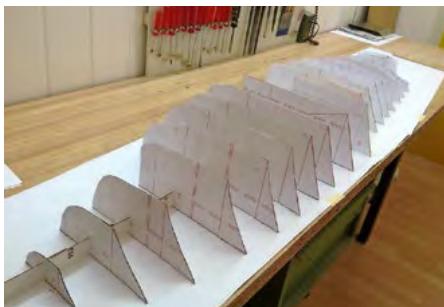
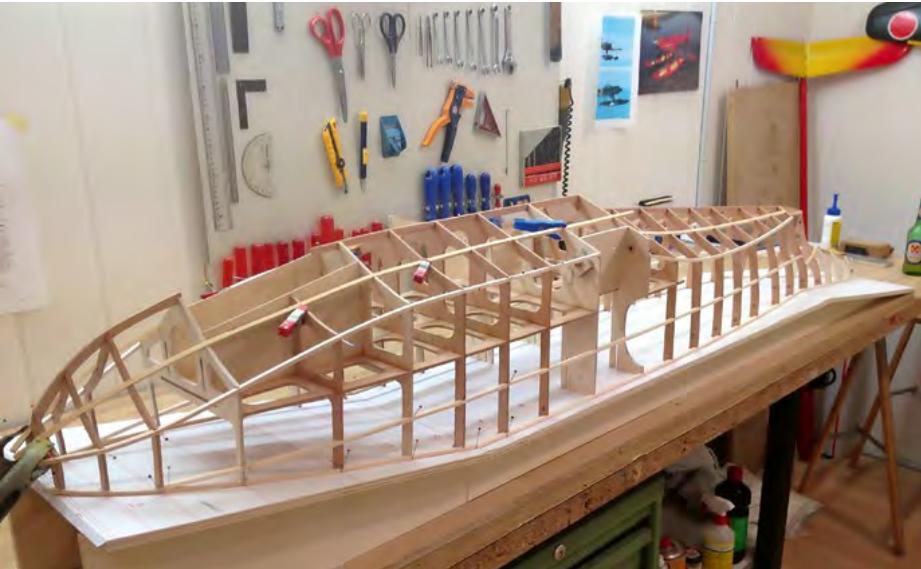
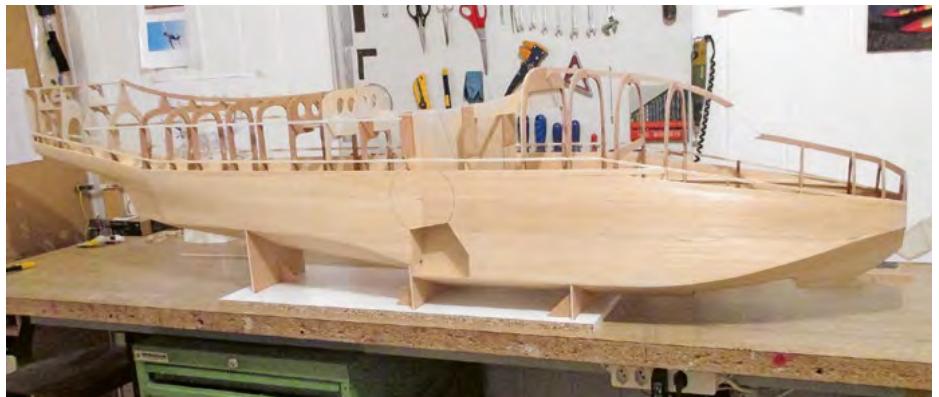
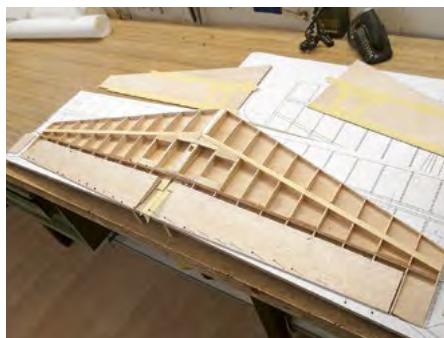
I began construction in August 2014 with the fuselage. I printed all the frames and stringers on paper using a copier, glued them onto five 0.5 x 1.0-meter plywood sheets of varying quality in a space-saving layout, and cut out all the parts with my scroll saw. I remembered how my father and I built a sailboat together more than 45 years ago, so I decided to build the lower part of the hull (the boat) first and then attach the upper part to it. I planked the hull with 4-mm balsa, mostly using the strip-building method. The elevator and horizontal stabilizer followed, built using the standard rib construction method.
For the wings, I had the ribs milled at Peges Milling Service from the types of wood I specified. Thanks to their excellent service, I received a perfect set of ribs after just a few days—
section. Due to the special wing geometry and the resulting variations in profile thickness, I had to build a multi-section frame. For space reasons, I built the right wing first and then the left. The two halves are connected with a 40-mm Strongal tube and an additional 10-mm Strongal tube, and for the
| Scale: | 1:9 |
| Wingspan: | 3.27 meters |
| Length: | 2.11 meters |
| Height: | 0.87 meters |
| Weight without/with battery: | 14.5/16.5 kg |
| Propulsion: | 2 E-Flite P110/280 Kv |
| Battery: | 8S-10,000 mAh |
| Propellers: | 16 x 10, 3-blade counter-rotating |
| Max. power: | 1,800 watts each |
| Total construction hours : | approx. 1,500 |
The wings were bolted to the fuselage from above. I cut and shaped the floats out of Styrofoam. The molds for the engine nacelles were also made from this material, while those for the engine cowlings were made from balsa wood. I shaped the cockpit
canopy and nose landing gear doors were shaped directly on the airframe.
With the exception of 2016 and 2017, I worked on my Albatross every winter; in between, my son Andreas and I built quite a few model airplanes, including a Toni Clark Pitts for him. By the spring of 2023, the airframe was finally ready.
After retiring in July, I spent many of my free summer days fly-fishing at the lake, and in early October I decided to finally finish building the model over the coming winter. I spent a lot of time designing and functionally fabricating the landing gear components. The complex mechanism with hydraulic cylinders that Grumman developed for the Albatross is quite a challenge—the retraction and extension processes are not, at the model scale,
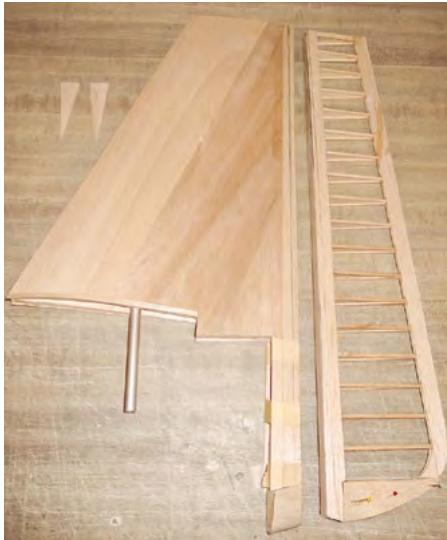
Easy to build. The landing gear is made of aluminum, with some parts made of fiberglass reinforced with Kevlar, and is powered by a combination of electric and mechanical systems. For the final finish, I applied a clear coat to
the entire model and then subjected the fuselage to a watertightness test at the nearby village fountain so I could make any necessary touch-ups before painting. Applying primer, multiple coats of filler, and sanding required a great deal of perseverance. With the help of my brother Pankraz—he handled the spray painting while I fed him the parts—this laborious work finally came to an end.
Even in the early stages of construction, I was thinking about which scheme I wanted to replicate. The sometimes fanciful paint schemes of civilian Albatrosses today didn’t appeal to me. Had the Italian Air Force deployed the SA 16 B, this would certainly have been a possible variant. After much back and forth, I decided on the authentically painted, airworthy prototype
. Unfortunately, I received only vague information from the museum regarding color shades and print templates. I created all the lettering and emblems myself using lettering film, Corel CAD, and a cutting plotter.
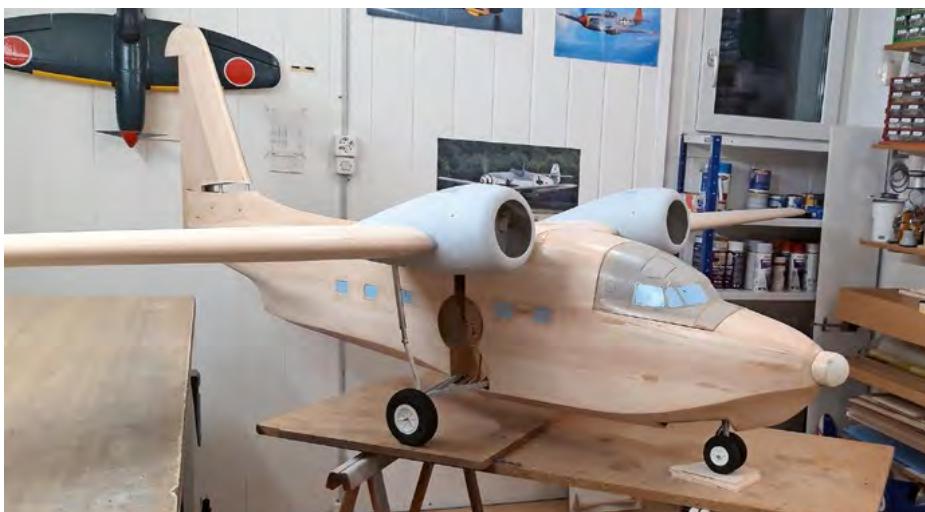
What a feeling—in mid-February, almost 10 years after construction began, to see the finished, assembled Grumman Albatross in my living room. In early March, conditions were right to launch the model for the first time. I planned to do a few test runs that day and then check the model for any water ingress. But the Albatross sat perfectly in the water, and as I accelerated, it planed smoothly and remained under control. Convinced that it would fly, there was no stopping me—with freshly charged batteries, I set off carefree on its maiden flight. After a good 9-minute
of flight with an acceptable splashdown, I was more than satisfied for the day; we then celebrated the project with wine and pizza.
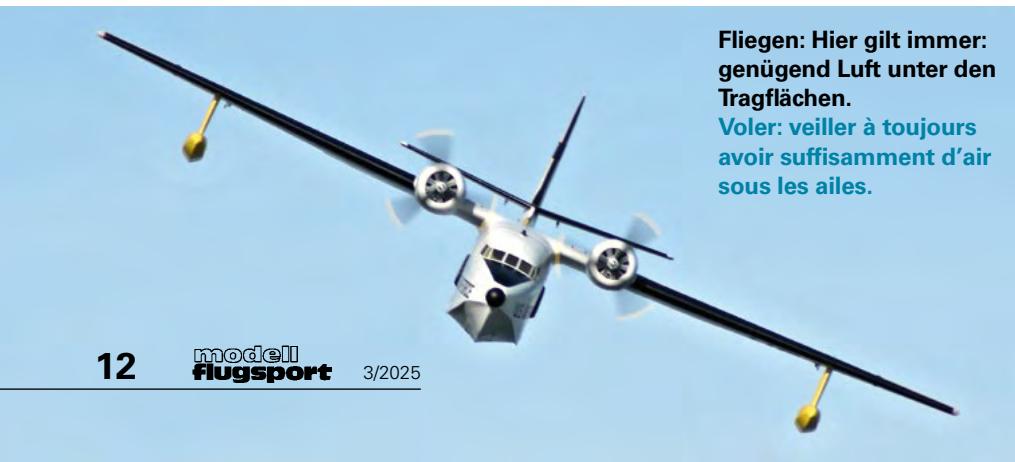
The model looks absolutely authentic in the air, flies very smoothly, and is meant to be flown over large areas. Aerobatics, of course, are an absolute no-go. The thrill of flying on water is clearly visible and palpable here, especially during takeoff and landing with bow waves and spray. When traveling on the water, the model—which, like the original, has no rudder—is easy to control thanks to the counter-rotating motors mixed with the rudder.
With this model, a long-cherished dream of mine came true.
Would I build another Albatross? Yes, of course—with a few modifications. I already have the first few commercially available parts ready to go.


TEAM MANAGER "THIS" BOSSHARD
 Rodito Nussbaumer

F3A EUROPEAN CHAMPIONSHIPS IN ST-MACAIRE, FRANCE
 Matthias Bosshard

News from HEBU

YOU KNOW WHAT I MEAN? 125 YEARS OF THE SWISS AERO CLUB
 Emil Giezendanner

SUMMER FUN 2026 AT MG USTER
Martin Wunderli
TRY-OUT DAY AT MFV WETTINGEN
Urs Keller
52. 2026 ALPS CUP
Emil Giezendanner
BY YOUTH, FOR YOUTH
Lorena Betschen
CORSAIR F4U – A WARBIRD WITH A MEMORABLE LOOK
Jürgen Rosenberger, Jürgen Prinz
SMALL, MODEL-LIKE SAILBOATS
Res Dauwalder
What's New at Leomotion.com

ATOM, THE NEW DOUBLE-DECKER FROM CPLR
Matthias Bosshard
INSIGHTS INTO THE HISTORY OF SEAPLANES

34th HAHNENMOOS ALPINE MODEL AIRPLANE CAMP
Res Dauwalder
HORIZON HOBBY/LEMACO NEWS: MICRO OV-10 BRONCO 645 MM BY E-FLITE

COUPE DES ALPES – OBSERVE AND LEARN
Rodito Nussbaumer
PRIDE AND GOOD IDEAS
 Markus Nussbaumer

EURO CONTEST GLIDER ACRO TOUR AUSTRIA 2026

FREE FLIGHT IN THE MIDDLE OF SUMMER
Urs Muntwyler
THE PC-21 STORY
Emil Giezendanner
TWIN TOWN PARTNERSHIP
Wolfgang Voeller
WELCOME, NEW MEMBER!
Andrea Bolliger
NEWS FROM HEBU
 Julia Bucher

FROM 0 TO 100
Markus Nussbaumer
MEMORIES
Wolfgang Völler
NOS REGION – A HUB FOR ELECTRIC AVIATION
Emil Giezendanner
Have you almost forgotten about aircraft that take off and land vertically?
Emil Giezendanner
70 YEARS OF THE NIDWALDEN MODEL AIRPLANE CLUB
Martin Barmettler