
Free Flight News – Indoor Flight F1D Model-Building Course
Model airplanes—and free-flight models in particular—are highly complex products today and are often supplied by professional manufacturers. One exception is indoor flying, where the model airplanes weigh just a few grams and must be built by hand. This is easier said than done.
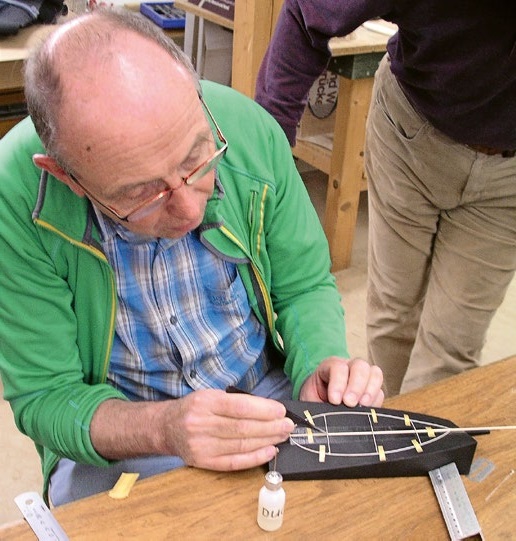
Christian Gugger of the Balsthal Model Aircraft Club and a member of the “Free Flight” Technical Commission has therefore once again announced an indoor flight model-building course this year. This year’s course focuses on F1D, the premier class of indoor flying, in which models weigh at least 1.4 grams and are powered by a rubber band weighing no more than 0.4 grams. In Switzerland, there is a size limit because there are no very large indoor venues for these models. In a triple-purpose gymnasium, the models (with a maximum wingspan of 55 cm) can fly for over 10 minutes. The use of a proven construction plan and pre-prepared components is essential for successful building. Another key to a successful model is the use of auxiliary jigs and procedures. Essential for indoor model aircraft construction is a very lightweight yet stable balsa with a C-grain fiber structure. This is currently difficult to obtain. Christian Gugger has sourced the necessary balsa and prepared the components for building the F1D model. The fuselage tube is made from three wound, very thin balsa tubes. The motor mount for the propeller and the counterweight for the rubber cord are attached to it. The two propeller blades are fabricated using special jigs. The wings, elevator, and ailerons are made from thin balsa strips. Simple jigs are also used here for assembly. The parts are glued together with a few drops of an adhesive/acetone mixture. The covering is applied using an extremely lightweight capacitor film. The extremely lightweight construction of F1D models requires careful handling of both the components and the models themselves. Rapid movements would cause the extremely light parts to fly around and become damaged. Building indoor gliders is therefore a leisurely activity. To prevent damage during transport, the models are transported in special shipping boxes. A torque meter is used to monitor the optimal winding of the 0.4-gram rubber cord. The rubber cord is wound using a crank with a 1:10 gear ratio to approximately 800–1,000 revolutions. The goal is now to let the rubber cord unwind over the propeller—which can be up to 50 cm in diameter—for as long as possible. The propeller’s rotational speed ranges from 40 to 60 revolutions per minute. This results in the maximum possible flight time. To distribute the torque more evenly throughout the flight, top pilots even use variable-pitch propellers. The propeller pitch is controlled by the torque applied. The power expended in this process amounts to a few mW.
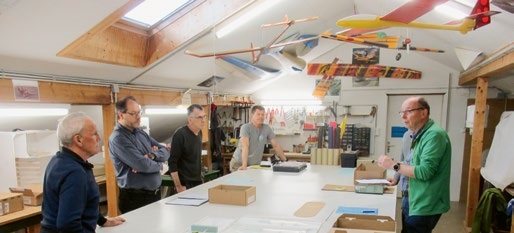
A suitable indoor flying facility is essential for success in indoor flying. There is a major shortage of such facilities in Switzerland. Club president Rainer Saner, himself an active indoor flyer, proposed a solution. If you become a member of the MG Balsthal, the indoor flying hall is open to indoor model aviators on flying days in Balsthal. Since then, the Balsthal Model Flying Group has gained a few more members. Here, indoor model aviators can also learn from experienced colleagues and improve their indoor model aircraft and flight techniques. This is where one advantage of indoor flying over all other types of flying comes into play: Inside the hall, the weather is always right for flying! To obtain the necessary equipment for indoor flying and some suitable models, indoor flyers have the option of purchasing these items from specialized suppliers. This “indoor flying depot” is operated in Germany by Dr. Eder as a nonprofit organization. Dr. Eder has also written a book (published by VTH-Verlag) on indoor flying. It’s just that not every place has a Christian Gugger in action. The dedication of Christian Gugger and the MG Balsthal is a great way to promote a very interesting specialty of model aircraft building. Indoor model aircraft enthusiasts have marked Sunday, November 26, on their calendars. That’s when the Swiss Indoor Flying Championship will take place at the “Haulismatte” triple gym in Balsthal. This is also a great opportunity for interested model aviators to get their first taste of indoor flying and take their first steps into the sport. The author did just that in 2022.
*Urs Muntwyler, Free Flight Newcomer
, MG Balsthal/MV
Bern/MG Interlaken*
*Photos: Roland Kohler (MG Balsthal) and Urs Muntwyler*


TEAM MANAGER "THIS" BOSSHARD
 Rodito Nussbaumer

F3A EUROPEAN CHAMPIONSHIPS IN ST-MACAIRE, FRANCE
 Matthias Bosshard

News from HEBU

YOU KNOW WHAT I MEAN? 125 YEARS OF THE SWISS AERO CLUB
 Emil Giezendanner

SUMMER FUN 2026 AT MG USTER
Martin Wunderli
TRY-OUT DAY AT MFV WETTINGEN
Urs Keller
52. 2026 ALPS CUP
Emil Giezendanner
BY YOUTH, FOR YOUTH
Lorena Betschen
ATOM, THE NEW DOUBLE-DECKER FROM CPLR
Matthias Bosshard
CORSAIR F4U – A WARBIRD WITH A MEMORABLE LOOK
Jürgen Rosenberger, Jürgen Prinz
SMALL, MODEL-LIKE SAILBOATS
Res Dauwalder
What's New at Leomotion.com

TWIN TOWN PARTNERSHIP
Wolfgang Voeller
EURO CONTEST GLIDER ACRO TOUR AUSTRIA 2026

INSIGHTS INTO THE HISTORY OF SEAPLANES

34th HAHNENMOOS ALPINE MODEL AIRPLANE CAMP
Res Dauwalder
HORIZON HOBBY/LEMACO NEWS: MICRO OV-10 BRONCO 645 MM BY E-FLITE

COUPE DES ALPES – OBSERVE AND LEARN
Rodito Nussbaumer
PRIDE AND GOOD IDEAS
 Markus Nussbaumer

FREE FLIGHT IN THE MIDDLE OF SUMMER
Urs Muntwyler
THE PC-21 STORY
Emil Giezendanner
WELCOME, NEW MEMBER!
Andrea Bolliger
NEWS FROM HEBU
 Julia Bucher

FROM 0 TO 100
Markus Nussbaumer
MEMORIES
Wolfgang Völler
NOS REGION – A HUB FOR ELECTRIC AVIATION
Emil Giezendanner
Have you almost forgotten about aircraft that take off and land vertically?
Emil Giezendanner
70 YEARS OF THE NIDWALDEN MODEL AIRPLANE CLUB
Martin Barmettler