
Multipurpose Models (F3B)
| Wingspan | 1,880 mm | 2,150 mm |
| Wing area | 37.20 dm² | 41.20 dm² |
| Wing depth | 200 mm | 200 mm |
| Profile | E 180/182 | E 180 |
| Fuselage Length | 1,160 mm | 1,160 mm |
| Weight without RC | 950 g | 1130 g |
| Surface load | 31 g/dm² | 31 g/dm² |
Fiberglass fuselage, styrofoam/epoxy/mahogany veneer wings, pendulum tailplane, fiberglass transport case; complete with all accessories, including transport case: 220 francs
Available from stock

Excellent organization – ideal terrain
Text: R. Schaub; Photos: P. Küng
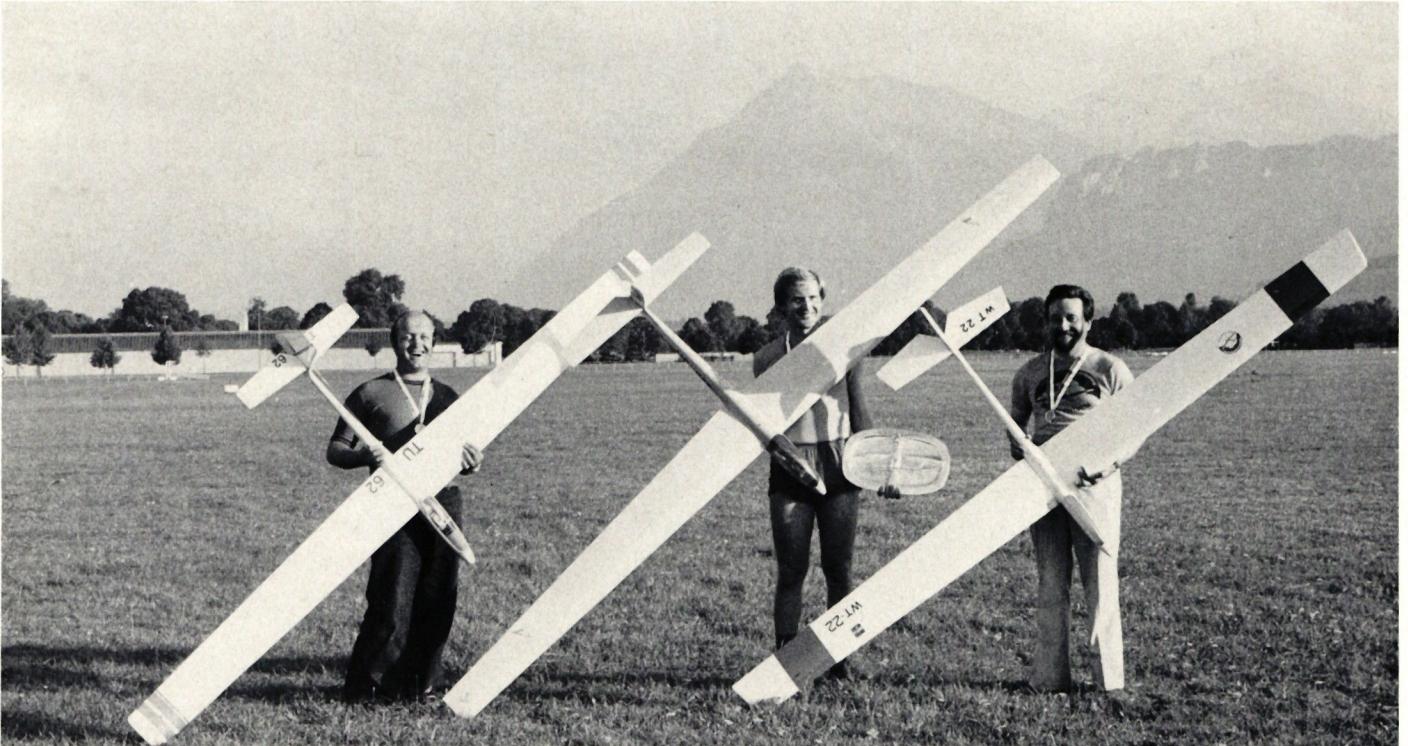
Just like last year, the Thun Model Aircraft Club hosted the Swiss Championships at the Thuner Allmend. The organizers and the venue make for an exceptionally good combination. The organization went so smoothly that it could hardly be improved upon. The flying field, with its impressive Alpine panorama, allows for high launches in three cardinal directions. This proved to be an advantage, as the weak thermal winds on that wonderful, cloudless day came from various directions. Indeed, it seems as though the people of Thun have a monopoly on good weather.
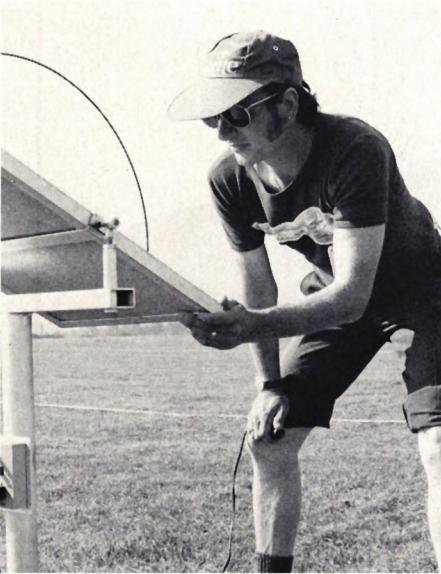
The measuring device rented by MG Interlaken is capable of meeting even the highest standards and played a key role in ensuring the competition ran smoothly. Since the mirror sighting system used for distance and speed flights is unique in Switzerland, a slightly more detailed description is sure to be of interest. Instead of the usual sighting rods with taut strings, four mirrors firmly bolted to concrete bases are used, forming a rectangle measuring 20×50 m, which allows for simultaneous flights of
| 1. Bruno Sieber, Mörsburg | 1921 | 1877 | 2000 | 1586 | 7,384 |
| 2. Peter Gerber, Thun | 1669 | 1960 | 1619 | 1849 | 7097 |
| 3. Fredi Schenk, Wettingen | 1943 | 1882 | 1682 | 1469 | 6976 |
| 4. Gerhard Läderach, Thun | 1948 | 1687 | 1224 | 1829 | 6688 |
| 5. Stoll, Hans, Bülach | 1947 | 1643 | 1568 | 1479 | 6637 |
| 6. Ruedi Binkert, Wehntal | 1,726 | 1,000 | 1666 | 1916 | 6308 |
| 7. Ruedi Baumgartner, Wettingen | 1,598 | 1,294 | 1294 | 1977 | 6163 |
| 8. Haigis Ernst, St. Gallen | 1578 | 1373 | 1285 | 1716 | 5952 |
| 9. Peter Käufeler, Wettingen | 874 | 1908 | 1059 | 1,624 | 5,465 |
| 10. Bertschi Heinrich, Frauenfeld | 1875 | 1310 | 984 | 967 | 5,136 |
| 11. Peter Hochuli, Schöftland | 1288 | 1,449 | 796 | 1513 | 5046 |
| 12. Scheidegger Fritz, Olten | 828 | 1,155 | 1,439 | 1,437 | 4,859 |
| 13. Lüscher Werner, Strengelbach | 1485 | 786 | 1034 | 1551 | 4,856 |
| 14. Fornera Silvano, Molinazzo | 1088 | 1406 | 1620 | 439 | 4,553 |
| 15. René Hunziker, Lutry | 1,103 | 1,469 | 1,228 | 628 | 4,428 |
| 16. Vogel Peter, Basel | 846 | 900 | 1,463 | 1156 | 4,365 |
| 17. Paul Dellenbach, Nidwalden | 1,478 | 928 | 1,194 | 617 | 4,217 |
| 18. Heinz Kuster, Upper Basel Region | 577 | 1,000 | 990 | 1,404 | 3,971 |
| 19. Frühwirth, Wolfgang, Upper Basel Region | 786 | 586 | 671 | 937 | 2,980 |
allows for two models. With adjustable, absolutely backlash-free tip bearings, the mirrors can be swiveled at right angles to the flight axis, allowing the model to be tracked even when it is farther away from the course. As shown in Figures 2 and 3, a semicircular wire projects a line onto the mirror. The operator must look at the mirror so that the wire and
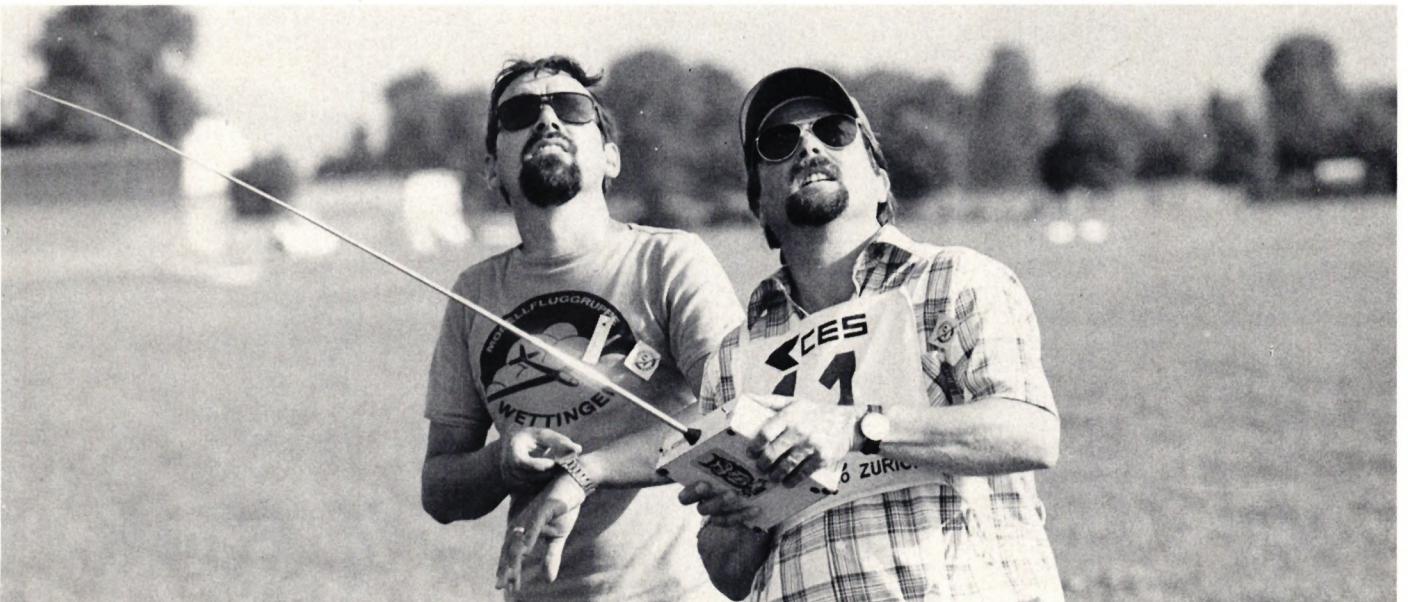
its reflection are perfectly aligned, and as soon as the model flies over this line, they must activate an electric switch that triggers an audible signal. Since, for example, a horn is used for one pair of mirrors and a bell for the other, the pilot need only concentrate on his own signal to turn immediately. This prevents misunderstandings and communication delays.
In speed flying, the pushers automatically start an electronic timer, allowing times to be measured to the nearest hundredth of a second. It goes without saying that the reaction time is many times longer than this and must be taken into account when evaluating the times.
To measure the length of the launch line, the device now mandated by the AeCS Technical Commission was used, which allows for measurements that are beyond any doubt. During each discipline, one competitor was selected at random to verify the line length, which took place immediately after the launch. With the exception of one case, no disqualifications had to be issued due to an excessively long launch cord; lessons had clearly been learned from last year’s incidents. But now, let’s turn to the course of the competition itself.
Four rounds were flown in the order B+A / A+C / A+B and A+C, with no results discarded. Of the 20 pilots eligible to start (22 were registered despite verification by the regional chairmen), 19 were present at the briefing.
As is well known, the distance flight was reduced to a maximum of 12 lengths starting this year. In the first round, G. Läderach (MG Thun), R. Baumgartner (MG Wettingen), and E. Haigis (MG St. Gallen) completed this distance. In the endurance flight, with thermals still weak, H. Bertschi (MG Frauenfeld) claimed the “thousander” with 356 seconds and 90 landing points. After this
round, G. Läderach led by one point ahead of H. Stoll (MG Bülach), closely followed by F. Schenk (MG Wettingen).
In the endurance flight of the second round, H. Kuster (MG Oberbaselbiet) came out on top with 360 seconds and 90 landing points. But even the competitors who had been in the lead up to that point lost only a few points to him. Only the dominant 1978 Region 5 champion, R. Binkert (MG Wehntal), had bad luck. During the high launch, the Silch snapped, and on the retry, the model veered off course and sustained minor damage, making it impossible to launch again in the remaining time. With this zero score, R. Binkert could no longer compete for the championship title, even though he was able to add 1,000 points to his total in the subsequent speed flight with a time of 13.2s. In this round, however, last year’s winner, P. Gerber (MG Thun), with his rotary-wing model, scored only 37 points (13.7 seconds) short of the maximum. Unlike most pilots, who performed the turn in a knife-edge flight, he executed it with a half roll and a half loop from an inverted flight. The Wettingen participants, P. Käufeler and F. Schenk, posted the next-best times at 14.0 seconds and 14.2 seconds. At the halfway point, F. Schenk was in the lead ahead of B. Sieber (MG Mörsburg), G. Läderach, and P. Gerber.
The endurance flight in the third round went to B. Sieber with 352 seconds and 95 landing points. In doing so, he demonstrated his exceptional knack for finding thermals, as his colleagues in the same group—who, like him, were among the leaders—managed to fly only about 3 minutes. Since he was also among the four pilots who flew 12 lengths in the distance flight, this round earned him the maximum of 2,000 points. Thus
He took the lead with a margin of nearly 300 points—a lead he held until the very end—ahead of F. Schenk, P. Gerber, and H. Stoll.
In the endurance flight of the final round, the third starting group faced unfavorable conditions. It was impressive to see R. Binkert, despite these conditions, fly his heavy model for nearly 3 minutes longer than his competitors in the same group, starting from a residual altitude of about 40 meters. In contrast, the pilots in starting groups 4 and 5 had it much easier in the emerging, widespread evening thermals, and it is by no means surprising that the 1,000-point flight was achieved during this time by R. Baumgartner (MG Wettingen) achieved a time of 360s and 95 landing points during this period. Since he also clocked a solid 13.2s in the subsequent speed flight, just behind R. Binkert (13.0s), he was able to move up a few places in the rankings.
F. Schenk had a poor endurance flight in the unlucky third starting group and had to swap places in the final standings with P. Gerber, who landed most reliably with 370 out of a possible 400 points. The second-best performer in this category was P. Dellenbach (MG Nidwalden) with 330 points.
The new Swiss champion, Bruno Sieber of MG Mörsburg (Winterthur), won primarily due to his consistent performance, averaging over 900 points per discipline.
The high-launch technique was further improved compared to last year. Most participants launched directly or with the help of a second person who held the end of the line and either stopped or ran alongside depending on the model’s climb performance. Relatively few false starts were observed.
Surprisingly, the multi-
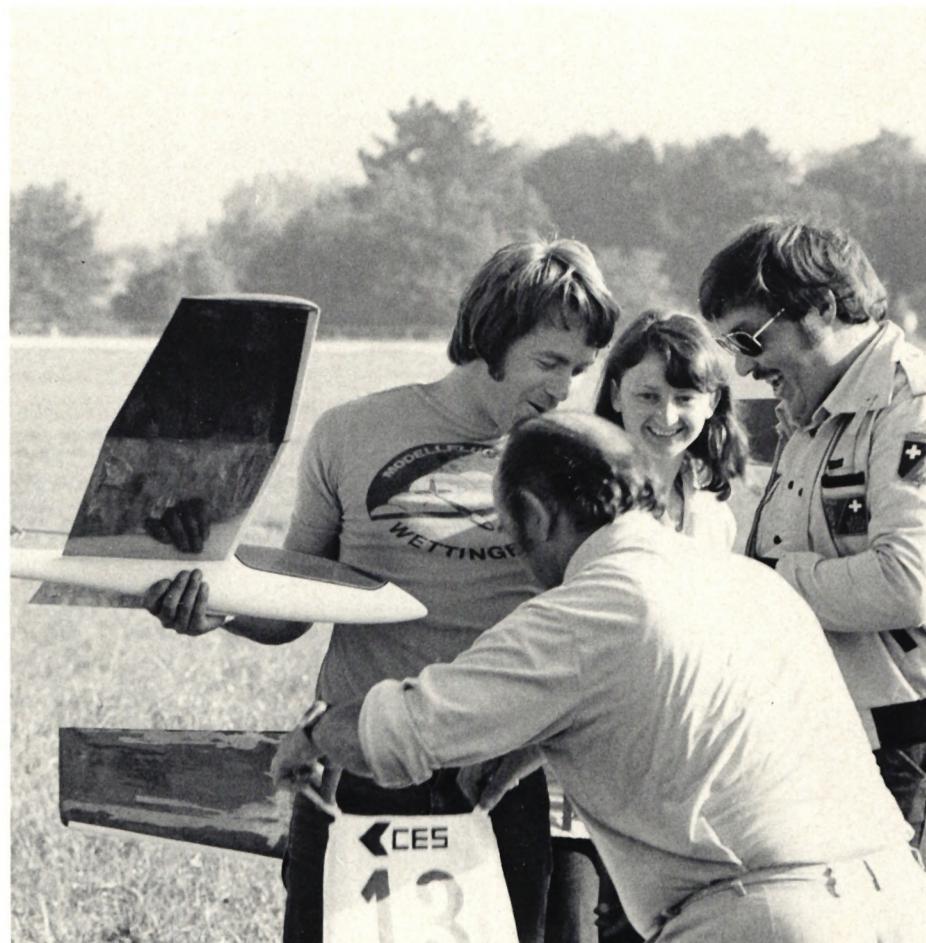
Many of the participants flew models without ailerons and, in some cases, even without air brakes. The wing loading was mostly below 30 g/dm², and the wingspans ranged from 2.8 to 3.2 meters. However, B. Sieber and R. Binkert demonstrated that very good performance can be achieved even with wing loading around 40 g/dm² and that these models can be launched directly even in practically windless conditions.
The competition was decided primarily by endurance flight, as thermal hunting apparently presented challenges for many pilots. Only when a few top pilots in Switzerland manage to fly speeds of around 10 seconds in speed flying—as demonstrated previously by the Austrian Working Group for Model Aircraft Development—will this discipline gain in importance.
Finally, we would like to extend our heartfelt thanks to MG Thun, its chairman H.P. Stähli, and the more than 50 full-time volunteers for their excellent organizational work. The frequency monitoring team, led by the tireless W. Prantl, also proved its necessity when a “Sunday pilot” was indulging in his hobby at the other end of the field and was detected only thanks to the frequency monitoring.
We hope that we will be able to enjoy the hospitality of the people of Thun again next year.
With the NM qualifier held on September 24, three of the competitions required for the nomination of the new F3B national team have now taken place. For selection purposes, only the two best results count; the worst competition is discarded. In the event of a tie in points, the better discarded result is decisive.
The new F3B national team is composed as follows:
- Pilots
: Peter Gerber, MG Thun
; Ruedi Baumgartner, MG Wettingen
; Fredy Schenk, MG Wettingen - Reserve
pilot: Peter Aeberli, MG Erlenbach
* Withdrew from the team
| Pilot: | 1977 World Championship | SM 1978 | Disqualified '78 | Points |
| Peter Gerber, Thun | 20 | 19 | - | 39 |
| Ruedi Baumgartner, Wettingen | 17 | 19 | 36 | |
| Fredy Schenk, Wettingen | 18 | 18 | 36 | |
| Rudolf Binkert*, Wehntal | 15 | 20 | 35 | |
| Bruno Sieber*, Mörsburg | 15 | 20 | - | 35 |
| Gerhard Läderach*, Thun | 12 | 17 | 17 | 34 |
| Hans Stoll*, Bülach | - | 16 | 16 | 32 |
| Peter Disler*, Upper Basel Region | 16 | - | 15 | 31 |
| Peter Aeberli, Erlenbach | 11 | - | 18 | 29 |
| Jost Galliker | 8 | - | 14 | 22 |


News from HEBU

TEAM MANAGER "THIS" BOSSHARD
 Rodito Nussbaumer

YOU KNOW WHAT I MEAN? 125 YEARS OF THE SWISS AERO CLUB
 Emil Giezendanner

F3A EUROPEAN CHAMPIONSHIPS IN ST-MACAIRE, FRANCE
 Matthias Bosshard

HORIZON HOBBY/LEMACO NEWS: MICRO OV-10 BRONCO 645 MM BY E-FLITE

PRIDE AND GOOD IDEAS
 Markus Nussbaumer

ATOM, THE NEW DOUBLE-DECKER FROM CPLR
Matthias Bosshard
SUMMER FUN 2026 AT MG USTER
Martin Wunderli
52. 2026 ALPS CUP
Emil Giezendanner
TWIN TOWN PARTNERSHIP
Wolfgang Voeller
CORSAIR F4U – A WARBIRD WITH A MEMORABLE LOOK
Jürgen Rosenberger, Jürgen Prinz
SMALL, MODEL-LIKE SAILBOATS
Res Dauwalder
TRY-OUT DAY AT MFV WETTINGEN
Urs Keller
WELCOME, NEW MEMBER!
Andrea Bolliger
What's New at Leomotion.com

COUPE DES ALPES – OBSERVE AND LEARN
Rodito Nussbaumer
EURO CONTEST GLIDER ACRO TOUR AUSTRIA 2026

BY YOUTH, FOR YOUTH
Lorena Betschen
INSIGHTS INTO THE HISTORY OF SEAPLANES

34th HAHNENMOOS ALPINE MODEL AIRPLANE CAMP
Res Dauwalder
FREE FLIGHT IN THE MIDDLE OF SUMMER
Urs Muntwyler
THE PC-21 STORY
Emil Giezendanner
NEWS FROM HEBU
 Julia Bucher

FROM 0 TO 100
Markus Nussbaumer
MEMORIES
Wolfgang Völler
NOS REGION – A HUB FOR ELECTRIC AVIATION
Emil Giezendanner
DO YOU KNOW WHAT I MEAN IN THE LAND OF SMILES?
Emil Giezendanner
Have you almost forgotten about aircraft that take off and land vertically?
Emil Giezendanner