
P-51: How about using the winter break to build something?
These are legendary airplanes that people dream of flying one day—or, quite simply, of building a model of them that’s as realistic as possible.
I was fascinated by a legendary aircraft whose construction began in the fall of 2009 and culminated in its first test flight last October: The P-51 Mustang from ARF Composite, built with the help of Philippe, a longtime model builder and unparalleled designer at the Lémont de Glovelier Flying Club.
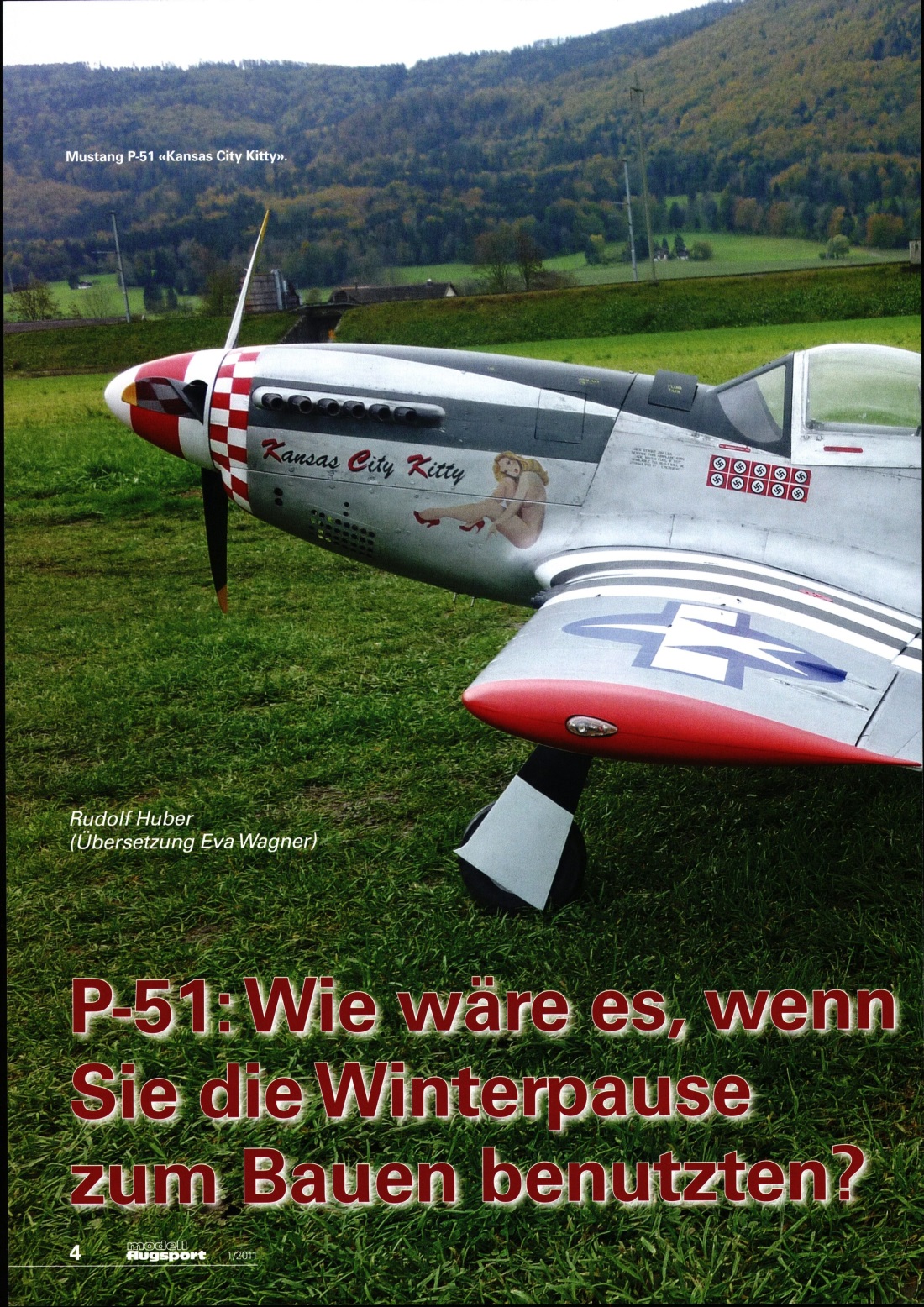
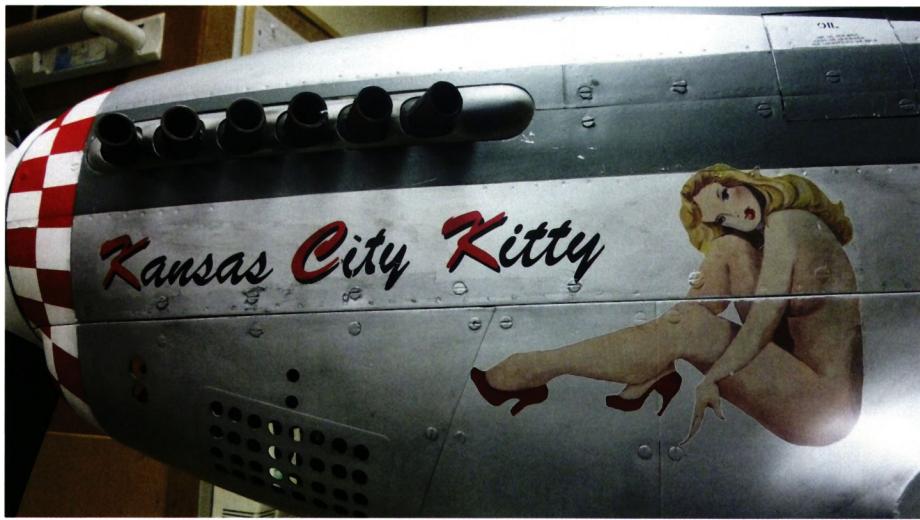
The replica is the P-51D Mustang “Kansas City Kitty,” which saw action in Europe during World War II. It was part of the 339th Fighter Group (FG) of the 8th U.S. Air Force, based in Felmore, England. The restored original is one that survived that era. It is still flying in the United States.
The Mustang P-51 from ARF Composite is a model made entirely of fiberglass-reinforced plastic (FRP) with a wingspan of 2.54 m and a length of 2.27 m. It is a kit from Fiber Classic that has been available since the 1990s and has been redesigned by Composite ARF. The quality of the kit is simply perfect and reproduces the aircraft as realistically as possible. The details of the fuselage, such as the aluminum panels and rivets, are an integral part of the laminating mold. The model is delivered in gray, which corresponds to an aircraft made entirely of aluminum.
The design principles were that all components had to be accessible and removable, and that access panels had to be provided that were identical to those on the full-scale model. My motto was to think twice and not rush into anything before milling, drilling, and gluing. The following documents provided valuable assistance throughout the entire construction process: “Build Report on Two P-51D Mustangs by Composite-ARF” by Tom Grimm and Herbert Dutscher, found online (*http://www.modellflieger-neu-kirchen.de/baubericht/P51 1.htm*), and “Aero Detail #13 North American P-51 Mustang” by Hobbylink in Japan, which provides a vast amount of detailed information, supported by numerous photos. Without getting bogged down in details, I will describe some essential and critical aspects of the build.
Considering that my final modifications to the “model” would come at the expense of weight, I decided to equip the Mustang with a powerful 3-W, 110-cm³, two-cylinder inline engine that produces 10.5 PS. As if made for this model, it fit perfectly under the hood. To cool the rear cylinder under the hood, Philippe—who’s never short on ideas—devised an air duct that runs from the air intake under the fuselage to the rear cylinder. It’s made of balsa wood and will be painted during the final finishing touches.
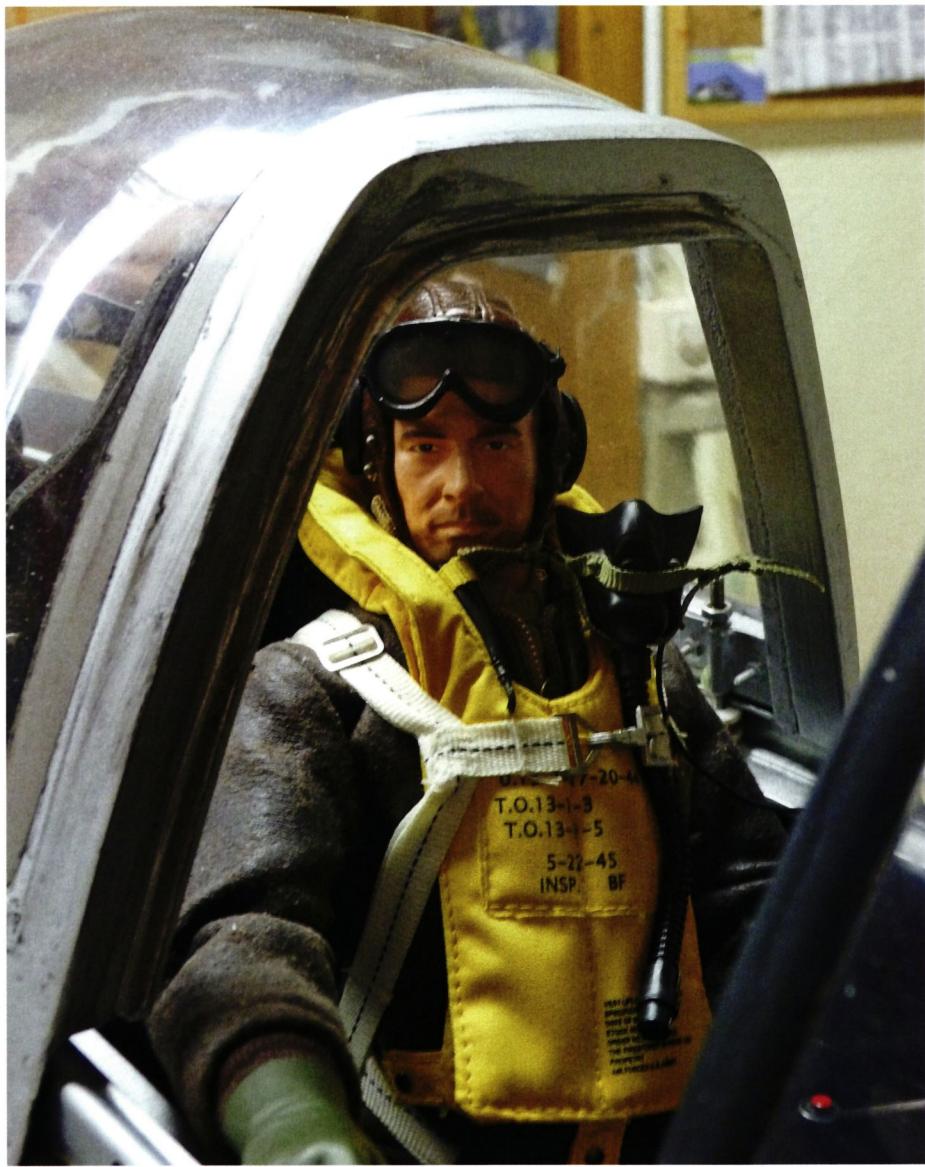
The interior consists of a housing mounted inside the fuselage that occupies the space of the receiver board. The receiver board is then placed directly behind the housing, which inevitably affects the aircraft’s center of gravity and, consequently, the weight that must be added to the front! The glass canopy runs on drawer slides. A spindle allows it to open 10 cm. It is actuated by a mechanical valve supplied by an air reservoir in the fuselage.
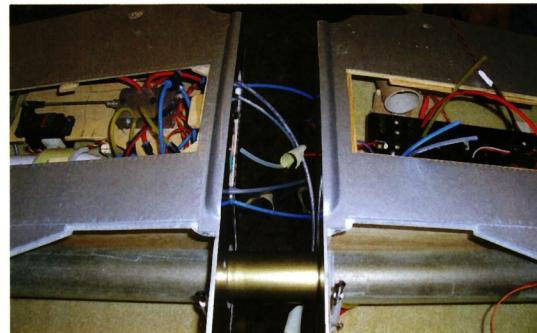
Located beneath the right hollow wing are the mechanical valve that operates the retractable landing gear and the air reservoir. Under the left wing, we have provided a circuit board that consolidates the wiring between the wing sections, such as the servos for the ailerons, flaps, and auxiliary fuel tanks, as well as the lighting and the cables coming from the fuselage.
Aging a model involves giving it a worn-out appearance resulting from use. We tried to reproduce the marks left by the exhaust, the scratches, the oil leaks, and the well-worn cockpit as realistically as possible. To highlight the rivets, we darkened the structural lines of the fuselage with acrylic paint diluted with water. To do this, we soaked a rag in gray paint and applied it to the desired areas to simulate accumulated dirt. Afterward, we vigorously wiped away excess paint with a clean rag. We were able to easily apply the water-soluble decals we found in Germany before the final coat of paint. This step should not be underestimated, as large decals tend to peel off easily.
The matte-gloss finish was entrusted to an auto body painter. This project really made his apprentice happy.
The first flight was quite a challenge (the center of gravity was way too far back). It took place last October, after several test runs to break in the engine on the test stand. The model’s flight ultimately turned out to be quite impressive and is sure to make quite a few model builders happy.
| Wingspan: | 254 cm |
| Length: | 227 cm |
| Weight: | 21 kg |
| Engine: | Gasoline engine, two-cylinder inline engine, 3 W, 110 cm³ (10.5 PS) |
| Propeller: | Mejzlik three-bladed 25×12 |
| RC System: | 13 servos + transmitter (?) + lighting control. Weatronic 2.4 GHz control board |
| Hours of operation: | A few hundred. We don’t keep track. |
Many club members were very active in the design process, and you can see how these models are taking shape on our field. We hope to see these models—as well as your own designs—at the international model aircraft meet organized by the Lémont Flying Club on September 3 and 4, 2011, in Glovelier.
Note for hobbyists and those with well-designed models: Rudolf_huber@bluewin.ch


News from HEBU

PRIDE AND GOOD IDEAS
 Markus Nussbaumer

TEAM MANAGER "THIS" BOSSHARD
 Rodito Nussbaumer

YOU KNOW WHAT I MEAN? 125 YEARS OF THE SWISS AERO CLUB
 Emil Giezendanner

F3A EUROPEAN CHAMPIONSHIPS IN ST-MACAIRE, FRANCE
 Matthias Bosshard

HORIZON HOBBY/LEMACO NEWS: MICRO OV-10 BRONCO 645 MM BY E-FLITE

ATOM, THE NEW DOUBLE-DECKER FROM CPLR
Matthias Bosshard
SUMMER FUN 2026 AT MG USTER
Martin Wunderli
52. 2026 ALPS CUP
Emil Giezendanner
TWIN TOWN PARTNERSHIP
Wolfgang Voeller
CORSAIR F4U – A WARBIRD WITH A MEMORABLE LOOK
Jürgen Rosenberger, Jürgen Prinz
SMALL, MODEL-LIKE SAILBOATS
Res Dauwalder
TRY-OUT DAY AT MFV WETTINGEN
Urs Keller
WELCOME, NEW MEMBER!
Andrea Bolliger
What's New at Leomotion.com

COUPE DES ALPES – OBSERVE AND LEARN
Rodito Nussbaumer
EURO CONTEST GLIDER ACRO TOUR AUSTRIA 2026

BY YOUTH, FOR YOUTH
Lorena Betschen
INSIGHTS INTO THE HISTORY OF SEAPLANES

34th HAHNENMOOS ALPINE MODEL AIRPLANE CAMP
Res Dauwalder
FREE FLIGHT IN THE MIDDLE OF SUMMER
Urs Muntwyler
THE PC-21 STORY
Emil Giezendanner
NEWS FROM HEBU
 Julia Bucher

FROM 0 TO 100
Markus Nussbaumer
MEMORIES
Wolfgang Völler
NOS REGION – A HUB FOR ELECTRIC AVIATION
Emil Giezendanner
DO YOU KNOW WHAT I MEAN IN THE LAND OF SMILES?
Emil Giezendanner
Have you almost forgotten about aircraft that take off and land vertically?
Emil Giezendanner