
Krones' Short Guide to Paper Airplane Flying
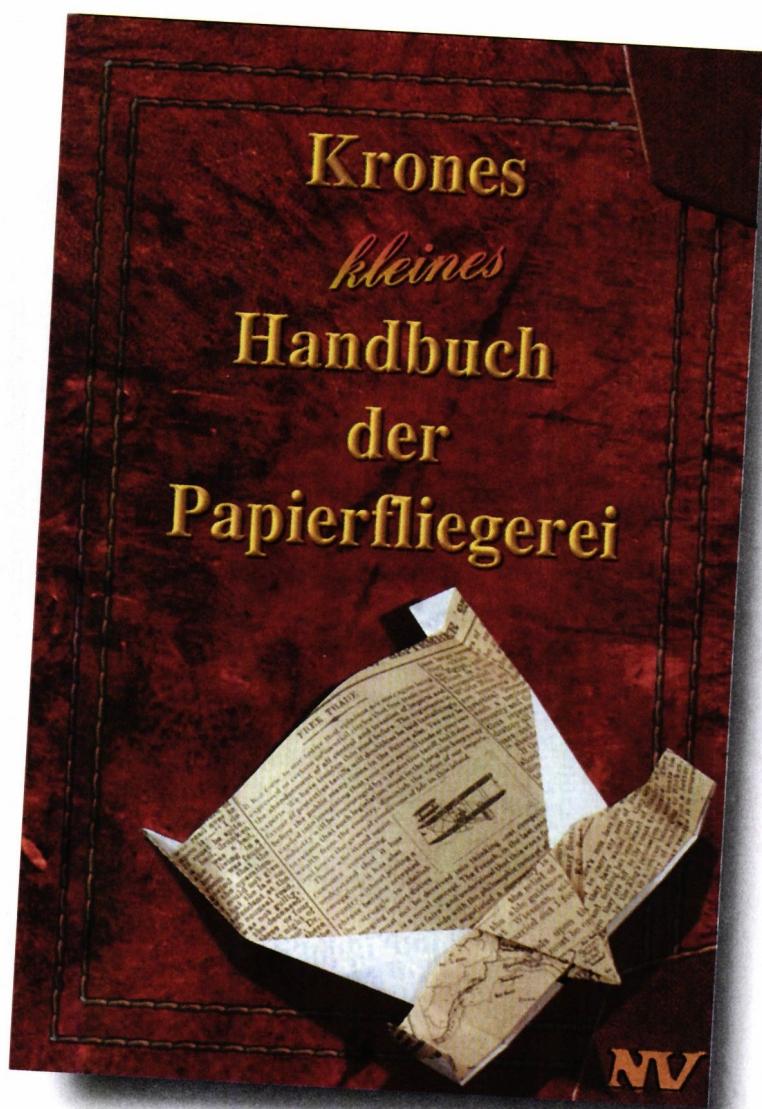
"A 'little' handbook," my foot! That’s quite a modest claim. The book displays a breadth and depth of detail that I’ve rarely encountered in hobby literature in recent years. Right from the first chapter, “500 Years of (Paper) Flight,” the author proves himself to be an expert in aviation and cultural history, describing where paper came from—China (which would be “normal,” so to speak, today) —then jumps right in with Leonardo da Vinci and continues all the way to the modern era. The historical overview is skillfully documented with quotes and drawings. It’s hard to believe just who has dabbled in paper airplanes: the list ranges from Leonardo da Vinci to Sir George Cayley, August Wilhelm Zachariae, Alphonse Pénaud, Buttler and Edwards, Otto Lilienthal, and the Wright brothers. The chapter concludes with a sort of “typology of the paper airplane.” In a “little flying school”—Chapter 2—once again very detailed, scientifically grounded, and yet easy to understand—the book covers balance and stability, teaches the “art of throwing,” and explains “flying outdoors” all the way to dynamic gliding
. The most extensive part of the book is then devoted to the actual folding process, beginning with the “Basics of Folding”—an introduction to the craft of paper airplane making—and followed by a vast number of models suggested for readers to fold themselves. The fifth chapter is devoted entirely to the physics of the paper airplane. “Don’t worry, I’ll try to keep it short and simple.” After all, Krone needs over sixty pages for his “brief” explanation, including all the formulas and diagrams! The author can likely afford this modesty because he is exceptionally competent in the field, which in turn is based on his extensive theoretical knowledge combined with a great deal of practical experience. The fact that a publisher today would release such a book—one that is neither spectacular nor geared toward quick gratification, but rather almost presupposes calm and deep reflection, plenty of time, and a joy in the small (and modest) things—cannot be praised highly enough.
Emil Giezendanner


TEAM MANAGER "THIS" BOSSHARD
 Rodito Nussbaumer

YOU KNOW WHAT I MEAN? 125 YEARS OF THE SWISS AERO CLUB
 Emil Giezendanner

F3A EUROPEAN CHAMPIONSHIPS IN ST-MACAIRE, FRANCE
 Matthias Bosshard

News from HEBU

SUMMER FUN 2026 AT MG USTER
Martin Wunderli
TRY-OUT DAY AT MFV WETTINGEN
Urs Keller
52. 2026 ALPS CUP
Emil Giezendanner
BY YOUTH, FOR YOUTH
Lorena Betschen
ATOM, THE NEW DOUBLE-DECKER FROM CPLR
Matthias Bosshard
CORSAIR F4U – A WARBIRD WITH A MEMORABLE LOOK
Jürgen Rosenberger, Jürgen Prinz
SMALL, MODEL-LIKE SAILBOATS
Res Dauwalder
What's New at Leomotion.com

TWIN TOWN PARTNERSHIP
Wolfgang Voeller
EURO CONTEST GLIDER ACRO TOUR AUSTRIA 2026

INSIGHTS INTO THE HISTORY OF SEAPLANES

34th HAHNENMOOS ALPINE MODEL AIRPLANE CAMP
Res Dauwalder
HORIZON HOBBY/LEMACO NEWS: MICRO OV-10 BRONCO 645 MM BY E-FLITE

COUPE DES ALPES – OBSERVE AND LEARN
Rodito Nussbaumer
PRIDE AND GOOD IDEAS
 Markus Nussbaumer

FREE FLIGHT IN THE MIDDLE OF SUMMER
Urs Muntwyler
THE PC-21 STORY
Emil Giezendanner
WELCOME, NEW MEMBER!
Andrea Bolliger
NEWS FROM HEBU
 Julia Bucher

FROM 0 TO 100
Markus Nussbaumer
MEMORIES
Wolfgang Völler
NOS REGION – A HUB FOR ELECTRIC AVIATION
Emil Giezendanner
Have you almost forgotten about aircraft that take off and land vertically?
Emil Giezendanner
70 YEARS OF THE NIDWALDEN MODEL AIRPLANE CLUB
Martin Barmettler