
Something new from something new—now the star shines
New aftermarket parts for the eflight Gaui Hurricane 550 in action
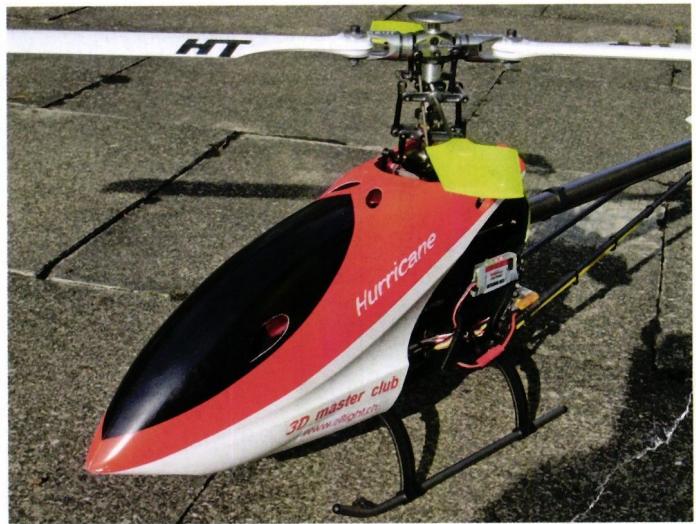
I was satisfied, but a little more power and a better look are always welcome. So I had to get all the aftermarket parts. Each reader must judge for themselves whether this was a good idea or not. To cut to the chase: The helicopter is now really g ...! The high-quality parts are a real feast for the eyes. Made of light gray aluminum, they’re cleanly crafted, lightweight, sturdy, and precise. I was most excited about the performance boost promised by the new 1500W tuning motor.
Will the Hurricane 550 finally become a true 3D helicopter? I also swapped out the original speed controller for an Elektronik JAZZ 80-06-18. I said goodbye to the wooden rotor blades a long time ago and now use the HeliTec 515 CFRP ones. I couldn’t get used to the original swashplates either, so I tested the extra-light Align swashplates for the 600 T-Rex. I was particularly drawn to the look of these swashplates, but unfortunately, the Hurricane tends to buck, causing it to veer off course quickly when flying straight ahead
turned into a wave ride. The yellow JR paddles are about 2 grams lighter and slightly larger than
the original paddles. As a result, the flight characteristics have become very impressive.
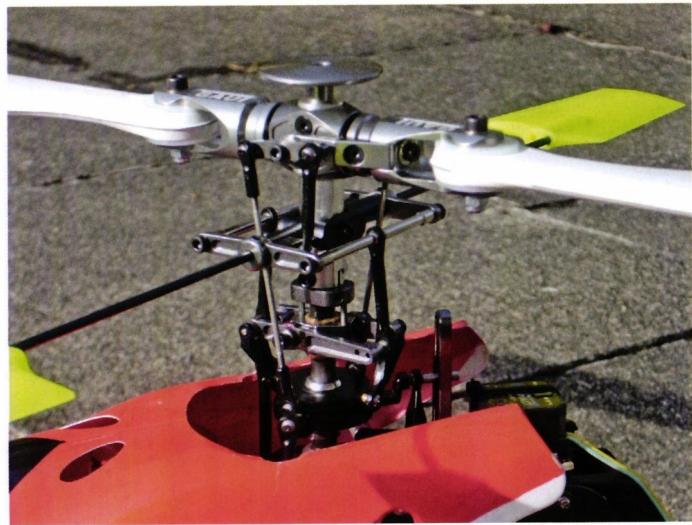
Basically, I’ve installed all the available tuning parts. That means the entire rotor head and deflection levers, as well as the motor and gear pinion. I’ll probably treat myself to the new CKF chassis someday, too. I hope that tuning parts for the tail linkage and tail rotor will become available over time as well. The conversion is simple. It’s worth following the assembly instructions carefully so that no washers are forgotten and no other minor mistakes creep in. Once again, the rule is: don’t skimp on threadlocker. After replacing the push-pull linkage levers, you’ll need to adjust the linkage. It’s very important to ensure smooth movement; otherwise, all that nice tuning is for nothing. Here’s a little trick: use flat-nose pliers to gently squeeze the ball sockets on the ball joints—but be very careful—to make them move more smoothly. You’ll need a bit of finesse; if you overdo it, the connection might develop play. Another option is to ream out the ball sockets using a special tool. Note that the GA204612 deflection levers for the push and pull linkages must not be installed without shims. Otherwise, the screws securing the ball joints might rub against the tuned motor, which could cause malfunctions. The new motor is quite a bit
larger and 32 grams heavier than the original motor and fits only very tightly. So I grabbed a file and created a little more space for the motor. A fiberglass cowling is now also available. Since the PVC cowling is lighter, I opted for that version. It’s a bit annoying that the cowling isn’t stable enough around the mounting rubber bands. It tears, and it’s no longer possible to reattach the cowling. Thin fiberglass mat with PVC adhesive helps with this. Treating the rubber bands with silicone grease regularly also helps. In the meantime, I’ve picked up various cowls in different designs. The motor is a real “tune-up”! The increase in performance is significant. Warning! The motor must only be operated with a No. 12 pinion. Furthermore, it’s absolutely necessary to replace the gearbox pinions. There are new OK pinions available—that is, the new pinions have a white “OK” stamp and can withstand more stress. In my case, I made the maiden flight with the tuned engine and
| Length: | 1060 mm |
| Height: | 305 mm |
| Width: | 85 mm |
| Rotor diameter: | 1140 mm |
| Rotor blades: | 515 mm |
| Tail rotor diameter: | 222 mm |
| Takeoff weight: | 2,340 g |
(Test model with ePower 3s2p 4200 mAh LiPo)
The “old” sprocket: The fun lasted just 3.5 minutes, and the sprocket was gone. The tooth flank clearance must be adjusted precisely. The adjustment process is quite fiddly, but it’s worth investing the time here. The sprockets will reward you with a long service life. I also noticed on my Hurricane that the front sprocket of the two-speed transmission was rubbing against the chassis. So I filed down the chassis a bit in that area.
The rotor is spinning at 2,200 RPM—I think that’s the maximum for this helicopter. The ESC is in helicopter mode, which means it maintains the preset rotor speed at a constant level. The throttle curve is linear and quite flat at about 50%, allowing the ESC plenty of room to make adjustments. The tail servo travel is set to 140%, which provides good pirouette speed. Pitch is set to +12/–11 degrees. A greater negative pitch won’t work, as the swashplate would otherwise bottom out against the swashplate guide if the pilot needs to pull back fully. After the modification, it’s necessary to readjust and check everything again. In the air, the Hurricane is now unrecognizable and truly lives up to its name. Plenty of power! Hover, then full pitch—the helicopter shoots into the sky; pure joy! It handles every maneuver the pilot can think of and is capable of performing. With the HeliTec blades and JR swashplates, it flies
as steady as a board in the air—even in really strong winds. Up and down, inverted or right-side-up. Only during really fast reverse flight is the tail a bit spongy. The Hurricane is now a true 3D helicopter: crisp, agile, with plenty of power—a competitor that demands attention. Of course, the flight time has decreased. But that’s not surprising given this increase in performance. With the configuration described and a power-intensive flying style, it’s about 6 minutes. The motor gets pretty warm. On really hot summer days, make sure to provide good ventilation. The servos’ power consumption has also increased, so the 900mAh battery needs to be recharged after two flights. One more note about the LiPo batteries. During the testing phase, I used the previously mentioned EMax 3S 4400 mAh cells and the ePower 3S2P 4200 mAh cells from eflight.ch. I feel that the ePower cells deliver power more smoothly; the voltage stability is definitely better. With the ePower cells, I had to reduce the speed control by about 6% to keep the RPM from exceeding 2,200. The ePower cells are also about 30 grams lighter per 3S pack.
Winter is just around the corner, and the flying season is coming to an end—at least for most of us. So, why not start a new project in the workshop?
Happy tuning and have fun
! René Stoll
Model-building accessories to take off!
www.STEMOTEC.ch


News from HEBU

TEAM MANAGER "THIS" BOSSHARD
 Rodito Nussbaumer

SUMMER FUN 2026 AT MG USTER
Martin Wunderli
BY YOUTH, FOR YOUTH
Lorena Betschen
SMALL, MODEL-LIKE SAILBOATS
Res Dauwalder
TRY-OUT DAY AT MFV WETTINGEN
Urs Keller
What's New at Leomotion.com

52. 2026 ALPS CUP
 Emil Giezendanner

ATOM, THE NEW DOUBLE-DECKER FROM CPLR
 Matthias Bosshard

INSIGHTS INTO THE HISTORY OF SEAPLANES

YOU KNOW WHAT I MEAN? 125 YEARS OF THE SWISS AERO CLUB
Emil Giezendanner
34th HAHNENMOOS ALPINE MODEL AIRPLANE CAMP
Res Dauwalder
CORSAIR F4U – A WARBIRD WITH A MEMORABLE LOOK
Jürgen Rosenberger, Jürgen Prinz
F3A EUROPEAN CHAMPIONSHIPS IN ST-MACAIRE, FRANCE
Matthias Bosshard
HORIZON HOBBY/LEMACO NEWS: MICRO OV-10 BRONCO 645 MM BY E-FLITE

PRIDE AND GOOD IDEAS
 Markus Nussbaumer

EURO CONTEST GLIDER ACRO TOUR AUSTRIA 2026

FREE FLIGHT IN THE MIDDLE OF SUMMER
Urs Muntwyler
THE PC-21 STORY
Emil Giezendanner
TWIN TOWN PARTNERSHIP
Wolfgang Voeller
WELCOME, NEW MEMBER!
Andrea Bolliger
COUPE DES ALPES – OBSERVE AND LEARN
Rodito Nussbaumer
NEWS FROM HEBU
 Julia Bucher

FROM 0 TO 100
Markus Nussbaumer
MEMORIES
Wolfgang Völler
NOS REGION – A HUB FOR ELECTRIC AVIATION
Emil Giezendanner
Have you almost forgotten about aircraft that take off and land vertically?
Emil Giezendanner
70 YEARS OF THE NIDWALDEN MODEL AIRPLANE CLUB
Martin Barmettler