
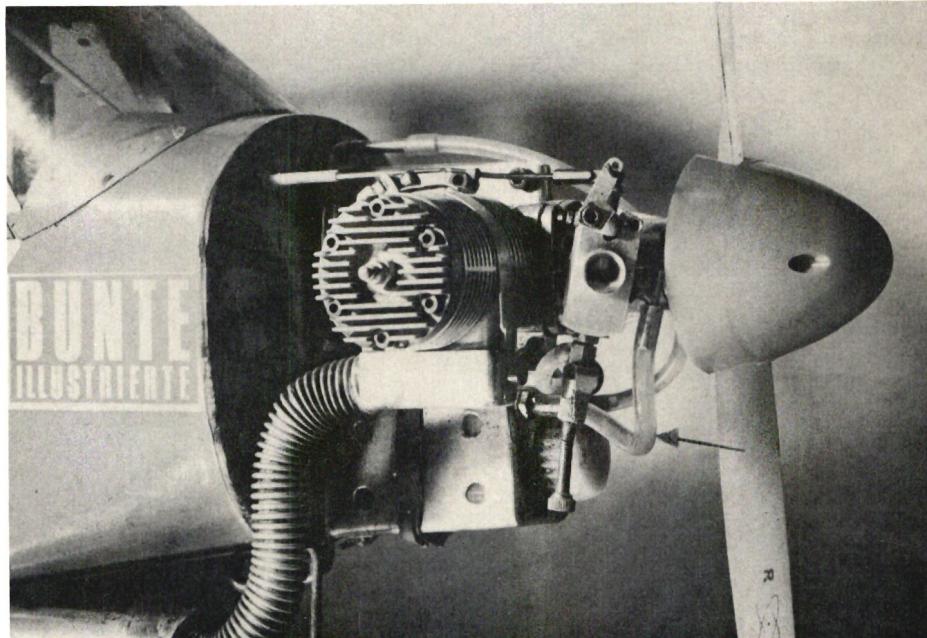
The new carburetor with the automatic fresh oil system
Our model engines are beginning to outgrow the “toy” category and are being taken seriously. Proof of this is the development of a new carburetor for model engines (glow plugs), which not only boosts performance but also puts an end to the hassle of using castor oil in a simple way. As is well known, using castor oil as engine lubricant has its drawbacks: the world of auto racing recognized this as early as the 1950s.
Our fuel, on the other hand—METHANOL—is virtually ideal for powering micro-engines, as its high heat of vaporization significantly reduces the thermal load on our engines. However, it does not mix with mineral oils under any circumstances. That is why this carburetor design circumvents this problem and makes a virtue of necessity: the required oil is metered to the engine separately from a dedicated tank via a simple automatic system. So there are two tanks: one for the fuel (METHANOL) and a much smaller one for the oil (MINERAL OIL). Both tanks are pressurized from the muffler in the usual manner.
The carburetor system itself is found in motorcycle engineering, where power outputs of 400 PS/liter have already been achieved. A quick calculation: 400 PS/liter would correspond to 4 PS in a 10-cc engine!!
Based on the system alone, a performance increase was to be expected, even if 400 PS/liter is hardly achievable at first. This is because, especially with 2-stroke engines, many factors must be taken into account. It was therefore particularly important to simultaneously develop an exhaust system that not only dampens noise but also boosts performance. Here, too, motorcycle design served as the inspiration. Generally speaking, there is no practical two-stroke engine that delivers more power without an exhaust system—or muffler—than it does with an exhaust system designed specifically for it. Until now, we’ve simply had to accept this as a fact when it comes to our model engines. Here’s an example of the performance achievable with the new carburetor in combination with a tuned muffler:
Engine: ENYA .45
Propeller: 11 x 7 (Graupner)
Fuel: METHANOL (unadulterated)
Lubricant: ARAL 2T
Carburetor: PL 7211
Muffler: PL 65
RPM: 13,200 rpm
, equivalent to 1.4 PS
For comparison, based on the DEMUTH test from MODELL, Issue 9/1974:
Engine: OPS .60 URSUS 74 RCA
Propeller: 11 x 7 (Graupner)
RPM
: 13,200 Fuel: ROKTAN-forte
(i.e., with nitro)
These figures speak for themselves. Another test—equipping a 6.5 WEBRA (.40) with a 14 x 4 propeller—resulted in over 8,000 rpm. This clearly shows that with this system, performance gains are not achieved through higher RPM, but rather through improved power delivery in the mid-range. In other words, an increase in torque across the entire RPM range.
Interestingly, an increase in performance was not initially intended by the designer at all. The main reason for developing the carburetor was to move away from castor oil as a lubricant—partly because of the sometimes almost unbearable contamination. In summary, it can be said that the set goals were fully achieved here as well; for example, a PIPER that was flown over the past season with all kinds of engines remained so clean that the usual “model wash” after flights was not necessary. The only marks on the model are traces of grass and clay, with just the occasional small oil splatter here and there. Enthusiastic customers fully confirm this.
Distribution for Switzerland is handled by MYKO A. L., Wollerau, Altenbachstrasse 45. They are happy to answer any questions; if necessary, they will also gladly put you in touch with the manufacturer. M. W.
Based on various test runs, particularly those conducted during flight, the following points are briefly summarized here:
- Significantly Cheaper Fuel
- No oily models
- Approx. 5% more power
- No soot buildup in the engine
- Greater susceptibility to malfunctions due to clogged nozzles or defective hoses
- Too many lines
- Very difficult to adjust the oil nozzle
If the engine initially receives too much oil, excess oil accumulates in the crankcase. If we close the nozzle at this point, the engine will continue to smoke for quite a while (3–4 minutes), so one is tempted to reduce the oil supply even further. However, once the excess oil has been used up and the oil supply is too low, the engine can seize. The resulting impact usually damages the connecting rod.
- Factory-set nozzle
- Engines with a permanently installed oil tank, eliminating the need for all the “hoses.” Emil Giezendanner


TEAM MANAGER "THIS" BOSSHARD
 Rodito Nussbaumer

SUMMER FUN 2026 AT MG USTER
Martin Wunderli
52. 2026 ALPS CUP
 Emil Giezendanner

ATOM, THE NEW DOUBLE-DECKER FROM CPLR
 Matthias Bosshard

INSIGHTS INTO THE HISTORY OF SEAPLANES

34th HAHNENMOOS ALPINE MODEL AIRPLANE CAMP
Res Dauwalder
CORSAIR F4U – A WARBIRD WITH A MEMORABLE LOOK
Jürgen Rosenberger, Jürgen Prinz
SMALL, MODEL-LIKE SAILBOATS
Res Dauwalder
F3A EUROPEAN CHAMPIONSHIPS IN ST-MACAIRE, FRANCE
Matthias Bosshard
What's New at Leomotion.com

HORIZON HOBBY/LEMACO NEWS: MICRO OV-10 BRONCO 645 MM BY E-FLITE

PRIDE AND GOOD IDEAS
 Markus Nussbaumer

News from HEBU

BY YOUTH, FOR YOUTH
Lorena Betschen
YOU KNOW WHAT I MEAN? 125 YEARS OF THE SWISS AERO CLUB
Emil Giezendanner
TRY-OUT DAY AT MFV WETTINGEN
Urs Keller
FREE FLIGHT IN THE MIDDLE OF SUMMER
Urs Muntwyler
THE PC-21 STORY
Emil Giezendanner
TWIN TOWN PARTNERSHIP
Wolfgang Voeller
EURO CONTEST GLIDER ACRO TOUR AUSTRIA 2026

WELCOME, NEW MEMBER!
Andrea Bolliger
COUPE DES ALPES – OBSERVE AND LEARN
Rodito Nussbaumer
NEWS FROM HEBU
 Julia Bucher

FROM 0 TO 100
Markus Nussbaumer
NOS REGION – A HUB FOR ELECTRIC AVIATION
Emil Giezendanner
MEMORIES
Wolfgang Völler
Have you almost forgotten about aircraft that take off and land vertically?
Emil Giezendanner
70 YEARS OF THE NIDWALDEN MODEL AIRPLANE CLUB
Martin Barmettler