
"Phänomen" flying wing, built in 1973
Author Gody Wettstein comments: “Actually, after all that intense work over the winter, I just wanted to clean up my workshop... After building two ‘full-blooded models’—a twin-engine Urvogel (named ‘Pterodactyl’) and a ‘Funtana’—nothing was in its right place anymore; to put it bluntly: it was a total mess.”
So: Enough with the cleaning up...! Right in the middle of this cleanup, I came across the plans for a flying wing from 1973, and the designer’s fantastic description also inspired and motivated me to start building right away: Forty years ago, the ailerons of the “Phänomen” were still controlled via Bowden cables. The two servos for this were installed in the fuselage and mechanically linked to the aileron mechanism
. A 1.5 cm³ tail motor was provided as an option. However, I wanted to build a modern replica using today’s advanced methods and technology: a one-piece wing (wingspan 1.8 m).
The original had two-piece wings connected with 5-mm piano wire (back then, pilots still had to

(built to “fit in a backpack”). Instead of the unattractive hull, I chose the one from my “Hai 3.” I was able to use the dimensions exactly as they were. I only had to make a slight adjustment to the stern section. In the hull, there are
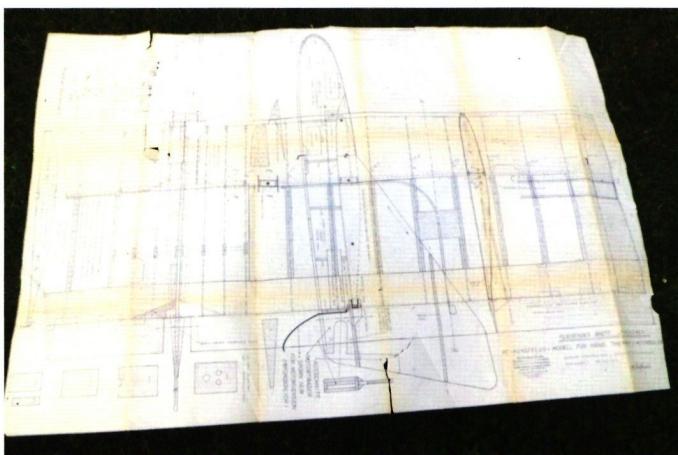
The "P H Ä N O M E N" flying board
is the result of several years of development work.
It wasn’t designed on paper, but tested under rigorous real-world conditions.
The well-known Eppler 182 profile, with its stable pressure distribution, gives this model flight characteristics that are currently unmatched by any other flying wing.
Its unexpectedly stable flight attitude and performance will exceed your expectations.
Easy to fly for any pilot familiar with the functions of the ailerons and elevator. No critical speed range!
Slope flyers will appreciate its incredible maneuverability. First-class handling!
Thermal gliders will get their money’s worth thanks to the low wing loading.
Towing: like it’s on rails (literally!)
A 1.5 cc motor is sufficient for use as a motor glider.
The “PHÄNOMEN” achieves the characteristics of an RC1 model through the following formula:
1. Reduce the wingspan from 1.80 m to any length down to approx. 1.40 m. (As a trunk-fit model to fit in your car. Do not split the wing in this case. This results in less weight and an even lower wing loading.
) 2. Use a motor (1.5 ccm is sufficient)
. 3. Use an additional servo for rudder control; this makes the turns more precise.
Finally, the simple construction should be mentioned. (No V-shape, no sweep, no dihedral!) Question: Do you know of any model that, in addition to these advantages, also offers these various possibilities?
Hence the name “PHÄNOMEN.” It also lives up to its name in flight.
The “PHÄNOMEN” has proven its capabilities in front of many aviation experts.
You, too, can steal the show with the “PHÄNOMEN.”
The “PHÄNOMEN”—my contribution to unhindered flying.
Schlangen 2, July 1973
Your fellow pilot
F.W. Wulfkühle
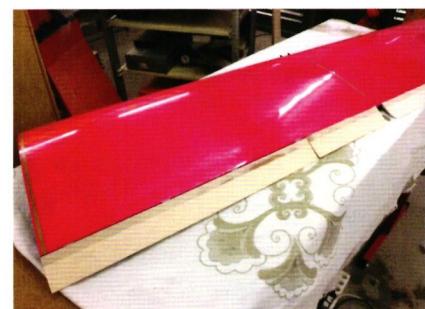
It houses only the drive motor, ESC, and LiPo battery. It is particularly worth noting that the receiver and rudder servo are mounted on the underside, centered on the wing. This means that only a single electrical connection to the fuselage is required (receiver → ESC). The wing and fuselage are connected by a single M6 screw. The wing profile is an Eppler 182, featuring
an “S-curve” that is supposed to guarantee “phenomenal” flight characteristics. Instead of the original ailerons (880 mm each), I have opted for conventional ailerons and elevators (600 mm ailerons and 280 mm elevators each). In my opinion, ailerons have a major disadvantage when the ailerons and elevators are at full deflection: one half of the wing then has an extremely aerodynamically inefficient deflection. With the other-
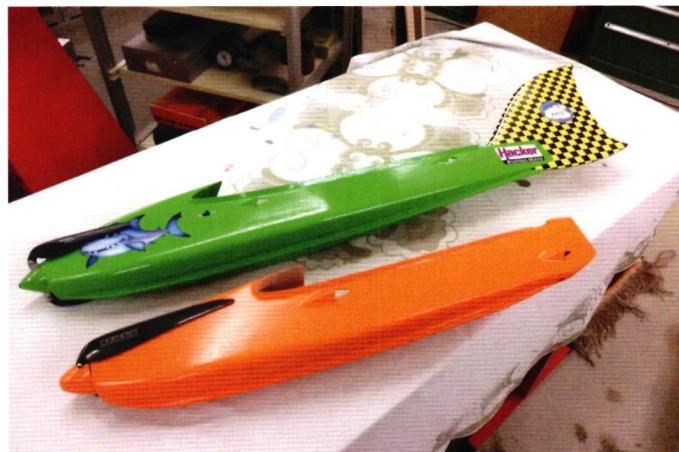
On the opposite wing half, the deflection practically cancels itself out to 0. This results in a very asymmetrical airflow! (But that's just my own idea...). Of course, the aileron and elevator servos could be reprogrammed to operate simultaneously at any time, restoring aileron control.
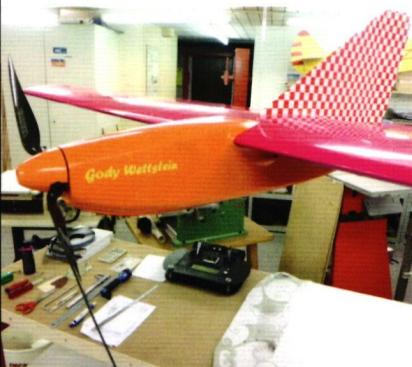
Unfortunately, to maintain the center of gravity as planned, I needed to add about 500 g of lead to the nose. This was likely due to the four servos in the wing and the relatively heavy Oracover film. However, I don’t have any weight specifications for the original. The wing loading is now just under 40 g/dm², whereas without the lead it would be only 30 g/dm². Because of the numerous technical improvements I made based on my own ideas, I’ve now christened the plane “Phänomen 2.”
As the designer’s report already states, flying—even with my “Phänomen 2”—is absolutely trouble-free. I had to reduce the control surface deflections because the plane (not the pilot) was behaving rather erratically. With the engine shut off, the aircraft is unusually slow, but thanks to the Eppler 182 airfoil, it promises very good glide-
and flying characteristics. To land, you have to approach at a shallow angle, since the plane shows no inclination to touch down.
Gody Wettstein →
| Model Name: | Phenomenon 2 | Technical Specifications: | ||
| Intended Use: | All-around model | Wingspan: | 1.80 m | |
| Model type: | Wooden scale model | Length: | 0.765 m | |
| Configuration: | Wing depth: | 45.0 cm | ||
| Fuselage: | Aviation plywood/balsa | Wing area: | 79 dm² | |
| Empty hull weight | 300 g | Wing loading: | 40 g/dm² | |
| Airframe, ready to fly | 1,434 g | Wing profile: | Eppler 182 | |
| (includes motor, battery, ESC, and lead weights) | Vertical stabilizer profile: | Flat | ||
| One-piece, balsa/pine/carbon tape, | Takeoff weight: | 3.125 kg | ||
| 10×0.5 top/bottom | ||||
| 2 ailerons/balsa | ||||
| 2 elevators/balsa | ||||
| Balsa, permanently glued to the wing | ||||
| Wing: | Powerplant: | |||
| Vertical stabilizer: | Motor: | Kontronik KIRA 480-31 | ||
| Covering/Surface: | ORACOVER iron-on film/acrylic spray can | Gear ratio: | 5.2:1 | |
| RC Functions – Components: | RPM: | 50% = --- RPM | ||
| Height/Width: | HITEC | 2× HS-5645MG each | Current consumption: | 50% = --- A/--- kW |
| Side: | HITEC | HS-225MG | Propeller: | epower |
| Futaba remote control system: | FX-30/R6008 HS | Spinner: | epower | |
| Receiver | Flight battery: | LiPo 3S 1P | ||
| BEC power supply via ESC | ESC: | PHOENIX ICE LITE 75 | ||
| SPECIAL FEATURES: | ||||
| Original PHÄNOMEN plan (1973): Controlled via Bowden cables → combined aileron/elevator | ||||
| “Two-piece wings with plug-in joints; 2 servos for ailerons in the fuselage” | ||||
| Rudder control optional for aerobatics (smoother rolls) | ||||
| Engine variant: 1.5 cm³ engine in the tail | ||||
| PHÄNOMEN 2 replica (2012): Ailerons and elevator are separate and controlled by 4 servos. | ||||
| Rudder with 1 servo | ||||
| One-piece wing. Fuselage based on the Hai 3 design (much more elegant!) | ||||
| Receiver and rudder servo located in the wing. This means only a single connection to the fuselage is required! | ||||
| (Speed controller → receiver) | ||||
| “Propulsion motor/spinner; integrated into the fuselage nose” | ||||


TEAM MANAGER "THIS" BOSSHARD
 Rodito Nussbaumer

F3A EUROPEAN CHAMPIONSHIPS IN ST-MACAIRE, FRANCE
 Matthias Bosshard

News from HEBU

YOU KNOW WHAT I MEAN? 125 YEARS OF THE SWISS AERO CLUB
 Emil Giezendanner

SUMMER FUN 2026 AT MG USTER
Martin Wunderli
TRY-OUT DAY AT MFV WETTINGEN
Urs Keller
52. 2026 ALPS CUP
Emil Giezendanner
BY YOUTH, FOR YOUTH
Lorena Betschen
ATOM, THE NEW DOUBLE-DECKER FROM CPLR
Matthias Bosshard
CORSAIR F4U – A WARBIRD WITH A MEMORABLE LOOK
Jürgen Rosenberger, Jürgen Prinz
SMALL, MODEL-LIKE SAILBOATS
Res Dauwalder
What's New at Leomotion.com

INSIGHTS INTO THE HISTORY OF SEAPLANES

34th HAHNENMOOS ALPINE MODEL AIRPLANE CAMP
Res Dauwalder
HORIZON HOBBY/LEMACO NEWS: MICRO OV-10 BRONCO 645 MM BY E-FLITE

COUPE DES ALPES – OBSERVE AND LEARN
Rodito Nussbaumer
TWIN TOWN PARTNERSHIP
Wolfgang Voeller
PRIDE AND GOOD IDEAS
 Markus Nussbaumer

EURO CONTEST GLIDER ACRO TOUR AUSTRIA 2026

FREE FLIGHT IN THE MIDDLE OF SUMMER
Urs Muntwyler
THE PC-21 STORY
Emil Giezendanner
WELCOME, NEW MEMBER!
Andrea Bolliger
NEWS FROM HEBU
 Julia Bucher

FROM 0 TO 100
Markus Nussbaumer
MEMORIES
Wolfgang Völler
NOS REGION – A HUB FOR ELECTRIC AVIATION
Emil Giezendanner
Have you almost forgotten about aircraft that take off and land vertically?
Emil Giezendanner
70 YEARS OF THE NIDWALDEN MODEL AIRPLANE CLUB
Martin Barmettler