
Off the floor, up into the air!
Not new models that look old, and not old models that look new, but old models that still look old—yet fly again. That is René Giger’s passion.
He spends more than half his time traveling for work somewhere in Europe. René Giger’s home is—as it always has been—in Breitenbach. The “Schwarzbube” has been a member of the local model aircraft club for almost as long as anyone can remember. And as with any long-time model builder, René has accumulated quite a collection over the years. It wasn’t just odds and ends, but entire models that were gathering dust in his attic—or on the top shelves of his hobby basement—just like those of many of his colleagues. Until René Giger finally decided to put an end to it. He didn’t want to throw them away, nor did he want to sell them online. Instead, he set out to restore the well-worn and temporarily discarded models to flying condition. A fascinating endeavor for anyone who enjoys tinkering.
This has little to do with nostalgia or retro. “I want to bring old things back to life,” René explains, describing what drives him. Accordingly, functionality—rather than perfect restoration—is the focus of his tinkering. He brings all the electronics up to current standards and restores the mechanical parts to a reliable condition. Specifically, this means replacing old servos, as well as the RC electronics and often the motors too; checking the linkages and replacing them if necessary; repairing damage to the fuselage and wings; and adding or replacing the fabric covering. This requires a fair amount of improvisation, but also a delicate touch, since the old balsa wood is often brittle and fragile.
The goal is airworthiness, not a beauty contest. René isn’t under any illusions—the models are old and will remain so. “This stuff isn’t meant for a museum; it’s meant to take to the skies,” he firmly believes. The highlight, accordingly, is when another model takes off from the Breitenbach Model Flying Club’s field—one that had been sitting in a basement or attic for decades and, after a complete overhaul, flies as well as ever—or even better. His colleagues react with anything from calm acceptance to enthusiasm. One or two have even caught the bug, “dug around” at home, found what they were looking for, and are now restoring models they’d long since forgotten about. René is delighted to see others following his lead and hopes that, sooner or later, a small community of like-minded people will form where they can share ideas.
R.Giger@westfaliaeurope.com
But what does “old” actually mean? It’s not about new models that look old. It’s about models that are old and actually look that way. For René, “old” means anything from the ’70s or earlier. The year of manufacture is the deciding factor—that is, when the model kit hit the market or the blueprint was drawn up. But René doesn’t want to be too picky. After all, it’s all about having fun. So his collection also includes the occasional model from the early ’80s.
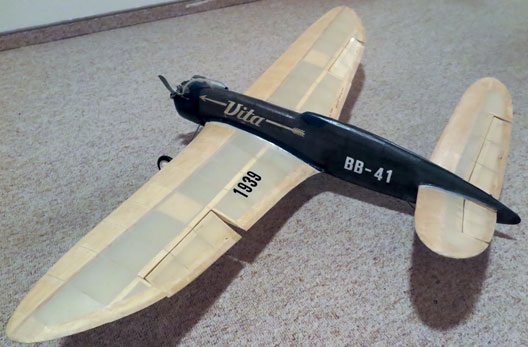
René now operates well over 30 old models, either on his own or together with colleagues. All of them are neatly documented in a catalog. He’d like to expand the catalog to include old models from colleagues in the region and then make it publicly accessible. It features many model-building legends from Graupner, such as the Cumulus (1974), Cirrus (1969), Jolly (1967), Topsy (1961), Kapitän (1957), Multiplex’s Alpha (1969) and Flamingo (1978), Wick’s Jonny (1968) and Salto (1973), the Carrera SB 10 (1977), the Hegis Bergfalk (1959), and Svenson’s Fieseler Storch (1978)—which René bought as a kit 30 years ago and only built three years ago. Then there are models built from plans, such as the Reiher, which René built from an FMT plan during his apprenticeship and with which he participated again in the Schwarzbubenfliegen this summer—more than 40 years later—after a major overhaul. As already mentioned, everything is airworthy, and everything takes to the air every now and then. But there’s an exception here as well: the Vita model, designer unknown, built in 1939. It’s so old that René doesn’t want to risk damaging it or, heaven forbid, losing it. Contrary to his philosophy, it belongs in the museum section—though the museum consists of only one item.
Roland Schlumpf


News from HEBU

TEAM MANAGER "THIS" BOSSHARD
 Rodito Nussbaumer

YOU KNOW WHAT I MEAN? 125 YEARS OF THE SWISS AERO CLUB
 Emil Giezendanner

F3A EUROPEAN CHAMPIONSHIPS IN ST-MACAIRE, FRANCE
 Matthias Bosshard

52. 2026 ALPS CUP
Emil Giezendanner
PRIDE AND GOOD IDEAS
 Markus Nussbaumer

CORSAIR F4U – A WARBIRD WITH A MEMORABLE LOOK
Jürgen Rosenberger, Jürgen Prinz
SUMMER FUN 2026 AT MG USTER
Martin Wunderli
TRY-OUT DAY AT MFV WETTINGEN
Urs Keller
BY YOUTH, FOR YOUTH
Lorena Betschen
ATOM, THE NEW DOUBLE-DECKER FROM CPLR
Matthias Bosshard
SMALL, MODEL-LIKE SAILBOATS
Res Dauwalder
What's New at Leomotion.com

HORIZON HOBBY/LEMACO NEWS: MICRO OV-10 BRONCO 645 MM BY E-FLITE

COUPE DES ALPES – OBSERVE AND LEARN
Rodito Nussbaumer
TWIN TOWN PARTNERSHIP
Wolfgang Voeller
EURO CONTEST GLIDER ACRO TOUR AUSTRIA 2026

INSIGHTS INTO THE HISTORY OF SEAPLANES

34th HAHNENMOOS ALPINE MODEL AIRPLANE CAMP
Res Dauwalder
WELCOME, NEW MEMBER!
Andrea Bolliger
FREE FLIGHT IN THE MIDDLE OF SUMMER
Urs Muntwyler
THE PC-21 STORY
Emil Giezendanner
NEWS FROM HEBU
 Julia Bucher

FROM 0 TO 100
Markus Nussbaumer
MEMORIES
Wolfgang Völler
NOS REGION – A HUB FOR ELECTRIC AVIATION
Emil Giezendanner
Have you almost forgotten about aircraft that take off and land vertically?
Emil Giezendanner
DO YOU KNOW WHAT I MEAN IN THE LAND OF SMILES?
Emil Giezendanner