
The Hunter MK-58 was his favorite aircraft
In February 2011, Werner “Werni” Wieser passed away at the age of 67 following a serious illness. His death marked the end of the life of a man who was universally cherished and a pilot with an exemplary career.
Even in elementary school, Werni was certain he would become a pilot. Together with his father, he built and flew his first model airplanes while still in school. His apprenticeship as a mechanic at the Dübendorf airfield gave him his first close-up experience with the military aircraft he hoped to fly one day. Werni gained his first practical flying experience while still in his vocational apprenticeship, at the controls of a Röhnlerche, Ka-2, S-18, and Ka-8 at the Spreitenbach airfield.
At the age of twenty, Werni began his traditional career as a military pilot on the Magadino Plain, initially flying various Bücker models as well as the P-2 and P-3. After basic training on piston-engine aircraft, he made the transition to jet aircraft. Werni initially flew Vampires and Venoms until he was able to retrain on the Hunter Mk-58, his declared favorite aircraft.
After seven years as a military pilot and member of the Surveillance Squadron, Werni enrolled in the Swiss Aviation School (SLS) in May 1969, where he trained to become a commercial pilot. A year later, he took off on his first scheduled flight as a first officer in the cockpit of a Swissair DC-9. In the years that followed, Werni flew various models of the DC-9 and DC-10, serving as captain beginning in August 1981. Just one year later, Werni was also entrusted with instructional duties. In addition, he was involved in the procurement and acceptance testing of the Focker 100 and various models of the Airbus family, as well as the associated simulators. He flew these aircraft himself and conducted simulator checks. In August 2000, after more than 10,000 flight and simulator hours, Werni made his 6,300th landing in a Swissair aircraft, thus bringing his 30-year career as a commercial pilot to a close.
Despite this strong involvement in civil aviation, Werni remained committed to military aviation. In addition to the PC-6, he flew Alouette II and III helicopters until he turned 50. His military flight log records over 4,000 flight hours and nearly 10,000 landings.
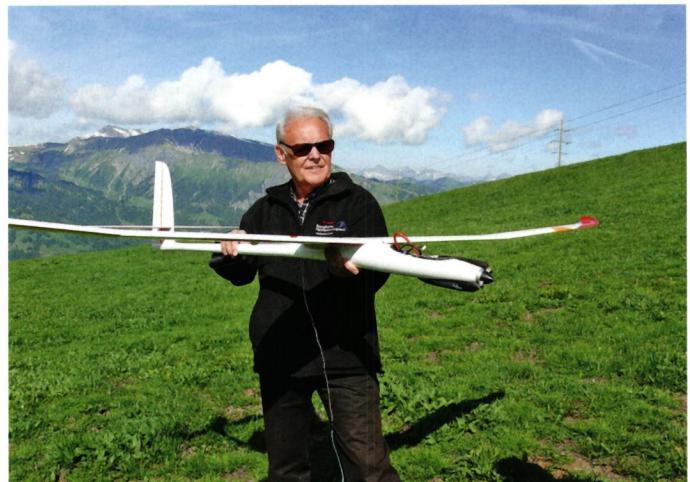
After retiring from Swissair due to age, Werni continued to work for several years as a flight instructor and trainer at various aviation companies, where his vast experience and high level of expertise were highly valued. Throughout his entire professional career, Werni remained an enthusiastic model airplane enthusiast. As early as the pioneering days of the mid-1970s, he was already working with helicopters and designed an electric powerplant for a Bell Huey Cobra AH1 at an early stage. In addition, Werni flew numerous powered aircraft and, with great pleasure, gliders as well. After his retirement, he devoted himself fully to jet aviation, drawing on his vast experience as a military and commercial jet pilot. He built the Kangaroo, Super Reaper, Mirage III S, Mirage III C, and F-16, as well as an engine he designed himself. Many of his fellow hobbyists who visited Werni in his perfectly equipped workshop marveled at the perfection of his jets. Everything was well thought out, designed for safety, and executed to the highest standards of craftsmanship—which is not surprising given Werni’s professional career, in which safety and professionalism were paramount. Unfortunately, some of his projects—such as the Vampire DH-100, F/A-18 C, and PC-21—remained unfinished. Starting in 2003, Werni supported the well-known jet pilot Urs Mayländer as an assistant during training flights and championships. In 2007, he accompanied him to the World Championships in Ireland, where Urs Mayländer became world champion in the build category with his BAE HAWK MK66. Urs Mayländer appreciated how Werni calmly and succinctly offered crucial suggestions for the flight plan and supported him with constructive criticism during the construction of the HAWK. The two last competed together at the 2009 Swiss Championship, where Urs Mayländer won the championship title for the second time in both the construction and flight categories with the HAWK. Unfortunately, this team was not able to complete the construction of their two Hunter Mk-58s, a joint project they had been pursuing for years.
Werni’s enthusiasm for technology and his widely valued expertise—which he was happy to share—were, however, only one side of his personality. The other side was his great interpersonal skills. This was evident, among other things, in the respect with which he treated the people he interacted with, whether in his personal or professional life. He thoroughly enjoyed windsurfing with his family on Lake Garda, spending a week with colleagues on the Hahnenmoos flying model gliders extensively in alpine terrain, and talking shop in good company late into the night. He took great pride in the successful careers of his two sons, who had caught the flying bug just like their father.
Since Werni was involved in various types of flying, he was a member of two model flying clubs. At MG Erlenbach, which he joined in 1989, he indulged his passion for gliding. He served as president of this club from 2000 to 2009. His general meetings, which he led with a combination of humor and efficiency, are fondly remembered. Thanks to his open, friendly nature, he knew how to resolve problems diplomatically—or, when necessary, with a firm hand at just the right moment. Werni had been a member of the MG Dübendorf since 2003. On the paved runway, he flew his jets and electric aerobatic models. For several years, he was in charge of the cash register at the MG Dübendorf’s annual swap meet. His fellow members knew Werni as a passionate, enthusiastic, and inspiring model aviator—always helpful and full of initiative.
For Werni, simply by virtue of his role as a Swissair captain, it was important—and second nature—to always have everything under control. It must have been a very painful experience for him to see his independence increasingly restricted—and ultimately taken away—over the course of a year due to a serious illness. His wife, Ruth, with the support of their two sons, cared for him selflessly during his final months. It was ultimately a relief when Werni was able to embark on his final journey on February 20, 2011. We will remember him fondly as a kind, always cheerful person, a good, reliable friend, and a competent fellow pilot. ■
Georg Staub, MG Erlenbach


TEAM MANAGER "THIS" BOSSHARD
 Rodito Nussbaumer

ATOM, THE NEW DOUBLE-DECKER FROM CPLR
 Matthias Bosshard

INSIGHTS INTO THE HISTORY OF SEAPLANES

CORSAIR F4U – A WARBIRD WITH A MEMORABLE LOOK
Jürgen Rosenberger, Jürgen Prinz
SUMMER FUN 2026 AT MG USTER
Martin Wunderli
F3A EUROPEAN CHAMPIONSHIPS IN ST-MACAIRE, FRANCE
Matthias Bosshard
What's New at Leomotion.com

HORIZON HOBBY/LEMACO NEWS: MICRO OV-10 BRONCO 645 MM BY E-FLITE

PRIDE AND GOOD IDEAS
 Markus Nussbaumer

News from HEBU

YOU KNOW WHAT I MEAN? 125 YEARS OF THE SWISS AERO CLUB
 Emil Giezendanner

34th HAHNENMOOS ALPINE MODEL AIRPLANE CAMP
Res Dauwalder
SMALL, MODEL-LIKE SAILBOATS
Res Dauwalder
TRY-OUT DAY AT MFV WETTINGEN
Urs Keller
52. 2026 ALPS CUP
Emil Giezendanner
TWIN TOWN PARTNERSHIP
Wolfgang Voeller
EURO CONTEST GLIDER ACRO TOUR AUSTRIA 2026

BY YOUTH, FOR YOUTH
Lorena Betschen
WELCOME, NEW MEMBER!
Andrea Bolliger
FREE FLIGHT IN THE MIDDLE OF SUMMER
Urs Muntwyler
THE PC-21 STORY
Emil Giezendanner
COUPE DES ALPES – OBSERVE AND LEARN
Rodito Nussbaumer
NEWS FROM HEBU
 Julia Bucher

FROM 0 TO 100
Markus Nussbaumer
NOS REGION – A HUB FOR ELECTRIC AVIATION
Emil Giezendanner
MEMORIES
Wolfgang Völler
Have you almost forgotten about aircraft that take off and land vertically?
Emil Giezendanner
70 YEARS OF THE NIDWALDEN MODEL AIRPLANE CLUB
Martin Barmettler