
Pylon-Racing Club 20 in Amriswil
Organization: MG Amriswil
Left: The exciting start of the Club 20 category.
Below: Once again, Bernhard Wächli from Langenthal finished in the thankless 4th place in the Club 20 race!
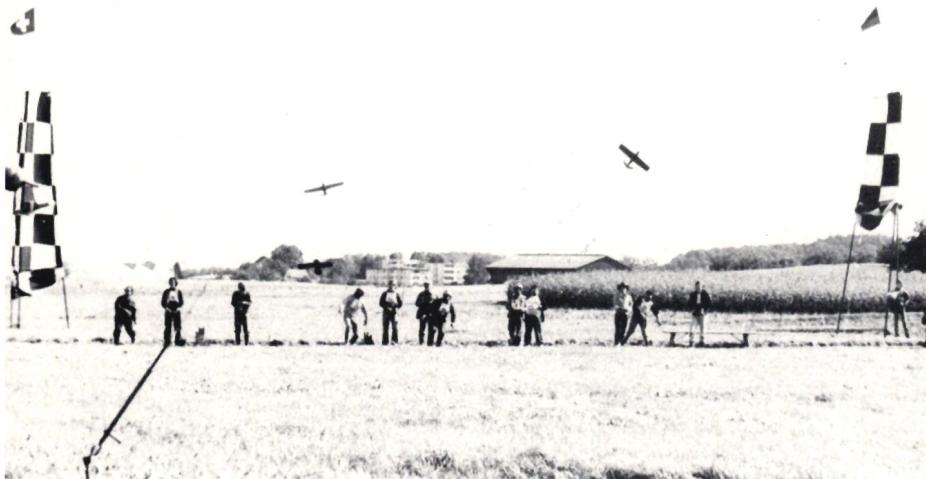
On October 4, MG Amriswil once again organized a pylon race. This time, the event was for the Club 20 class (models with a wingspan of about 1 m and a maximum engine displacement of 3.5 ccm) and the Elektro 714 class (electric models with the sole requirement of 7 battery cells, each with a maximum capacity of 1.4 Ah). With 32 entries from all over Switzerland and 2 from France, an exciting competition was in store, and the organizers had to ensure the races were run efficiently—after all, each participant had to complete four preliminary rounds! What had become apparent in recent years was impressively confirmed in Amriswil: The models in the Club 20 class are nearly equally fast (about 180 km/h in level flight), so the pilots were forced to fly the 250-meter-long triangular course as cleanly as possible—that is, as low as possible and as close as possible to the pylon! Four pilots each started simultaneously for the 10-lap race. If a pylon is not flown around correctly, the pilot receives a 10% time penalty added to their lap time. Two errors result in disqualification. The two best times from the preliminary rounds count toward the semifinals, for which the eight fastest pilots qualify. The four fastest pilots from the semifinals compete in the final race. The slight differences in speed among the models were not without consequences. There were mid-air collisions, contact with the pylons, and crashes to the ground… 17 models, including four electric models, fell victim in this battle for seconds! The Club 20 class places the highest demands on model pilots. However, it also offers them—and the spectators—a unique racing atmosphere and excitement unlike anything experienced in almost any other model flying discipline!
The competition in the electric category was a bit calmer. Four competitors also started a race at the same time. The fastest models still managed to reach an average speed of 70 km/h. The 7-cell limit also gives less experienced or less well-off model builders the chance to build a model just as fast as their “pro” competitors and truly test their flying skills against them. Fingertip sensitivity—in the truest sense of the word—determines victory or defeat. The electric model aircraft impressively demonstrated that silent motorized flight has become a genuine alternative.
Rolf Hess
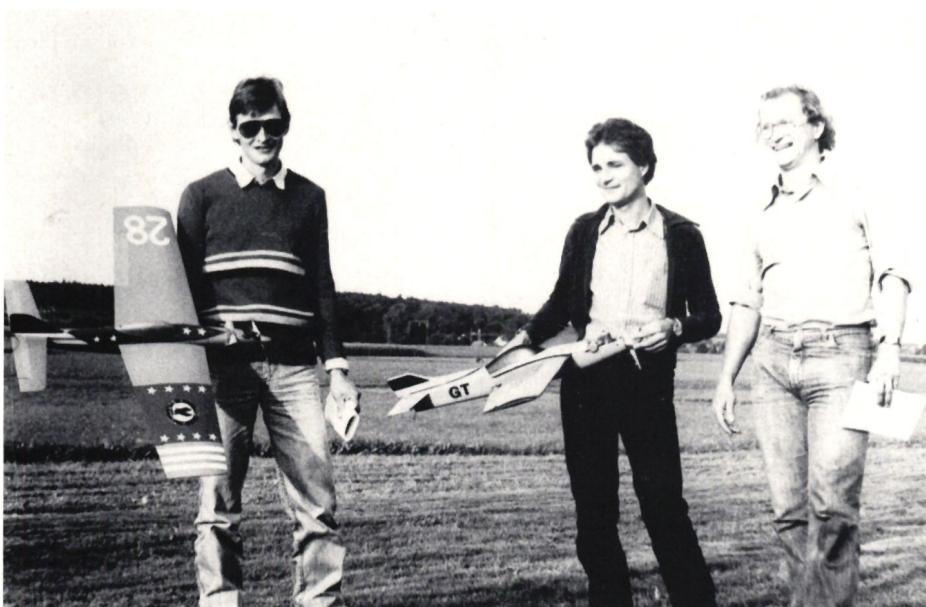
Left: The winners of the Club 20 class. From left to right: Martin Michel, Glattal; Hansruedi Zwingli, Thal; and Patrice Garelli, Lyon, France.
| 1. Hansruedi Zwingli | MG Thal |
| 2. Patrice Garelli | MG Lyon (F) |
| 3. Martin Michel | MG Glattal |
| 4. Bernhard Wächli | MG Langenthal |
| 5. Martin Forster | MG Amriswil |
| 6. Jo Seiboz | MG Geneva |
| 7. Roger Mercanton | MG Geneva |
| 8. Andreas Mettler | MG Grischei/ZH |
| 9. Peter Klauser | MG Grischei/ZH |
| 10. Remo Gerber | MG Amriswil |
| 11. Jean-Cl. Requet | Thonon (F) |
| 12. Oskar Leutenegger | MG Weinfelden |
| 13. Armin Müller | MG Grischei/ZH |
| 14. Oskar Lenz | MG Amriswil |
| 15. Jörg Lenz | MG Amriswil |
| 16. Fredy Muller | MG La Côte |
| 17. Ernst Weissinger | MG Rorschach |
| 18. Heinz Lattmann | MG Grischei/ZH |
| 19. Carlo Ritter | MG Grischei/ZH |
| 20. Michel Jeanneret | MG La Côte |
| 21. Urban Sutter | MG Amriswil |
| 22. Kurt Bächler | MG Weinfelden |
| 23. Hasy Morf | MG Grischei/ZH |
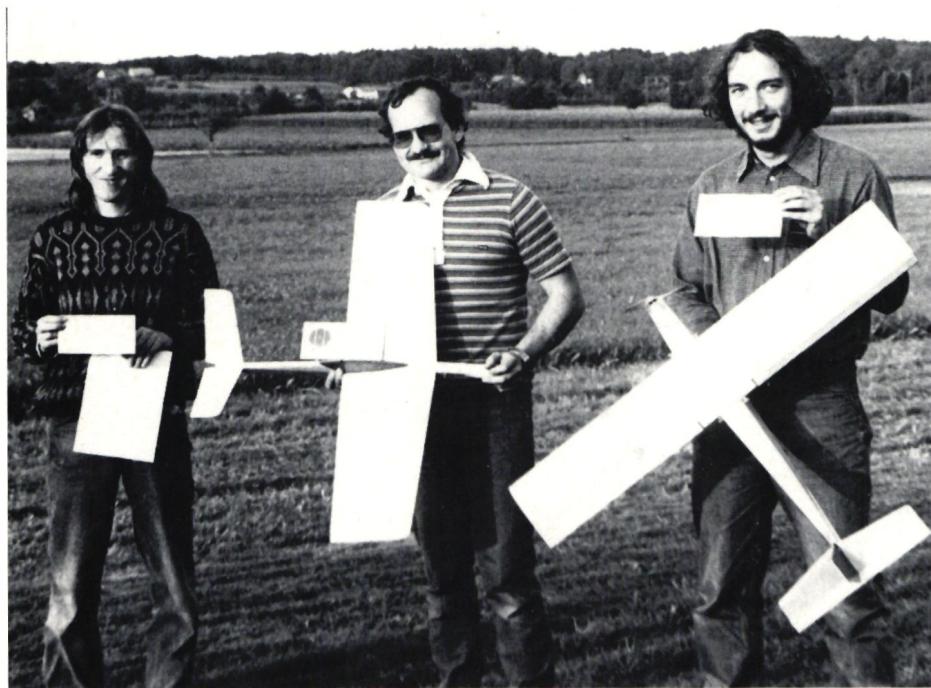
| 1. Andreas Mettler | MG Grischei |
| 2. Roland Hersperger | MG Meilen |
| 3. Hansjakob Sommerauer | MG Zumikon |
| 4. Hanspeter Bieri | MG Amriswil |
| 5. Markus Weidmann | |
| 6. Daniel Bosshart | MG Pfäffikon |
| 7. Ernst Weissinger | MG Rorschach |
| 8. Ruedi Käppeli | MG Meilen |
| 9. Walter Cadonau | MG Arbon |
| 10. Marco Boholzer | |
| 11. Stefan Cadonau | MG Arbon |


News from HEBU

TEAM MANAGER "THIS" BOSSHARD
 Rodito Nussbaumer

SUMMER FUN 2026 AT MG USTER
Martin Wunderli
SMALL, MODEL-LIKE SAILBOATS
Res Dauwalder
TRY-OUT DAY AT MFV WETTINGEN
Urs Keller
What's New at Leomotion.com

52. 2026 ALPS CUP
 Emil Giezendanner

ATOM, THE NEW DOUBLE-DECKER FROM CPLR
 Matthias Bosshard

INSIGHTS INTO THE HISTORY OF SEAPLANES

YOU KNOW WHAT I MEAN? 125 YEARS OF THE SWISS AERO CLUB
Emil Giezendanner
34th HAHNENMOOS ALPINE MODEL AIRPLANE CAMP
Res Dauwalder
CORSAIR F4U – A WARBIRD WITH A MEMORABLE LOOK
Jürgen Rosenberger, Jürgen Prinz
F3A EUROPEAN CHAMPIONSHIPS IN ST-MACAIRE, FRANCE
Matthias Bosshard
HORIZON HOBBY/LEMACO NEWS: MICRO OV-10 BRONCO 645 MM BY E-FLITE

PRIDE AND GOOD IDEAS
 Markus Nussbaumer

BY YOUTH, FOR YOUTH
Lorena Betschen
FREE FLIGHT IN THE MIDDLE OF SUMMER
Urs Muntwyler
THE PC-21 STORY
Emil Giezendanner
TWIN TOWN PARTNERSHIP
Wolfgang Voeller
EURO CONTEST GLIDER ACRO TOUR AUSTRIA 2026

WELCOME, NEW MEMBER!
Andrea Bolliger
COUPE DES ALPES – OBSERVE AND LEARN
Rodito Nussbaumer
NEWS FROM HEBU
 Julia Bucher

FROM 0 TO 100
Markus Nussbaumer
MEMORIES
Wolfgang Völler
NOS REGION – A HUB FOR ELECTRIC AVIATION
Emil Giezendanner
Have you almost forgotten about aircraft that take off and land vertically?
Emil Giezendanner
70 YEARS OF THE NIDWALDEN MODEL AIRPLANE CLUB
Martin Barmettler