
A Helicopter for the Heart
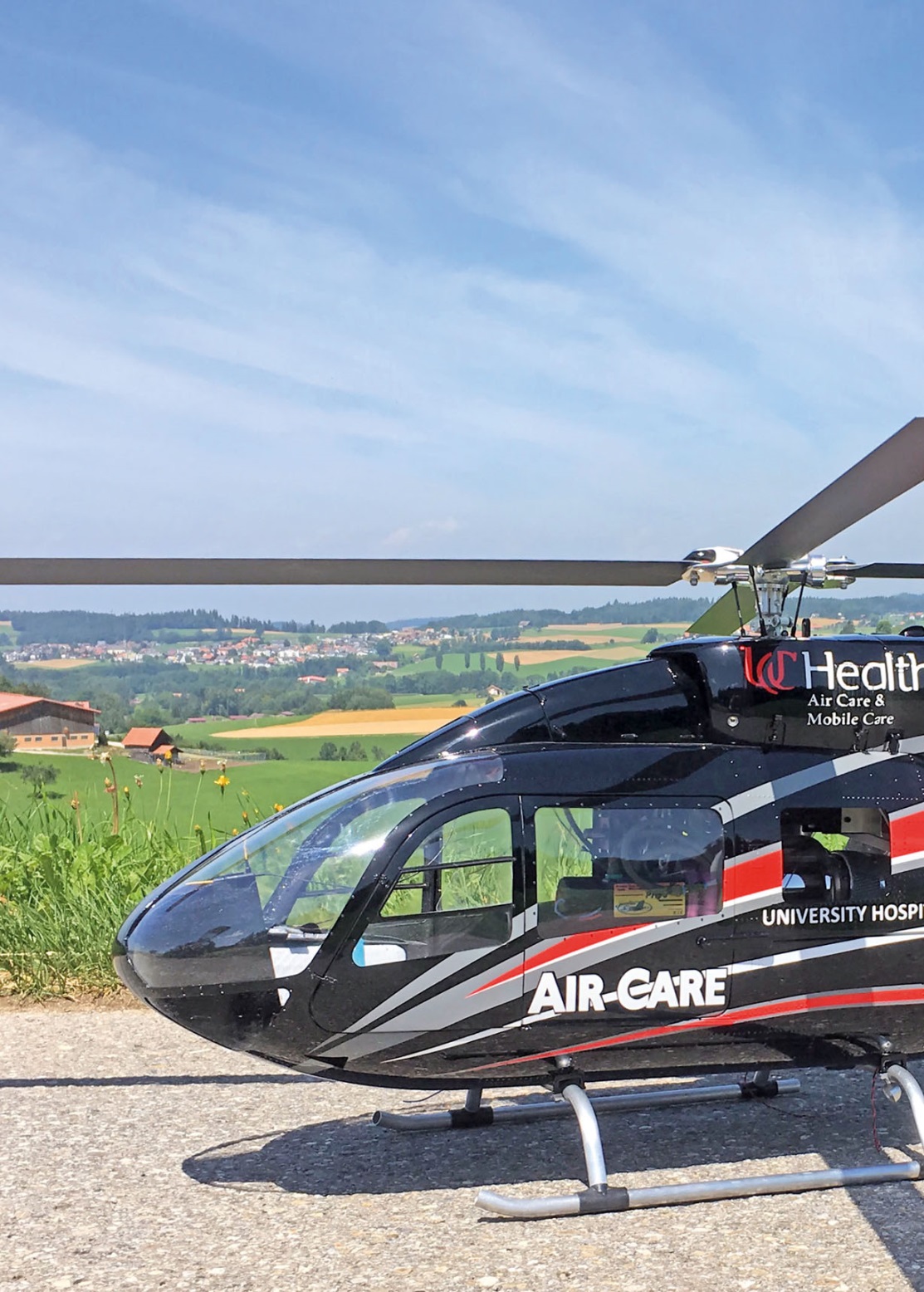
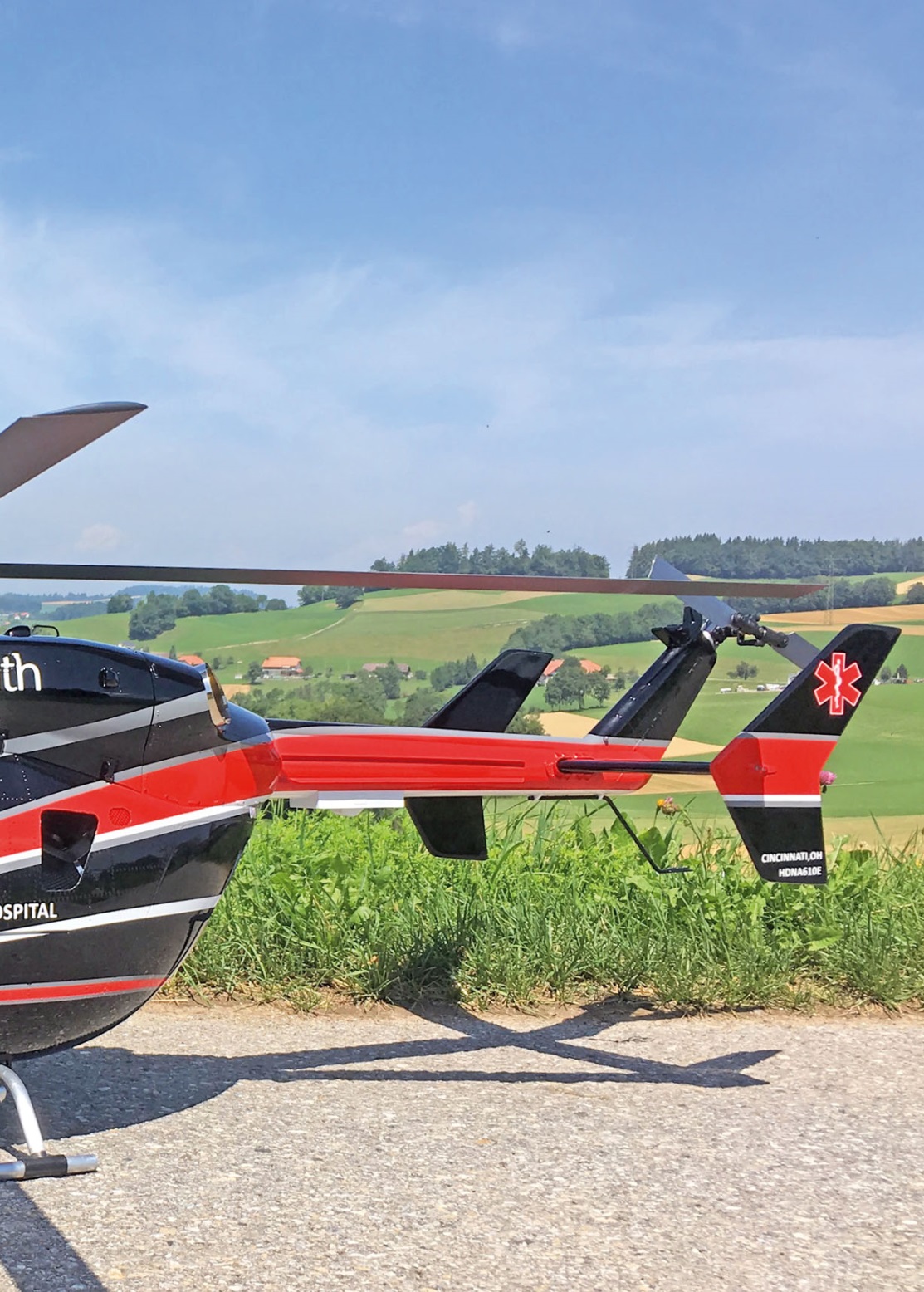
In the Cincinnati area in the United States, very long distances between patients in need of care and hospitals are the norm, requiring specialized transportation options. Since 1984, Air Care & Mobile Care (ACMC) at the University of Cincinnati has been dedicated to establishing and expanding these services for the benefit of patients. When it comes to heart disease, time is always of the essence. Over the past 25 years, ACMC has focused specifically on these factors and has continually refined its operations in day-to-day practice. Daniel Zbinden built the EC 145 based on the model of the American Air Care & Mobile Care unit at the University of Cincinnati Medical Center. The model kit came from Helikopter Baumann in Belp, Switzerland; over countless hours, he recreated the helicopter down to the last detail, faithfully replicating the original.
Patients who have a heart attack require immediate medical attention. The American Heart Association generally recommends that no more than 90 minutes elapse between the time a patient seeks medical care and the time their heart block is resolved through a procedure at the hospital. A procedure known as percutaneous coronary intervention (PCI) is the preferred treatment for most heart attack patients. In the U.S., however, relatively few hospitals are able to perform PCI (about one-quarter of all hospitals are capable of doing so; in Canada, the percentage is even lower). Consequently, many heart attack patients must be transferred from the facilities where they were diagnosed to hospitals farther away, where they can then be treated.
Transportation is a very important factor in consistently meeting the American Heart Association’s 90-minute PCI standard. In most cases, air transport is significantly faster than ground transport by ambulance.
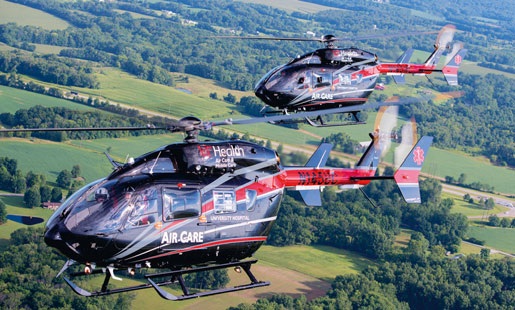
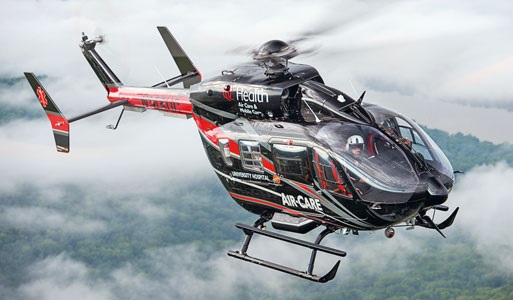
Air Care & Mobile Care, part of the University of Cincinnati Medical Center, began operations in 1984 with a single ambulance and an MBB BO105 helicopter. But the BO105 was soon replaced by two BK117 helicopters, which remained in service for many years. In August and December 2012, they were replaced by two twin-engine EC145s with glass cockpits. Today, ACMC carries out its mission with these two state-of-the-art Eurocopter EC145 helicopters. Two leased BK117s, stationed at airfields in the Cincinnati area, round out the Medical Center Cincinnati’s air transport fleet.
To provide a comprehensive patient transport program in the Greater Cincinnati region, ACMC offers ground ambulance transport in three categories: Basic Life Support, Advanced Life Support, and Mobile Intensive Care Units. In 2012, the approximately 140 transport specialists transported more than 1,000 patients by helicopter and more than 10,000 by ambulance.
Clinical Director Matt Grunderman explains his program as follows: “Every ACMC helicopter always carries blood units and hypertonic saline on every flight. New technologies are constantly being added to our equipment, such as a portable ultrasound device that helps the medical crew members better diagnose and monitor patients in flight. There is no status quo when it comes to caring for our patients. We now carry medications in our emergency kit that we didn’t carry even half a year ago, because experience has taught us that a patient might need them one day.” However, this focus on patient care has also helped shape the helicopter side of the program so that the patient’s best interests always come first.
Safety and patient care are the reasons why ACMC has been using large twin-engine helicopters for many years. The safety provided by an additional turbine, as well as space for additional medical equipment and an extra caregiver or family member, are the criteria that ACMC must meet.
For the model’s builder, Daniel Zbinden from Zumholz in the canton of Fribourg, Switzerland, it was clear from the start that his EC 145 model would never be painted in the colors of the Swiss operator REGA. While researching online, he came across the EC 145 operated by Air Care & Mobile Care in Cincinnati, Ohio. After an intensive email exchange lasting over two months with the director at the time, Mr. Matthew, Daniel had gathered enough information to build a scale model of the highest caliber.
The fuel system specified by the manufacturer for this model consists solely of two plastic tanks and a small hopper tank, all of which are designed to be mounted beneath the mechanical components in the fuselage. Three tanks in series certainly do not contribute to the kerosene pump’s service life. After much deliberation and a few sleepless nights, Daniel decided to design and build a new fuel system himself. There was enough space beneath the turbine assembly in the fuselage floor to accommodate a tank with a capacity of just over two liters. However, since the tank’s shape had to be adapted to the fuselage in order to maximize the total tank volume, he had no choice but to build a fuel system himself. But how does one go about this when one has never done it before? After asking several fellow model builders for advice and conducting research online, he decided to create a dummy tank using a Styrofoam model. Once the Styrofoam core had the exact shape and also fit in the intended location, he was able to calculate whether the fuel capacity would be sufficient for acceptable flight times. With a capacity of just over 2.2 liters, the requirements were fully met. After covering the core with fiberglass cloth and doing some filling and sanding, the tank could be molded. In hindsight, Daniel realized that all his fears were unfounded. The one-deciliter hopper tank was also mounted under the cockpit floor. As a result, the model’s entire fuel system is now housed beneath the cockpit floor.
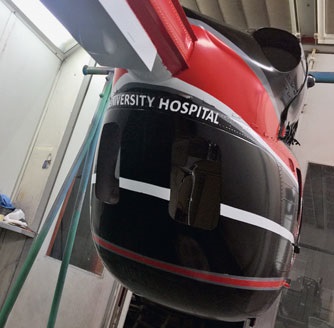
The EC-145 fuselage from Helikopter Baumann has a smooth surface. Unfortunately, no details—such as sheet metal joints, rivets, or ventilation grilles—have been added yet. For many manufacturers, this is already standard today. However, a wide range of accessories designed to match the fuselage more than makes up for this.
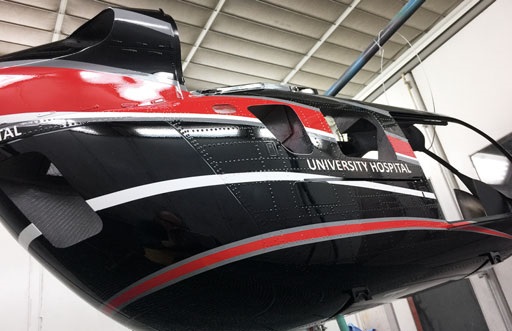
Many covers and fasteners were made using vinyl cut on a plotter. Often, these very parts from many manufacturers’ accessory lines are simply too thick and protrude far too much from the fuselage. A standard 3M film is approximately 0.15 mm thick. However, since this would be too thin in proportion, Daniel layered two pieces of film on top of each other. This created a great relief effect that closely resembles the original.
On the original, all hatches can be locked with hinged latches. To replicate this, numerous imitation latches were glued into cutouts specifically made for this purpose as decoration. ABS reinforcements were attached to the tail boom. Also not to be missed on the boom was the radar box, which Daniel also crafted himself using ABS sheets. Precisely positioned air intakes, sheet metal seams, and antennas round out the overall look. →
For the lighting, light sources from trusted manufacturers were used. Super-bright LEDs provide the model with the appropriate lighting. However, in the original U.S. version, the operator himself made modifications to the helicopter by adding additional spotlights. For example, there is a spotlight mounted at the top rear between the two turbine exhausts, which illuminates the area behind the helicopter when patients need to be loaded or unloaded. There is also a spotlight mounted on each side near the air intakes—one on the left and one on the right—which provides light for boarding and disembarking at night. However, since these spotlights must shine downward, Daniel couldn’t simply install a spotlight inside the fuselage. Using ABS sheets, he built special mounts for the spotlights, which could then be installed in the fuselage at the appropriate locations.
As a trained auto body painter, the very labor-intensive painting process was the least of Daniel’s problems when building his EC 145. After applying the fillers and primer, he first painted the fuselage white, then masked everything off, painted it red, masked everything off again, painted it gray, masked everything off once more, painted it black, removed all the tape and masking film, and finally sprayed on the clear coat. What sounds relatively simple here actually involved quite a bit of work in the evenings and at night, but the result is certainly impressive. The lettering also had to be re-plotted several times because the correct size only became apparent after it was applied to the model. However, none of the lettering was applied with adhesive; instead, it was painted using the negative method. That’s why the order in which the colors were applied also played a major role. Well, as the saying goes: “Once learned, never forgotten.”
Once the paint job was complete, assembly of all necessary components could begin. Four BLS 451 servos were installed in the mechanical system with the JetCat PHT 3 turbine, and a Futaba BLS 251 was installed at the tail. For the stabilization system, Daniel relies on the tried-and-true Bavarian Demon 3SX. The two-blade tail rotor is driven by a rigid drive; all parts, including the matching couplings, are from Vario Helicopter. The built-in bevel gearbox is from Helikopter Baumann in Belp. The scale rotor head is from SK-Rotorkopf, while the drive shaft and swashplate are from BENDA. The set of four main rotor blades, each 845 mm long, as well as the two-blade tail rotor set, each 145 mm long, are from M-Blades. Twelve LEDs provide the necessary lighting on the model, including position lights and headlights. An AURORA V2 is used to control the entire lighting system. After the required programming and setup work, nothing stood in the way of the maiden flight.
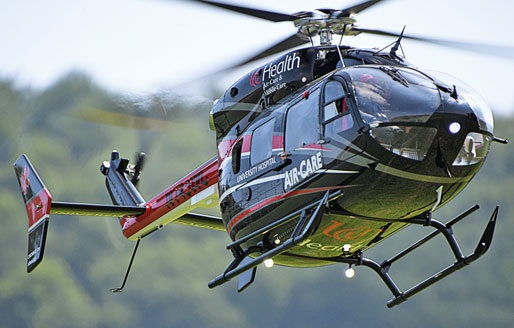
Right from the start, Daniel’s EC 145 flew exactly as he’d imagined. After a few minutes of hovering, he began the sightseeing flight. “Like it was on rails,” was his first comment after the maiden flight. Only the tail control system failed to meet his expectations and had to be modified—partly because of play in the linkage and partly because it wasn’t smooth enough. Compared to the previous work involved in building the model—which took over 300 hours and nearly two years—this was a breeze.
Unfortunately, however, as early as the third flight, there was a tail failure due to a melted cardan joint in the tail drive. The reason for this was that the 45-degree gearbox was not 100% aligned. The drive shaft was not centered in the guide tube, which put pressure on the joint; the resulting increased friction caused the plastic gimbal coupling to melt. Fixing the problem required a fair amount of work, as well as new parts. The entire drivetrain had to be painstakingly removed, overhauled, and refurbished. During the subsequent reinstallation, Daniel paid meticulous attention to the alignment of the rear-wheel drive. Since the rear failure occurred very close to the ground during takeoff, fortunately no other damage was caused to the model.
After these modifications, the model’s builder was able to make a few more flights in late fall 2017 and became increasingly familiar with his first scale model. The only major adjustment for him was the weight of just over 16 kilograms; until then, he had only flown trainer models weighing less than five kilograms.
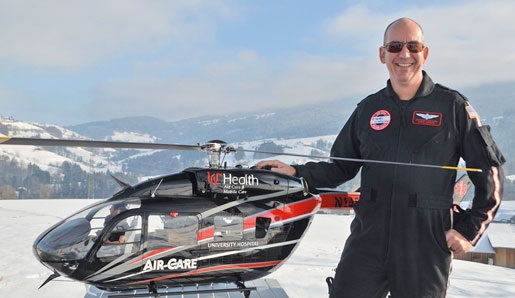
The interior fit-out was very important to Daniel, and he wanted it to match the prototype 99.9%. During his extensive online research, he came across the company FineScaleModela, which manufactures seats, pedals, and control and pitch sticks in the required design. After prompt delivery, nothing stood in the way of the interior fit-out during the winter of 2017–2018. He lined the cockpit floor with checker plate, which he secured along the edges with small scale screws (M 1.2 × 4 mm). The true-to-prototype model was built from a kit offered by Heli Baumann. Installing the pre-painted cockpit components was the easiest part of the process.
The real highlight of the cockpit is the two pilots. Special electronics—which can be activated independently of the RC system—control the pilots’ heads, arms, and feet. This allows the pilot figures to perform movements that bring the reality of the aircraft even closer to the viewer of this fantastic model.
But it became clear that he’d done everything right during his first public appearance in 2019 at the spring meet in Leuggern. The enthusiasm and recognition from the other scale pilots were the reward for three years of work in his hobby room.
From the very beginning, Daniel Zbinden was in contact with the Air Care representatives. He could request information and photos from the director at any time, and they were always provided very quickly.
Just how much the project came to mean to the ACMC team over time was evident from the fact that they simply mailed him an original pilot’s jumpsuit with a custom-made patch.
I’d like to conclude this report with the following online post from his build log: “... a quick update regarding UC Health Air Care & Mobile Care in Cincinnati:
The night before last, Air Care Director Matthew showed a video of my EC 145 at the quarterly meeting. Until then, only three people at ACMC knew that I had built their EC 145. According to the director, people were a bit puzzled because they didn’t recognize the region where the helicopter was flying, and it didn’t look like the Cincinnati area either. The mechanics were the first to realize it was a model, followed shortly afterward by the pilots, and then the nurses who fly with Air Care. Finally, they saw me in the background with the RC controller during the landing, and people laughed and cheered. The surprise was definitely a success. One of those nurses has already messaged me on Facebook, and her fiancé wants to send me photos of the real thing.”
What more could a model builder ask for!
The model is currently for sale. Anyone interested can contact the editorial office for contact information.
Photos: Sylwia Richard, Daniel Zbinden, Heinz Rolli, Anton Laube
| EC 145 | Prototype | Model |
|---|---|---|
| Crew | Pilot, emergency physician, paramedic, etc. | – |
| Max. takeoff weight | 1,340 kg | 17.3 kg |
| Engine | Two Arriel 1E2 engines, 720 PS each | JetCat PHT 3 |
| Fuel capacity | 879 liters | 2.7 liters |
| Fuselage length | 11.69 m | 1.65 meters |
| Length overall | 13.17 m (rotor spinning) | – |
| Rotor diameter | 11.0 m | 1.85 meters |
| Height | 4.00 m | 0.6 meters |
| Max. cruising speed | 268 km/h | – |
| Range | 663 km (without reserve) | – |
| Max. rate of climb | 8.4 m/sec | – |


News from HEBU

TEAM MANAGER "THIS" BOSSHARD
 Rodito Nussbaumer

YOU KNOW WHAT I MEAN? 125 YEARS OF THE SWISS AERO CLUB
 Emil Giezendanner

F3A EUROPEAN CHAMPIONSHIPS IN ST-MACAIRE, FRANCE
 Matthias Bosshard

52. 2026 ALPS CUP
Emil Giezendanner
CORSAIR F4U – A WARBIRD WITH A MEMORABLE LOOK
Jürgen Rosenberger, Jürgen Prinz
SUMMER FUN 2026 AT MG USTER
Martin Wunderli
TRY-OUT DAY AT MFV WETTINGEN
Urs Keller
BY YOUTH, FOR YOUTH
Lorena Betschen
ATOM, THE NEW DOUBLE-DECKER FROM CPLR
Matthias Bosshard
SMALL, MODEL-LIKE SAILBOATS
Res Dauwalder
What's New at Leomotion.com

HORIZON HOBBY/LEMACO NEWS: MICRO OV-10 BRONCO 645 MM BY E-FLITE

COUPE DES ALPES – OBSERVE AND LEARN
Rodito Nussbaumer
TWIN TOWN PARTNERSHIP
Wolfgang Voeller
PRIDE AND GOOD IDEAS
 Markus Nussbaumer

EURO CONTEST GLIDER ACRO TOUR AUSTRIA 2026

INSIGHTS INTO THE HISTORY OF SEAPLANES

34th HAHNENMOOS ALPINE MODEL AIRPLANE CAMP
Res Dauwalder
WELCOME, NEW MEMBER!
Andrea Bolliger
FREE FLIGHT IN THE MIDDLE OF SUMMER
Urs Muntwyler
THE PC-21 STORY
Emil Giezendanner
NEWS FROM HEBU
 Julia Bucher

FROM 0 TO 100
Markus Nussbaumer
MEMORIES
Wolfgang Völler
NOS REGION – A HUB FOR ELECTRIC AVIATION
Emil Giezendanner
Have you almost forgotten about aircraft that take off and land vertically?
Emil Giezendanner
DO YOU KNOW WHAT I MEAN IN THE LAND OF SMILES?
Emil Giezendanner