
Extraordinary Airplanes
Otto Widlroither and Hans Kolm are regulars at the Hausen Air Show. That alone wouldn’t be reason enough to mention them in this report. However, last year, unlike the Turner W4X Bee Gee—which had flown there before and was listed in the program—Otto brought along a very special racing airplane.
The original had tragically crashed two weeks earlier in Reno (USA) during a National Air Race. Nine people, including the well-known pilot Jimmy Leeward, lost their lives in the accident. The history of the original and that of the model share several striking similarities. Originally built as a classic Mustang P51,
both aircraft were eventually placed in a storage hangar after a long period of active service, to be stored for an uncertain future.
At some point, the respective owners decided to convert the mothballed aircraft into a purebred racing plane. To do this, the tips of both wings were trimmed by a total of about 10% of the original wingspan; however, this reduction had to be slightly less on the model than on the original. This was done to maintain the necessary flight characteristics. As a further measure to significantly reduce drag, the distinctive oil cooler under the fuselage was completely removed, and the fully enclosed cockpit canopy was substantially
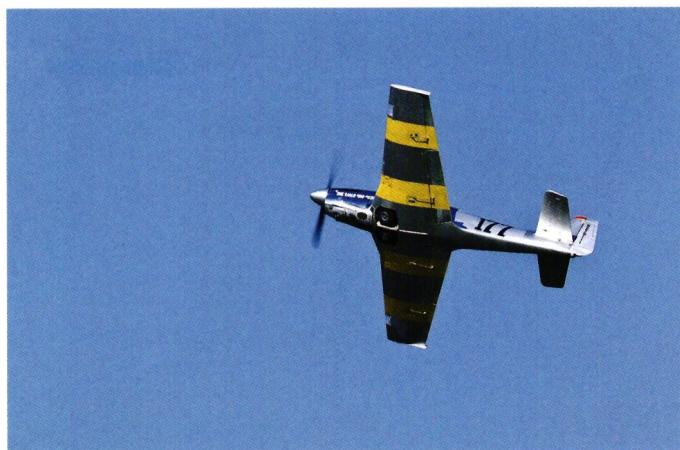
scaled down. In the prototype, the engine power was also doubled from a robust 2,000 to an extreme 4,000 PS, resulting in a significant increase in the already high flight speed.
The model was also upgraded in a similar manner. Instead of the adequate 90-cc engine, it was now equipped with a very powerful 3-cylinder inline engine with a displacement of 200 cc and
a robust 16 PS of power. Thus, two new race planes were born, both pursuing a very similar goal: to offer spectators a truly spectacular show. Jimmy Leeward went on to win the famous Silver Race in Minden, Nevada, in 2010. His Mustang reached speeds of around 800 km/h there. The model also experienced a massive increase in maximum
Airspeed. During a test in August 2011, it reached 255 km/h, which is a very high speed for a propeller-driven aircraft.
But that’s not all. The engine, developed and manufactured by Hans Kolm Engines, has yet another extraordinary feature. To capture the audience’s full attention during an air show
, the model emits a robust engine sound that is strikingly similar to that of the original. This sound is produced by the three open, trumpet-shaped exhaust pipes on the engine block. A muffler was deliberately omitted. According to Otto, one could still be installed—even though the engine already utilizes the space designated for it down to the very last
millimeter. However, doing so would reduce the high sound level—which is expressly desired in this case—and unnecessarily dampen the very distinctive sound, much to the regret of some spectators.
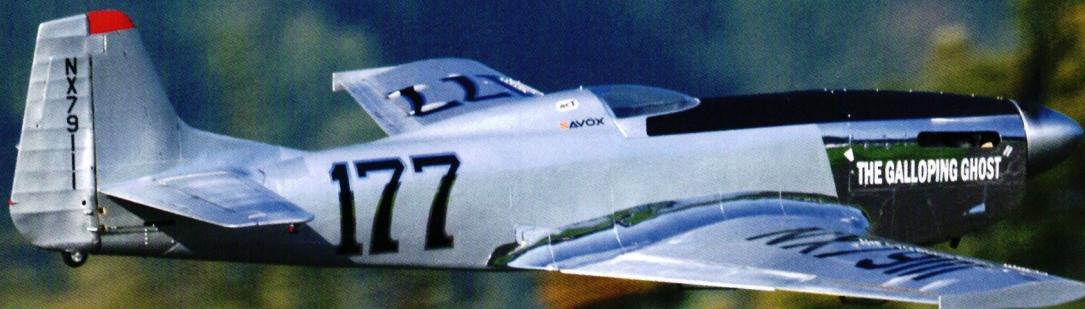
The model itself is built fairly true to the original at a scale of 1:4.5. A few minor compromises had to be made regarding the length of the wings, the air intake in the engine cowl,
, and other minor details. In return, the fuselage—which is highly reflective in sunlight—was faithfully reproduced using a very durable film typically used in vehicle graphics. This film is a distinctive hallmark of Otto’s racing airplanes. With its high reflectivity, it has driven more than a few photographers to despair.
According to the owner, the model is fairly easy to fly. However, it tends to land at a relatively high speed. When doing so, you must pay very close attention to deploying the two-leg landing gear at the same time. Otherwise, there is a risk of the aircraft veering off to the side. At a typical air show, the engine runs at full throttle for nearly six minutes. This includes during a nosedive following a loop. Sometimes, at this moment, Otto intentionally reduces the throttle very abruptly while simultaneously flying a 90° turn away from the spectators. This adds an extra element of surprise to the already highly entertaining performance. However, this maneuver has nothing to do with a suspected engine malfunction. It simply creates a bit more excitement among the spectators and perhaps also sparks a little imagination for the bar-table conversations that follow later. Low, fast flybys are also part of the show. For this purpose, two 30-watt halogen bulbs each—purchased from a hardware store—are installed in the wings. They shine very brightly and are clearly visible even in strong backlighting. In difficult visibility conditions, they make it easier to determine the aircraft’s position and also serve as landing lights in low-light conditions. After the real Mustang takes off—
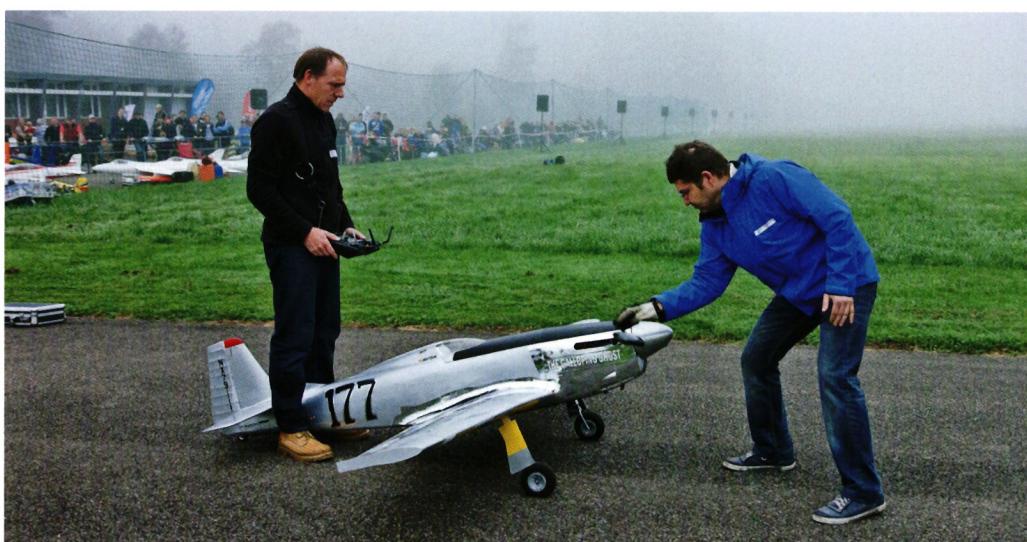
Although the original no longer exists due to the tragic crash in Reno, its form and spirit now live on in this beautiful model. And, in the interest of the many enthusiastic spectators, we can only hope that this model will not
quickly meet the same fate as its prototype, so that it can continue to be admired at many more national and international air shows.
Text and photo:
Hermann Mettler
| Wingspan: | 2.35 m; weight 21.5 kg |
| Powerplant/Engine: | Kolm Engines IL 200 inline engine, 3 cylinders / 4-stroke with 200 ccm displacement; 16 PS power; electronic ignition driving a 2-blade propeller 34 × 14" |
| Engine cooling: | Air intake beneath the spinner with cross-ventilation through the engine block |
The conversion of the existing model took approximately 300 hours last winter. It was completed in March 2011. The engine is currently still a prototype. However, it is scheduled to go into series production soon.


TEAM MANAGER "THIS" BOSSHARD
 Rodito Nussbaumer

ATOM, THE NEW DOUBLE-DECKER FROM CPLR
 Matthias Bosshard

INSIGHTS INTO THE HISTORY OF SEAPLANES

34th HAHNENMOOS ALPINE MODEL AIRPLANE CAMP
Res Dauwalder
CORSAIR F4U – A WARBIRD WITH A MEMORABLE LOOK
Jürgen Rosenberger, Jürgen Prinz
SUMMER FUN 2026 AT MG USTER
Martin Wunderli
F3A EUROPEAN CHAMPIONSHIPS IN ST-MACAIRE, FRANCE
Matthias Bosshard
What's New at Leomotion.com

HORIZON HOBBY/LEMACO NEWS: MICRO OV-10 BRONCO 645 MM BY E-FLITE

PRIDE AND GOOD IDEAS
 Markus Nussbaumer

News from HEBU

YOU KNOW WHAT I MEAN? 125 YEARS OF THE SWISS AERO CLUB
 Emil Giezendanner

SMALL, MODEL-LIKE SAILBOATS
Res Dauwalder
TRY-OUT DAY AT MFV WETTINGEN
Urs Keller
52. 2026 ALPS CUP
Emil Giezendanner
THE PC-21 STORY
Emil Giezendanner
TWIN TOWN PARTNERSHIP
Wolfgang Voeller
EURO CONTEST GLIDER ACRO TOUR AUSTRIA 2026

BY YOUTH, FOR YOUTH
Lorena Betschen
WELCOME, NEW MEMBER!
Andrea Bolliger
FREE FLIGHT IN THE MIDDLE OF SUMMER
Urs Muntwyler
COUPE DES ALPES – OBSERVE AND LEARN
Rodito Nussbaumer
NEWS FROM HEBU
 Julia Bucher

FROM 0 TO 100
Markus Nussbaumer
NOS REGION – A HUB FOR ELECTRIC AVIATION
Emil Giezendanner
MEMORIES
Wolfgang Völler
Have you almost forgotten about aircraft that take off and land vertically?
Emil Giezendanner
70 YEARS OF THE NIDWALDEN MODEL AIRPLANE CLUB
Martin Barmettler