
The Silent Revolution — RC Electric Flight
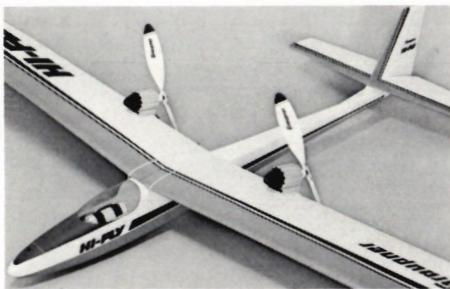
Ever since the impressive demonstration of a remote-controlled electric model aircraft (an electric-powered motor glider) at the 1971 RC World Championships in the U.S., this fascinating topic has never completely faded from view here either. The RC electric model the RC electric model on display was a twin-motor design. Fred Militky, who has been involved in electric flight for many years, has ushered in a highly interesting new era with the design of this RC electric model—not very spectacular; quite modestly and quietly, so to speak. This promising shift is already being called the “Silent Revolution,” and I am convinced that electric flight offers the model aviation movement a real chance of survival well into the distant future.
As early as 1962, the free-flight electric glider designed by Militky was built by numerous model aircraft enthusiasts eager to experiment. The model was called SILENTIUS and was equipped with a Micromax electric motor. The gear ratio was 1:3, which allowed the motor to operate at its high RPM with maximum efficiency. The motor was mounted in the nose of the model and drove a folding propeller—designed to reduce drag during gliding flight, on the one hand, and to prevent propeller breakage upon landing, on the other. The SILENTIUS had outstanding flight characteristics. Many who chose not to activate the fuse-operated engine shut-off device for the maiden flight were in for a nasty surprise when the model vanished forever from their astonished eyes during a rapid climb.
Back then, however, carrying an RC system on board was out of the question. The engine power and battery capacity were too low, and the commercially available RC systems were too heavy. That is probably why, unfortunately, electric propulsion has since fallen into obscurity almost everywhere. Yet electric flight could have become a highly interesting free-flight category—perhaps linked to related categories such as F1B (GM), F1C (VM), or F1D (indoor flight). In any case, the EM (electric motor flight) category would have deserved at least as much attention as the VM National category, which never really took off, and the officials in charge at the time would have done more than just pay lip service to the noise problem—they would have actually taken effective action. Well, you should never expect too much from others—it’s always better to tackle the problem yourself.
The surprise was all the greater, then, when Militky demonstrated his remote-controlled electric model in 1971, showcasing truly astonishing performance and features. This time, the two motors were mounted on the wing and powered propellers designed for positive-pressure flight. While the SILENTIUS still had a wingspan of about 70 cm, the wingspan of the RC model has been increased to over 200 cm.
It didn’t take long for other designs to follow. Barely a year later, an American made a name for himself with his remote-controlled electric Fournier. The motor and battery pack (Powerpack) he used are now available for sale, including the propeller. While Militky achieves the required performance with lower RPMs and larger propellers, it appears that the American prefers high RPMs and small propellers, which almost certainly spares him the need for elaborate propeller braking devices or folding propellers. A few days ago, the improved version of the Militky model was unveiled to the public as a kit at the GRAUPNER booth in Nuremberg. However, the entire kit is expected to cost nearly 900 francs. This, however, should not prevent interested model builders from conducting their own further experiments, and it is likely that a wide range of possibilities will open up here. Here as well, various model aviators are currently working on electric flight, and it would be interesting to continue reporting on their experiences.


TEAM MANAGER "THIS" BOSSHARD
 Rodito Nussbaumer

YOU KNOW WHAT I MEAN? 125 YEARS OF THE SWISS AERO CLUB
 Emil Giezendanner

F3A EUROPEAN CHAMPIONSHIPS IN ST-MACAIRE, FRANCE
 Matthias Bosshard

News from HEBU

SUMMER FUN 2026 AT MG USTER
Martin Wunderli
TRY-OUT DAY AT MFV WETTINGEN
Urs Keller
52. 2026 ALPS CUP
Emil Giezendanner
BY YOUTH, FOR YOUTH
Lorena Betschen
ATOM, THE NEW DOUBLE-DECKER FROM CPLR
Matthias Bosshard
CORSAIR F4U – A WARBIRD WITH A MEMORABLE LOOK
Jürgen Rosenberger, Jürgen Prinz
SMALL, MODEL-LIKE SAILBOATS
Res Dauwalder
What's New at Leomotion.com

TWIN TOWN PARTNERSHIP
Wolfgang Voeller
EURO CONTEST GLIDER ACRO TOUR AUSTRIA 2026

INSIGHTS INTO THE HISTORY OF SEAPLANES

34th HAHNENMOOS ALPINE MODEL AIRPLANE CAMP
Res Dauwalder
HORIZON HOBBY/LEMACO NEWS: MICRO OV-10 BRONCO 645 MM BY E-FLITE

COUPE DES ALPES – OBSERVE AND LEARN
Rodito Nussbaumer
PRIDE AND GOOD IDEAS
 Markus Nussbaumer

FREE FLIGHT IN THE MIDDLE OF SUMMER
Urs Muntwyler
THE PC-21 STORY
Emil Giezendanner
WELCOME, NEW MEMBER!
Andrea Bolliger
NEWS FROM HEBU
 Julia Bucher

FROM 0 TO 100
Markus Nussbaumer
MEMORIES
Wolfgang Völler
NOS REGION – A HUB FOR ELECTRIC AVIATION
Emil Giezendanner
Have you almost forgotten about aircraft that take off and land vertically?
Emil Giezendanner
70 YEARS OF THE NIDWALDEN MODEL AIRPLANE CLUB
Martin Barmettler