
Pilatus Model Meetup
Exactly 10 years ago, the Pilatus PC-7 prototype took to the skies for the first time.
The fact that we in the Münchenbuchsee Model Flying Club enjoy flying model aircraft together certainly connects us with most other model flying clubs. However, the fact that our shared experience begins right in the workshop can probably be described as something of a special case. Without our shared model-building activities, this report would not have been possible.
There was quite a bit of skepticism among my friends and family as to whether a model with a 1.6-meter wingspan, powered by an electric motor and drawing its energy solely from a 3S LiPo battery, would fly at all. But it worked: After 10 years and well over 500 flights, the model still flies flawlessly.
The target weight—as much as possible below 3 kg—could only be achieved thanks to a new construction method that as many model builders as possible could implement, since a building course was planned from the very beginning.
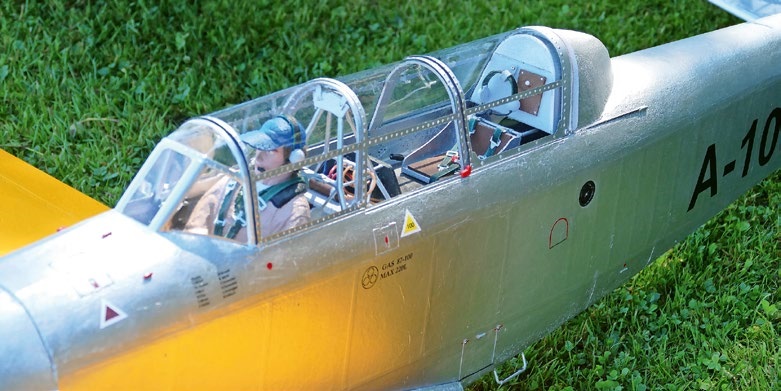
The solution was as follows: A wooden frame absorbs as many forces as possible (Figure 2), while the rest is made of EPP, reinforced with round and flat CFRP rods (Figure 3). Areas requiring a more complex shape were sanded from Styrofoam (Figure 4). Weight was saved wherever possible; this also applied, for example, to the pilots: A store-bought figure weighed a hefty 70 g—our self-molded foam version weighed only 12 g (Figure 5); for two pilots, this resulted in a weight savings of a whopping 120 g. Tests on sample pieces and online research showed that EPP can also be sanded: Use coarse-grit sandpaper (approx. 100 grit) with light (!) pressure and then seal the pores with an iron and parchment paper (Figure 6)—it works, and with a little practice, it gets even better! The surface was very sparingly coated with a mixture of epoxy resin and microballoons; this process strengthens the surface and increases torsional stiffness—which is especially important for the wings and tail surfaces.
Following the successful maiden flight of the PC-7 and the planning of the scheduled model-building course, the idea arose that we could also build a Pilatus P-3; after all, the
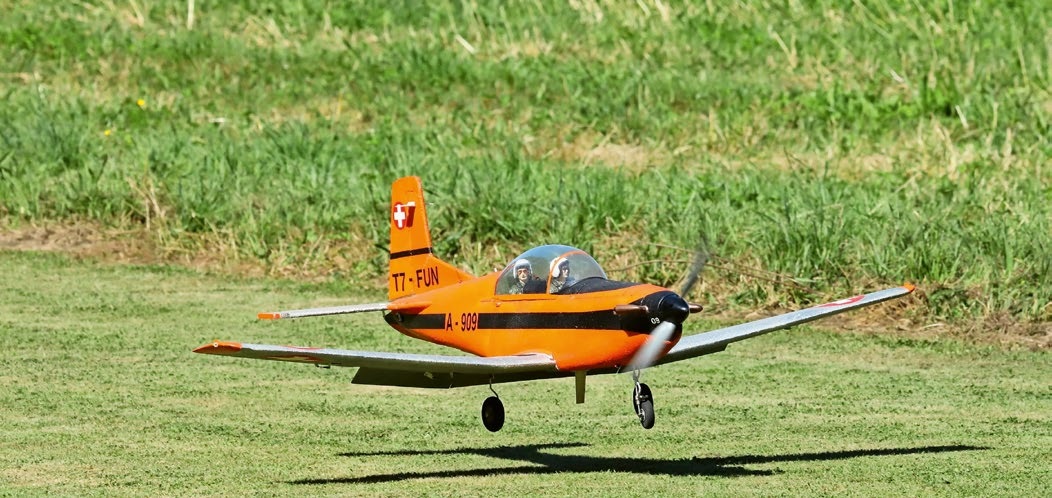
The first PC-7 was also derived from a P-3—so the reverse should work as well. And so, while preparing for the course, a P-3 was built (Figure 7).
The consequences of this design approach: The model is light, not very fast, and has a rough surface; for many model airplane enthusiasts, these are primarily negative aspects.
However, we view these points positively for the following reasons:
- 1) The low weight ensures flight characteristics similar to the real thing despite the model’s modest size—after all, the original isn’t a rocket either. The models still fly well even in moderate winds.
- 2) The light weight and rough surface ensure forgiving flight characteristics; the pool of model pilots capable of flying the PC-7 or even the P-3 becomes significantly larger; as a result, there’s a good chance that multiple models will be at the airfield at any given time, making formation flights possible.
- 3) The rough surface and the resulting air resistance ensure that the model can be held quite well in the desired position during formation flying; the model isn’t too dynamic in flight and doesn’t shoot past fellow pilots’ models after catching up. In addition, the docile flight behavior is likely due to the special surface and the low wing loading.
The model-building course in the winter of 2015/16 was a huge success: Over 35 models of the two types, the P-3 and PC-7, were started—I reported on this eight years ago.
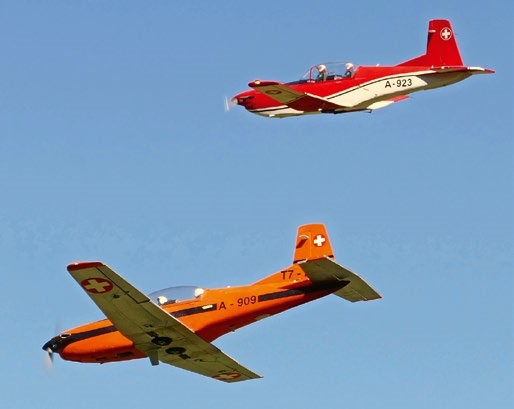
So what has become of them? Over 30 models were completed and fly more or less regularly; in any case, PC-7 and P-3 models regularly ensure varied and colorful flight operations at our airfield. The desire to capture and enjoy beautiful formation photos has repeatedly worked out in various formations (Photos 8a and b) and has sometimes even led to more daring maneuvers (Photo 9). To capture beautiful formation shots, the models must fly quite close to one another—which isn’t always a given with self-built model airplanes.
Four years later, the construction of the Pilatus P-2 closed an important gap (Figure 10); the model was constructed similarly in many respects and therefore has comparable flight characteristics—the first successful formation flights soon followed and are proof of the balanced flight characteristics of this aircraft type as well.
In the meantime, we can recreate a part of Swiss aviation history using models on a similar scale: the P-2 at the forefront, followed by the P-3, the PC-7, and the PC-7NG (Figure 11), do indeed represent an important part of trainer aircraft history—who knows, maybe there’s more to come...?!?
The fact that model building with foam yields such beautiful results is demonstrated by Thomas’s cockpit interior for the Pilatus P-2 (Figure 12); even in this type of model building, ever finer details can be incorporated, right down to imitating rivets or sheet metal seams; the various model builders have inspired one another to create increasingly diverse detailed solutions. It’s all the more surprising that, despite numerous beautiful flights and self-built and
When discussing our foam-construction models, people often bring it up with a negative undertone, even though most model airplane enthusiasts have an ARF foam model stored in their hangar...! You don’t have to understand everything…! One question also comes up time and again: Why only a 3S or 4S power system? Here, too, the key consideration was that as many club members as possible could actually afford these models, thereby enabling them to participate in the courses and enjoy flying them. I’m
am also impressed by the skill of many model builders and model pilots when they demonstrate their great technical marvels. However, for most model flyers, these models are beyond their reach—both financially and in terms of mastering the technology or even the flying skills required. While perfect model building may earn us the admiration of observers of our hobby, it hardly attracts new model flying colleagues—and, as we all know, we really need them.
Our Pilatus model gathering on August 10 at our little airfield showed that model building and flying can be fun even on a modest scale, and that we can enjoy our flights together—that’s how it should be (Photo 13). Thanks to our shared hobby of model building, we were able to treat ourselves to a wonderful in-house model flying day! Great—that calls for a sequel to this story—let’s see what happens next...!


TEAM MANAGER "THIS" BOSSHARD
 Rodito Nussbaumer

52. 2026 ALPS CUP
 Emil Giezendanner

ATOM, THE NEW DOUBLE-DECKER FROM CPLR
 Matthias Bosshard

INSIGHTS INTO THE HISTORY OF SEAPLANES

34th HAHNENMOOS ALPINE MODEL AIRPLANE CAMP
Res Dauwalder
CORSAIR F4U – A WARBIRD WITH A MEMORABLE LOOK
Jürgen Rosenberger, Jürgen Prinz
SUMMER FUN 2026 AT MG USTER
Martin Wunderli
F3A EUROPEAN CHAMPIONSHIPS IN ST-MACAIRE, FRANCE
Matthias Bosshard
What's New at Leomotion.com

HORIZON HOBBY/LEMACO NEWS: MICRO OV-10 BRONCO 645 MM BY E-FLITE

PRIDE AND GOOD IDEAS
 Markus Nussbaumer

News from HEBU

BY YOUTH, FOR YOUTH
Lorena Betschen
YOU KNOW WHAT I MEAN? 125 YEARS OF THE SWISS AERO CLUB
Emil Giezendanner
SMALL, MODEL-LIKE SAILBOATS
Res Dauwalder
TRY-OUT DAY AT MFV WETTINGEN
Urs Keller
FREE FLIGHT IN THE MIDDLE OF SUMMER
Urs Muntwyler
THE PC-21 STORY
Emil Giezendanner
TWIN TOWN PARTNERSHIP
Wolfgang Voeller
EURO CONTEST GLIDER ACRO TOUR AUSTRIA 2026

WELCOME, NEW MEMBER!
Andrea Bolliger
COUPE DES ALPES – OBSERVE AND LEARN
Rodito Nussbaumer
NEWS FROM HEBU
 Julia Bucher

FROM 0 TO 100
Markus Nussbaumer
NOS REGION – A HUB FOR ELECTRIC AVIATION
Emil Giezendanner
MEMORIES
Wolfgang Völler
Have you almost forgotten about aircraft that take off and land vertically?
Emil Giezendanner
70 YEARS OF THE NIDWALDEN MODEL AIRPLANE CLUB
Martin Barmettler