
Problems with Self-Adhesive Labels
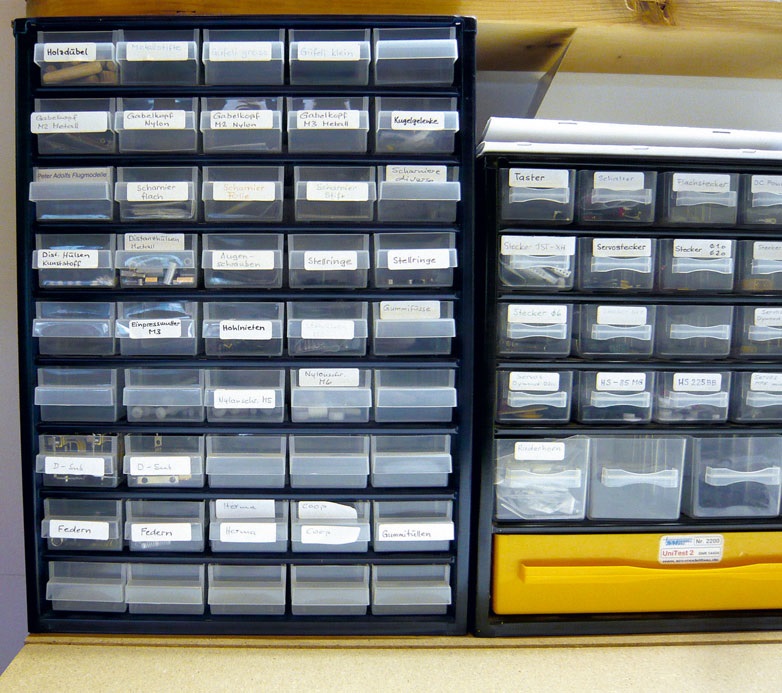
"People who keep things organized are just too lazy to look for things"—so goes an old saying. I love organization, which is why I labeled the drawers of my small-parts storage bins with self-adhesive labels: rowlocks, hinges, clevises, ball joints, M3x10 screws, etc. But it’s all for nothing if the labels gradually fall off after a few months.
About three years ago, when I was standing in front of the large selection of Herma labels at “Heim & Hobby Heimberg” and searching in vain for the 13×40 mm size I’d been using, the saleswoman explained to me: “Well, you know—ever since Coop bought the company, the products are being phased out one by one and replaced with private-label brands.” Not suspecting anything was wrong, I just went ahead and bought the
13×40 mm self-adhesive labels from the Qualité & Prix brand, which read: “Fabriqué en Suisse.”
In the spring of 2019, I noticed in the workshop that labels were starting to peel off, and I soon suspected it might be the Qualité & Prix labels. A parallel test conducted with both brands twelve months later confirmed this: The Herma label is difficult to remove, while the Coop label falls off at the slightest touch. (Testing other labels by touching them immediately led to disaster!)
Hypothesis 1: A marketing strategist with no knowledge of adhesives finds the Herma labels in the Coop lineup too expensive and launches a private label—with 320 labels instead of 112, and at a much lower price. Made in Switzerland—customers will be delighted!
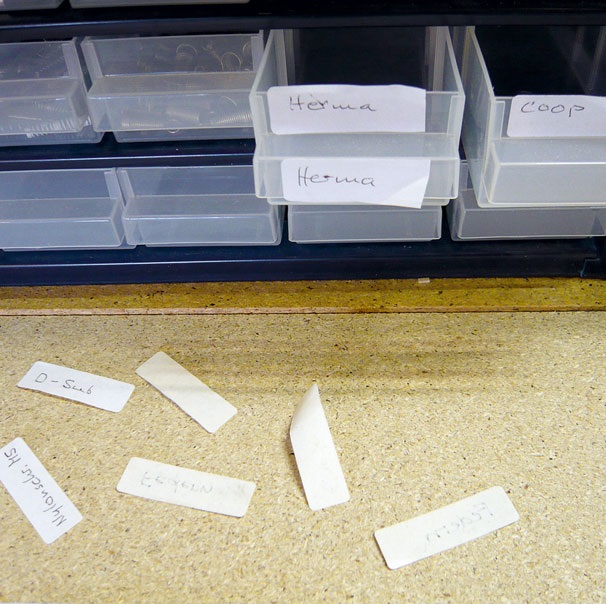
(Note: The “Swiss made” label may be used if at least 60% of the manufacturing costs are incurred in Switzerland—see the Trademark Protection Act (MSchG) of 2019. This might even be possible with a cheap, adhesive-coated paper roll from China.)
When I stopped by the store mentioned above about three months ago, just out of curiosity, to look for self-adhesive labels, my suspicion was confirmed: The selection had been reduced to just two label sizes!
Hypothesis 2: Based on sales figures, the person in charge of the product line has since determined that customers are no longer buying labels and has decided to streamline the product line due to lack of demand.
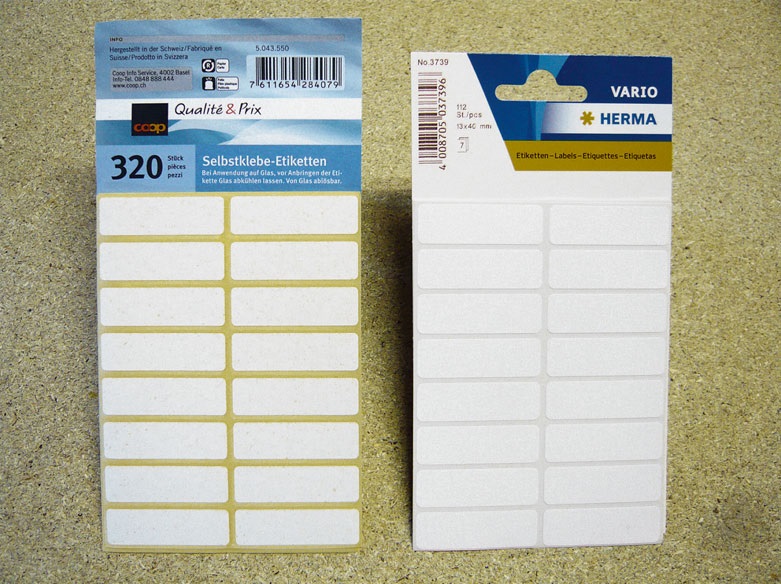
It actually makes sense: If you sell three times as many labels in a pack, customers will come back three times less often to buy more—unless you know that the labels fall off and need to be replaced more frequently. But then again, maybe customers won’t come back at all.
Conclusion: With its private label, Coop has successfully eliminated itself from the label market.
“The end.” In any case, my small-parts drawer is labeled again today—with labels from Herma GmbH in Filderstadt. Made in Germany—quality built in, not just on the package insert.


News from HEBU

HORIZON HOBBY/LEMACO NEWS: MICRO OV-10 BRONCO 645 MM BY E-FLITE

PRIDE AND GOOD IDEAS
 Markus Nussbaumer

TEAM MANAGER "THIS" BOSSHARD
 Rodito Nussbaumer

YOU KNOW WHAT I MEAN? 125 YEARS OF THE SWISS AERO CLUB
 Emil Giezendanner

F3A EUROPEAN CHAMPIONSHIPS IN ST-MACAIRE, FRANCE
 Matthias Bosshard

ATOM, THE NEW DOUBLE-DECKER FROM CPLR
Matthias Bosshard
SUMMER FUN 2026 AT MG USTER
Martin Wunderli
What's New at Leomotion.com

52. 2026 ALPS CUP
Emil Giezendanner
TWIN TOWN PARTNERSHIP
Wolfgang Voeller
34th HAHNENMOOS ALPINE MODEL AIRPLANE CAMP
Res Dauwalder
CORSAIR F4U – A WARBIRD WITH A MEMORABLE LOOK
Jürgen Rosenberger, Jürgen Prinz
SMALL, MODEL-LIKE SAILBOATS
Res Dauwalder
TRY-OUT DAY AT MFV WETTINGEN
Urs Keller
WELCOME, NEW MEMBER!
Andrea Bolliger
FREE FLIGHT IN THE MIDDLE OF SUMMER
Urs Muntwyler
COUPE DES ALPES – OBSERVE AND LEARN
Rodito Nussbaumer
EURO CONTEST GLIDER ACRO TOUR AUSTRIA 2026

BY YOUTH, FOR YOUTH
Lorena Betschen
INSIGHTS INTO THE HISTORY OF SEAPLANES

THE PC-21 STORY
Emil Giezendanner
NEWS FROM HEBU
 Julia Bucher

FROM 0 TO 100
Markus Nussbaumer
MEMORIES
Wolfgang Völler
NOS REGION – A HUB FOR ELECTRIC AVIATION
Emil Giezendanner
DO YOU KNOW WHAT I MEAN IN THE LAND OF SMILES?
Emil Giezendanner
Have you almost forgotten about aircraft that take off and land vertically?
Emil Giezendanner