
Model airplane enthusiasts as test pilots
Design engineers at Pilatus in Stans are currently working—among other major projects—to develop a twin-engine business and passenger aircraft that is intended to stand out above all for its exceptional fuel efficiency (two engines, each rated at only 150 PS).
For various reasons—such as an unobstructed field of view, a simple solution for engine placement from a structural standpoint, improved efficiency of the pressurized propellers, a simplified airframe design (since the wings are located at the rear), etc.—the aircraft was designed as a “duck.” The entire design offers some interesting new aspects in light aircraft construction, and it is to be hoped that Pilatus Works will one day be able to bring this fascinating project to fruition, despite cost-cutting and rationalization measures in what is practically Switzerland’s last remaining aircraft industry.
However, since quite a bit of water is likely to flow from the Engelberger Aa into Lake Lucerne between the first sketches on the drawing board and the test flight, the team at the design office has decided to study the flight characteristics using a scaled-down, radio-controlled model, which is apparently much cheaper than wind tunnel tests. Working mainly in their spare time, the Pilatus idealists built a flight-worthy model out of balsa and plywood, equipped with a Graupner Varioprop. Two 10-cc OS engines.
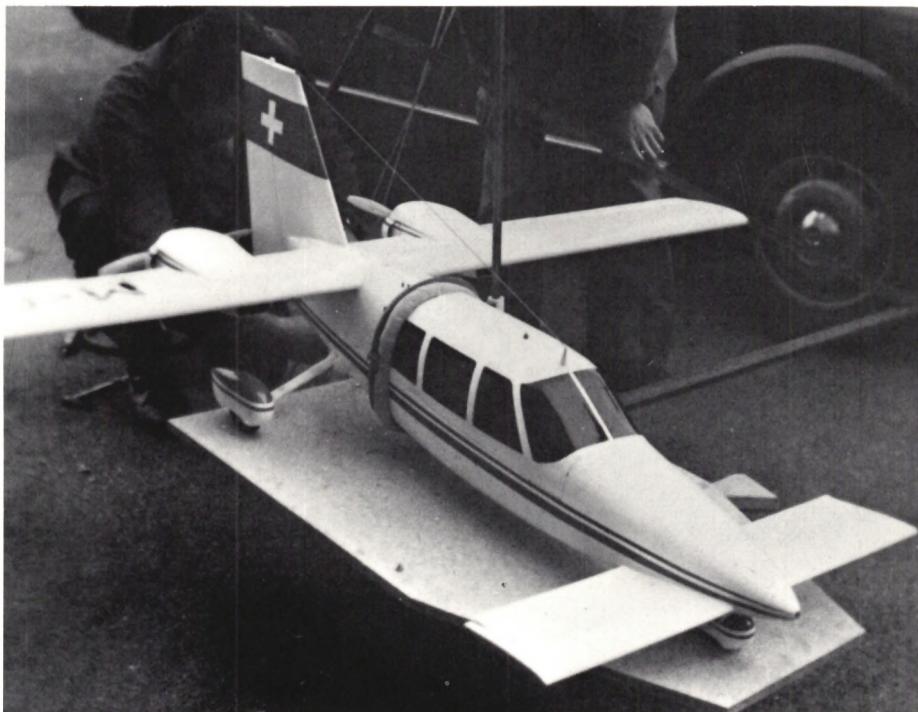
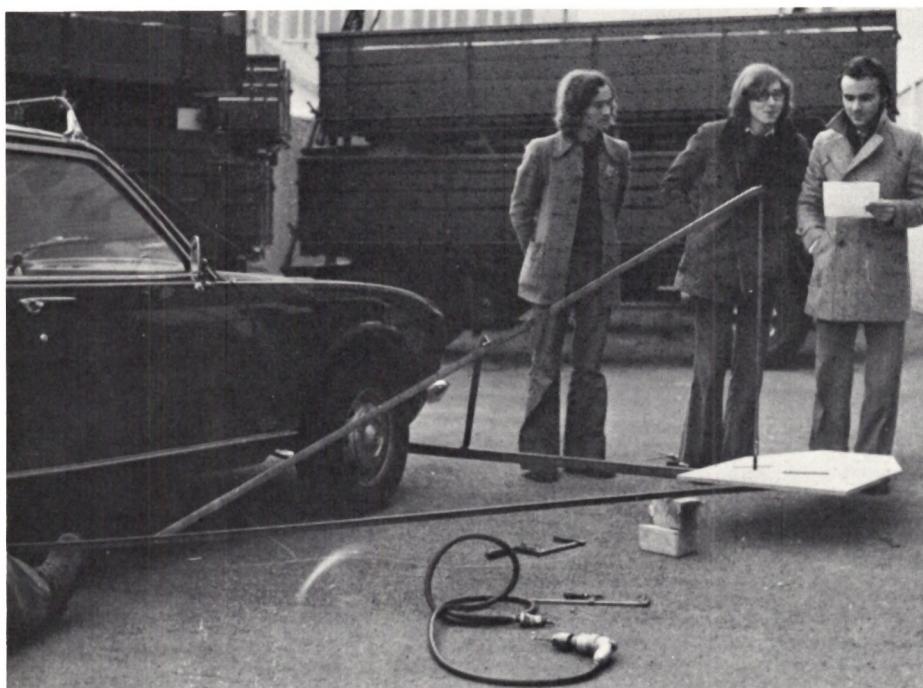
However, before venturing into the air with the precious model, tethered tests were intended to provide insights into, for example, the takeoff speed and other behavioral characteristics. A frame with a platform attached to a car secured the model so that it could move freely up to a height of about one meter. It could rotate freely around the vertical axis and, depending on its speed, assume the correct angle of attack.
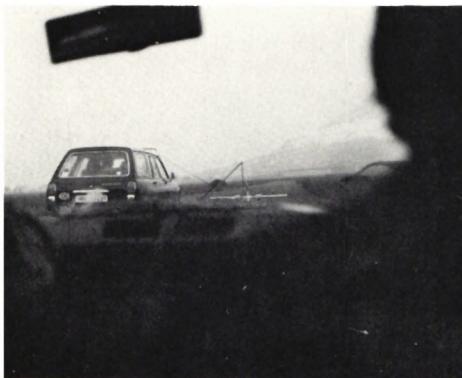
Bruno Giezendanner, an experienced RC pilot, was brought in to conduct the first “tethered flight” tests. The occupants of the test car and a second accompanying vehicle were able to observe the model up close. In addition, these tests were recorded in their entirety on film and later studied in great detail. However, even the first tethered test did not succeed right away. Since the platform’s mounting was too “loose,” it tilted forward due to the airflow. As a result, the model also took on a strong forward tilt. Anyone who frequently practices ground launches with RC models knows that forward-tilted models “stick” to the ground for a very long time and then suddenly lift off almost instantly at high speed. That is exactly what happened to the Pilatus model during the first test. Suddenly, the plane “shot” upward, hit the ground hard, broke free from its mount, and flipped over. It goes without saying that some damage was caused, considering the accident occurred at over 80 km/h. Well, even those people couldn’t escape the fate of the model airplane—namely, countless hours of repairs. They learned their lesson, reinforced the platform, and repeated the whole process a few weeks later, this time with better results.
At last, the time had come to attempt the first test flights. Bruno traveled to Stans once again. After a few problems with the two engines, everyone’s attention turned to the takeoff phase. After a takeoff run of about 120 meters, the duck-shaped model lifted off the runway. The two
The 10-cc engines gave the model quite a high speed, even in level flight. However, it should be noted that the model’s wing loading was exactly double what is permitted by the model aircraft regulations, namely $150 \text{ g/dm}^2$. Nevertheless, the model handled quite well, at least when both engines were running in sync. When one engine was throttled back, flying seemed rather tricky, which would certainly be less of an issue with a lower wing loading. Nevertheless, the duck model could be pitched up relatively steeply during the approach to glide in at high speed. Unfortunately, the tests came to an abrupt end when the model experienced a momentary loss of control during a turn and crashed violently onto the runway.
It’s possible that the Pilatus team will now build a second, larger, and—above all—lighter model to gain a realistic picture during further test flights. Above all, however, we can only hope that the company’s executive board gives the green light for this interesting project to move forward.
gz.
The model is maneuverable; it can take off, land, hover, etc.


TEAM MANAGER "THIS" BOSSHARD
 Rodito Nussbaumer

F3A EUROPEAN CHAMPIONSHIPS IN ST-MACAIRE, FRANCE
 Matthias Bosshard

News from HEBU

YOU KNOW WHAT I MEAN? 125 YEARS OF THE SWISS AERO CLUB
 Emil Giezendanner

SUMMER FUN 2026 AT MG USTER
Martin Wunderli
TRY-OUT DAY AT MFV WETTINGEN
Urs Keller
52. 2026 ALPS CUP
Emil Giezendanner
BY YOUTH, FOR YOUTH
Lorena Betschen
ATOM, THE NEW DOUBLE-DECKER FROM CPLR
Matthias Bosshard
CORSAIR F4U – A WARBIRD WITH A MEMORABLE LOOK
Jürgen Rosenberger, Jürgen Prinz
SMALL, MODEL-LIKE SAILBOATS
Res Dauwalder
What's New at Leomotion.com

TWIN TOWN PARTNERSHIP
Wolfgang Voeller
EURO CONTEST GLIDER ACRO TOUR AUSTRIA 2026

INSIGHTS INTO THE HISTORY OF SEAPLANES

34th HAHNENMOOS ALPINE MODEL AIRPLANE CAMP
Res Dauwalder
HORIZON HOBBY/LEMACO NEWS: MICRO OV-10 BRONCO 645 MM BY E-FLITE

COUPE DES ALPES – OBSERVE AND LEARN
Rodito Nussbaumer
PRIDE AND GOOD IDEAS
 Markus Nussbaumer

FREE FLIGHT IN THE MIDDLE OF SUMMER
Urs Muntwyler
THE PC-21 STORY
Emil Giezendanner
WELCOME, NEW MEMBER!
Andrea Bolliger
NEWS FROM HEBU
 Julia Bucher

FROM 0 TO 100
Markus Nussbaumer
MEMORIES
Wolfgang Völler
NOS REGION – A HUB FOR ELECTRIC AVIATION
Emil Giezendanner
Have you almost forgotten about aircraft that take off and land vertically?
Emil Giezendanner
70 YEARS OF THE NIDWALDEN MODEL AIRPLANE CLUB
Martin Barmettler