
Polar curves for a Quabeck flap profile
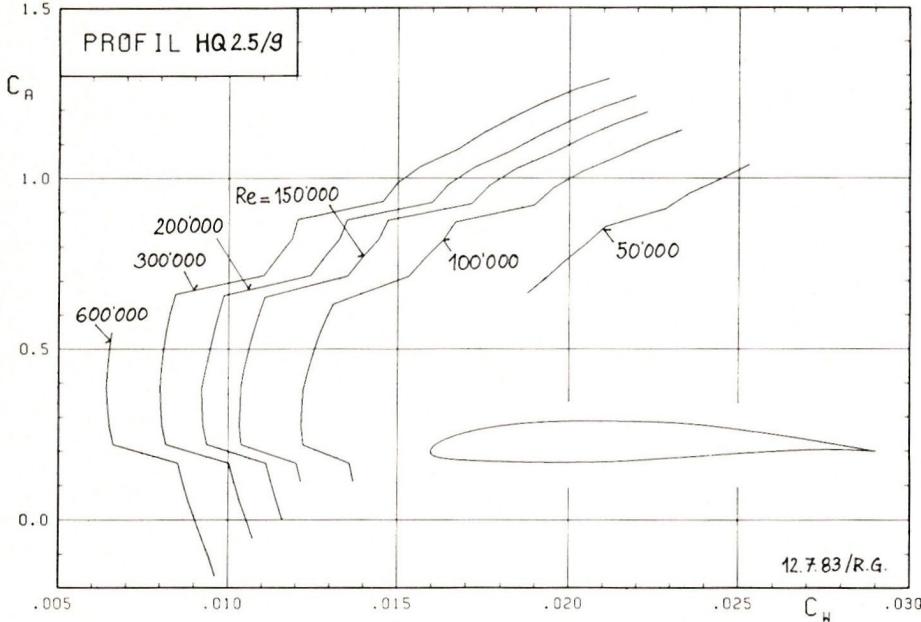
Figure 1 Theoretical polars of the HQ 2.5/9 profile
H. Quabeck has developed a special family of camber flap profiles for RC gliders [1]. Calculated profile polars have recently become available for two of these profiles, the HQ 2.5/8 and the HQ 2.5/9 [2]. Unfortunately, these polars apply only to the base profile with the flap in the neutral position. To obtain data on the theoretical behavior of one of these profiles with the flap fully extended, the HQ 2.5/9 profile was recalculated using Professor Eppler’s program [3]. For these new calculations, the smoothed profile coordinates published in [2] were entered. Figure 1 shows the theoretical polars of the HQ 2.5/9 profile without flap deflection at 5 Reynolds numbers. For the lowest Reynolds number, only the values at high lift are shown, and for the highest Reynolds number, only those at low lift are shown. The curves shown here do not differ from those published by W. Thies [2] for the same Reynolds numbers. Minor differences arise because the calculations were not performed at exactly the same angles of attack.
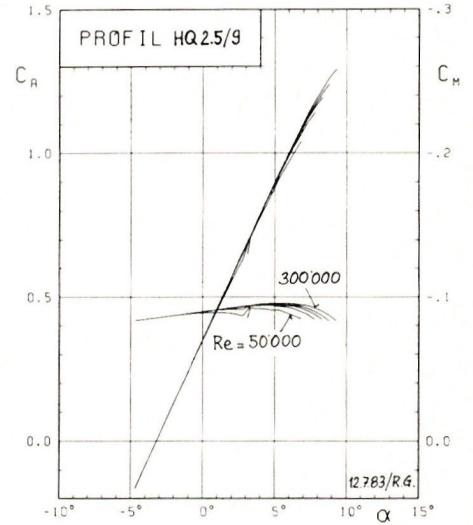
Figure 2: Theoretical polars of the HQ 2.5/9 profile with a camber flap
Figure 2 shows the calculated polars of the HQ 2.5/9 airfoil when the 22%-depth flap is deflected 5° downward or 5° upward. For comparison, the corresponding polars of the basic airfoil are also plotted on the same diagram. Extending the flap downward (positive flap angle $η_K$) is of interest for slow flight and high-altitude takeoff. Figure 2 therefore shows the polars at high lift for three low Reynolds numbers. The flap is deflected upward (negative flap angle $η_K$) only at higher airspeeds. Accordingly, Fig. 2 shows the polars for two high Reynolds numbers at lower lift coefficients. A few additional remarks are necessary to evaluate the calculation results. The program takes the influence of flow separation in the region of the trailing edge into account only in a very simplified manner, particularly the associated increase in drag. This is especially noticeable at high lift coefficients. Nevertheless, experience has shown that the calculated maximum lift agrees quite well with measured values.
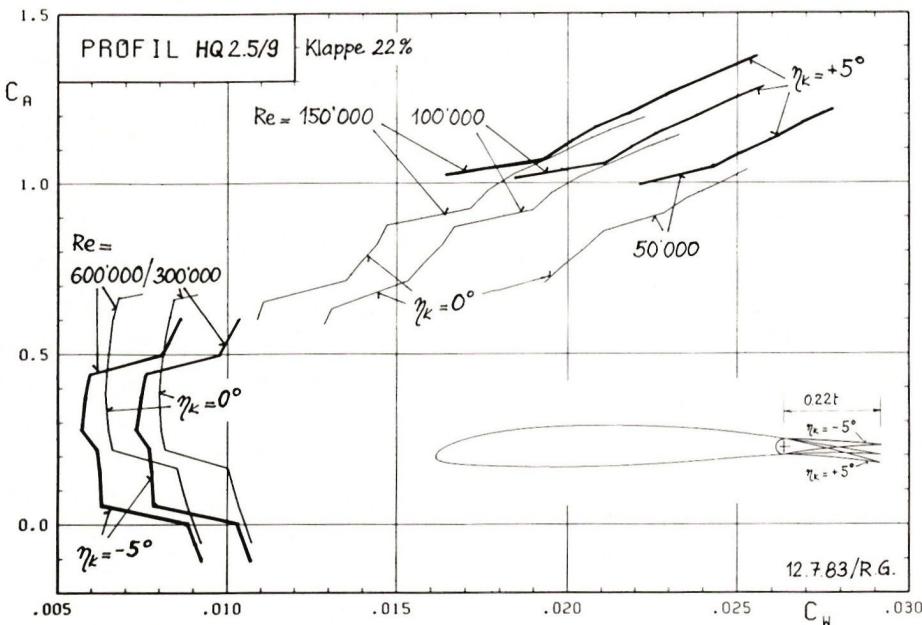
Figure 2: Theoretical polars of the HQ 2.5/9 profile with a camber flap
Figure 3 schematically illustrates how the calculated polars can be interpreted at high lift coefficients. The program is also unable to calculate the effects of laminar separation on the polars.
Based on the theoretical polars, a critical Re number significantly below 100,000 is expected for the HQ 2.5/9. The maximum lift coefficient $C_{A \max}$ reaches approximately 1.1 at a flap angle of $η_K = 0^°$. It increases to approximately 1.25 at a flap angle of $η_K = +5^°$. If the flap is set from $η_K = 0^°$ to $η_K = -5^°$, the region of low profile drag (laminarelle) shifts by just $Δ C_A = -0.2$ toward lower lift coefficients. The lower boundary of the laminar deltoid then lies at approximately $C_A = 0.05$. An even greater negative flap deflection is not recommended. Overall, the theoretical polars confirm the typical behavior of a cambered flap profile. For F3B models designed to reach particularly high speeds, a slightly less cambered profile (e.g., HQ 1.5/9 or HQ 2/9) would likely be preferable, provided a small loss in slow-flight performance can be accepted.
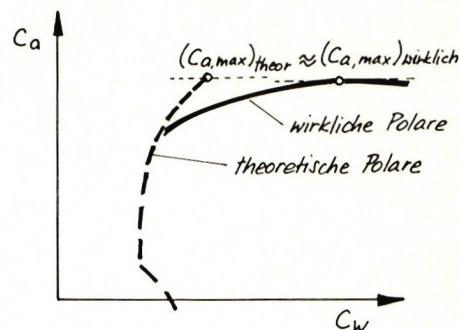
Figure 3: Schematic representation of the deviation between the theoretical and actual polars at high lift coefficients
[1] H. Quabeck, “Profiles for Flap-Equipped Wings.” Flug+modelltechnik 1 and 2 (1983)
[2] W. Thies, Polars for Quabeck Profiles. Flug+modelltechnik 7 (1983)
[3] R. Eppler/D. Somers, A Computer Program for the Design and Analysis of Low-Speed Airfoils. NASA Technical Memorandum 80210.


News from HEBU

TEAM MANAGER "THIS" BOSSHARD
 Rodito Nussbaumer

SUMMER FUN 2026 AT MG USTER
Martin Wunderli
SMALL, MODEL-LIKE SAILBOATS
Res Dauwalder
TRY-OUT DAY AT MFV WETTINGEN
Urs Keller
What's New at Leomotion.com

52. 2026 ALPS CUP
 Emil Giezendanner

BY YOUTH, FOR YOUTH
Lorena Betschen
ATOM, THE NEW DOUBLE-DECKER FROM CPLR
 Matthias Bosshard

INSIGHTS INTO THE HISTORY OF SEAPLANES

YOU KNOW WHAT I MEAN? 125 YEARS OF THE SWISS AERO CLUB
Emil Giezendanner
34th HAHNENMOOS ALPINE MODEL AIRPLANE CAMP
Res Dauwalder
CORSAIR F4U – A WARBIRD WITH A MEMORABLE LOOK
Jürgen Rosenberger, Jürgen Prinz
F3A EUROPEAN CHAMPIONSHIPS IN ST-MACAIRE, FRANCE
Matthias Bosshard
HORIZON HOBBY/LEMACO NEWS: MICRO OV-10 BRONCO 645 MM BY E-FLITE

PRIDE AND GOOD IDEAS
 Markus Nussbaumer

EURO CONTEST GLIDER ACRO TOUR AUSTRIA 2026

FREE FLIGHT IN THE MIDDLE OF SUMMER
Urs Muntwyler
THE PC-21 STORY
Emil Giezendanner
TWIN TOWN PARTNERSHIP
Wolfgang Voeller
WELCOME, NEW MEMBER!
Andrea Bolliger
COUPE DES ALPES – OBSERVE AND LEARN
Rodito Nussbaumer
NEWS FROM HEBU
 Julia Bucher

FROM 0 TO 100
Markus Nussbaumer
MEMORIES
Wolfgang Völler
NOS REGION – A HUB FOR ELECTRIC AVIATION
Emil Giezendanner
Have you almost forgotten about aircraft that take off and land vertically?
Emil Giezendanner
70 YEARS OF THE NIDWALDEN MODEL AIRPLANE CLUB
Martin Barmettler