
Regional Training Groups (RTG)
Forming training teams in various model aircraft competition classes is not, in itself, a new concept. However, since the use of appropriate training sites—mostly model aircraft fields—is not unlimited, it seemed sensible to coordinate such activities on a regional basis.
About a year ago, the NOS Region’s Youth and Sports Commission (chaired by Werner Erismann) began working on establishing regional training groups for 2009. The project outline generated widespread interest. It was soon decided to start with the following age groups:
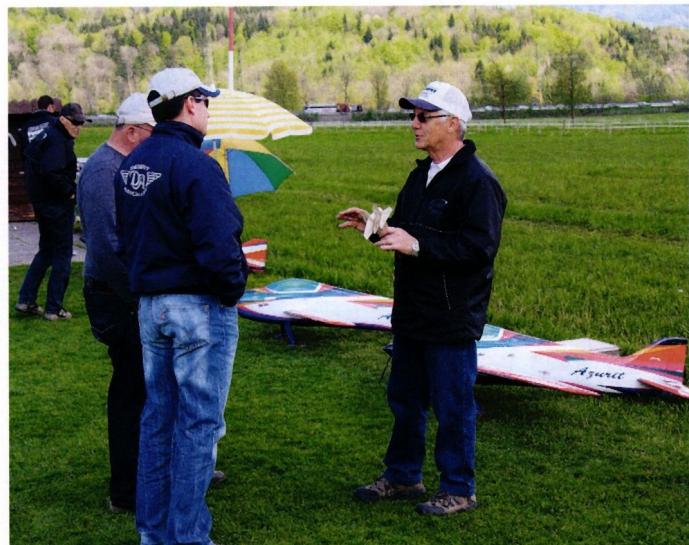
... and the criticism follows immediately.
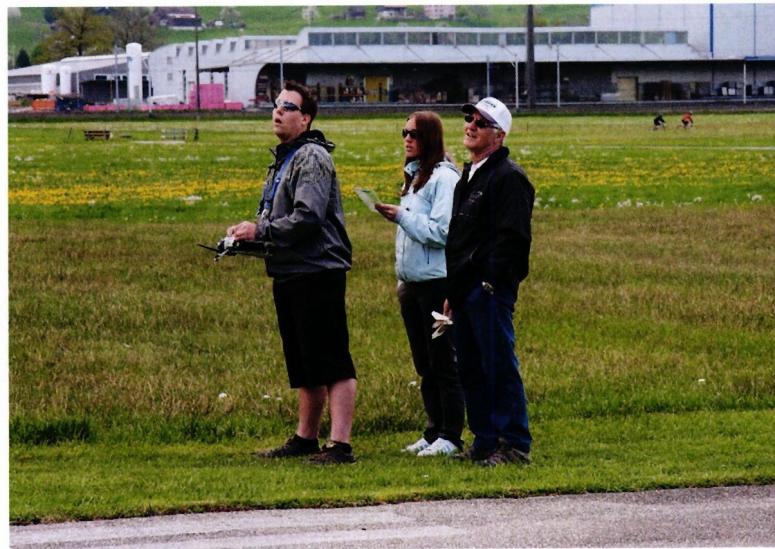
Flights under close scrutiny ...
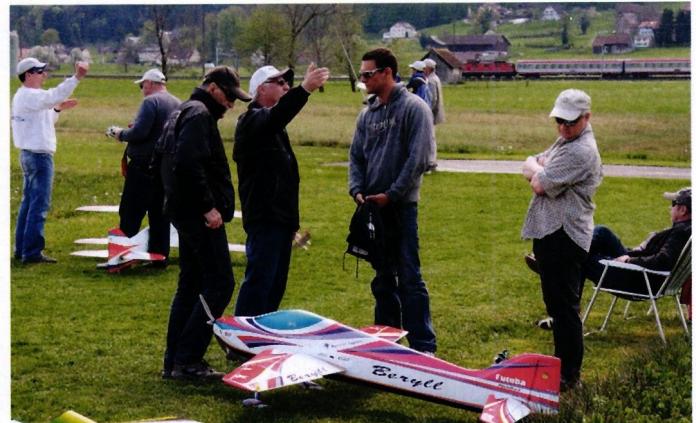
Coordinated by Werner Erismann
Coordination: Emil Giezendanner
Coordinated by Andreas Lüthi
Coordinated by Christian Hanke
Both the aerobatic pilots and the helicopter pilots got off to a good start with just over a dozen participants. The glider aerobatics pilots will meet on May 30. The electric flight training (gliding and pylon) has seen a modest turnout so far. This could improve as the Swiss Championships approach. During the aerobatics session at the Reichenburg airfield, participants were divided into two groups: Wolfgang Matt led the F3A group, and Emil Giezendanner led the F5A electric aerobatics group. This allowed for alternating between theory sessions and flight practice, which made for a very efficient session.
Instructional training for airplane and helicopter aerobatics is a much greater challenge than is generally assumed. Telling an aerobatic pilot after landing that that they had a slight wobble during the roll, overshot by 12 degrees during the snap, or had a corner in the loop is ineffective and pointless, because in most cases the pilot already knows all of this, and on the next flight, that corner might be in a completely different place. Genuine criticism should focus on general, recurring errors—for example, that all downward rolls and partial rolls —whether 45 degrees or vertical—are generally performed too late, resulting in the notorious “rushing” at the bottom, or that, for example, in all dotted rolls, the first side is too short, etc.


TEAM MANAGER "THIS" BOSSHARD
 Rodito Nussbaumer

SUMMER FUN 2026 AT MG USTER
Martin Wunderli
52. 2026 ALPS CUP
 Emil Giezendanner

ATOM, THE NEW DOUBLE-DECKER FROM CPLR
 Matthias Bosshard

INSIGHTS INTO THE HISTORY OF SEAPLANES

34th HAHNENMOOS ALPINE MODEL AIRPLANE CAMP
Res Dauwalder
CORSAIR F4U – A WARBIRD WITH A MEMORABLE LOOK
Jürgen Rosenberger, Jürgen Prinz
SMALL, MODEL-LIKE SAILBOATS
Res Dauwalder
F3A EUROPEAN CHAMPIONSHIPS IN ST-MACAIRE, FRANCE
Matthias Bosshard
What's New at Leomotion.com

HORIZON HOBBY/LEMACO NEWS: MICRO OV-10 BRONCO 645 MM BY E-FLITE

PRIDE AND GOOD IDEAS
 Markus Nussbaumer

News from HEBU

BY YOUTH, FOR YOUTH
Lorena Betschen
YOU KNOW WHAT I MEAN? 125 YEARS OF THE SWISS AERO CLUB
Emil Giezendanner
TRY-OUT DAY AT MFV WETTINGEN
Urs Keller
FREE FLIGHT IN THE MIDDLE OF SUMMER
Urs Muntwyler
THE PC-21 STORY
Emil Giezendanner
TWIN TOWN PARTNERSHIP
Wolfgang Voeller
EURO CONTEST GLIDER ACRO TOUR AUSTRIA 2026

WELCOME, NEW MEMBER!
Andrea Bolliger
COUPE DES ALPES – OBSERVE AND LEARN
Rodito Nussbaumer
NEWS FROM HEBU
 Julia Bucher

FROM 0 TO 100
Markus Nussbaumer
NOS REGION – A HUB FOR ELECTRIC AVIATION
Emil Giezendanner
MEMORIES
Wolfgang Völler
Have you almost forgotten about aircraft that take off and land vertically?
Emil Giezendanner
70 YEARS OF THE NIDWALDEN MODEL AIRPLANE CLUB
Martin Barmettler