
Old Gliders – Replicas and Flights
The construction of replicas of old gliders is currently experiencing a real boom. This is due in no small part to computer-aided design (CAD) and the associated production of wooden components—milled or laser-cut kits. Pre-manufactured sets of ribs and struts simplify the construction of vintage glider models, which are often quite complex. Another helpful resource is the large number of archives containing images, texts, and original plans.
Sir George Cayley, 6th Baronet, a British engineer, is considered the “inventor” of the hang glider (1858). Otto Lilienthal (born in 1848 in Anklam, Germany) is considered the true pioneer of gliding as well as a forerunner of modern aviation. Drawing on the experience gained from over 2,000 flight attempts on various sites, reaching heights of up to 110 m and gliding distances of 20 to 250 m, he developed a glider in 1893 that was the first aircraft in history to be patented, manufactured, and sold.
Lilienthal’s pioneering achievements are said to have had a major influence on the work of the Wright brothers (USA). As early as 1900, brothers Orville and Wilbur Wright built a biplane glider. It functioned similarly to a kite. Among their major innovations (1902) was the development of aerodynamic control around all three axes. In 1911, further experiments with unpowered gliders were conducted in the coastal winds of the Kitty Hawk dunes. On October 24, they achieved a flight lasting 9 minutes and 45 seconds. It may come as a surprise to many that the inventors of powered flight also devoted themselves to gliding and sailplane flight.
The list of all these pioneers is long. The German Ferdinand Schulz (1892–1929) is considered a pioneer of gliding. In 1927, he is said to have held all the world gliding records. Seven of his designs—the “Besenkiste”—went down in gliding history. Among the true greats are Alexander Schleicher, with his self-built “Hol’s der Teufel,” and the Alexander Schleicher GmbH company he founded. After the postwar ban on aircraft construction was eased, the company built various gliders, ranging from the “Grunau Baby” to the “Rhönlerche I”—Alexander Schleicher’s final design. Other well-known names include Wolf Hirth and Martin Schempp. The company they founded, Schempp-Hirth, soon began successfully launching aircraft such as the “Gö-1 Wolf” (1935), the “Gö-3 Minimoa,” and the “Gö-4” (1937). The “Standard Austria S,” built under license, was awarded the Science Prize at the 1960 World Championships. Klaus Holighaus, born in 1940, was a great asset to the Schempp-Hirth company. He began as a model aircraft pilot and, in 1959, set an endurance flight record of 6 hours and 11 minutes with an RC glider model. His “Nimbus-1,” with a wingspan of 22 m and a cambered wing profile, became world champion in 1970. This was followed by the “Cirrus” in several versions. This is said to have laid the foundation for his successful business career. He also won various European and German championship titles. In 1977, he became the sole owner of Schempp-Hirth.
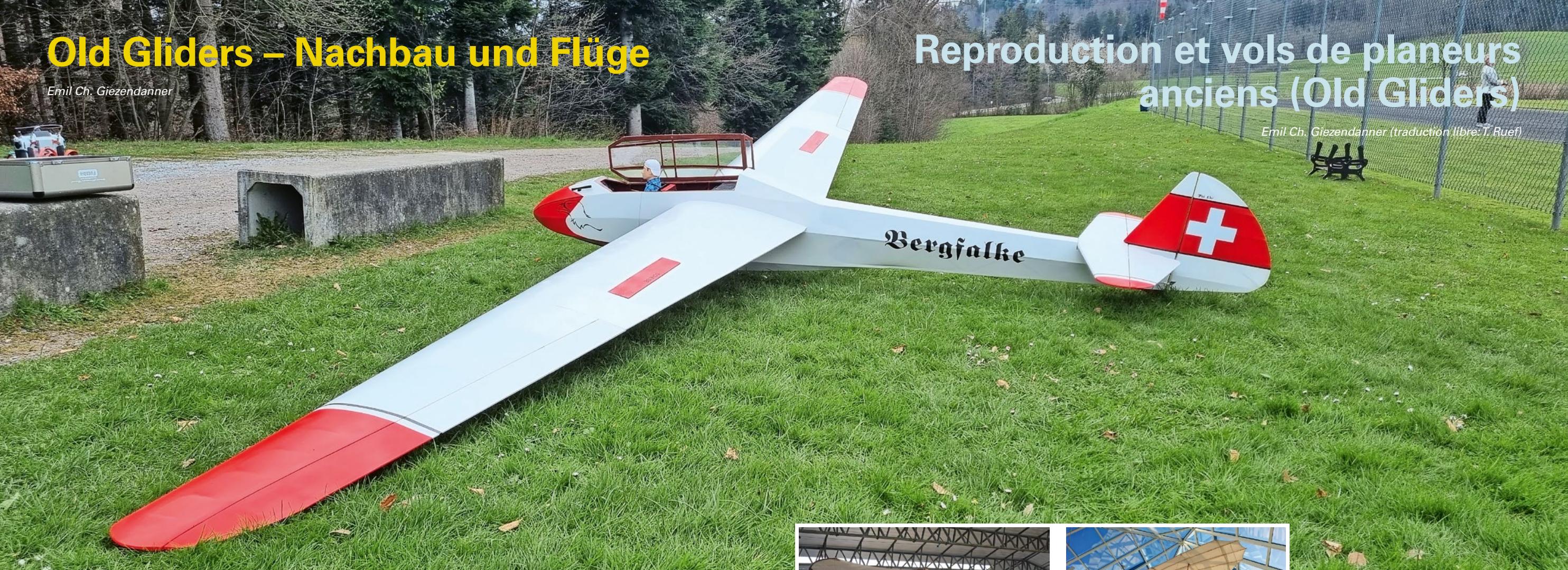
2 Sir George Cayley, 6th Baronet: Replica of a glider (circa 1850).
3 Otto Lilienthal
4 Lilienthal Museum: Replica of the first glider, circa 1895.
5 Lilienthal’s gliding experiments.
6 The Wright brothers’ glider in the dunes of Kitty Hawk.
7 Wright design.
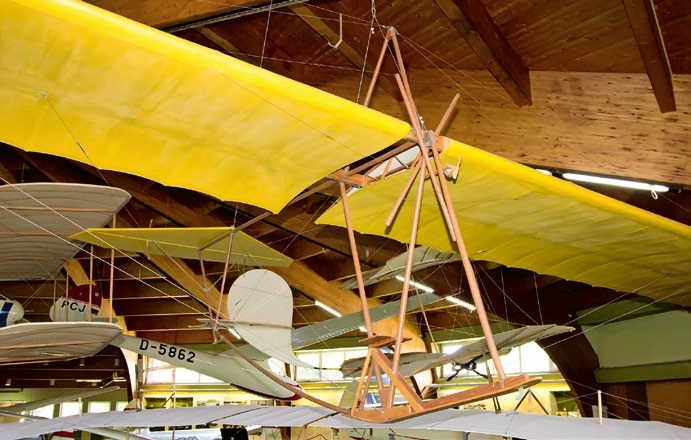
Schulz “F.S.3 Broomstick.”
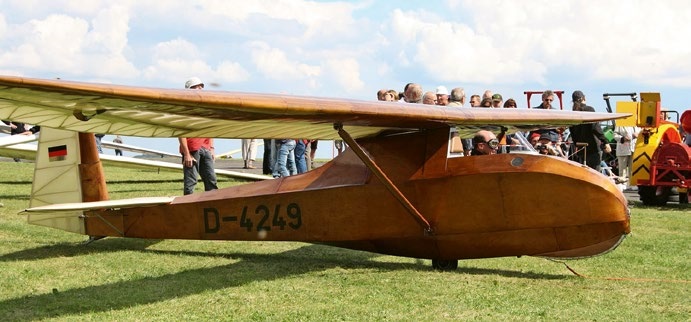
"Grunau Baby III."
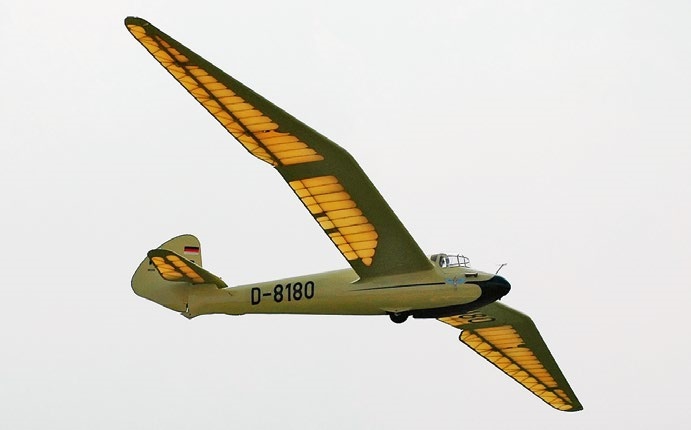
Schempp-Hirth "Gö-3 Minimo"
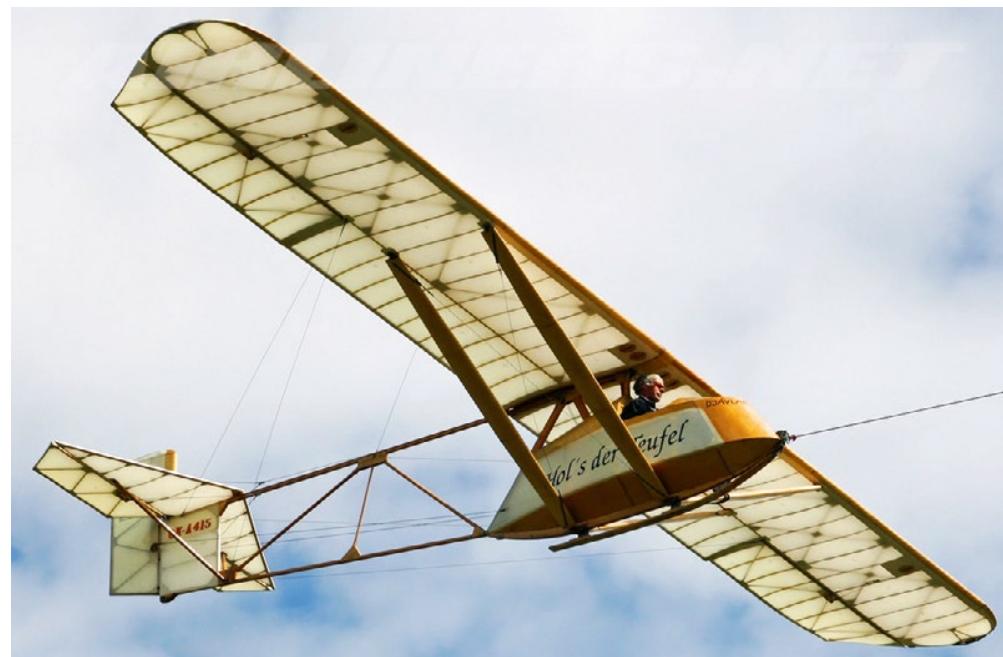
Alexander Schleicher's "Hol's der Teufel."
Glider construction in Switzerland could be described as a “side hobby.” Many gliders were built in small workshops. As early as 1926, Jakob Spalinger built the “S9.” In 1929, the aircraft successfully completed a true glide flight with a climb from a launch point 55 m above ground level. Twenty units of Spalinger’s “S15k” (1944) were built. As early as 1930, August Hug designed the “Spyr I.” As part of the famous glider launch from the Jungfraujoch (1931), the “Spyr I” set a distance record of 52 km. His “Spyr IV” (first flight in 1941) was designed as a high-performance aircraft. Flug- und Fahrzeugwerke Altenrhein developed the “HBV Diamant,” which made its first flight in 1964. Synthetic resins were primarily used in its construction. Pilatuswerke built the all-metal “B-4” aircraft. The maiden flight of the B-4 prototype took place in 1966. Various licenses were granted, and a total of over 300 units are said to have been sold.
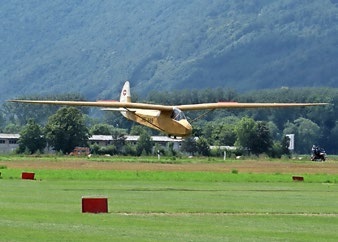
August Hug's "Spyr 1" (1941).
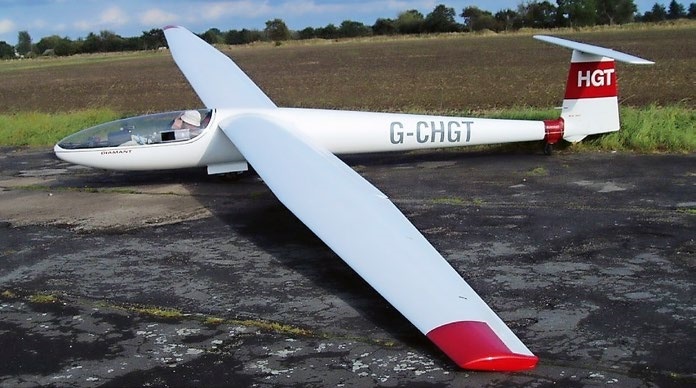
"HBV Diamant" by FFA Altenrhein and Glasflügel.
Time and again, we can see from construction and flight reports that model aircraft enthusiasts encounter problems similar to those faced by our predecessors. Studying and building vintage RC glider models—made entirely of wood—are challenging but wonderful experiences. As early as around 1970 and even earlier, several scale glider models were built in Switzerland. These were replicas of old gliders dating back to the 1920s through the 1950s (estimated). The vintage glider scene is growing steadily, although—as mentioned at the beginning—CAD and milling techniques have accelerated the process in recent years. Even in the early days, using a jigsaw, a balsa knife, and old construction plans, beautiful replicas were created whose sizes were impressive. Model airplane enthusiasts are repeatedly surprised by how our ancestors developed structural solutions that have stood the test of time to this very day. That should leave a deep impression on us.
As mentioned at the beginning, it is difficult to get an overview of the vintage glider scene with its many scale RC glider models. It is almost impossible to avoid leaving out individual successful enthusiasts. Almost since the founding of our magazine “modell flugsport” (1971), enthusiasts of old hand-launched gliders have repeatedly produced beautiful replicas—without using spar and rib kits. Unfortunately, I am not aware of any build reports on vintage gliders prior to 1980. But after that, things really took off. MFS can look back on a long list of successful build and flight reports. Here are a few examples:
- MFS 5-1982: Fafnir by Hans Dürst. Cover photo and brief description.
- MFS 4-1987: Moswey III. Construction and flight report by Georg Staub.
- MFS 3-1988: ASK 18 by Angelo Beltrame (1988). Cover photo and brief description.
- MFS 2-1999: Spalinger S18 III. Construction and flight report by Georg Staub.
- MFS 4-2004: Maxi-Minimoa by Dominique Baer.
- Etc.
Later, Georg Staub reported on his experiences with the “Spalinger S 18 III” (1999) and on the construction of the Pfenninger Elfe 2 (MFS 4/2017). The Minimoa by Alois Bühlmann is also mentioned. The “Zürivogel”—designed in 1922—was built by Max Pfenniger. In addition, there are designs—mostly of very large models—by Patrick Trauffer and Markus Frey.
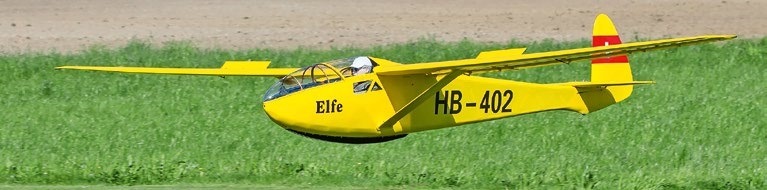
"Pfenninger Elfe 2" by Georg Staub.
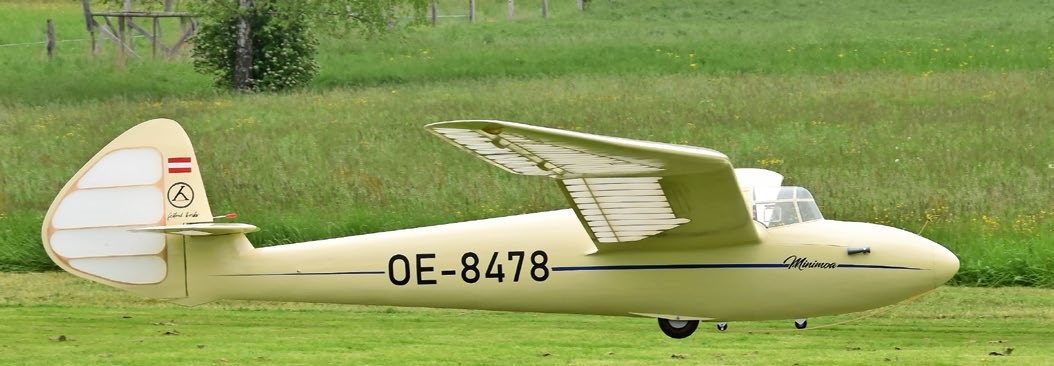
Builder Daniel Hirscher from Austria.
Müswangen, 23.
Markus Frey, the organizer of the classic car meet in Müswangen, offered a glimpse into the past with his wonderful event and promoted modern RC gliding.
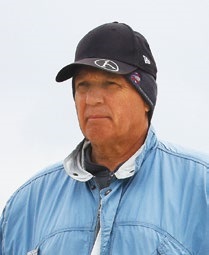
*IG Albatros:* Among the beacons of inspiration, I count the immense work of IG Albatros. It’s truly remarkable: More than a quarter-century ago (1997), Peter Ziegler wrote the report “Tow-Flying with IG Albatros.” It featured photos and text describing the models
- Spalinger S 18 Chouka by Ernst Gerber,
- “Minimoa” by Bruno Hinnis,
- the “OBS” search glider by Markus Hirschi,
- the Spalinger S15 by Beat Jäggi,
- the “Mü 13 E” disc glider by Alfred Genther,
- and other foreign pilots are briefly introduced.
The plans and photo archive is a magnificent achievement by IG Albatros, and the annual program is impressive and varied (see also the MFS Calendar).
*Müswangen International Vintage Model Glider Meet:* As the second flagship event of the Swiss vintage model gliding scene, the MV Müswangen International Vintage Model Glider Meet must definitely be mentioned. This highly acclaimed event is led by Markus Frey, who builds and flies exciting—and often very unique—vintage models himself. A major asset to this wonderful event is its collaboration with the Gliding History Foundation. I am not aware of any other organization where model aviation and manned gliding go hand in hand so closely—one highlight was certainly the anniversary celebration of the Alp Scheidegg Model Gliding Group.
Appetite comes with eating. This saying seems to ring true for Patrick Stahel. After building several successful model kits, the Bergfalke kit made its way onto his wish list. After a long wait, the model arrived in the mail—and off he went. The model’s incredibly delicate construction is astonishing. One thing is certain: the designers knew very early on that it was worth making it as light as possible. The following photos hardly need any description. The in-flight shot is beautiful. ■
Photos: Markus Nussbaumer, Patrick Stahel
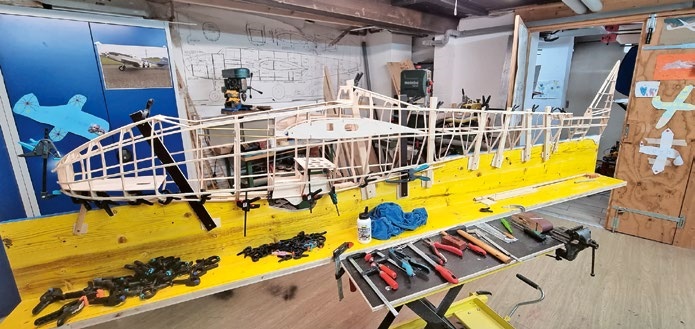
Delicate hull construction.
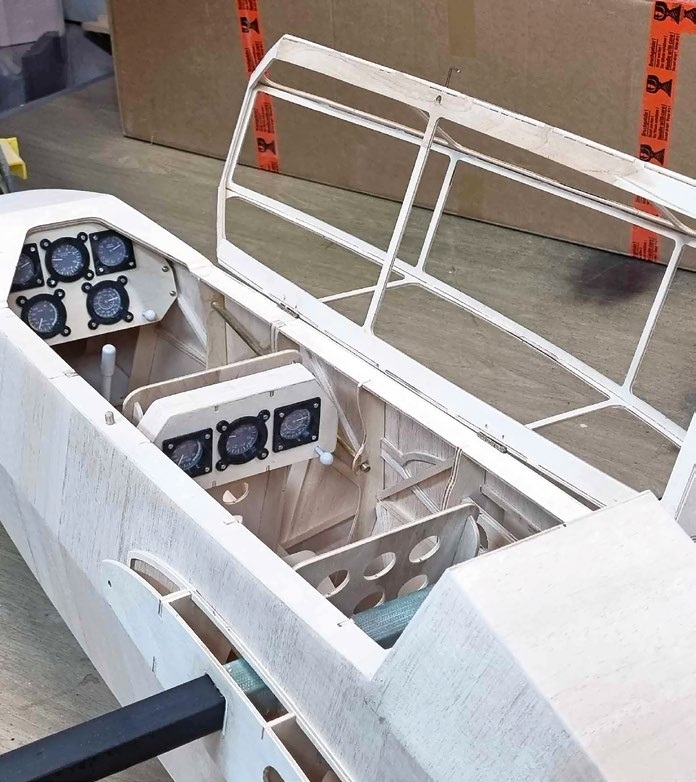
"Wings": A Test of Patience.
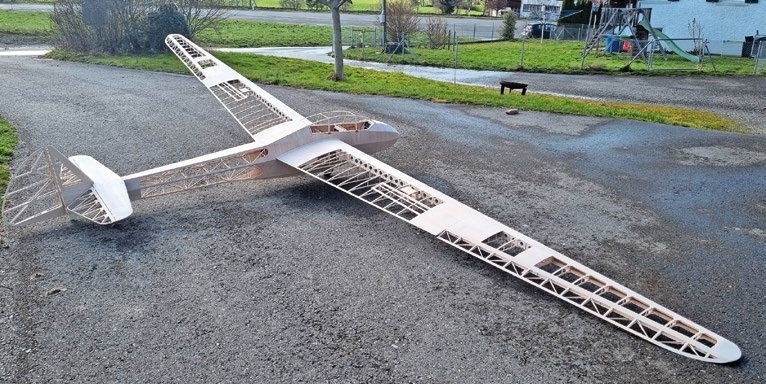
An impressive work.
| Scale: | 1:1.7 |
| Wingspan: | 10 meters |
| Length: | 4.2 meters |
| Weight: | 24,560 kg |
| Area: | 600 dm² |
| Surface load: | 40.9 g/dm² |
https://www.ig-albatros.ch
https://www.mv-mueswangen.ch
https://www.segelfluggeschichte.ch
http://www.lilienthal-museum.de
https://wasserkuppe.net/segelflugmuseum/
Attention! Some images may be protected by copyright.


TEAM MANAGER "THIS" BOSSHARD
 Rodito Nussbaumer

SUMMER FUN 2026 AT MG USTER
Martin Wunderli
52. 2026 ALPS CUP
 Emil Giezendanner

ATOM, THE NEW DOUBLE-DECKER FROM CPLR
 Matthias Bosshard

INSIGHTS INTO THE HISTORY OF SEAPLANES

34th HAHNENMOOS ALPINE MODEL AIRPLANE CAMP
Res Dauwalder
CORSAIR F4U – A WARBIRD WITH A MEMORABLE LOOK
Jürgen Rosenberger, Jürgen Prinz
SMALL, MODEL-LIKE SAILBOATS
Res Dauwalder
F3A EUROPEAN CHAMPIONSHIPS IN ST-MACAIRE, FRANCE
Matthias Bosshard
What's New at Leomotion.com

HORIZON HOBBY/LEMACO NEWS: MICRO OV-10 BRONCO 645 MM BY E-FLITE

PRIDE AND GOOD IDEAS
 Markus Nussbaumer

News from HEBU

BY YOUTH, FOR YOUTH
Lorena Betschen
YOU KNOW WHAT I MEAN? 125 YEARS OF THE SWISS AERO CLUB
Emil Giezendanner
TRY-OUT DAY AT MFV WETTINGEN
Urs Keller
FREE FLIGHT IN THE MIDDLE OF SUMMER
Urs Muntwyler
THE PC-21 STORY
Emil Giezendanner
TWIN TOWN PARTNERSHIP
Wolfgang Voeller
EURO CONTEST GLIDER ACRO TOUR AUSTRIA 2026

WELCOME, NEW MEMBER!
Andrea Bolliger
COUPE DES ALPES – OBSERVE AND LEARN
Rodito Nussbaumer
NEWS FROM HEBU
 Julia Bucher

FROM 0 TO 100
Markus Nussbaumer
MEMORIES
Wolfgang Völler
NOS REGION – A HUB FOR ELECTRIC AVIATION
Emil Giezendanner
Have you almost forgotten about aircraft that take off and land vertically?
Emil Giezendanner
70 YEARS OF THE NIDWALDEN MODEL AIRPLANE CLUB
Martin Barmettler