
1973 RC Aerobatics World Championships
Once upon a time, there lived in Africa
a wise marabou
stork who almost
always kept one eye closed!
As always, a great deal has been written about the 1973 World Cup—ink has been used up, paper has been printed on. Sometimes, however, pages are so crammed with nonsense that one might be tempted to believe that for many magazines, the sole purpose is to include some “technical” content alongside the many advertising and promotional pages—no matter what it is, and even less matter how it’s presented! It would be presumptuous and exaggerated to claim that a model aviation journalist must be a model aviator himself—but it seems even more presumptuous to me when model aviators pass judgment on matters for which they lack sufficient expertise and even publish these opinions in writing as amateur journalists. Most often, personal commitment is lacking, and even more frequently, genuine personal experience and practical knowledge are missing. Whenever skill and knowledge are replaced by speculation, bragging, pomposity, or envy and resentment, a vacuum is left behind for the reader—emptiness instead of expertise, a hole where the information should be. Added to this are all the things that are never spoken of or written about. Every athlete has to grapple with them personally—to come to terms with them.
Anyone who wants to better understand recurring major sporting events such as world championships—their nature and unique characteristics—would do well to delve into the past.
RC World Championships are held every two years, meaning they have always coincided with odd-numbered years (since 1963). The first World Championship in this category took place in Dübendorf in 1960 and is still glorified today by older generations as “the greatest World Championship,” and many in those circles believe that such a high standard of organization could never be matched again. Of course, there are also model aircraft enthusiasts who, despite their advanced age, have not lost their sense of reality and are able to point out that even the perfectly Swiss organization of 1960 had its unresolved problems and weaknesses—that such issues are not unique to other countries.
The first five of the eight World Championship titles awarded to date all went, without exception, across the ocean to the United States of America. It can certainly be regarded as a very special achievement, an honor, and, of course, a stroke of luck that the first—and so far only—gold medals to make their way to Europe were won, of all people, by a Swiss model aviator. Bruno Giezendanner is the proud owner of two FA1 gold medals—a fact we must acknowledge, with or without envy.
Thus, the United States, Switzerland, and Japan have, to date, divided the eight titles among themselves. When one compares the talent pools of Japan and the U.S. with ours, Giezendanner’s achievements become all the more impressive. At the same time, this phenomenon also proves that any support provided by associations, industry, and expert committees is wasted if the individual athlete does not demonstrate the highest level of personal commitment. A team is only as good as its weakest member, and all the effort—the dedication of coaches, team managers, mechanics, and others—can be undone by a single instance of unreliability.
| Year | Organizer | RC World Champion | Team Standings |
|---|---|---|---|
| 1960 | Switzerland | Kazmirski/USA | U.S.A. |
| 1962 | United Kingdom | Brett/USA | Great Britain |
| 1963 | Belgium | Brooke/USA | U.S.A. |
| 1965 | Sweden | Brooke/USA | U.S.A. |
| 1967 | France | Kraft/USA | U.S.A. |
| 1969 | Germany | Giezendanner/CH | Germany |
| 1971 | U.S.A. | Giezendanner, Switzerland | U.S.A. |
| 1973 | Italy | Yoshioka/Japan | Japan |
At the 1972 International Graupner Meeting in Gorizia, we had the opportunity to get to know the venue a bit better, as well as the ability of those people to organize an RC championship. It should also be noted that Italy has numerous excellent free-flight pilots in all categories, while the top tier in RC aerobatics is very narrow, and, in my opinion, RC flying is only now beginning to gain a certain degree of popularity. The most important criterion for many RC aerobatic pilots I know personally is still: LST (Loud — Fast — Low). Unfortunately, the resolution of some fundamental organizational issues was still very much in its infancy at the 1973 World Championships. While in 1972 they “discussed” the matter until almost midnight—debating what should happen if a model flew over the spectators— at the 1973 World Championships, they finally settled on a siren and set the flight path precisely so that even relatively slow models would regularly fly over the crowd when turning. Well, the jury then “doomed” the siren, but the spectator problem was completely neglected. It wasn’t until Sunday, during the tiebreaker, that they hastily improvised a hybrid of an imaginary and a real barrier—and all of a sudden—I couldn’t believe my ears — they organized a pre-war loudspeaker system—which croaked so terribly that even the “best Austrians,” with all good will, couldn’t make out Hanno’s scores. The Italians excused all the organizational shortcomings with the large number of participants: “Molto concorrenti . . . schuso . . .” When we requested a precise schedule (similar to the one from 1969 in Bremen) at the first team leaders’ conference, this suggestion was rejected on the grounds that the competition would run more smoothly without a rigid schedule, since the intervals between rounds could be made shorter. But no one considered that this would mean delays at the individual launch sites would have to be offset by long waiting times. These delays weren’t always noticed, though. Just as Ferdi Schaden had his model ready to launch at Runway 1 and turned on the transmitter, a Yugoslavian model crashed at Runway 2. He was using the same transmission frequency as Schaden—what a coincidence!
Whenever I have to write reports like this one, I’m very interested in what others have written on the same topic. I don’t do this because I don’t know anything else and therefore copy other people’s work. I do it for the sake of objectivity. Anyone who has been personally involved in a matter—committed, deeply immersed, and giving it their all—is at extraordinary risk of having a skewed perspective. The danger of being “blinded by one’s own perspective”—of seeing only oneself and one’s own achievements—is ever-present and requires constant correction
. Although I am aware that other reports also frequently contain subjective elements — after all, they are written by people, not robots — I believe that the opportunity to read other reports helps to paint a more comprehensive and multifaceted picture here, without, however, having to deny my own opinion and experience.
Particularly in the field of model-building technology, virtually all major trade journals worldwide clearly express the view that technical development in RC aerobatic models is stagnating. The trend toward a standardized aerobatic model is evident. Size, weight, wing area, design, airfoils, etc., seem to be converging more and more each year. The low-wing configuration has clearly become the standard. ... The “Whistler” model by Brian Green of Australia was equipped with wheel well covers that opened and closed in a sophisticated manner to achieve a clean, less angular underside of the wing. ... It seems that the RC aerobatic model, as a sporting apparatus, has been treated rather “conservatively” for several years now. ... The risk, the full commitment. The cautious tactician is always there, but takes away the sport’s liveliness, excitement, and uniqueness. ... The “Salamandre” model, which arguably incorporates genuine innovations across the board, provided a modest break from the monotony and routine at the 1973 World Championships. ... Unfortunately, Bruno didn’t have enough time to train with this model. He certainly flew it flawlessly during practice at home. However, the mental strain surrounding the model inspection and additional difficulties prevented him from achieving success in the competition.
With engines having become much more powerful and less prone to mechanical issues since 1971, the trend toward flying over longer distances and at higher speeds has become evident. However, this has led to contradictions in the evaluation. ... I believe that the performances of the top group were not significantly better than in 1971. The second-place finish by the reliable Wolfgang Matt provides a benchmark for connoisseurs. In contrast, the rest of the field has improved tremendously. The point totals have converged to an alarming degree. ... The Japanese team’s magnificent triumph actually came as no surprise to anyone after Doylestown. ... It is no exaggeration to describe the Japanese as the most disciplined and serious team. It is also evident that, despite the commotion around them, they are able to concentrate far better than the Western pilots. ... The two Americans, Page and Whitley, have taken the grand European aerobatic maneuvers and taken them to the extreme. ... A small (or large) personal rivalry once again emerged between Matt and Prettnner. ...
After the Swiss team’s (Bruno Giezendanner, Fredi Schenk, and Kurt Saupe) successful third-place finish in Bremen in 1969 and the truly unprecedented second-place finish! by the Swiss team (Bruno Giezendanner, Emil Giezendanner, and Renato Ragoni) in Doylestown in 1971, it was reasonable to assume that repeating such achievements would not be possible anytime soon. But even my long-standing pessimism hadn’t anticipated such a poor result. There
are no excuses. Everything seemed to go wrong. None of the three pilots came even close to living up to their potential. ... The fact that the “Salamandre” didn’t work out has, by now, been sufficiently discussed and described. There are exceptionally smart and experienced people who know significantly more about our model than we do ourselves—I was particularly fascinated by the idea of the adjustable center of gravity (which isn’t correct).
It’s always very easy to make grand statements about the future and make predictions that never turn out to be true. But there are two things we can already say with certainty: 1. That we’ve learned a great deal throughout the entire expedition. 2. That the Swiss team must be carefully prepared for the 1975 World Championships in Bern—not only in terms of flying skills, but also as a well-functioning team.
The Japanese have shown us that cohesion, teamwork, and concentration become increasingly important the longer the competition goes on.
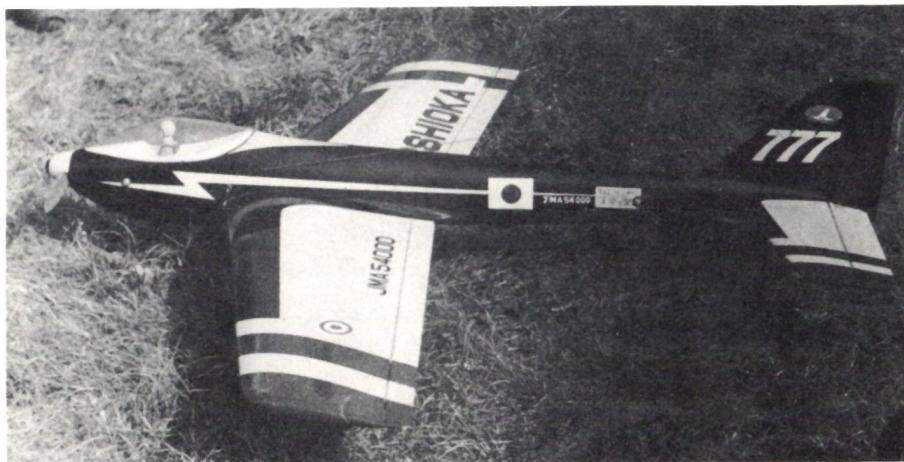
- Photo 1: 1973 RC World Champion Tsugutaka Yoshioka, Japan. His brother served as his mechanic. The two are shown here preparing for the race. Model: Blue Angel.
- Photo 2: Wolfgang Matt, Liechtenstein, won the silver medal again, just as he did in 1971. Pictured here with his “Super Star” model.
—Photo 3: Hanno Prettnner of Austria improved his ranking by one place compared to 1971. His “Super Sicroly” model is equipped with landing flaps.
—Photo 4: Harald Neckar of West Germany took 4th place. His “Mephisto” model is one of the most remarkable designs at this World Championship. The “Mephisto” is equipped with a pendulum elevator.
—Photo 5: Norman Page of the USA took 5th place. His “Mach 1” model stands out for its great wing depth. It is exceptionally well-crafted. Norman Page likely performed the most impressive aerobatic maneuvers at this World Championship.
—Photo 6 The Canadian team was quite successful this time around. From left to right: Ivan Kristensen (14th place), Philip Soden (6th place), Warren Hitchcox (26th place). Soden was among the leaders at the start of the World Championship and held second place in the standings for a long time
.- Photo 7 Tied with Soden for sixth place was Yoshiki Takahashi of Japan with his “Cinnamon” model
.- Photo 8 Winners are often lonely.
- Image 9: Japan’s Tetsuiji Okumura, the third member of the successful Japanese team, finished in 9th place
.- Image 10: Award ceremony
.- Image 11: Preparing for the start: Bruno Giezendanner with his Salamandre shortly before the start. Kurt Müller (left), team manager, and Mario Waldmeier (right), mechanic.
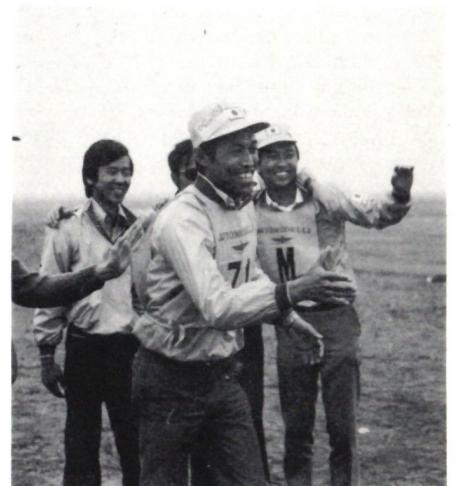
—Image 12 The Japanese have every reason to be happy. On the left is Okumura, on the right is Yoshioka.
—Image 13 Part of the U.S. team. From left to right: James Martin (11th place), Ron Chidgey, team manager, and Norman Page (5th place).
—Photo 14 The team from the Principality of Liechtenstein.
—Photo 15 Serious faces among the Swiss. From left to right: Willi Gloor, mechanic; Renato Ragoni (64th place); Kurt Müller.
—Photo 16 James Whitley (8th place) with his trusty “Daddy Rabbit.”
—Photo 17 “Marabu” at the measurement wall during model inspection.
- Photo 18: Elliptical wing on the model built by South African John Brink (63rd place).
- Photo 19: The Sandrair model built by South African Ivan Olivier (43rd place).
- Photo 20 The Swiss team got along well with the Japanese
.- Photo 21 Among the most elegant models at this World Championship was the “Demon” by Franci Markun of Yugoslavia (32nd place).
- Photo 22 The team from the Federal Republic of Germany. Kurt Matke, 1972 German Champion (22nd place), Harald Neckar (4th place), and team leader Rudolf Godel.
—Photo 23 Edi Maranta, MG Wohlen.
—Photo 24 The flags are being lowered. Closing ceremony.
| Rank | Name | Country | Points | RC Set | Motor |
|---|---|---|---|---|---|
| 1. | Tsugutaka Yoshioka | Japan | 28,420 | Degicon | Enya 60 |
| 2. | Walfgang Matt | Liechtenstein | (12,130) | Simprop | HP 61 |
| 3. | Hanno Prettnner | Austria | (12,104) | Simprop | Webra-S. |
| 4. | Harald Neckar | B.R. Germany | (12,420) | Varioprop | HB 61 |
| 5. | Norman Page | U.S.A. | (12,165) | Pro-Line | Ross 61 |


News from HEBU

TEAM MANAGER "THIS" BOSSHARD
 Rodito Nussbaumer

YOU KNOW WHAT I MEAN? 125 YEARS OF THE SWISS AERO CLUB
 Emil Giezendanner

HORIZON HOBBY/LEMACO NEWS: MICRO OV-10 BRONCO 645 MM BY E-FLITE

PRIDE AND GOOD IDEAS
 Markus Nussbaumer

TRY-OUT DAY AT MFV WETTINGEN
Urs Keller
F3A EUROPEAN CHAMPIONSHIPS IN ST-MACAIRE, FRANCE
 Matthias Bosshard

52. 2026 ALPS CUP
Emil Giezendanner
ATOM, THE NEW DOUBLE-DECKER FROM CPLR
Matthias Bosshard
SUMMER FUN 2026 AT MG USTER
Martin Wunderli
What's New at Leomotion.com

TWIN TOWN PARTNERSHIP
Wolfgang Voeller
34th HAHNENMOOS ALPINE MODEL AIRPLANE CAMP
Res Dauwalder
CORSAIR F4U – A WARBIRD WITH A MEMORABLE LOOK
Jürgen Rosenberger, Jürgen Prinz
SMALL, MODEL-LIKE SAILBOATS
Res Dauwalder
WELCOME, NEW MEMBER!
Andrea Bolliger
FREE FLIGHT IN THE MIDDLE OF SUMMER
Urs Muntwyler
COUPE DES ALPES – OBSERVE AND LEARN
Rodito Nussbaumer
EURO CONTEST GLIDER ACRO TOUR AUSTRIA 2026

BY YOUTH, FOR YOUTH
Lorena Betschen
INSIGHTS INTO THE HISTORY OF SEAPLANES

THE PC-21 STORY
Emil Giezendanner
NEWS FROM HEBU
 Julia Bucher

FROM 0 TO 100
Markus Nussbaumer
MEMORIES
Wolfgang Völler
NOS REGION – A HUB FOR ELECTRIC AVIATION
Emil Giezendanner
DO YOU KNOW WHAT I MEAN IN THE LAND OF SMILES?
Emil Giezendanner
Have you almost forgotten about aircraft that take off and land vertically?
Emil Giezendanner