
Alpine model gliding at 2,000 meters above sea level on the Hahnenmoos Pass
The Hahnenmoos Gliding School is now well known far beyond the country's borders. It was founded several years ago by Christian Ruch. The Hahnenmoos Pass is an absolutely ideal gliding site. Our photo: Kestrel.
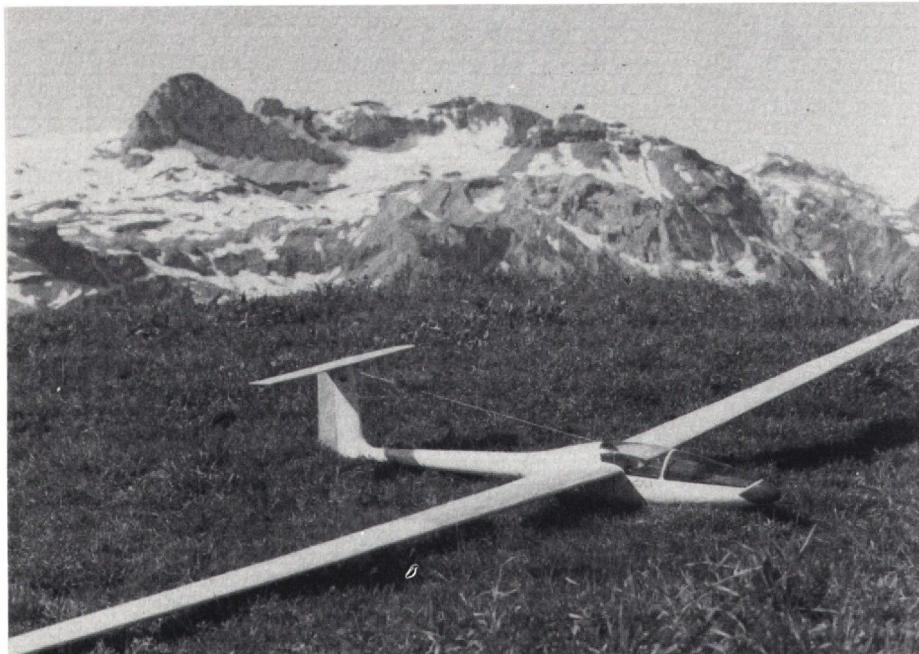
The Hahnenmoos Pass in the Bernese Oberland has for many years, known as a beautiful and virtually ideal model flying site in Switzerland, mainly due to the annual site manager courses organized by the Aero Club of Switzerland and the international model flying school at Hahnenmoospass, which was founded several years ago and is led by Christian Ruch.
Set amid a breathtaking mountain backdrop between the Wildstrubel and the Albristhorn, a truly great flying experience awaits model glider pilots. The flying sites on the Schalm, Metschstand, and Laveygrat offer ideal updraft conditions for virtually all wind directions, combined with good thermal development. The “tubes”—which are quite numerous at this altitude—feature considerable climb and are very productive.
And all of this takes place on alpine meadows that are practically free of stones and rocks, above the tree line.
Model flying at this altitude requires an adjustment in flying technique compared to thermal and slope flying in lowland areas.
The atmosphere is considerably more turbulent, and in light wind conditions, pure slope flying can only achieve a relatively small gain in altitude beyond the slope edge. As a result, finding thermal tubes and flying them out takes on crucial importance. To fully exploit these thermal updrafts, the model must be flown relatively far into the valley, though “sinkings” several hundred meters below the launch site are not uncommon. Precise flying combined with close observation of cloud formation, as well as knowledge of thermal conditions in the Alps, enable the pilot to “crank” the model back to the launch site with a high degree of probability—and often at a significantly higher altitude.
It is precisely this form of gliding in its purest form that makes alpine model gliding so fascinating.
Should the search for thermals prove unsuccessful, landings—even several hundred meters below the launch site—can be accomplished without difficulty, though in such cases model gliding can turn into a real fitness workout.
In addition to these unique flying opportunities, the Hahnenmoos Pass serves as a starting point for beautiful hikes, whether as a change of pace for the model glider pilot or for their family members.
An ideal advantage is the fact that the Hahnenmoos Pass is not directly accessible by motor vehicles. On the first floor of the town hall in Adelboden, you can obtain a permit to drive on the road from Gilbach to Geils—valid for one day or, for model aviators, for several consecutive days. This permit can also be obtained at the Hotel Des Alpes in Gilbach.
In Geils, motor vehicles must be parked at the valley station of the gondola. From there, the Hahnenmoos Pass can be reached by a 45-minute hike or by taking the gondola. The gondola staff are very accommodating toward model airplane enthusiasts. Small models can easily be taken along in the 4-person cabins. For larger models, with a wingspan of 3 meters or more, special transport carts are available.
For excellent lodging options, we highly recommend the Berghotel Hahnenmoospass, managed by the W. Sporri family, 3175 Adelboden, Tel.: (033) 73 21 41 and private (033) 73 19 58. Accommodations are available in dormitories as well as in comfortable rooms. The restaurant offers excellent dining options.
Due to the increasing use of the airfield at Hahnenmoos, ways and means naturally had to be found to provide the farmers with some compensation.
The plan is to collect a small fee for this purpose in the future from participants in the various courses and events held at Hahnenmoos. All model aircraft enthusiasts interested in Hahnenmoos as a flying field agree that this flying field must remain freely accessible to every model aircraft enthusiast in the future as well. However, the organizers of the events published annually in the trade press—such as model aircraft construction courses and the model flying school—would appreciate it if flight operations during these courses were not disrupted by additional model flyers present at Hahnenmoos (overcrowding). The total duration of all three courses is three weeks.
Fascinated by visits to the international model flying school, this year’s large-scale glider meet, and a week’s vacation at the Hahnenmoos Pass, the author and Jakob Kägi—who helped round out this report with the photos appearing in this issue—arranged a meeting with Christian Ruch, the founder and director of the International Model Aircraft School, to learn more about the ideas and reasons behind the school’s founding, as well as the experimental developments in aircraft materials that have taken place in recent years.
Since there were only a few model glider enthusiasts in each of the individual model flying clubs who were willing to take the development of model gliding seriously and work on it collaboratively, Christian Ruch came up with the idea of reaching out to fellow enthusiasts in Switzerland and, later, in neighboring countries. This idea was well received, and soon these fellow enthusiasts began meeting annually at Hahnenmoos. In an effort to further develop model gliding and to make up for the years of lag that remote-controlled model gliders had fallen behind real gliders, the focus was primarily on finding new airfoil profiles for model gliding, but the design aspects of model building were also closely examined.
The core team of the Hahnenmoos International Model Flying School consists of:
Christian Ruch, Uerkheim
; Bruno Meuwly, Fribourg
; Rolf Studer, Baretswil
Later, the following joined the team:
Peter Grollimund and Arthur Scheidegger from Basel, Rolf Bammert from Liebfeld, and Hans Holenweg.
Willy Baumann of Wädenswil deserves special mention as a major supporter and sponsor of the model flying school.
In addition to ongoing communication regarding issues that arise during the construction and development of new models, the model flying school holds two one-week courses at Hahnenmoos every July. During these courses, participants can fly to their heart’s content from early morning until late evening. Beginners are introduced to the art of flying by experienced model pilots.
After dinner, participants gather in a relaxed setting to discuss theories of aerodynamics, meteorology, and modern, efficient building methods, as well as to watch film screenings and engage in lively discussions about future developments.
In addition, members of the model flying school meet annually for a fall weekend gathering in the Black Forest.
For four years, the model flying school experimented with various Worthman profiles. Since no scientific calculation methods exist for this type of profile in model gliding, the selected profile combinations and wing shapes had to be tested in practical in-flight trials. The team concluded that the selection and composition of the airfoils into airfoil sets, as well as the geometric design of the wings, are of crucial importance.
This would result in a 1:3 scale model.
It took a long process of investigation, calculations, and deliberation before it became possible to begin realizing this dream. When Willy Baumann saw this project, he suggested to Christian that they try building a wing using fiberglass-reinforced plastic (FRP) construction. Thanks to this initiative, as well as the generous offer of free use of the workshop and its facilities—and above all, thanks to the dedication of skilled workers who focused exclusively on solving the task at hand—the first attempt was made to to design the wings of this model according to the principles of glider construction—specifically, a fiberglass half-shell construction without a rib structure. The original airfoil of the large LS-1 was used. In the fall of 1973, the time had finally come. On
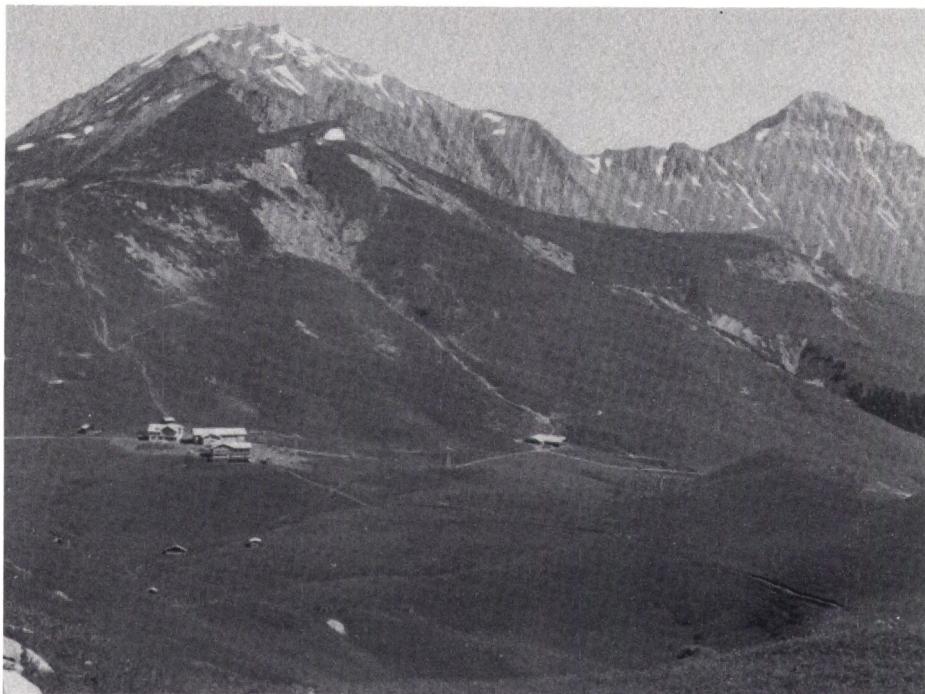
Set against a stunning mountain backdrop, model glider pilots can look forward to a truly memorable flying experience.
With the airfoil profiles used by the model flying school, a certain level of optimization appears to have been achieved today. While there are still various new profiles being developed in full-scale glider construction, these are not currently being considered, as they do not meet the objectives of model glider design.
The first project undertaken by the model flying school was the LS-1 with a 3-meter wingspan, which marked the first use of the Worthman airfoils adopted from full-scale glider construction.
After this model confirmed its expected good performance in actual flight operations, the idea arose to build a version of this model with a wingspan of approximately 5 m.
During a fall weekend gathering of the model flying school, this “super bird” was able to take to the skies for the first time.
Anyone who has ever had the opportunity to see this model in flight is impressed in every respect. In flight, the model is indistinguishable from the original glider, and its performance can be described as outstanding.
The effort required to build such a model is, of course, considerable, and not everyone has that much spare cash on hand; moreover, with its 5-meter wingspan and approximately 10 kg flight weight (about 100 gp/dm² wing loading), this model is hardly a “trunk model.”
Based on these facts and following widespread pressure, a slightly smaller and more manageable model was developed by the end of 1975 as part of the model aircraft school.
The NIMBUS II was developed and manufactured true to scale at 1:4.5 using an all-plastic construction. The technical specifications are:
| Wingspan | 4.51 m |
| Wing area | 80.4 dm² |
| Aspect ratio | 26.2 |
| Weight approx. | 4.5 kg |
| Area load approx. | 56.0 gp/dm² |
| Glide ratio (tested) | 30 |
| Model length | 1.63 m |
| In the root zone | FX 63–145 |
| in the aileron area | FX 60–126 |
| in the wingtip area | FX 60–100 |
| At the root rib | 23 cm |
| in the aileron area | 18 cm |
| at the wingtip | 10 cm |
The wing is constructed from laminated fiberglass half-shells and fiberglass spars. Although no supporting ribs are used, this construction results in a very clean and flexible wing.
Both the tail planes and the rudder are made of fiberglass-reinforced plastic. The fuselage is constructed using methods that are already conventional in model glider construction.
The wing mounts, which are cast into the wings, as well as the connections in the fuselage, are essentially based on the design principles used in large glider construction.
The wing is inserted into the fuselage fittings and securely anchored with two bolts. This results in a safe and sturdy connection between the wings and the fuselage.
The wing can also be constructed using a conventional balsa wood rib structure. However, this would likely not be feasible without a strut, due to the pronounced S-bend of the thin and tapered trailing edge of the airfoil.
A fiberglass reinforcement insert in the trailing edge is strongly recommended.
Such a conventional wing construction, however, requires a certain level of familiarity with model building.
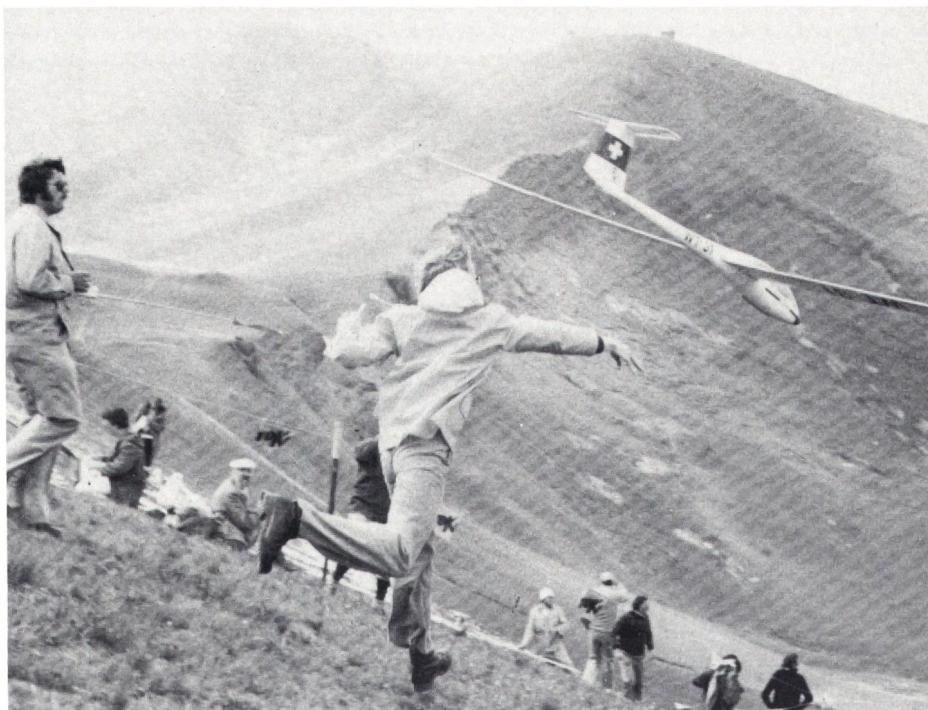
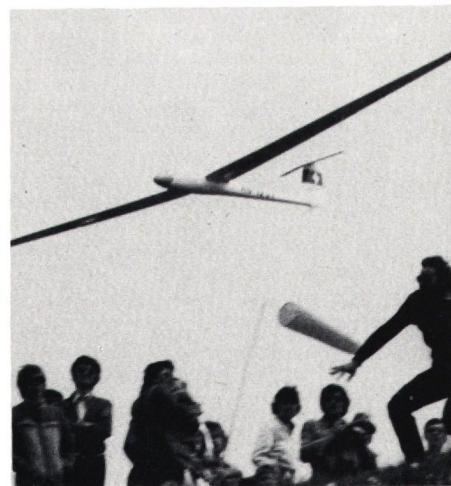
Peter Käufeler, MG Wettingen (on the left in the photo), at the takeoff of his ASW.
The NIMBUS II is controlled via ailerons, a pendulum, a T-tail, a rudder, and Schempp-Hirt air brakes.
Thanks to the selected airfoil set, the model impresses with its surprisingly docile flight characteristics.
For the airfoils used in model gliding to this day, the airfoil depth at the wingtip could not fall below a minimum of approximately 16 cm.
In the NIMBUS II, the airfoil depth was kept low by scaling the wing geometry to scale, which helped to take advantage of these profiles’ low drag and, through a careful selection of the airfoil set, prevent flow separation at the wingtip and in the aileron area at relatively low airspeeds.
The aspect ratio of the wing achieved through this design, combined with the low-drag profile, contributes to an exceptionally good glide ratio and excellent thermal performance.
Pilots who fly conventional model gliders with a wingspan of approximately 3 m initially tend to fly the NIMBUS II too slowly by pulling back on the control stick.
Watching such a tail-heavy flight attitude inevitably makes one break out in a sweat and shift from one foot to the other. You get the impression that the NIMBUS II is about to stall at any moment. But it’s a huge surprise when the pilot, even in this flight attitude, still finds the courage to initiate a turn—the model reacts immediately and shows absolutely no signs of stalling. But if it does happen, the stall can be recovered by correcting with the ailerons, and after a brief nose-dip, the Nimbus obediently continues flying straight ahead.
Although wind tunnel tests in Emmen have shown that, with the FX 60–126 airfoil, the flow remains clean over three-quarters of the airfoil depth, there is still no scientific documentation on these airfoils for model aviation.
However, it is known from a well-informed source that investigations with these profiles are currently being conducted in the high-laminar wind tunnel in Stuttgart. It is hoped that once this interesting work is completed, the results will be published.
Practical flight testing of the flight characteristics by the International Model Aircraft School at Hahnenmoos, however, confirms the accuracy of these findings.
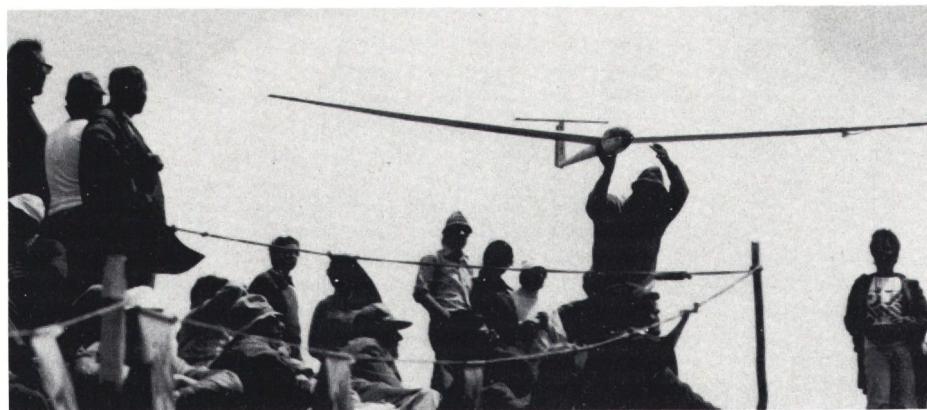
To get the most out of it—especially its excellent glide ratio and thermal flying characteristics—you’ll need to adjust your flying style quite a bit. This applies, by extension, to all new large glider models.
The model must be built very carefully and true to the design, and it must be flown in and trimmed for optimal performance. Once these conditions are met, the most important thing when flying is to have confidence in the established and trimmed flight attitude and to let the model fly with the best glide angle. Since we model pilots still rely solely on visual cues regarding speed and attitude, it takes some effort to resist the urge to pull back on the control stick when flying through downdraft zones and instead let the model fly through these zones as quickly as possible.
The relatively high airspeed—corresponding to the high glide ratio—combined with minimal altitude loss, allows the pilot to cover a great distance. This increases the chances of reaching a suitable
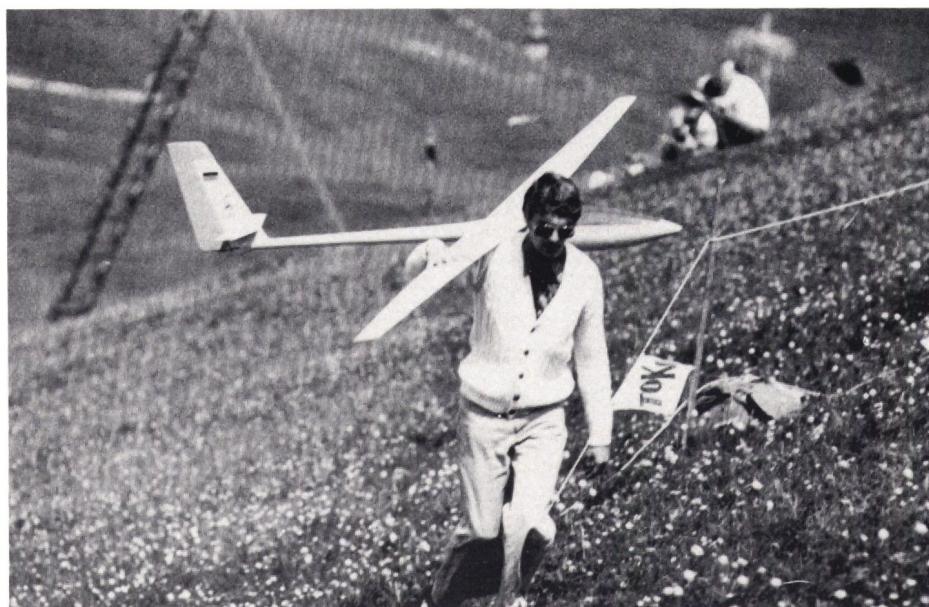
Retrieving the models is often physically demanding and has a distinctly athletic feel to it. Roland Kern/BRD with his SB-10.
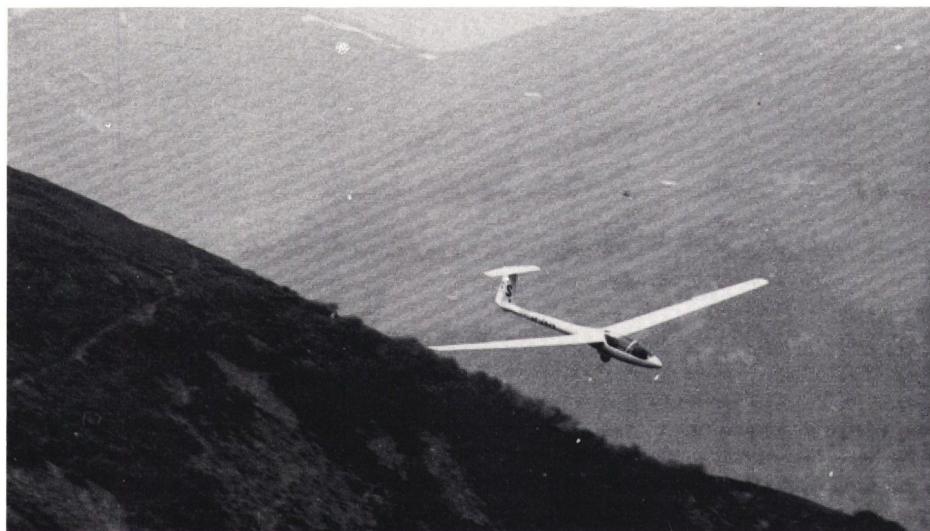
A 5-meter Jantar flying slowly by with its landing gear extended.
Look for an updraft tube. Any necessary control corrections must be applied gently and very gradually, because every full deflection of the control surfaces creates more drag and reduces performance. Your mental calculations should always be a few hundred meters ahead of the model.
A large model glider requires the greatest adjustment during landing. Due to its large dimensions, greater mass, and greater inertia in response to control inputs—especially during slow flight—the greatest attention must be paid to the planning of the approach. The use of air brakes is particularly helpful in this regard, especially if the approach is initiated at a slightly higher altitude than intended. The model must be properly arrested before touchdown. Special caution is required when landing on a leeward slope with a tailwind. Begin the approach with a steep angle of descent; do not approach too slowly; select a speed approximately 15% above the normal approach speed; and smoothly pull the model up along the slope’s profile until the airspeed is reduced to zero, and only then touch down. Deploying the air brakes during landings on the leeward side is very problematic, as the tailwind creates the impression of excessive airspeed, and once the air brakes are deployed, the model will most likely no longer respond to control inputs at all.
In my opinion, this example of idealistic collaboration at the International Model Flying School—in the development of model gliders and the sharing of the knowledge gained with course participants—demonstrates an ideal way to promote model gliding, especially at the highest competitive levels, and deserves our thanks and recognition.
As the success of the Hahnenmoos International Model Flying School began to take shape, there arose a desire to gain an overview of the latest developments in the model gliding sector.
When Uwe Gewalt from Reutlingen, who shared this same idea, approached Christian Ruch, nothing stood in the way of a large glider gathering at Hahnenmoos in 1974.
Seventeen participants gathered for a weekend in the Bernese Oberland to share their experiences. Christian Ruch’s 5-meter LS-1 was, of course, a major draw for the slope-flying specialists from the Teck region.
A year later, the number of participants had already grown to 27, and this year there were as many as 38.
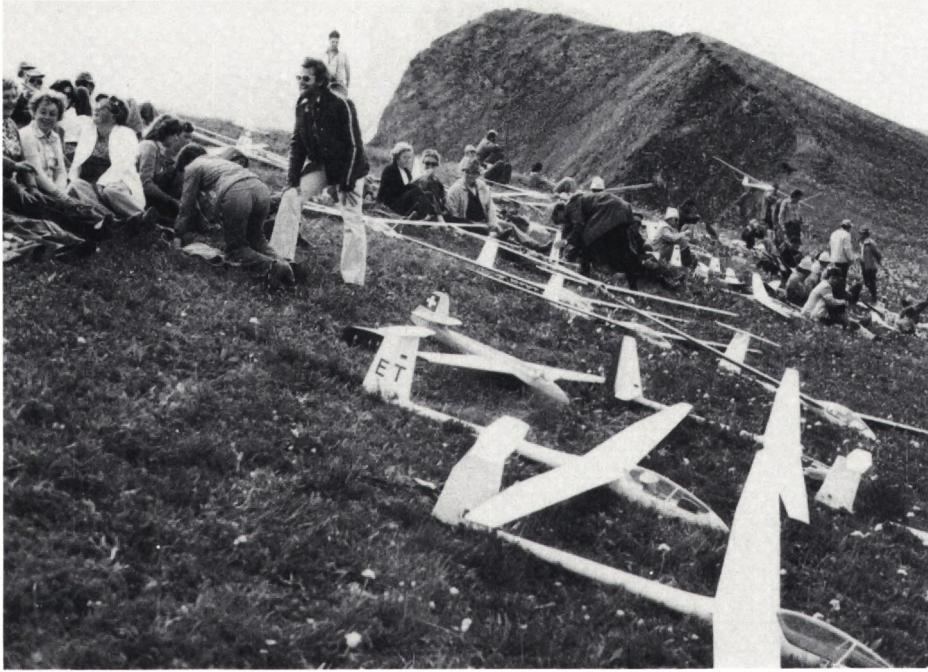
On Saturday afternoon, amid a relatively strong westerly wind, everyone gathered on the Laveygrat for a large gathering. With this relatively strong wind, the model aviators from Teck—who are particularly well-suited to such conditions—naturally got to show off their skills.
On Saturday evening, after dinner, everyone gathered down in Adelboden for film screenings and a get-together.
On Sunday, during the simple performance comparison competition—when only a light westerly wind was blowing at Schalmly and making the most of the thermals was of great importance—the criteria were adjusted slightly. Here, only the aerodynamically well-designed model gliders came into their own. When you can, so to speak, draw on the full potential of the model—as was the case on Saturday—it doesn’t matter if the air brakes aren’t aerodynamically cleanly adapted to the airfoil surface. Some people might enjoy “hearing” their model whiz back and forth along the edge of the slope, but when it really comes down to full performance, those pilots are out of the running.
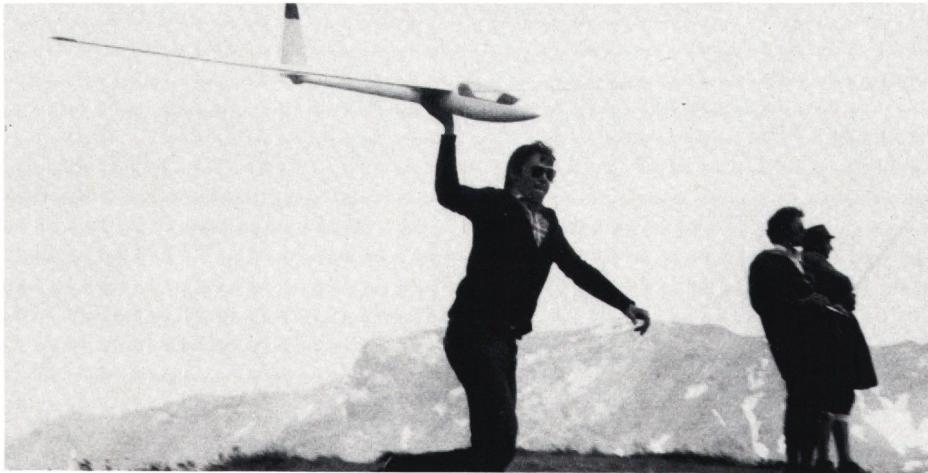
In any case, it was worth being there. Approximately 450 people—pilots and spectators combined—were counted during the competition. Many people went home that evening with new experiences. It would be wonderful if some of these spectators were to actively participate next year, which could lead to a majority of Swiss participants.
Christian Ruch comments on this topic: During this year’s course at the International Model Aviation School, a decision was made to promote flight development in the near future. To this end, we will be undertaking a cross-country flight. Objective:
Cross-country flight combined with a hike from the Hahnenmoos Pass over the Lavey Ridge to the Albristhorn and back. Approximately 5 km as the crow flies, with an elevation gain of about 800 m. To achieve this goal, it will be necessary to explore the planned route in sections, step by step, just as is done when planning cross-country flights for gliders. These explorations will need to proceed in parallel with further training in meteorology. Such a task makes it abundantly clear that even high-performance model gliding cannot bypass the development that has taken place in conventional gliding. For this reason, anyone interested in the advancement of model gliding is encouraged to study the gliding books *SEGELFLUG UEBER DEN ALPEN* by J. v. Kalkreuth and “STRECKENFLUG” by Helmut Reichmann, in which topics such as aviation meteorology, slope and thermal updrafts, their formation and development, wave soaring, and much more are covered in depth.
Another key focus for the future will be on the exchange of information and establishing contacts to expand theoretical knowledge, publish the results of development work, and define common goals.
In the more distant future, model glider pilots must have access to systems for transmitting necessary flight data such as altitude, changes in altitude (vario), airspeed, and flight attitude. In other words, actual feedback from the model to the pilot.
Only when these systems are available will it be possible to continue working on further refinements in the airfoil sector; then we would be able to obtain accurate measurement data on actual flight performance with relatively little effort and possibly even record this data. At that point, it will also make sense to use model gliders equipped with flaps.
Finally, a word about flying model aircraft weighing more than 5 kilograms.
According to both the FAI competition regulations and the liability insurance provisions of the Swiss Aero Club, model airplanes may have a maximum flight weight of 5 kg. Similarly, Swiss aviation law limits the maximum flight weight for model airplanes to 5 Kp.
The Aviation Ordinance requires that model aircraft with a takeoff weight exceeding 5 Kp undergo an inspection by the Federal Aviation Authority. However, this inspection is limited to assessing potential hazards to third parties.
In practice, it works as follows: Anyone intending to operate a model aircraft with a flight weight exceeding 5 Kp must request the registration forms by phone from the Federal Aviation Office in Bern.
These completed forms, along with technical specifications, a photograph, and proof of liability insurance for this model, must then be submitted to the Federal Aviation Authority in Bern. (Liability insurance with a minimum coverage of CHF 250,000.)
The pilot will then receive authorization or registration from the Federal Aviation Authority, along with a plate bearing the registration number, which must be affixed to the model.
We ask all model aircraft pilots who own such a model and intend to fly it to make this truly minimal effort to have their model properly insured and registered with the Federal Aviation Authority. You will be doing model aviation a great service.
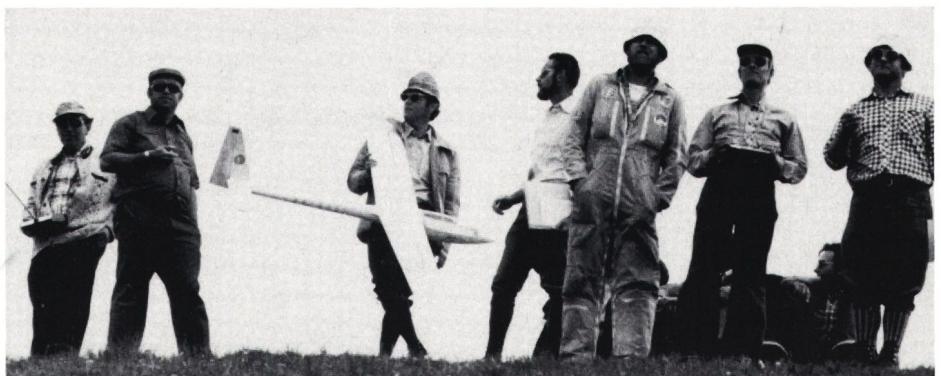
Christian Ruch (in his flight suit), pioneer, supporter, and tireless driving force behind the Hahnenmoospass High-Alpine Gliding School.


News from HEBU

TEAM MANAGER "THIS" BOSSHARD
 Rodito Nussbaumer

SUMMER FUN 2026 AT MG USTER
Martin Wunderli
BY YOUTH, FOR YOUTH
Lorena Betschen
SMALL, MODEL-LIKE SAILBOATS
Res Dauwalder
TRY-OUT DAY AT MFV WETTINGEN
Urs Keller
What's New at Leomotion.com

52. 2026 ALPS CUP
 Emil Giezendanner

ATOM, THE NEW DOUBLE-DECKER FROM CPLR
 Matthias Bosshard

INSIGHTS INTO THE HISTORY OF SEAPLANES

YOU KNOW WHAT I MEAN? 125 YEARS OF THE SWISS AERO CLUB
Emil Giezendanner
34th HAHNENMOOS ALPINE MODEL AIRPLANE CAMP
Res Dauwalder
CORSAIR F4U – A WARBIRD WITH A MEMORABLE LOOK
Jürgen Rosenberger, Jürgen Prinz
F3A EUROPEAN CHAMPIONSHIPS IN ST-MACAIRE, FRANCE
Matthias Bosshard
HORIZON HOBBY/LEMACO NEWS: MICRO OV-10 BRONCO 645 MM BY E-FLITE

PRIDE AND GOOD IDEAS
 Markus Nussbaumer

EURO CONTEST GLIDER ACRO TOUR AUSTRIA 2026

FREE FLIGHT IN THE MIDDLE OF SUMMER
Urs Muntwyler
THE PC-21 STORY
Emil Giezendanner
TWIN TOWN PARTNERSHIP
Wolfgang Voeller
WELCOME, NEW MEMBER!
Andrea Bolliger
COUPE DES ALPES – OBSERVE AND LEARN
Rodito Nussbaumer
NEWS FROM HEBU
 Julia Bucher

FROM 0 TO 100
Markus Nussbaumer
MEMORIES
Wolfgang Völler
NOS REGION – A HUB FOR ELECTRIC AVIATION
Emil Giezendanner
Have you almost forgotten about aircraft that take off and land vertically?
Emil Giezendanner
70 YEARS OF THE NIDWALDEN MODEL AIRPLANE CLUB
Martin Barmettler