
Plastic glider with Rotowing aileron mechanism
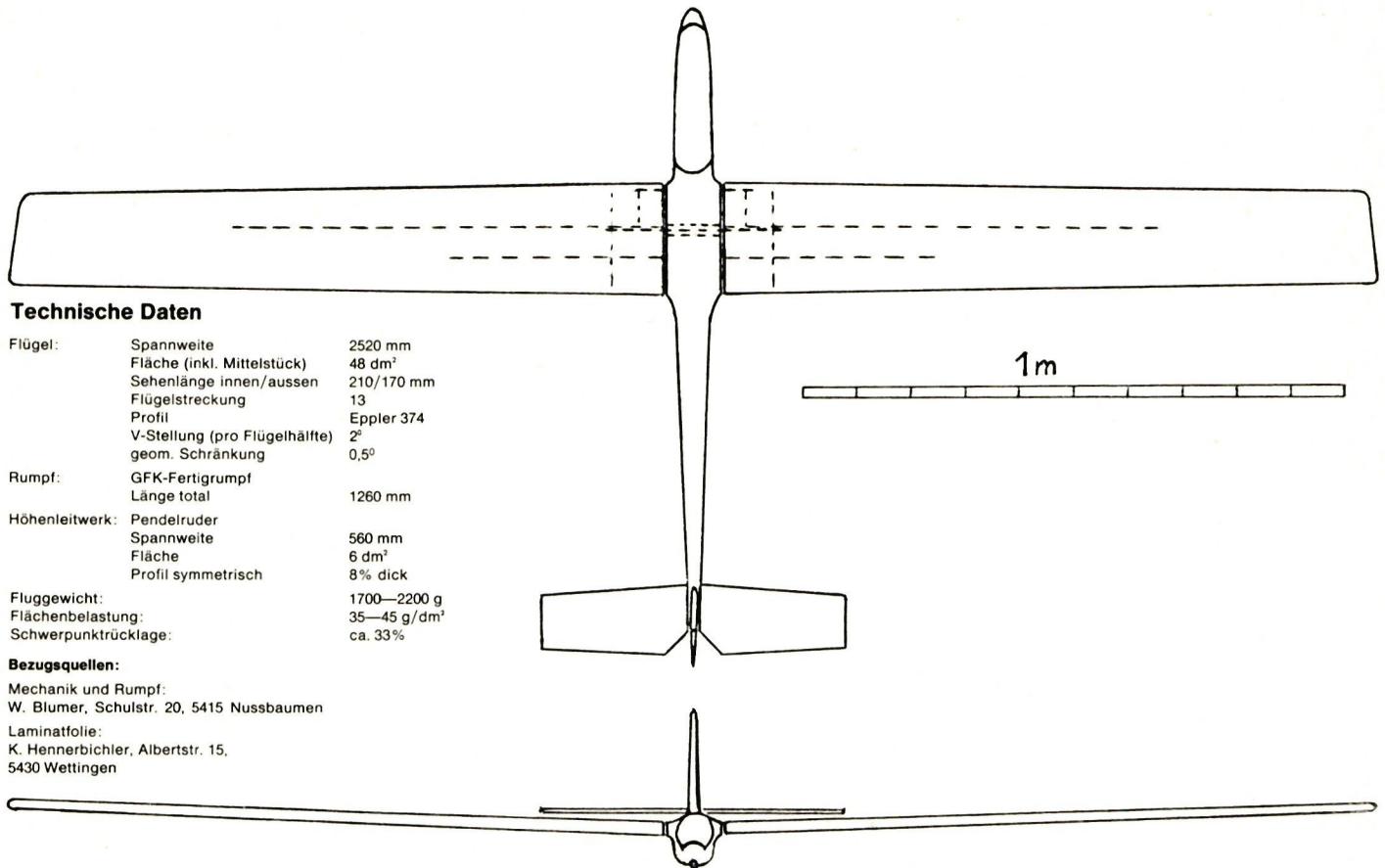
| Wingspan: | |
| Wingspan | 2520 mm |
| Surface area (including center section) | 48 dm² |
| Chord length (inner/outer) | 210/170 mm |
| Wing span | 13 |
| Profile | Eppler 374 |
| V-angle (per wing half) | 2° |
| Geometric skew | 0.5° |
| Fuselage: | Prefabricated fiberglass fuselage |
| Total length | 1260 mm |
| Horizontal stabilizer: | Pivoting rudder |
| Wingspan | 560 mm |
| Wing area | 6 dm² |
| Airfoil | symmetrical, 8% thick |
| Flight weight | 1,700–2,200 g |
| Wing loading | 35–45 g/dm² |
| Center of gravity offset | approx. 33% |
Sources:
Mechanics and fuselage:
W. Blumer, Schulstr. 20, 5415 Nussbaumen
; Laminate film:
K. Hennerbichler, Albertstr. 15,
5430 Wettingen
Wing halves that can be twisted relative to each other as a replacement for ailerons—that’s an idea that has likely crossed the minds of quite a few model builders. To the best of our knowledge, the first functional solution to this problem—one that has been proven in flight—is the Rotowing aileron mechanism developed by Hanspeter Senn. The system is virtually ideal for fast and agile slope gliders.
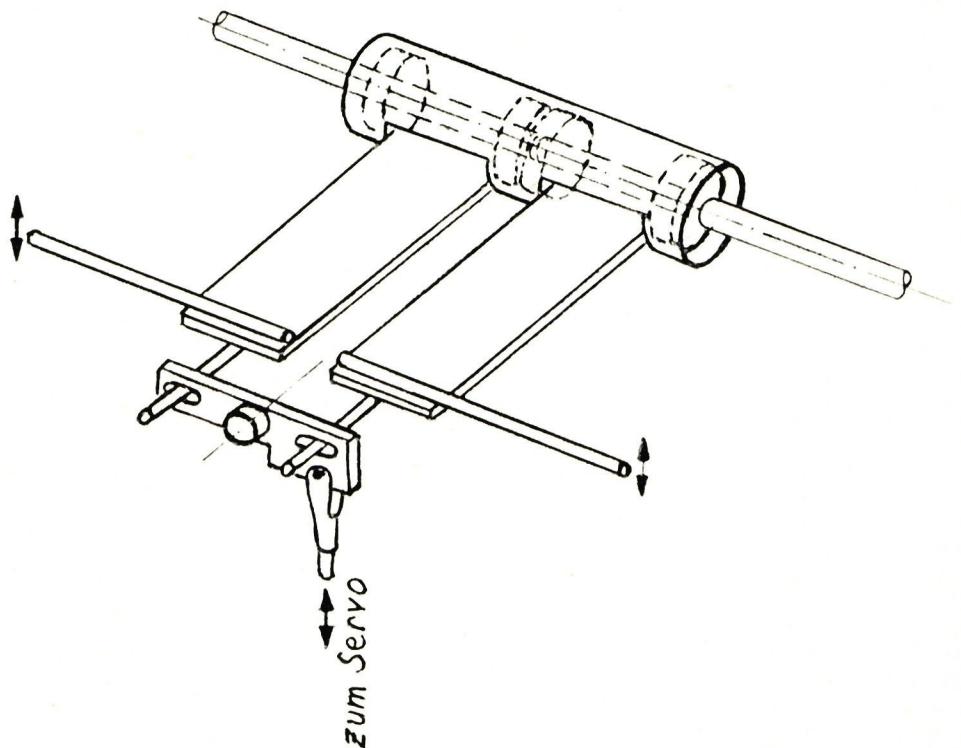
A detailed description can be found in issue 10/1973 of *Aero Revue*, so we can limit ourselves to a brief explanation of the operating principle (see sketch). The pivot axes of the two wing halves are formed by two sturdy pins (6 mm Ø), each of which is mounted in an aluminum sleeve secured to the fuselage via two ball bearings. Turning a rocker arm deflects two tabs, whose movement is transmitted to the wing halves by two thin pins. It is recommended to use precise and, if possible, play-free rudder servos to drive this aileron mechanism.
The wings are made from a foam core covered with a 0.15 mm-thick fiberglass laminate sheet. This construction method was described in detail in issue 4/1974 of *Aero Revue*. This method allows for the production of wings with an almost razor-sharp leading edge and high torsional and flexural strength. Those who prioritize high profile accuracy must proceed with great care when fabricating the core, as it is no longer possible to rework the profile contour after gluing. “Styrofoam” is an excellent core material due to its completely uniform structure. It can be cut with a hot wire or a sharp knife and can be carefully reshaped with sandpaper.
Special attention should be paid to fitting the wings to the fuselage and ensuring minimal gap width. A flexible sealing lip could be advantageous, as it would completely prevent flow separation between the underside and top of the wing.
The model stays in the air surprisingly well even under high wing loading and is completely easy to fly for a moderately experienced pilot. Even in slow flight, the glider responds very smoothly to large aileron deflections. However, it really comes into its own at higher speeds, and that’s when flying it becomes truly enjoyable.


TEAM MANAGER "THIS" BOSSHARD
 Rodito Nussbaumer

YOU KNOW WHAT I MEAN? 125 YEARS OF THE SWISS AERO CLUB
 Emil Giezendanner

F3A EUROPEAN CHAMPIONSHIPS IN ST-MACAIRE, FRANCE
 Matthias Bosshard

News from HEBU

SUMMER FUN 2026 AT MG USTER
Martin Wunderli
TRY-OUT DAY AT MFV WETTINGEN
Urs Keller
52. 2026 ALPS CUP
Emil Giezendanner
BY YOUTH, FOR YOUTH
Lorena Betschen
ATOM, THE NEW DOUBLE-DECKER FROM CPLR
Matthias Bosshard
CORSAIR F4U – A WARBIRD WITH A MEMORABLE LOOK
Jürgen Rosenberger, Jürgen Prinz
SMALL, MODEL-LIKE SAILBOATS
Res Dauwalder
What's New at Leomotion.com

TWIN TOWN PARTNERSHIP
Wolfgang Voeller
EURO CONTEST GLIDER ACRO TOUR AUSTRIA 2026

INSIGHTS INTO THE HISTORY OF SEAPLANES

34th HAHNENMOOS ALPINE MODEL AIRPLANE CAMP
Res Dauwalder
HORIZON HOBBY/LEMACO NEWS: MICRO OV-10 BRONCO 645 MM BY E-FLITE

COUPE DES ALPES – OBSERVE AND LEARN
Rodito Nussbaumer
PRIDE AND GOOD IDEAS
 Markus Nussbaumer

FREE FLIGHT IN THE MIDDLE OF SUMMER
Urs Muntwyler
THE PC-21 STORY
Emil Giezendanner
WELCOME, NEW MEMBER!
Andrea Bolliger
NEWS FROM HEBU
 Julia Bucher

FROM 0 TO 100
Markus Nussbaumer
MEMORIES
Wolfgang Völler
NOS REGION – A HUB FOR ELECTRIC AVIATION
Emil Giezendanner
Have you almost forgotten about aircraft that take off and land vertically?
Emil Giezendanner
70 YEARS OF THE NIDWALDEN MODEL AIRPLANE CLUB
Martin Barmettler