
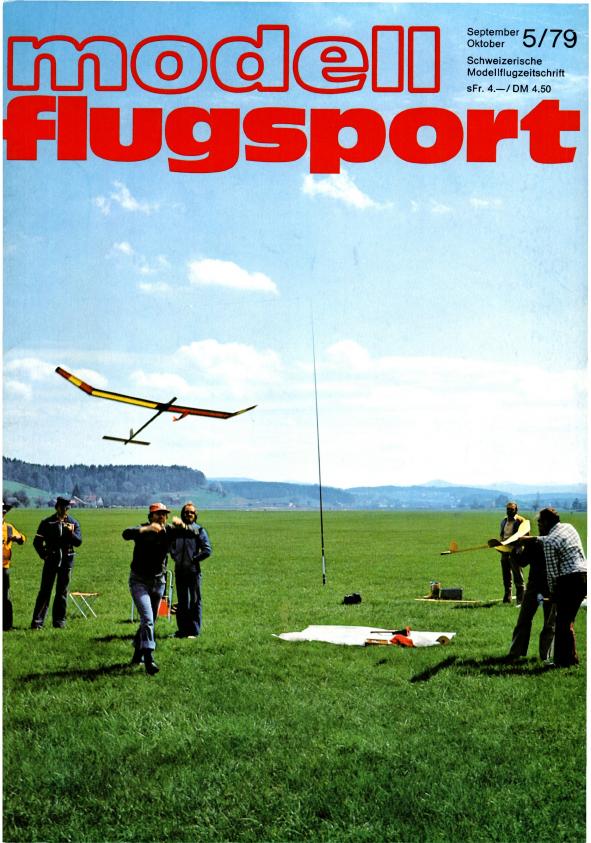
Israel – once with a model airplane
Jan. 15, 1977, Cirrus cl, 20 m
Ramatelihu, Akb 40 m, GS 2 High 5
Competition according to FAI 1. 6 min ideal time + precision landing 2. Fly 150 m as many times as possible in 4 min (1500) 3. Fly 300 m as fast as possible (21 sec) Rank = ...
... well, I don’t want to give everything away. On Sabbath morning, Amos wakes me up at the youth hostel. In no time, my glider is loaded into the car. We arrive at the already bustling competition site. I wonder what our Swiss friends in the overcrowded Region 5 would give for a place like this?—Completely flat, not a rock, not a tree, not a farmer coming toward us with wide eyes.
I make my first practice launch. It’s quite a strange feeling, flying right in the middle of the desert. I frantically search for a slope so I can catch a thermal. But as I said, there’s no slope or anything like that. I cruise around the area a bit and then attempt a hand landing, which works out.
The call is made for the competition briefing. It’s incredibly interesting what Mose, the director, has to say. The only problem is, he’s speaking in Hebrew, and I don’t understand a word. But Amos is kind enough to translate the most important points into English, the language I use most often in Israel.
We’re flying according to the FAI rules: 6 minutes of ideal flight time + target landing = first round. Second round: fly the 150-meter course as many times as possible within 4 minutes. The third round was to cross 300 meters as fast as possible. I’ve already competed in all kinds of glider competitions, but I have to say, flying according to these rules was the most fun I’ve had—even though the luck factor here probably isn’t less than 30%, even for a good pilot (70% skill, 30% luck).
When I asked about the starting order, Mose just looked at me in bewilderment and asked what I meant. I started drawing with my finger in the sand to illustrate my explanation. It turned out that there was no such thing. Everyone just says when they want to fly, and that’s that. Furthermore, there’s no transmitter fee and no measuring tape for the target landing—a competition “Made in Israel.” To the organizers’ credit, it must be said
that no model crashed due to radio interference, nor was there any confusion in the scoring. And personally, I felt a lot more at ease at this event than at an RCS slope, where everything is meticulously planned, measured, and monitored (I’m thinking of those honorable comrades who raise a huge ruckus when a number is missing or isn’t in the right place!).
I decide not to be the first one out of the gate this time—that is, I’ll let my competitors go first in the first round and take the time to check out the aircraft lineup of the (approx. 22) participants. The Windfree, an American model, really catches my eye. It stands out for its manageable size, trouble-free flight, and clean construction. This is the model I’ve encountered most often. The English Ridge Rover is also present—a real gem whose only flaw is that hardly any pilot can handle it. In addition to quite a few homemade models, I also spot another Cirrus and, last but not least, one of those darn… Hobie Hawks (the only model I can definitively say is superior to my Cirrus in competitions).
A burning desire to prove myself as a pilot overtakes me, and I immediately start organizing a high-launch opportunity. After releasing the glider, I search in vain for a thermal, but not a single little air current strays near my glider. The result is a short flight (about 4 minutes) plus a landing that goes completely wrong. – That’s a great start.
The other pilots, of course, have a lot of questions, and vice versa. Suddenly, someone at the transmitter gets nervous. I look up at the sky and see a Windfree shooting upward on its line, but the model isn’t climbing smoothly as usual—instead, its nose keeps dropping and rising constantly, and after release, the thing even goes into a tailspin. An older model pilot takes the transmitter in hand; the plane flies better, but still not smoothly. After a while, the model touches down—what happened? The pilot had attached the elevator and rudder the wrong way around and only noticed it once in the air—so “The grass over the hill is green” after all.
I’m getting ready for the second event: the longest possible distance in 4 minutes. It’s going better than on the first flight; above all, I have
A good starting elevation, but I still can't make it past 600 meters.
Things really come to life in the final run: speed. Many people now add up to 300 grams or more of ballast to their gliders. Strangely enough, this extra weight doesn’t help at all. The Hobie Hawk manages to cover the 300 meters in 21 seconds; I come in second in this round with 24 seconds. We both flew without ballast; it’s worth noting that the Cirrus is utterly unsuitable for speed flying, which would seem to confirm my 70 and 30% theory a bit more.
I ask if there will be a second round. To my delight, the answer is no—but I see the majority of the participants carefully packing their gear into their cars and driving off. They’ve probably lost interest. Now there are only five of us left.
We start all over again. This time, luck is more on my side. Right at the start, I catch a pretty good thermal but forget to plan my landing properly; I come shooting down from the sky like lightning; I think to myself that I’ll use a touch-and-go landing to burn off the excess speed. The “touch” part worked, but the “go” part didn’t. The nose of the fuselage immediately dug into the sand, then a little cloud appeared, and my red thing stood there like a sawhorse. I measure twelve steps—the Israelis call them meters—from the ideal point. The flight time, however, is impressive: exactly six minutes, not a second more or less.
During the cross-country flight, there’s another thermal that I ride quite high; afterward, I glide along the measured course. I cross it ten times, covering a distance of 1,500 meters. In the speed category, I manage, if not to beat the Hobie Hawk, then at least to tie it (= 21 seconds).
Satisfied with myself and my surroundings, I stow my glider in Amos’s car and, once again, almost forget the radio bag.
Amos personally informs me of the results of this weekend competition two weeks later. He does it quite simply, shakes my hand, and says, “You won!” Here’s the rest of my flight log entry: 1st place (out of 15) with 2,908 points, 2nd place with 2,403 points, 3rd place with 2,340 points.
You can imagine that I wasn’t very pleased when I returned to Tel Aviv from a trip to the Sinai and found an invitation to the Israeli Championships, but the registration deadline had already passed a few days earlier—C’est la vie. Amos’s words weren’t much of a consolation either when he said I’d had a chance to become champion, since competitive gliding is still in its infancy here. Two days after that competition—on January 17—Amos and I were flying again at our usual slope by the sea. We’d both taken off after sunset and were leisurely circling. Then suddenly something happened that I still can’t explain to this day. My glider began to
I’m losing altitude. Well, I think to myself, the updraft will die down—I’d better land. Just then, I hear a crack below me—Amos has crashed into the cliffs; that means it’s a total loss. Now I, too, am in serious trouble; the glider rears up and veers out toward the sea. With great difficulty, I manage to steer my Cirrus back toward the beach. It touches down in the water but still comes to a stop on land. I sprint down to the beach, take a closer look at the glider—the canopy is a bit damp, but the cockpit is dry, aside from a few splashes. “Hey Amos, we came crashing down like rotten plums from a tree!” – “Yeah, it broke my wing here—it’ll be back in the air in a week. What’s wrong with yours?” – “Nothing really—the Vulture just got a little wet, that’s all.” Amos advises me to open the canopy immediately and dry even the tiniest spot of water. At the restaurant—it’s night by now—I take the control unit apart down to the last detail, following Amos’s advice. Amos explains to me that saltwater can act like acid if it gets into the electronic components. It turns out that the prismatic batteries are beyond repair—the rest of the system is still usable, though from now on I’ll only be able to fly with store-bought transistor batteries—once again, a blessing in disguise. How I got the glider to the cliffs is a story in itself. I usually took the often overcrowded No. 25 bus to the university. The bus drivers’ driving style (apparently with only two positions on the accelerator pedal: full throttle and idle) didn’t exactly contribute to the safety of the journey. Despite all the hustle and bustle and jostling, though, nothing on the glider ever broke on the bus. Another time, Nissim, the cook, wanted to know what the Cirrus looked like in the air. On the spur of the moment, we hopped on his Vespa and off we went through the traffic chaos. It must have looked funny, with me holding the transmitter bag and the fuselage in my right hand, the wings in my left, all while carefully keeping my balance!
On January 29, 1977, the flying is fun again. I’m steering my glider at ridge height toward Tel Aviv, intending to turn around, and that’s when it happens; I can’t get the glider to turn anymore; it keeps veering toward the cliffs, but doesn’t actually hit them, and completes a circle, nose pointing toward the lake. I look desperately at my transmitter—this can’t be happening—no power on the battery indicator! —I shake the transmitter, and lo and behold, the Cirrus obeys again and I land it immediately in the sand. The diagnosis should be simple: a loose connection. Amos took a closer look at my transmitter, and right away he didn’t like the battery holder— “Can you solder batteries?”—“I’ve never done it before.”—“Beseder (good in Hebrew), be in your room at seven o’clock tonight; I’ll bring the soldering iron—we’ll figure it out.”
That evening, my room looks like an operating room. The table is set up in the middle of the
He pushes the room aside, pulls up a chair, and Amos appears. “I’m in a bit of a hurry,” he says, sitting down right away and trying to make sense of the tangle of wires connecting the individual pin cells—and he seems to be succeeding. He picks up the soldering iron and the untangled solder and gets to work. After just under a quarter of an hour, the cells are professionally connected; wrapping them with electrical tape is a routine matter—and, besides, my problem. “Goodbye, Amos, and thank you very much”—Bewacascha (that’s fine), and Amos is gone as quickly as he came. I take another look at the solder joints; they’re really well done—I could really take a cue from Amos when it comes to soldering.
My model caused quite a stir in Jerusalem’s Old City. First of all, I was surprised by the Israeli soldiers who were already stationed at the gates of the Holy City in full combat gear (radios on their backs, batons, machine guns, etc.). No wonder—it was the eve of the Jewish national holiday, and they were preparing for terrorist attacks and unrest. What particularly surprised me was that none of the soldiers inspected me more closely. Not so the Arabs. Along the way, I counted three of them who wanted to buy my model. I don’t think they knew what a Segler was, but they wanted it—apparently at any cost.
My last airfield in Israel was also extremely interesting from a historical perspective. It was Latrun. A mishmash of a Crusader castle, dilapidated bunkers, and trenches, spiced with barbed-wire fences and waist-high brush. All of this situated on a hill overlooking a plain. In short, promising for thermals, but a nightmare for landing.
It was here that Shlomo Shamir’s Seventh Brigade had suffered one of the bloodiest defeats in modern Jewish history. Here’s how it happened: During the First War in 1948, this brigade was hastily thrown together. Some came straight from German concentration camps; others from all corners of the world. They’d been in the country for less than 72 hours and often had no idea how to handle a rifle. This unit was tasked with capturing the strategically important ridge above the Trappist monastery. But they had to fight not only against the Arabs in their bunkers, but also against the heat, insects, thirst, and clouds of smoke. The Arabs had, in fact, set the wheat fields on fire, just as Samson (a biblical figure) once did. Officially, seventy-five Jews were killed. If you ask historians, the number must have been much higher.
I didn’t fly up there all that much; landing really wasn’t any fun. But there was plenty of activity in the air around me. I watched a crop-dusting plane ahead of me that, after finishing its work, began its return flight at such a low altitude that the pilot had to pull up whenever a car was on the road. Very close to the yellow crop-dusting plane, a military helicopter appeared to be searching for its home base—
The airport—not even fifty meters above the ground, of course—and right above me I could make out a twin-engine Dakota chugging its way toward Tel Aviv. One is tempted to say, “thick air in thin clouds.”
I also frequently observed storks migrating northward from the south, from Egypt. There were times when the birds formed a giant, stationary “Z” in the air. They flew, one behind the other, up to a good eighty meters above the ground. The lead birds spiraled upward in a thermal shifted by the local wind. Once the lead stork had reached an altitude of, say, five hundred meters, it set a northerly course. Thus, this route formed a giant “Z.” I still wonder today how the “phantom pilots” are able to track the birds. I can well imagine that a jet engine might look pretty beat up if a stork had flown right through it.
Unfortunately, time did what makes it so unpleasant—it passed—and my departure date, May 16, was drawing ever closer.
From Latrun, I took a Scherud—
A taxi—an eight-seater vehicle with a large roof rack and an adventurous driver. The driver secured the sailboat, and we headed toward Tel Aviv. After a few kilometers, I could hardly believe my eyes: I could see in the shadow of the taxi that my model was now attached only at the rear; the rest was hanging in the air, lifted by the wind, and looked as if it were about to detach completely from the stand. I alerted the driver to the predicament my glider was in. After we stopped, I realized: the elevator and ailerons were missing. The tail had broken free and was nowhere to be found. You just have to expect certain losses!
The return flight to Switzerland goes smoothly. The DC-10 leaves Israeli soil at 8:15 a.m., and a magnificent flight over Greece and Italy brings my trip to the Wild East to a close. An idea—one is tempted to call it a crazy one—conceived on a foggy, cold November day in 1976, was carried out. I can’t promise anyone heaven on earth, but I can recommend it: Israel with a model airplane.

TEAM MANAGER "THIS" BOSSHARD
 Rodito Nussbaumer

F3A EUROPEAN CHAMPIONSHIPS IN ST-MACAIRE, FRANCE
 Matthias Bosshard

News from HEBU

YOU KNOW WHAT I MEAN? 125 YEARS OF THE SWISS AERO CLUB
 Emil Giezendanner

SUMMER FUN 2026 AT MG USTER
Martin Wunderli
TRY-OUT DAY AT MFV WETTINGEN
Urs Keller
52. 2026 ALPS CUP
Emil Giezendanner
BY YOUTH, FOR YOUTH
Lorena Betschen
ATOM, THE NEW DOUBLE-DECKER FROM CPLR
Matthias Bosshard
CORSAIR F4U – A WARBIRD WITH A MEMORABLE LOOK
Jürgen Rosenberger, Jürgen Prinz
SMALL, MODEL-LIKE SAILBOATS
Res Dauwalder
What's New at Leomotion.com

TWIN TOWN PARTNERSHIP
Wolfgang Voeller
EURO CONTEST GLIDER ACRO TOUR AUSTRIA 2026

INSIGHTS INTO THE HISTORY OF SEAPLANES

34th HAHNENMOOS ALPINE MODEL AIRPLANE CAMP
Res Dauwalder
HORIZON HOBBY/LEMACO NEWS: MICRO OV-10 BRONCO 645 MM BY E-FLITE

COUPE DES ALPES – OBSERVE AND LEARN
Rodito Nussbaumer
PRIDE AND GOOD IDEAS
 Markus Nussbaumer

FREE FLIGHT IN THE MIDDLE OF SUMMER
Urs Muntwyler
THE PC-21 STORY
Emil Giezendanner
WELCOME, NEW MEMBER!
Andrea Bolliger
NEWS FROM HEBU
 Julia Bucher

FROM 0 TO 100
Markus Nussbaumer
MEMORIES
Wolfgang Völler
NOS REGION – A HUB FOR ELECTRIC AVIATION
Emil Giezendanner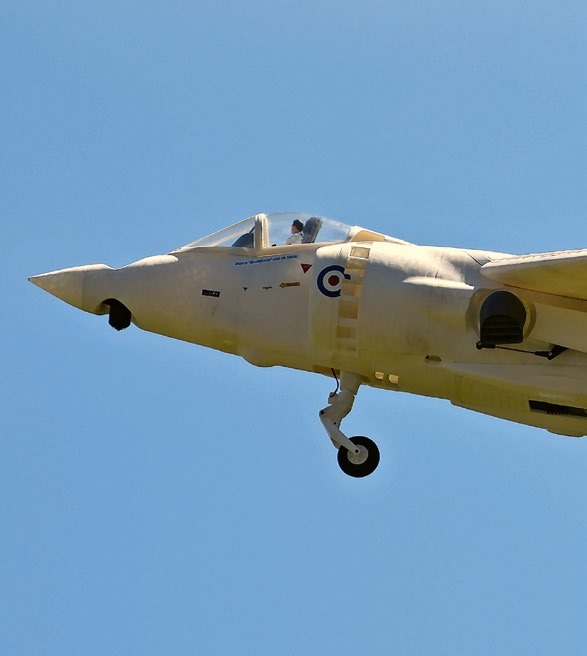
Have you almost forgotten about aircraft that take off and land vertically?
Emil Giezendanner
70 YEARS OF THE NIDWALDEN MODEL AIRPLANE CLUB
Martin Barmettler