
2.4 GHz: A Boon for Model Aviation (Part 2)
In the report “2.4 GHz: A Blessing for Model Aviation?” you may have read that a high number of model crashes were recorded at two flying fields involving models controlled by 2.4-GHz systems from various manufacturers.
In the spring of 2012, I conducted test flights at these locations to determine whether and how any interference might occur. First, I used a spectrum analyzer and broadband antennas to measure all existing radio signals between 80 and 5,000 MHz. I then began the test flights. The setup was as follows: I used an Easyglider model, whose wings were painted with orange reflective paint so it would be clearly visible even from a distance (I flew at distances of up to >1 km). As a receiver, I used a Multiplex receiver capable of return-path communication, equipped with bandpass filters in the antennas. I also attached a GPS module to always know the exact position and to record the flight path. I set the failsafe so that the glider would go into a stall as soon as the failsafe was triggered. The settings were determined through test flights, programmed, and tested by turning off the transmitter in mid-flight (not recommended during normal flight operations). An assistant monitored the reception quality at the transmitter, which was transmitted back by the receiver. To prepare for the flight, I studied the log of recorded crashes. I incorporated this information into the planning of the flight routes.
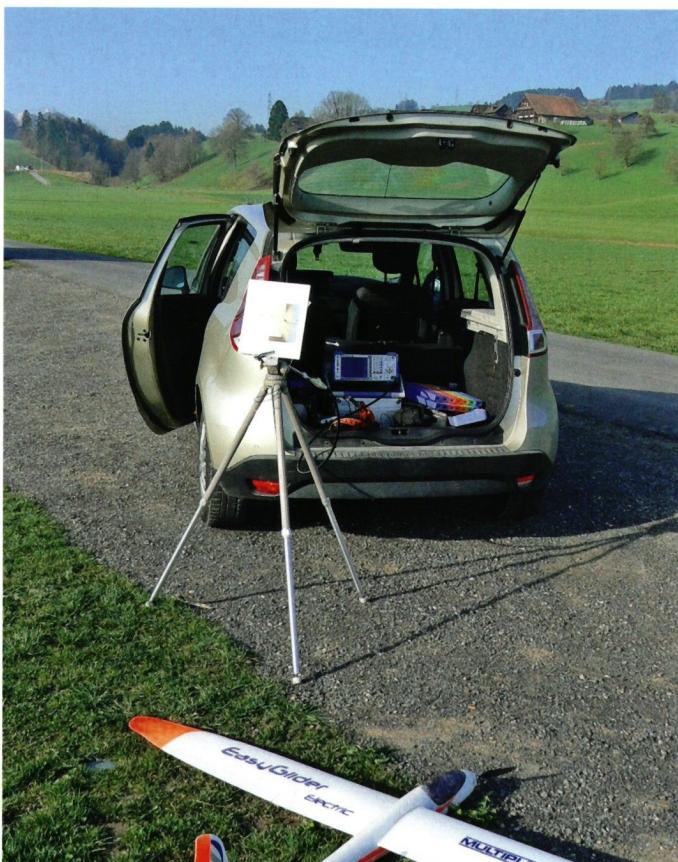
First, I used the spectrum analyzer to measure the existing signals. A range test confirmed that the transmitter and the electric glider were functioning properly. After takeoff, I brought the glider to the altitude specified in the journal as being above the crash site. I marked the flight path on the terrain. I was able to read the distance from the GPS. In this way, I flew over the critical points. Reception quality was continuously monitored and any changes were reported immediately. When flying over the area showed no interference, I flew over the same spot at various altitudes. I also expanded the flight path to see if there were any critical areas in the vicinity of the crash site. The result was surprisingly positive, as not a single dropout was detected. Then I approached the cell phone antenna tower with the model. I was able to fly in such a way that, in the event of an interference, the model would have glided to the ground in a stall. I flew closer and closer until I reached a distance of two wingspans from the radiating antenna. The model—or rather, the receiver—was unaffected. It didn’t react with reduced reception quality, servo fluctuations, or a failsafe. This confirmed the lab test results, which showed that an external transmitter outside the 2.4-GHz band does not cause interference on its own.
Once everything had gone well, I tested the influence of the antenna on the remote control transmitter. I angled the antenna so that the antenna rod pointed directly toward the model. And lo and behold, the reception quality dropped significantly (from 100% to as low as 70%). Just to test it, I wrapped one hand around the antenna (which, according to the user manual, should be avoided at all costs). This was promptly met with even worse signal quality. When a person stands directly and close in front of my transmitter, the same thing happens, though not as drastically as when touching it with my hand.
What could not be detected during the measurements at the airfield were interference levels within the ISM band. I deliberately chose a workday so that I could assume that Wi-Fi networks in the nearby industrial area would be active. Very weak Wi-Fi signals were detected on the spectrum analyzer, but their field strength does not interfere with flight operations. However, this does not mean that this situation will always remain the same.
The radio transmitter located near the airfield, 1 km away, broadcasts at 554 MHz with a radiated power of 10 kW. In addition, transmission stations from all three cell phone providers are installed and transmit at power levels in the kilowatt range. Measurements taken with the spectrum analyzer confirmed the signal strength to within 10%. The second round of measurements proceeded in the same manner as the first.
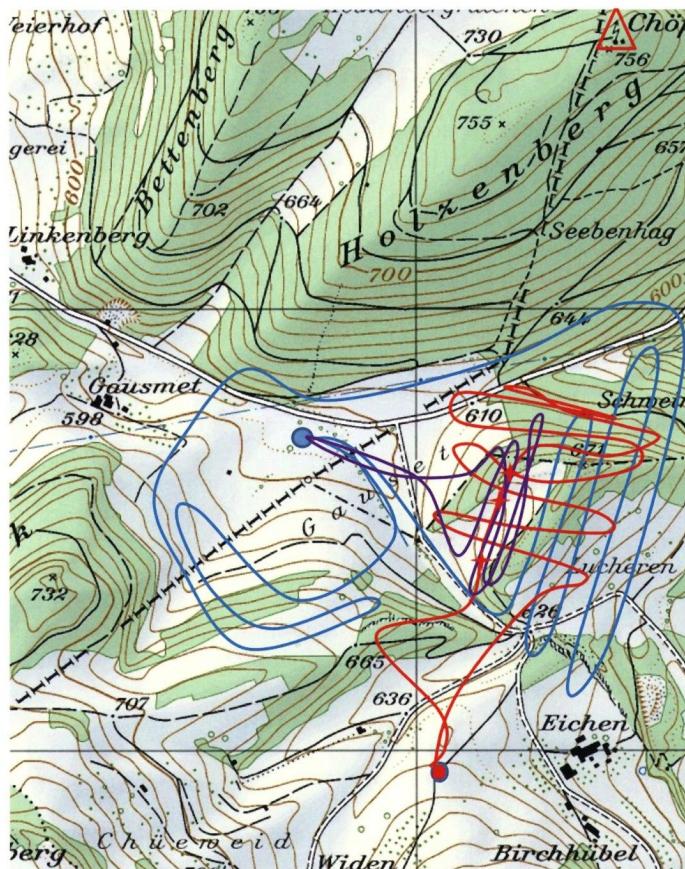
To ensure a clear view of the crash sites, the first flight did not take off from the airfield but from a nearby hill. The first flight was again conducted using the Easyglider, an MPX receiver, and bandpass filters in the antenna cables. The signal quality dropped to 90% at a distance of 1 km from the remote control transmitter and to 80% a few seconds later. No interference was detected.
Before the second flight, the filters were removed to see the difference between flying with and without them. To the surprise of everyone involved, no difference was noticeable when flying the same course.
Laboratory tests have shown that mixed signals can occur at the receiver that may interfere with the reception of the remote control signal; however, these signals must be significantly stronger than what was measured at the airfield. Additional test flights were launched from the airfield, this time without the bandpass filters. During the final flight, the entire area surrounding the airfield was flown over to see if interference would occur anywhere. Even during this final flight, neither signal loss nor model malfunction was detected.
- The 2.4-GHz remote control systems are highly resistant to external signals outside the 2.4-GHz band (as was also observed in the test cell).
- However, if broadband interference completely saturates the ISM band (multiple high-speed Wi-Fi networks operating simultaneously, possibly with signal boosters), temporary interruptions in data transmission (of the control commands) may occur, even with frequency hopping.
- What the tests revealed is that the transmitted signal at the receiver becomes much weaker when the transmitter antenna is pointed directly at the model. Covering the antenna with your hand has a disastrous effect. This should be avoided at all costs.
To measure and monitor the 2.4-GHz band—for example, at model aircraft events—the Infrastructure Department has purchased a mini-scanner with analysis software. This allows the spectrum to be checked using a laptop as needed and continuously monitored and recorded during events. Interference signals can be verified and located using a directional antenna. If a measurement is needed at an airfield or during an event, a request can be submitted to the Infrastructure Department. ■
SMV Infrastructure Department,
Paul Rudolf


TEAM MANAGER "THIS" BOSSHARD
 Rodito Nussbaumer

SUMMER FUN 2026 AT MG USTER
Martin Wunderli
52. 2026 ALPS CUP
 Emil Giezendanner

ATOM, THE NEW DOUBLE-DECKER FROM CPLR
 Matthias Bosshard

INSIGHTS INTO THE HISTORY OF SEAPLANES

34th HAHNENMOOS ALPINE MODEL AIRPLANE CAMP
Res Dauwalder
CORSAIR F4U – A WARBIRD WITH A MEMORABLE LOOK
Jürgen Rosenberger, Jürgen Prinz
SMALL, MODEL-LIKE SAILBOATS
Res Dauwalder
F3A EUROPEAN CHAMPIONSHIPS IN ST-MACAIRE, FRANCE
Matthias Bosshard
What's New at Leomotion.com

HORIZON HOBBY/LEMACO NEWS: MICRO OV-10 BRONCO 645 MM BY E-FLITE

PRIDE AND GOOD IDEAS
 Markus Nussbaumer

News from HEBU

BY YOUTH, FOR YOUTH
Lorena Betschen
YOU KNOW WHAT I MEAN? 125 YEARS OF THE SWISS AERO CLUB
Emil Giezendanner
TRY-OUT DAY AT MFV WETTINGEN
Urs Keller
FREE FLIGHT IN THE MIDDLE OF SUMMER
Urs Muntwyler
THE PC-21 STORY
Emil Giezendanner
TWIN TOWN PARTNERSHIP
Wolfgang Voeller
EURO CONTEST GLIDER ACRO TOUR AUSTRIA 2026

WELCOME, NEW MEMBER!
Andrea Bolliger
COUPE DES ALPES – OBSERVE AND LEARN
Rodito Nussbaumer
NEWS FROM HEBU
 Julia Bucher

FROM 0 TO 100
Markus Nussbaumer
NOS REGION – A HUB FOR ELECTRIC AVIATION
Emil Giezendanner
MEMORIES
Wolfgang Völler
Have you almost forgotten about aircraft that take off and land vertically?
Emil Giezendanner
70 YEARS OF THE NIDWALDEN MODEL AIRPLANE CLUB
Martin Barmettler