
The new, exciting winter sport:
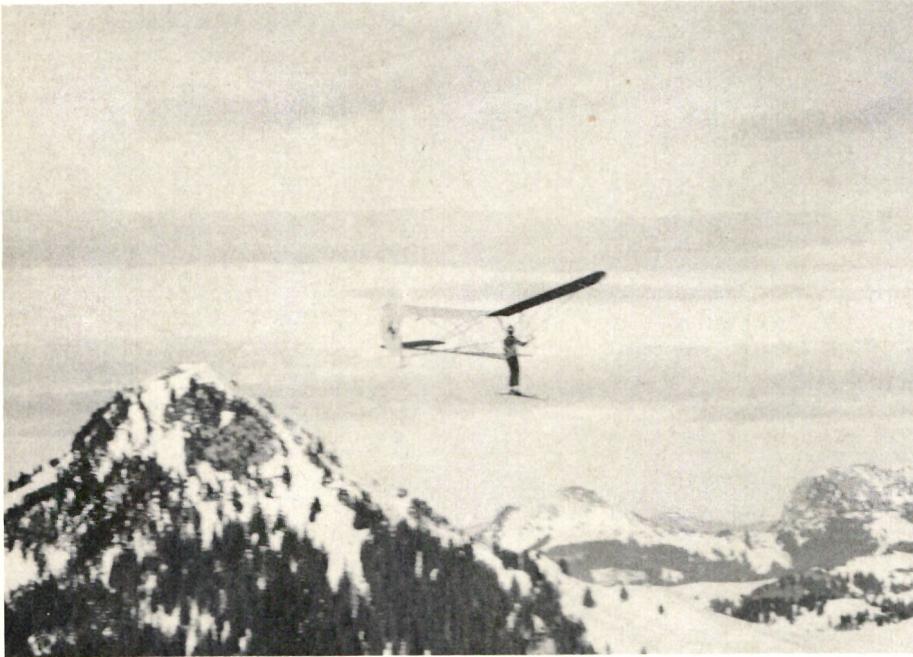
For some time now, there have been frequent reports of hang glider flights. In Switzerland, however, there are two fundamentally different types of hang gliders: one is the Swiss-built Skikarus, with sturdy wings and a fuselage; its appearance resembles that of a conventional airplane. The other is the delta wing glider, also known as the Rogallo wing after its inventor.
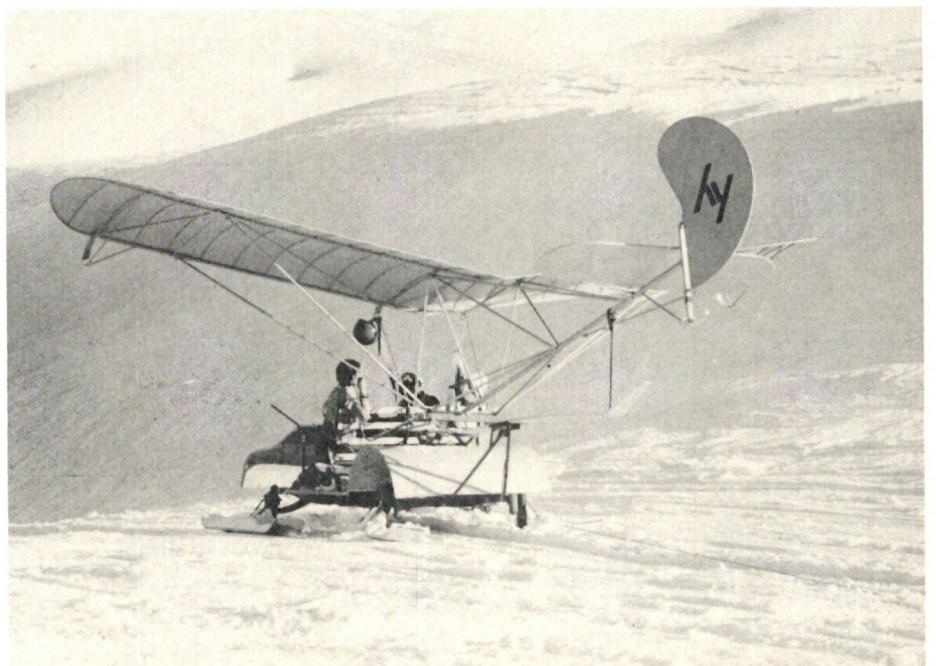
"Skikarus"—this type of flight was first successfully demonstrated by Lilienthal in 1892. Compared to the historical flying machine, the "Skikarus" has been significantly improved in both design and function. The entire frame consists of lightweight metal tubes, and the 11 m² wings are covered with canvas. As a result, with a wingspan of 7.14 m and a length of 5.20 m, the total weight is only 36 kg. The pilot’s feet, equipped with skis, serve as the landing gear. After many hundreds of test flights and improvements, a series of several “Skikarus” was built in the spring of 1973 and certified by the Federal Aviation Authority in Bern.
Unlike historical hang gliders, the “Skikarus” is not launched on foot, but always on skis. This method allows for a relatively high wing loading of approximately 12 kp/m² at a flight speed of 40 km/h to 50 km/h. As a result, the aircraft is relatively insensitive to wind and light gusts.
Another difference from earlier hang gliders is that, before takeoff, the center of gravity and the elevator are precisely adjusted to the pilot’s weight. These settings cannot be changed during flight, ensuring that the airspeed remains constant during takeoff, flight, and landing. This ensures a very stable glide and also eliminates the possibility of incorrect pilot reactions. Unlike the elevator, the rudder can be moved at will, allowing the pilot to freely determine the aircraft’s flight path.
With historical gliders, on the other hand, the pilot had to reduce airspeed during takeoff and landing by shifting the center of gravity, since it is difficult to reach speeds exceeding 30 km/h under foot power alone. However, these maneuvers required nearly the same flying skills as those needed for an airplane with stick controls and can quickly lead to a crash if performed improperly.
In contrast, the “Skikarus” is safe to operate and requires no prior flying experience, so that any skier with good balance can effortlessly learn ski-gliding in a very short time. Aside from standard ski equipment—or grass skis in the summer—no special gear is required.
Just how safe the “Skikarus” is is demonstrated by the fact that, since the spring of 1969, thousands of flights have been completed by hundreds of people without a single serious incident.
The fact that the Federal Aviation Authority nevertheless recorded three serious—and in some cases fatal—accidents involving hang gliders within just five weeks this year alone is attributable to other designs. (Delta gliders). Unlike the “Skikarus,” the delta glider is triangular in shape, which is where its name comes from.
Its design and flight characteristics differ greatly from those of the “Skikarus.” In addition to undisputed advantages—such as its foldability, extremely low takeoff and landing speeds, and the resulting ability to take off and land in very small areas—the delta glider also has serious drawbacks. Due to its modest glide ratio of 1:4 (1 m loss of altitude over 4 m of flight distance)—compared to 1:9 for the “Skikarus”—the delta glider requires a fairly steep slope just to get airborne. Likewise, a large elevation difference is required to stay airborne for an extended period. Due to its very low wing loading of only 5 to 6 kp/m², the delta glider is particularly sensitive to wind and turbulence. Unlike the dune winds in the U.S., which often blow steadily for days on end, wind conditions in the Alps are much more irregular—especially on hot summer days.
Another disadvantage of the delta design is the risk of wing flutter. This can occur when the pilot suddenly shifts their weight forward or during turbulence. This poses the danger of an uncontrollable nosedive. Since speeds are influenced by the pilot’s weight shifts, speeds ranging from approximately 20 km/h to over 80 km/h are possible. This inevitably carries the risk of incorrect reactions, which, as mentioned, can have serious consequences.
Tr.
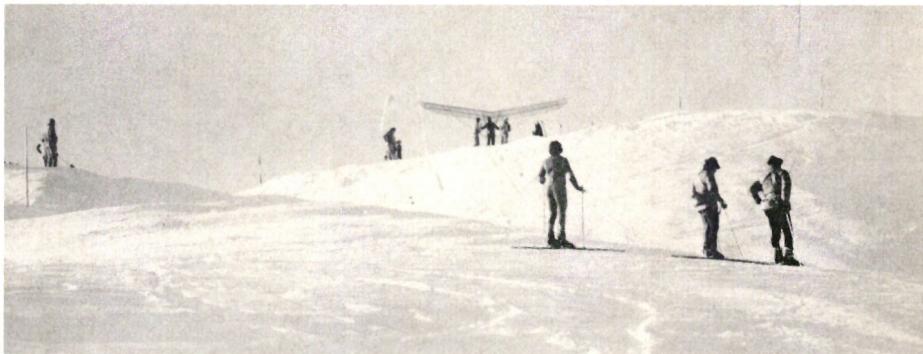
The new, exciting winter sport in Hoch-Ybrig, where snow is guaranteed
- Switzerland’s largest and most modern facility
- EAV-certified hang gliders (no delta gliders)
No prior flying experience required.
Day, week, or weekend courses.
Basic courses, including insurance: CHF 100.— per day.
Course instructor: Hch. Treichler, Wald, 055 95 21 72
.
Accommodations can be arranged. Advance registration is absolutely required; please contact the course instructor or
“Berglade” in Hoch-Ybrig, Tel. 055 56 15 67.


News from HEBU

HORIZON HOBBY/LEMACO NEWS: MICRO OV-10 BRONCO 645 MM BY E-FLITE

PRIDE AND GOOD IDEAS
 Markus Nussbaumer

TEAM MANAGER "THIS" BOSSHARD
 Rodito Nussbaumer

YOU KNOW WHAT I MEAN? 125 YEARS OF THE SWISS AERO CLUB
 Emil Giezendanner

F3A EUROPEAN CHAMPIONSHIPS IN ST-MACAIRE, FRANCE
 Matthias Bosshard

ATOM, THE NEW DOUBLE-DECKER FROM CPLR
Matthias Bosshard
SUMMER FUN 2026 AT MG USTER
Martin Wunderli
What's New at Leomotion.com

52. 2026 ALPS CUP
Emil Giezendanner
TWIN TOWN PARTNERSHIP
Wolfgang Voeller
34th HAHNENMOOS ALPINE MODEL AIRPLANE CAMP
Res Dauwalder
CORSAIR F4U – A WARBIRD WITH A MEMORABLE LOOK
Jürgen Rosenberger, Jürgen Prinz
SMALL, MODEL-LIKE SAILBOATS
Res Dauwalder
TRY-OUT DAY AT MFV WETTINGEN
Urs Keller
WELCOME, NEW MEMBER!
Andrea Bolliger
FREE FLIGHT IN THE MIDDLE OF SUMMER
Urs Muntwyler
COUPE DES ALPES – OBSERVE AND LEARN
Rodito Nussbaumer
EURO CONTEST GLIDER ACRO TOUR AUSTRIA 2026

BY YOUTH, FOR YOUTH
Lorena Betschen
INSIGHTS INTO THE HISTORY OF SEAPLANES

THE PC-21 STORY
Emil Giezendanner
NEWS FROM HEBU
 Julia Bucher

FROM 0 TO 100
Markus Nussbaumer
MEMORIES
Wolfgang Völler
NOS REGION – A HUB FOR ELECTRIC AVIATION
Emil Giezendanner
DO YOU KNOW WHAT I MEAN IN THE LAND OF SMILES?
Emil Giezendanner
Have you almost forgotten about aircraft that take off and land vertically?
Emil Giezendanner