
Our National Gliding Team
At the end of March 1977, our national gliding team traveled to South Africa for the 1st F3B World Championships. Here is a report by team leader H. R. Schläpfer
Following the introduction of the F3B Series A, the FAI program in Switzerland in 1975, the first national RC thermal gliding team was formed based on the qualifying flights held on August 15, 1976, during the F3B Swiss Championship in Embrach, and was confirmed by the MFK on September 1, 1976. This team will represent the Aero Club of Switzerland at the 1st F3B World Championship in Pretoria, South Africa.
A few words about the high-launch team:
The efficiency of the high launch is of crucial importance in terms of both safety and the achievable starting altitude.
The order in which the pilots will launch is not expected to be announced until shortly before the start of the World Championships. Targeted high-launch training based on the assumption of who will launch whom at the World Championships is therefore not feasible without running the risk of being severely disadvantaged from the outset. Every model and every pilot has their own specific characteristics and techniques; moreover, Pretoria is located on a high plateau at an altitude equivalent to that of the Rigi in terms of prevailing air pressure.
These factors place significant demands on the high-launch procedure. We have therefore decided within the team to form a dedicated high-altitude launch team for this demanding task.
These two idealists must bear the same personal financial burden as the pilots and the team leader. Both are active model airplane pilots in Ae.C.S.
model flying clubs. The team is, of course, deeply and sincerely grateful to these two comrades for their selfless and, in truth, thankless work, as there are no official accolades to be earned here.
Just 14 days after the MFK confirmed the F3B M.N.M., we took the opportunity to gain our first international experience.
As part of the training program, three pilots from the MNM and the team manager participated in the last F3B FAI competition to be held in Munich before the World Championships.
Photo shown here:
H. R. Schläpfer, team manager; Paul Gassmann, pilot; Gerhard Läderach, pilot; Peter Aeberli, reserve pilot; Ruedi Baumgartner, pilot. Kneeling:
Karl Voser and Heinz Schenk, high-launch team.
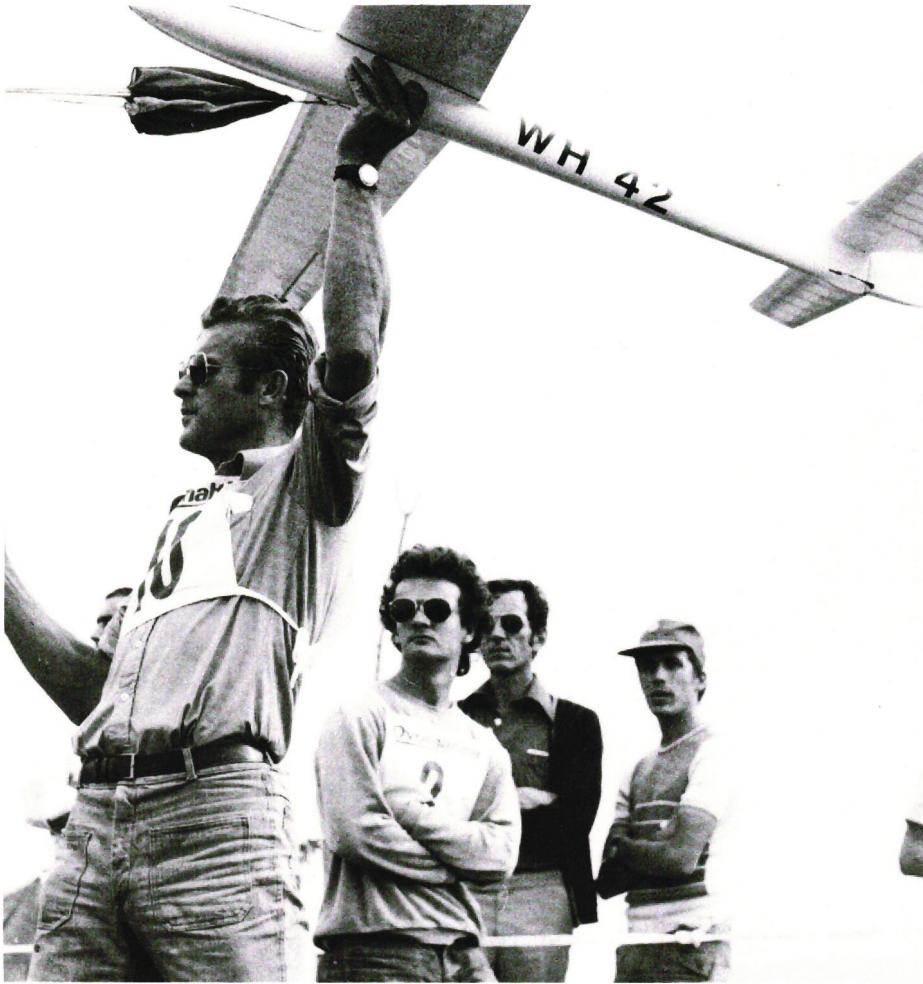
Paul Gassmann of Wehntal, the 1975 Swiss champion, was unable to qualify for the Swiss Championships due to an accident, but won the qualifying competition for the national team unchallenged.
Although the performances and results achieved did not quite meet expectations, it can be said that the primary objectives we had set for this competition were fully achieved. Namely, becoming familiar with the challenges and atmosphere of an international competition, fostering teamwork, and conducting an international comparison (assessing our current status relative to Europe’s elite) in terms of flying skills as well as aircraft equipment.
In this regard, our pilots can certainly count themselves among the very best. Unlike most of our competitors, our team members flew very cleanly and with great discipline within the safety zones designated by the organizer. The experience we gained in Embrach may well have contributed significantly to this advantage.
Aside from a previous team training session, we were able to test the entire team’s collaboration for the first time in Munich under practical, competition-like conditions.
It became clear that it is difficult for pilots to concentrate on flying their model while also constantly monitoring atmospheric conditions and the behavior of their competitors.
Close cooperation between the pilot and the assistant can be crucial to achieving maximum performance, especially in conditions of weak and constantly shifting thermal activity.
This fact has certain implications for the high-launch procedure, since, according to FAI regulations, only two assistants are permitted per pilot.
Successful high-altitude launches without a pulley system have already been achieved in other training sessions.
At this time, we are unfortunately unable to provide any information about the aircraft used at the 1977 World Cup.
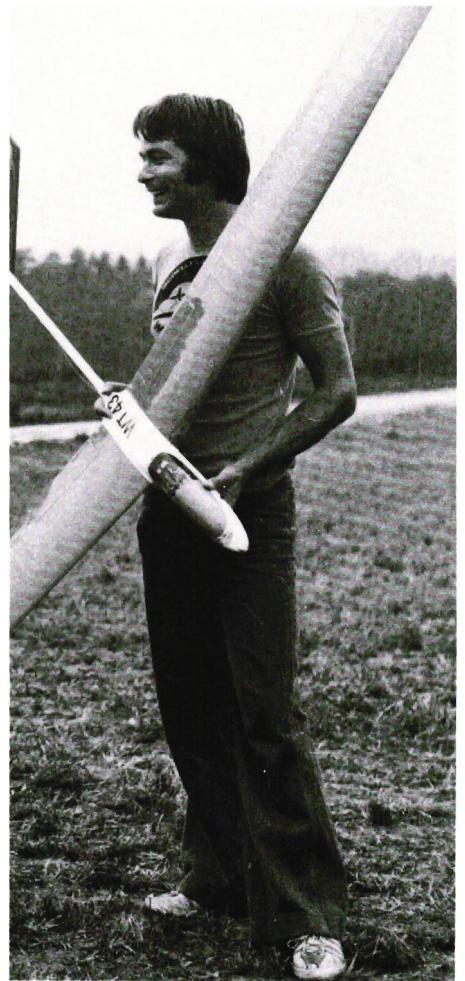
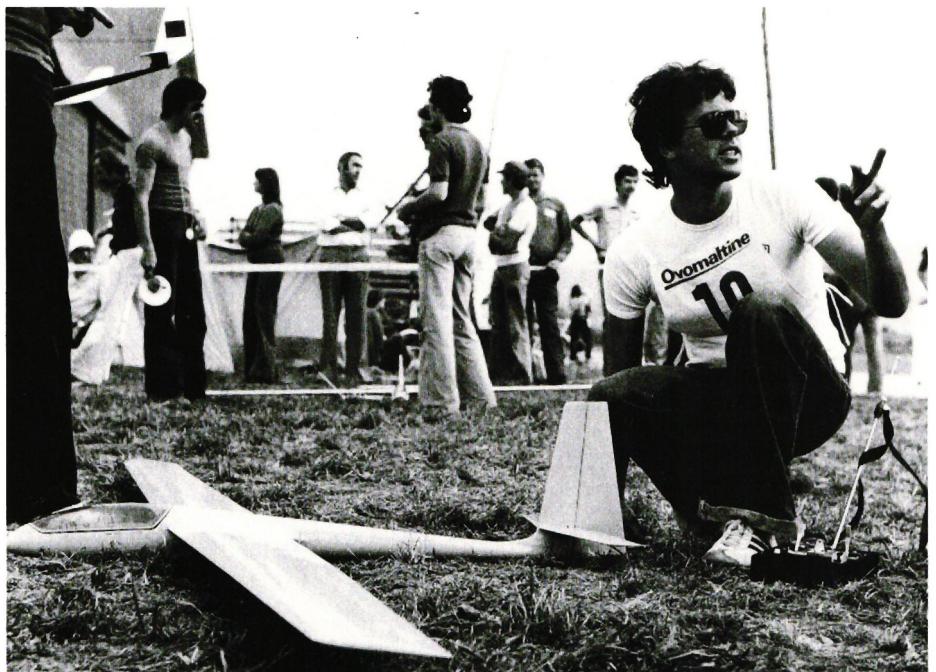
Above: Ruedi Baumgartner, a pilot, is a member of the MG-Wettingen, which has made a name for itself particularly in gliding.
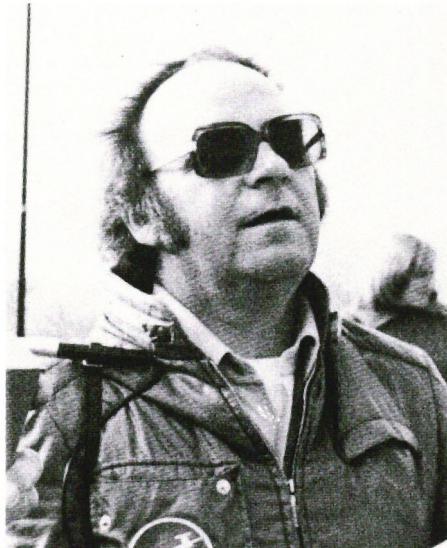
On the left: H. R. Schläpfer, from Bülach, the team leader, doesn’t want to leave anything to chance.
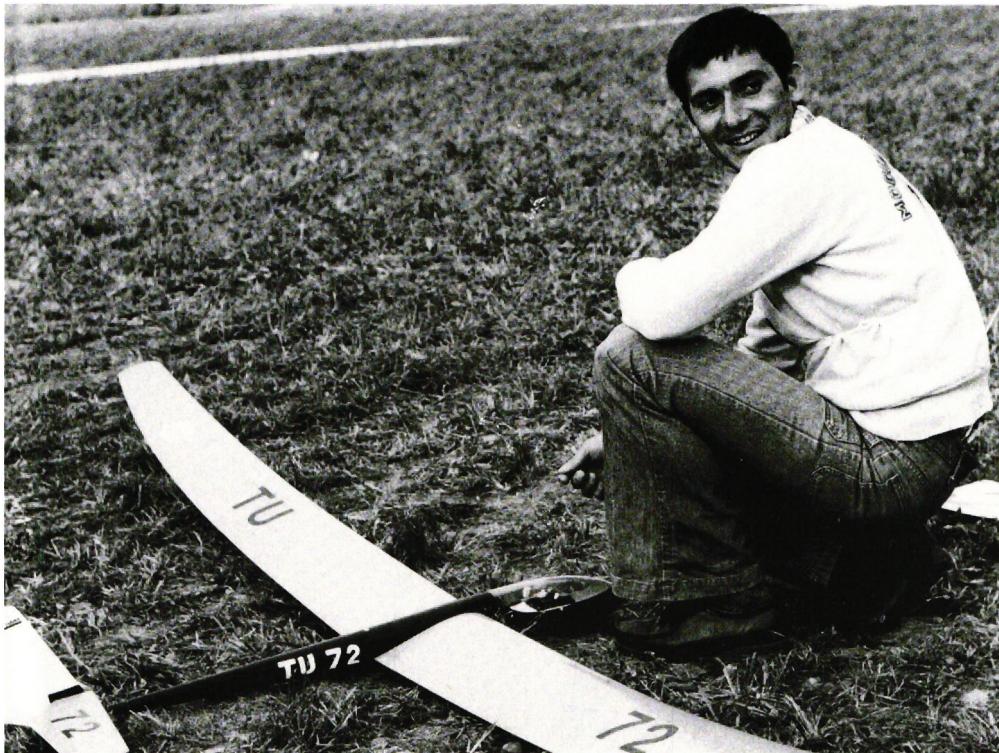
Gerhard Läderach, vice chairman of MG-Thun, an experienced and successful glider pilot
. It’s not that we want to keep anything a secret, but we’re currently working flat out. In some cases, we’re building new models; in others, we’re modifying and refining existing equipment. Afterward, the performance of these models must be compared once again before a final decision is made.
Unfortunately, there isn’t enough time left for extensive experiments or large-scale new developments. Therefore, we must rely on tried-and-true methods, while of course still taking the latest findings into account.
In general, it can be said that our gliders certainly hold their own in international competition.
However, an analysis of the results from Munich shows that we lost the most ground, particularly in the distance discipline. The reasons for this, however, are not solely attributable to the gliders themselves. This fact demonstrates once again that, for the FAI program, a good glide ratio paired with a low-drag model is an indispensable prerequisite for a top-tier ranking. However, speed flying is also becoming increasingly important as soon as thermal conditions must be factored into endurance and distance flights.
| Event A: Endurance Flight | 950 ... 1000 points | Full 6 min. – 20 points LDG, max. 20-point deduction for LDG |
| Event B: Distance Flight | 900 ... 1,000 points | corresponding to approx. 1,800 m distance |
| Discipline C: Speed Flight | at least 900 points | corresponding to approx. 14 seconds for 300 m |
Pete Aeberli, from MG-Erlenbach, is traveling with the national team as a reserve player—a role that is certainly always relatively thankless, but can be extremely educational.
The team spirit of the F3B MNM can be described as excellent. All team members demonstrate a strong willingness to support the team and their teammates. There are no tensions, and the team’s conduct is exemplary.
In the relatively short time remaining until the World Championships, the focus will be on analyzing the experiences and insights gained in Munich, as well as on making travel arrangements for the World Championships, which will take place from March 28, 1977, to April 2, 1977, in Pretoria, South Africa.
We also need to expand our theoretical knowledge of thermal development and conduct training at an altitude that, as far as possible, matches the conditions in Pretoria.
Pretoria is located about 100 km from Johannesburg; it is the capital of South Africa and isn't exactly on the way.
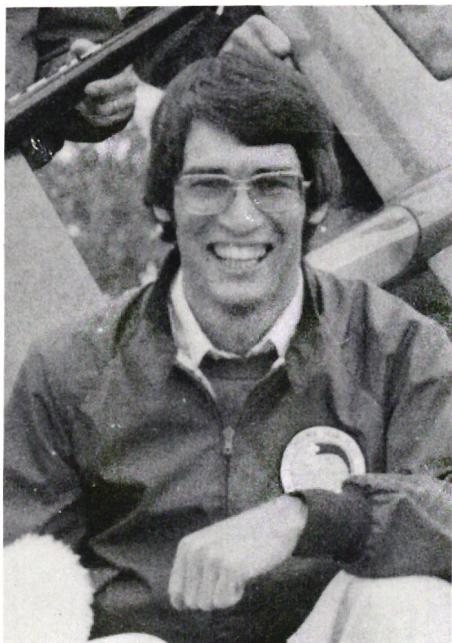
Heinz Schenk, MG-Turgi, is a member of the high-launch team and is therefore directly involved in ensuring the success of every single flight.
Despite the expected support from the Ae.C.S., the personal financial burden for each team member will still be quite substantial. Of course, the largest portion of this expense is accounted for by the
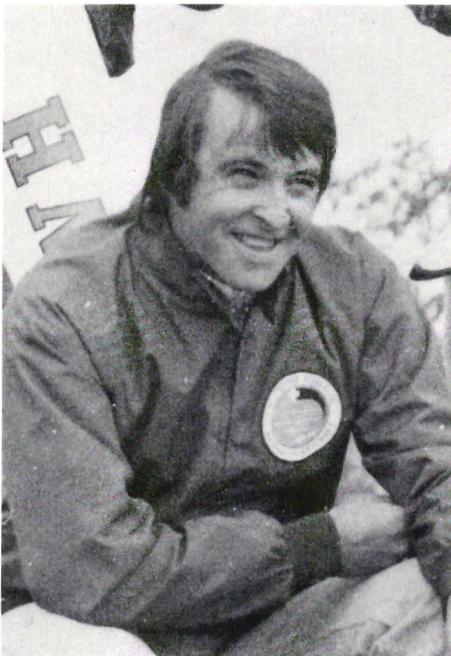
ground crew: Karl Voser is also a member of the high-launch team. As an active member of MG-Wehntal, he belongs to one of Switzerland’s leading RC gliding model flying clubs.
Air travel to Johannesburg. Charter flights are therefore very important, even when traveling with scheduled airlines. Discounted travel is generally only available if the stay at the destination is 3 weeks. A minimum of 8–10 or more travelers in the same group is required. We would therefore be very pleased if anyone interested—especially those who have already decided to attend the World Cup followed by a vacation in South Africa—would join the team.
The tentative departure date is March 26, 1977, at 10:00 p.m.
Those interested should please contact the team leader, preferably in writing and as soon as possible.
To help ease the financial burden on team members a little, we have designed the F3B M.N.M. logo and recommend that anyone wishing to support the team in this way purchase this sticker for 3 francs.—
The stickers are available from all team members as well as at some model shops.
An expedition of this magnitude requires significant help and cooperation from many enthusiasts. To all those who have provided us with such support and to all those who would like to support us in the future, we would like to express our heartfelt thanks.
H. R. Schläpfer


News from HEBU

TEAM MANAGER "THIS" BOSSHARD
 Rodito Nussbaumer

SUMMER FUN 2026 AT MG USTER
Martin Wunderli
BY YOUTH, FOR YOUTH
Lorena Betschen
SMALL, MODEL-LIKE SAILBOATS
Res Dauwalder
TRY-OUT DAY AT MFV WETTINGEN
Urs Keller
What's New at Leomotion.com

52. 2026 ALPS CUP
 Emil Giezendanner

ATOM, THE NEW DOUBLE-DECKER FROM CPLR
 Matthias Bosshard

INSIGHTS INTO THE HISTORY OF SEAPLANES

YOU KNOW WHAT I MEAN? 125 YEARS OF THE SWISS AERO CLUB
Emil Giezendanner
34th HAHNENMOOS ALPINE MODEL AIRPLANE CAMP
Res Dauwalder
CORSAIR F4U – A WARBIRD WITH A MEMORABLE LOOK
Jürgen Rosenberger, Jürgen Prinz
F3A EUROPEAN CHAMPIONSHIPS IN ST-MACAIRE, FRANCE
Matthias Bosshard
HORIZON HOBBY/LEMACO NEWS: MICRO OV-10 BRONCO 645 MM BY E-FLITE

PRIDE AND GOOD IDEAS
 Markus Nussbaumer

EURO CONTEST GLIDER ACRO TOUR AUSTRIA 2026

FREE FLIGHT IN THE MIDDLE OF SUMMER
Urs Muntwyler
THE PC-21 STORY
Emil Giezendanner
TWIN TOWN PARTNERSHIP
Wolfgang Voeller
WELCOME, NEW MEMBER!
Andrea Bolliger
COUPE DES ALPES – OBSERVE AND LEARN
Rodito Nussbaumer
NEWS FROM HEBU
 Julia Bucher

FROM 0 TO 100
Markus Nussbaumer
MEMORIES
Wolfgang Völler
NOS REGION – A HUB FOR ELECTRIC AVIATION
Emil Giezendanner
Have you almost forgotten about aircraft that take off and land vertically?
Emil Giezendanner
70 YEARS OF THE NIDWALDEN MODEL AIRPLANE CLUB
Martin Barmettler