
1977 RC Glider World Championships
1st RC Glider World Championship (F3B) in Verwoerdburg near Pretoria, South Africa
The rain continued all night, and things didn’t look promising at all in the morning. Jack, however, remained optimistic. The meteorologists at the SAAF Base promised better weather, and they turned out to be right. What had been looming yesterday became a certainty today. The Swiss Boys were finally hitting their stride, and a comeback was in the works. In the distance flight for the fourth round, Paul completed 14 laps, which moved him up a few spots in the standings. Mike O’Reilly of Australia set a new record with 18 rounds, while local pilot Spavins recorded only one zero from a normal starting altitude.
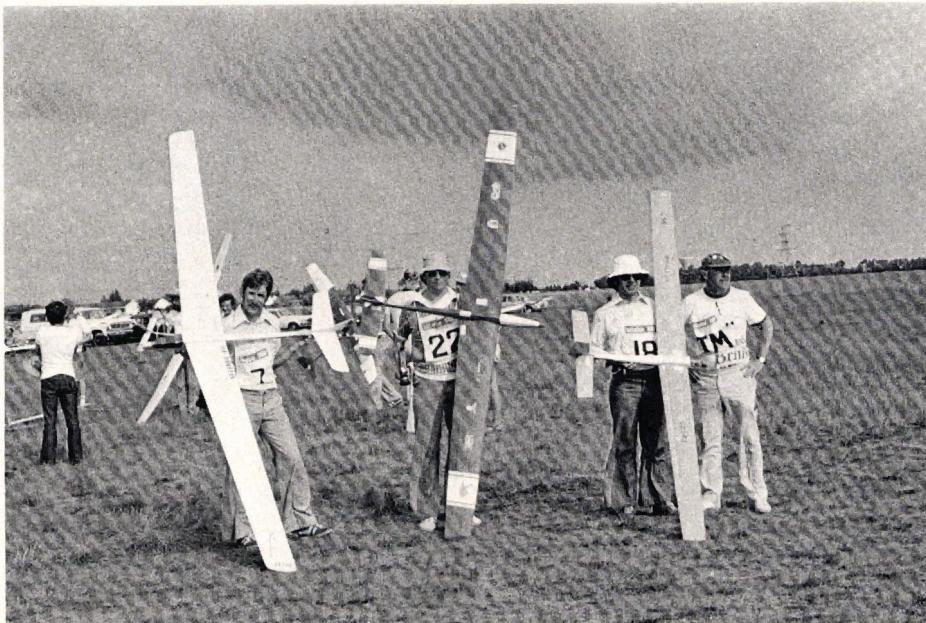
The fifth round began immediately and came to a successful conclusion by evening. Not only did the organizing committee shine, but the Swiss also really picked up the pace. Gerhard secured the 1,000 distance points with 16 rounds. This was the first time a Swiss pilot had appeared at the very top of the rankings—and in a Hobie Hawk, no less! Unfortunately, Gerhard only managed 20 seconds in the speed flight, but at least he moved up to 18th place overall. Ruedi, with a brilliant performance, completed a full endurance flight, while his five competitors all failed to finish. When, after the high-altitude launch, none of the pilots who had started earlier found any clear thermal tubes and everyone was stuck in the same spot, our TM made a decisive decision. He instructed Ruedi to fly out onto the plain at a 180° offset and continue doing so until he could barely see the model anymore. He was to let the model glide calmly and smoothly and watch closely to see if even the slightest thermal was visible. And right at the edge of visibility, the Brillant began to climb, and so Ruedi was the only one in this group to log a full flight. In the speed flight, Ruedi clocked 15.2 seconds, landing him in 3rd place for the round. Unfortunately, Paul was unable to build on his strong distance flight and had to give up a few places again. When the final group of six was called up for the endurance flight, the sky darkened rapidly, and the worst was feared. Peter Keim from the Netherlands also had to compete in this final group. His model had suffered a total loss in the previous flight; the fuselage and wings were practically shattered into pieces. In a magnificent team effort, the model was patched back together under the direction of the Dutch technical marshal.
And thanks to the Englishman’s efforts, Ruedi was able to secure his strong result. In that day’s speed flight, LeMon Payne set a new record of 12.4 seconds. His Legion Air gives no indication whatsoever that it can handle such speeds. Sean Bannister was able to maintain his 2nd place overall. Sean flew a pure performance model. The airfoil appeared very similar to the E 347. Across all disciplines, Sean delivered top performances. The wings are relatively strongly swept, but his model has virtually no V-shape. Due to the sweep, the front section of the fuselage was kept very short, making it all the more bulky. The fuselage was characterized by a high cabin and a boxy structure. The model is relatively heavy, weighing around 2.5 kg. What’s particularly astonishing are the excellent endurance flight performances achieved with this model. There must certainly be a highly skilled pilot at the controls here.
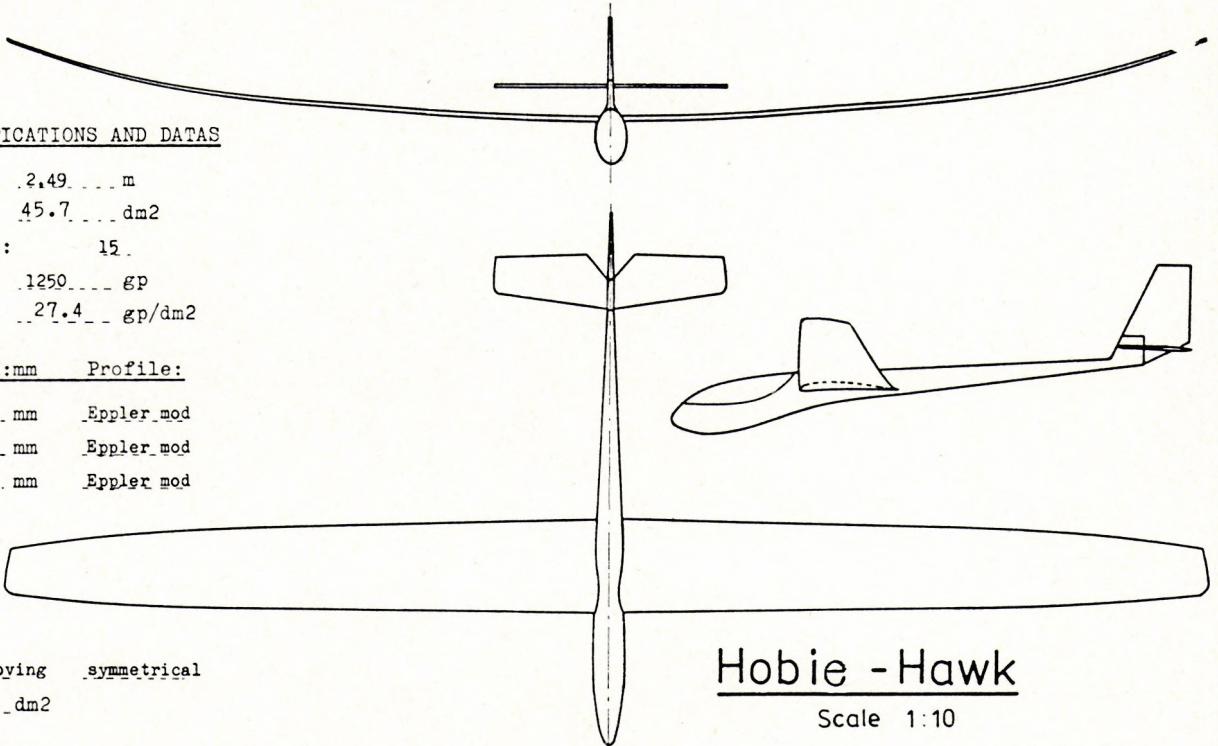
Competitors Name | Gerhard Laederach |
Registration | HB - TU 72 |
Model | A |
RC-Equipment | Digi-fly 7 |
Frequency | 27.195 MHz |
Span | 2.49 m |
Aera | 45.7 dm2 |
Aspect ratio | 15 |
Weight | 1250 g |
Loading | 27.4 g/dm2 |
Chord:mm | t root 195 mm Eppler mod |
ELEVATOR: | Type: all moving symmetrical |
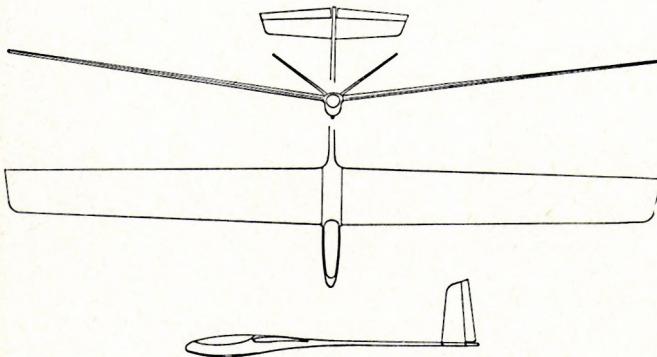
COMPETITORS NAME | Boutgordner Ruedi |
REGISTRATION | HB - WL 43 |
MODEL | A |
R C - EQUIPMENT | Simprop Contest |
FREQUENCY | 26.995 Mhz |
chord:mm | t root 230 mm E.176 |
span | 2.96 m |
aera | 66.2 dm2 |
aspect ratio | 14.8 |
weight | 1700 g |
loading | 25.7 g/dm2 |
ELEVATOR: | type: V NACA 0009 |
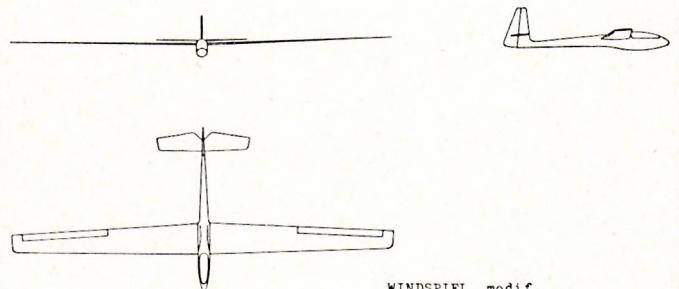
COMPETITORS NAME | Paul GASSMANN |
REGISTRATION | HB - WH 42 |
MODEL | A |
R C - EQUIPMENT | Digi-fly 7 |
FREQUENCY | 27.045 MHz |
troot | 232 mm Eppler 387 |
taileron | mm Eppler 387 |
ttip | 125 mm Eppler 387 |
tm | 178.5mm |
span | 2900 mm |
aera | 59.76 dm2 |
aspect ratio | 16.25 |
weight | 1800 g |
loading | 30.12 g/dm2 |
ELEVATOR: | type: cross tail/ stabilizer |
The final day of the World Championships had dawned, and for the last time, it was time to get in the game—because we still had a lot to do and wanted to move up a few spots. Our pilots continued to be in top form, thanks in large part to our team manager, Hansruedi. He, too, was in top form and gave the pilots flight instructions like a pro. The good results from Friday and Saturday were largely thanks to him. Hansruedi put all his tactical skills to work, and the daily standings turned out exactly as we’d only dared to dream throughout the entire World Championship. We were able to—and had to—learn a lot at the start of the World Championships. But yesterday and today, all of that began to bear fruit. Ruedis’s endurance flight from the previous day was repeatedly praised over the loudspeaker today. The speed flight at the start of the sixth and final round was a great success for our pilots. Ruedi clocked 15.1 seconds and Geri 17.7 seconds; only Paul lagged slightly behind with his 19.5 seconds. But the crowning achievement came during the distance flight.
Paul completed 14 laps, Ruedi 12, and Geri 11 laps. It was almost certain that, if not 1,000 points, then at least a high point total would be achieved; Skip Miller completed 15 laps and Frik Roos even 19 laps. Thanks to Ruedi and Geri’s excellent endurance flight results, however, they were able to secure 6th and 7th place in the round. These outstanding performances then placed Geri in 12th place overall and Ruedi in 14th. Paul finished in 20th place overall. In the team standings, we managed to hold on to 7th place. Fatigue became increasingly noticeable among everyone during this final day. On top of that came the nervousness. The physical and mental strain of this week had been immense. That is the only explanation for why Mattingly and O’Shea both scored zero points in the distance flight due to their poor high-altitude launches. LeMon Payne and Mike O’Reilly both suffered tail cracks, and Friedhelm Schiborr burned out his model early in the morning during the speed flight at the turn. Pagliano crossed the center line during the speed flight. We heard from various sources that it was simply a mystery why the Swiss hadn’t performed better. But the reasons are well known, and we had to learn—and most importantly, we did learn and tried to put what we learned into practice. Without exaggerating, we can say that we succeeded in doing so.
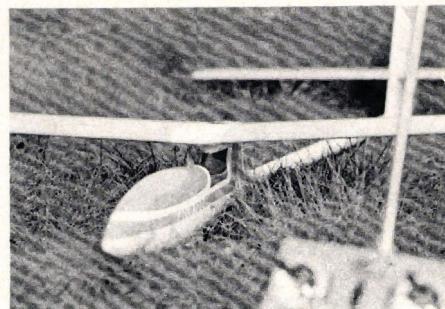
I would like to add a few lines here regarding the Swiss team’s rankings. The pilots, the technical manager, and the high-launch crew gave it their all. Considering the aircraft available to us and our flying skills, we Swiss have certainly been ranked and classified correctly. Our goal was to place at least in the top half of the field, and we succeeded in doing so. However, when looking at our performance as a percentage of the world champion’s score, the numbers actually look significantly better.
Skip Miller scored a total of 13,185 points, which corresponds to 100%; Gerhard, 10,695 points (81.0%); Ruedi, 10,523 points (79.8%); Paul 10,185 points (77.2%).
In the team standings, things look even better: with our 31,367 points, we achieved 88.2% of the total compared to the U.S.’s 35,579 points.
These results can undoubtedly be described as very good. After all, there isn’t an unbridgeable gap between the world’s elite and us Swiss. The elite is very broadly distributed, and we are absolutely capable of keeping up.
In addition to the shortcomings already discussed, the lack of a high-start technique also prevented us from achieving a better result. We were practically never able to reach the same starting altitudes as the others. However, with one exception, we had no crashes, which certainly gave us the opportunity to approach the tasks at hand with confidence. A detachable high-launch hook offers significant advantages here. If the model is towed through a downdraft zone, the pilot can maintain tension on the line by banking the model sideways, and the high-launch team can then tow the model back up to full altitude. This also makes the launch safer. The hook can be disengaged, as a model that has veered off course can be easily brought back to the line. Resetting the hook significantly shortens the distance the launch crew must cover. If the model is unhooked from the line at the summit while under tension, up to 15 meters of altitude can be gained with sufficient experience.
Initially, we Swiss were the only ones using the redirected tow method, and we were met with a bit of a pitying smile. But as failures became more frequent, even top experts in the field—such as the Germans—decided to adopt the redirected tow method. Finally, on behalf of the National RC Gliding Team, I would like to sincerely thank our team manager Hansruedi for his tireless efforts before and during the World Championships. He cleared many obstacles out of our way, allowing us to enjoy our stay in South Africa much more carefree. We all fondly look back on this wonderful time. Our new friends from the land of the springbok went to immense lengths to make the stay in South Africa as pleasant, hassle-free, and hospitable as possible for both competitors and supporters. Even minor problems were handled just as naturally as those that seemed almost impossible to solve. We would like to take this opportunity to extend our heartfelt thanks to all members of the organizing committee and all their behind-the-scenes helpers. We would especially like to thank Mervin Brett of Pretoria, Alfred Langenegger of Johannesburg, and Benno Lüthi, as well as our teammate Peter Aeberli, who made it possible for us to stay in touch with those back home and keep them updated on the latest news from the World Championships.
We’ve made many new friends and hope to see many of them again in two years at the next World Championship.


News from HEBU

TEAM MANAGER "THIS" BOSSHARD
 Rodito Nussbaumer

YOU KNOW WHAT I MEAN? 125 YEARS OF THE SWISS AERO CLUB
 Emil Giezendanner

HORIZON HOBBY/LEMACO NEWS: MICRO OV-10 BRONCO 645 MM BY E-FLITE

PRIDE AND GOOD IDEAS
 Markus Nussbaumer

34th HAHNENMOOS ALPINE MODEL AIRPLANE CAMP
Res Dauwalder
TRY-OUT DAY AT MFV WETTINGEN
Urs Keller
F3A EUROPEAN CHAMPIONSHIPS IN ST-MACAIRE, FRANCE
 Matthias Bosshard

52. 2026 ALPS CUP
Emil Giezendanner
ATOM, THE NEW DOUBLE-DECKER FROM CPLR
Matthias Bosshard
SUMMER FUN 2026 AT MG USTER
Martin Wunderli
What's New at Leomotion.com

THE PC-21 STORY
Emil Giezendanner
COUPE DES ALPES – OBSERVE AND LEARN
Rodito Nussbaumer
TWIN TOWN PARTNERSHIP
Wolfgang Voeller
BY YOUTH, FOR YOUTH
Lorena Betschen
CORSAIR F4U – A WARBIRD WITH A MEMORABLE LOOK
Jürgen Rosenberger, Jürgen Prinz
SMALL, MODEL-LIKE SAILBOATS
Res Dauwalder
WELCOME, NEW MEMBER!
Andrea Bolliger
FREE FLIGHT IN THE MIDDLE OF SUMMER
Urs Muntwyler
EURO CONTEST GLIDER ACRO TOUR AUSTRIA 2026

INSIGHTS INTO THE HISTORY OF SEAPLANES

NEWS FROM HEBU
 Julia Bucher

FROM 0 TO 100
Markus Nussbaumer
MEMORIES
Wolfgang Völler
NOS REGION – A HUB FOR ELECTRIC AVIATION
Emil Giezendanner
DO YOU KNOW WHAT I MEAN IN THE LAND OF SMILES?
Emil Giezendanner
Have you almost forgotten about aircraft that take off and land vertically?
Emil Giezendanner