
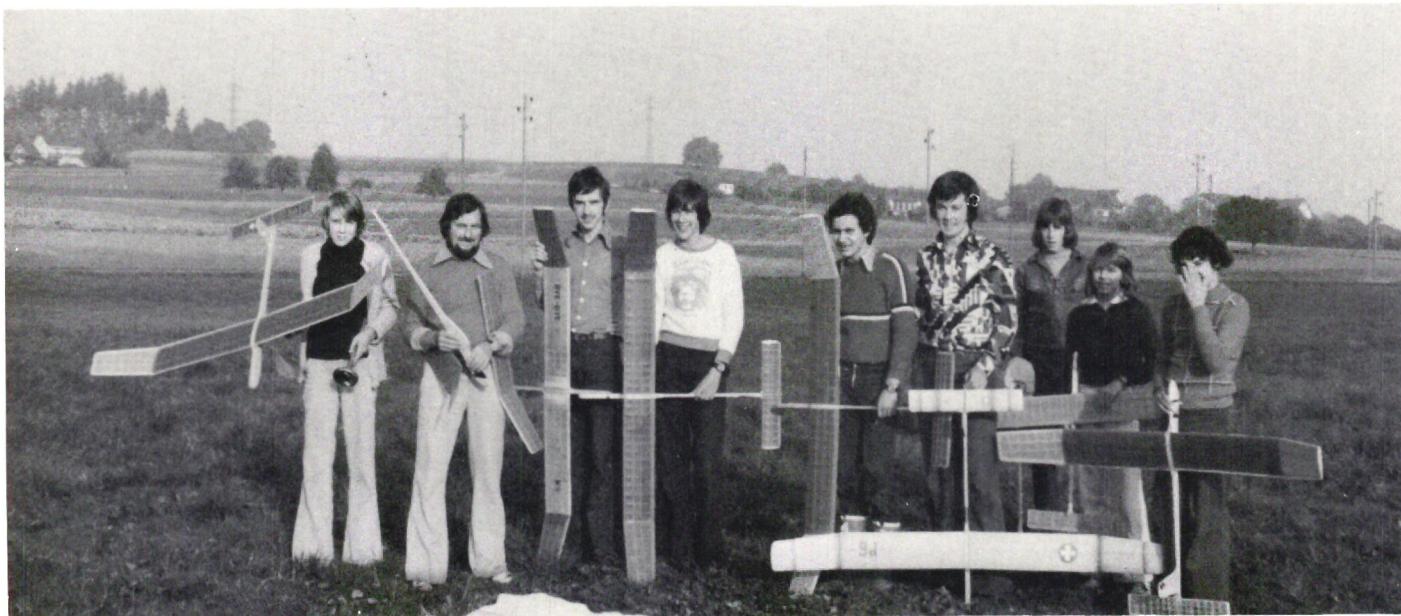
Model Airplane Building Class, Fall Break 75
Rather than under the motto “same old, same old,” but rather “What’s next?” I’d like to share my thoughts on this year’s model aircraft building course. Building courses can be organized throughout the year. In Germany, for example, there’s a mobile model aircraft training workshop called the Dr. Adalbert Seifriz Model Aircraft School; it’s in high demand and operates year-round.
Their curriculum covers both theoretical and practical knowledge and includes slide shows, film screenings, and wind tunnel exercises. Participants will build a beginner’s model as well as a larger glider model. The cost is DM 80.—, with the Baden-Württemberg State Association covering the costs of meals and lodging.
Well, since we don’t have such a facility, we’ll just have to explore other options.
We have a large number of hobby workshops—Zurich is said to be a leader in this regard even beyond our national borders. A course can be organized with relatively few facilities. For example, to keep the workshop tidy, a rack for the building boards with wings attached, etc. Planing rooms are, of course, the best, but even air-raid shelters can be improvised into a workshop.
If you’re willing, the opportunities for woodworking courses are always there, and with a skillful approach, you’ll also have the authorities’ support.
1. Each course should have a maximum of 15 participants.
2. Especially for younger participants, the course should be held over a short period of time (week-long course).
3. The instructor also builds the same model, using it to explain each step without going off on too many tangents.
4. After each explanation, a demonstration should be given.
5. Sometimes hands-on guidance is necessary to help the student become familiar with the materials.
6. Many models don’t turn out right until the covering stage, so pay special attention to covering.
7. Include a brief theory lesson here and there, and don’t forget to take breaks.
8. Instill this in the students: “Neat construction = good flights!”
9. Organize a competition after the test flights.
10. Downplay the importance of the high launch. Many people are afraid of high launches.
I deliberately didn't mention the AeCS this time, but when I explained the different model categories and
demonstrated a glider on the playground, the questions just kept coming.
Among other things, they asked where they could sign up for an MG. Six students are eager to join the AeCS. I told the students about the beginners’ competition (around April) in Losdorf, which is also open to non-members.
Speaking of youth competitions, I’d like to suggest that at least one youth category should be included in AeCS competitions. Only then can everyone show how well they’ve mastered the subject, and small successes or failures in the competition encourage them to work toward new goals.
It is in the interest of both the young people—who can benefit in many ways from model flying—and the older members and model flying clubs to give youth programs significant attention; Perhaps someone will one day ask about the benefits of our hobby for the general public (for example, when it comes to land use issues), and after all, we do claim to be a nonprofit organization. Where better to prove that than here? W. Heise


News from HEBU

TEAM MANAGER "THIS" BOSSHARD
 Rodito Nussbaumer

YOU KNOW WHAT I MEAN? 125 YEARS OF THE SWISS AERO CLUB
 Emil Giezendanner

F3A EUROPEAN CHAMPIONSHIPS IN ST-MACAIRE, FRANCE
 Matthias Bosshard

HORIZON HOBBY/LEMACO NEWS: MICRO OV-10 BRONCO 645 MM BY E-FLITE

PRIDE AND GOOD IDEAS
 Markus Nussbaumer

ATOM, THE NEW DOUBLE-DECKER FROM CPLR
Matthias Bosshard
SUMMER FUN 2026 AT MG USTER
Martin Wunderli
52. 2026 ALPS CUP
Emil Giezendanner
TWIN TOWN PARTNERSHIP
Wolfgang Voeller
CORSAIR F4U – A WARBIRD WITH A MEMORABLE LOOK
Jürgen Rosenberger, Jürgen Prinz
SMALL, MODEL-LIKE SAILBOATS
Res Dauwalder
TRY-OUT DAY AT MFV WETTINGEN
Urs Keller
WELCOME, NEW MEMBER!
Andrea Bolliger
What's New at Leomotion.com

COUPE DES ALPES – OBSERVE AND LEARN
Rodito Nussbaumer
EURO CONTEST GLIDER ACRO TOUR AUSTRIA 2026

BY YOUTH, FOR YOUTH
Lorena Betschen
INSIGHTS INTO THE HISTORY OF SEAPLANES

34th HAHNENMOOS ALPINE MODEL AIRPLANE CAMP
Res Dauwalder
FREE FLIGHT IN THE MIDDLE OF SUMMER
Urs Muntwyler
THE PC-21 STORY
Emil Giezendanner
NEWS FROM HEBU
 Julia Bucher

FROM 0 TO 100
Markus Nussbaumer
MEMORIES
Wolfgang Völler
NOS REGION – A HUB FOR ELECTRIC AVIATION
Emil Giezendanner
DO YOU KNOW WHAT I MEAN IN THE LAND OF SMILES?
Emil Giezendanner
Have you almost forgotten about aircraft that take off and land vertically?
Emil Giezendanner