
The Fascination of Gliding
Respect for nature, consideration for other users
Anyone who flies their model glider on a hillside against a stunning backdrop is thrilled, feels good, and feels free. That’s how it should be. But that freedom has its limits. Consideration, respect, and tolerance are essential, because model aviators are never alone. They’re always in harmony with nature, often sharing the same terrain with other users, and almost always with fellow model aviators.
For many, slope flying is the supreme discipline of model gliding. Whether using thermals or dynamic slope winds—it’s always fun to “devour” altitude at high speed while performing challenging aerobatic maneuvers like a four-point roll or a roll circle. Modern airfoil profiles and sophisticated construction methods that come close to aerodynamic perfection help maintain speed for long periods and then quickly regain altitude. But slope flyers are never alone. Where conditions are ideal, they often have to share the terrain with others—with fellow model aircraft enthusiasts, farmers, or other users such as paragliders. In any case, slope flyers are entering the natural habitat of flora and fauna. This can affect rare plants in Alpine meadows as well as wildlife or birds. If slope flyers behave like a bull in a china shop, they become unwelcome guests. This is the case, for example, at the Creux du Van, where unauthorized flyers are now even fined.
This brief and by no means exhaustive overview shows
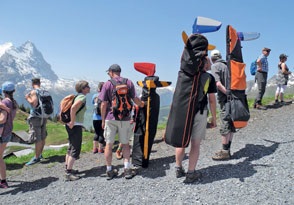
The diverse demands placed on a hang gliding site and its pilots. Reconciling these demands requires respect, consideration, and tolerance. A few simple rules are sufficient to ensure safe flight operations. Everyone is generally familiar with them, but they are not always followed by everyone:
- Announce takeoffs loudly and clearly. Before taking off, make sure the airspace is clear.
- Landings must be announced loudly and clearly. Before beginning the approach, you must ensure that the landing area is clear.
- Anyone currently flying should make way for models taking off and landing.
- Anyone who wants to fly past the slope at full speed or perform an aerobatic routine must announce this intention loud and clear.
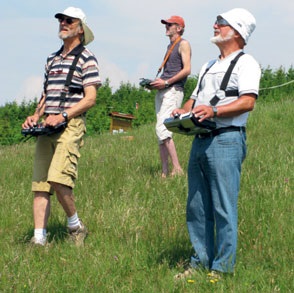
- To ensure that such communication is even possible, pilots should stand close together; talking and listening are essential when you are not alone on the slope.
- No flying over people’s heads or vehicles.
- Pilots should position themselves so they do not have to look directly into the sun.
- Do not fly the model directly toward the sun.
Slope fliers are entering the natural habitat of flora and fauna. This requires respect and consideration.
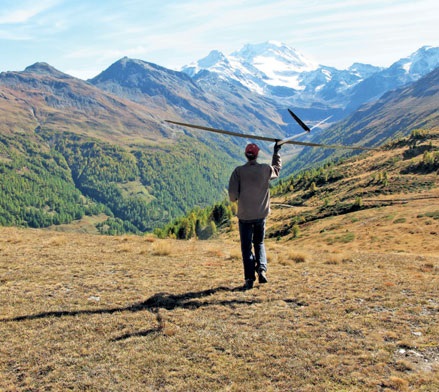
Such basic rules of conduct during flight operations ensure the safety of the models and the pilots. However, the responsibility of slope pilots begins much earlier—as soon as they enter the flying field. Although model flying is (still) generally permitted in Switzerland, the use of the airfield is a completely different—and sometimes rather complicated—matter. To avoid unnecessary friction, a few questions need to be clarified:
- Can the site be reached by car, or only on foot? Model airplane pilots are not off-road adventurers.
- Where is the best place to park cars so as not to obstruct other vehicles, pedestrians, or flight operations?
- Who is the primary user of the site? A model aircraft club and/or a farmer?
- Where can you obtain permission to fly on the site?
- Does the condition of the site even allow access or model flying operations—snow, mud, tall grass?
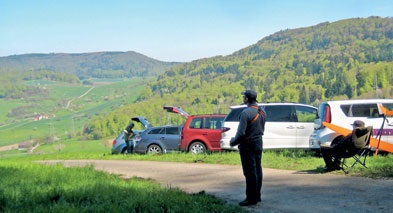
If there are fees for flying on the site—whether to the local model aircraft club or the landowner—payment is a matter of honor. There’s nothing more embarrassing than when model aircraft pilots, who spend thousands of francs on models and remote controls, try to skimp on a few francs for the use of a site.
Once these questions have been clarified, the next step is to establish the rules for the site. If it’s a regularly used slope-flying site, you should ask about these rules; if it’s only used occasionally, you’ll need to discuss them on-site:
- Where should vehicles be parked?
- Where are the models set up?
- What is the safety zone?
- What is the flight zone?
- Where do the pilots stand?
- Are there any overlapping zones that are used simultaneously on the ground and in the air?
Before takeoff, it’s also a good idea to ask pilots who are familiar with the area about any flight rules and customs, as well as flying tips. Conversely, those familiar with the area should point these out to newcomers. The same applies to coordination with other users, such as paragliders.
Once everything is clear and the pilot has verified that the model is in good working order, nothing stands in the way of takeoff. Once the model is airborne, consideration and caution are called for:
- Toward nesting birds, which will sound the alarm if models come too close.
- Toward horses, which tend to get startled and shy away when models fly by nearby.
- Toward passersby who enter the landing zone: They should be politely asked to leave.
- Be mindful of the sun’s position, which changes over the course of a long flight and can interfere with the pilot’s landing.
- Toward other model aircraft and other flying objects: always give way!
Also recommended for flying days on a slope are:
- A sun hat
- Sunscreen
- Sunglasses
- Good shoes
- Drinking water
All of these guidelines and recommendations are intended to promote respect for nature and the flying field. They ensure the greatest possible safety for pilots, their models, and bystanders. They are an expression of consideration and prudence. For only if we, as model aircraft pilots, behave appropriately can we expect tolerance and acceptance of our hobby from others.
Four final remarks—which should actually go without saying:
- Top pilots have no special claims.
- Anyone flying a model can cause damage, despite the highest level of skill and all their experience. Appropriate insurance is essential.
- Even with the highest level of skill, all the experience in the world, and the utmost caution, a mid-air collision can still occur. In such cases, each party involved is responsible for their own damages. There is no liability provision.
- A slope-flying site is not a dumping ground. Trash must be disposed of at home.
Peter Simon and
Roland Schlumpf


News from HEBU

TEAM MANAGER "THIS" BOSSHARD
 Rodito Nussbaumer

SUMMER FUN 2026 AT MG USTER
Martin Wunderli
SMALL, MODEL-LIKE SAILBOATS
Res Dauwalder
TRY-OUT DAY AT MFV WETTINGEN
Urs Keller
52. 2026 ALPS CUP
 Emil Giezendanner

ATOM, THE NEW DOUBLE-DECKER FROM CPLR
 Matthias Bosshard

INSIGHTS INTO THE HISTORY OF SEAPLANES

YOU KNOW WHAT I MEAN? 125 YEARS OF THE SWISS AERO CLUB
Emil Giezendanner
34th HAHNENMOOS ALPINE MODEL AIRPLANE CAMP
Res Dauwalder
CORSAIR F4U – A WARBIRD WITH A MEMORABLE LOOK
Jürgen Rosenberger, Jürgen Prinz
F3A EUROPEAN CHAMPIONSHIPS IN ST-MACAIRE, FRANCE
Matthias Bosshard
What's New at Leomotion.com

HORIZON HOBBY/LEMACO NEWS: MICRO OV-10 BRONCO 645 MM BY E-FLITE

PRIDE AND GOOD IDEAS
 Markus Nussbaumer

BY YOUTH, FOR YOUTH
Lorena Betschen
FREE FLIGHT IN THE MIDDLE OF SUMMER
Urs Muntwyler
THE PC-21 STORY
Emil Giezendanner
TWIN TOWN PARTNERSHIP
Wolfgang Voeller
EURO CONTEST GLIDER ACRO TOUR AUSTRIA 2026

WELCOME, NEW MEMBER!
Andrea Bolliger
COUPE DES ALPES – OBSERVE AND LEARN
Rodito Nussbaumer
NEWS FROM HEBU
 Julia Bucher

FROM 0 TO 100
Markus Nussbaumer
MEMORIES
Wolfgang Völler
NOS REGION – A HUB FOR ELECTRIC AVIATION
Emil Giezendanner
Have you almost forgotten about aircraft that take off and land vertically?
Emil Giezendanner
70 YEARS OF THE NIDWALDEN MODEL AIRPLANE CLUB
Martin Barmettler