
Rada and Renny, two new RC sailors
As an ambitious F3C helicopter pilot, I had long wanted a small electric glider for some relaxed flying. That’s how, through a clubmate, I came across Fritz Jucker’s online store at www.net-RC.ch, where the two electric gliders, the Rada and the Renny, are also available.
The fiberglass fuselage has a smooth surface, and the nose has already been cut off. The cutout for the vertical stabilizer is already in place. Unfortunately, the elevator mount is a bit wavy, but it already has holes, and the wooden dowels have threaded holes. The Bowden cable tubes are glued in place, though I noticed the 0.8-mm steel wires were missing. Upon inquiry with Fritz Jucker, however, these will be included in future shipments. The canopy is cut to fit perfectly and lies flush against the fuselage.
The wings are a fiberglass D-box construction and are built in the mold. The ribs are made of CNC-cut balsa wood, and the entire structure is neatly and wrinkle-free covered with Oracover film. The embedded plastic tube for the servo cables is already in place, though it has a very small diameter that does not allow for large cable cross-sections. The ailerons and flaps are already neatly attached with hinge tape. The tail surfaces are also made of CNC-cut balsa wood and covered neatly and wrinkle-free with Oracover. The control surfaces are made of fiberglass and attached with hinge tape. A small bag also contains servo covers, a motor mount, 5-mm wing connectors, and various screws.
During assembly, you’ll need to make the servo board yourself; on my Rada, I embedded it in resin in the rear opening of the wing mount. This makes it easy to adjust the center of gravity with my 2500-mAh LiPo battery. Resin-bonding the rudder also poses no problems, since the cutout in the fuselage fits perfectly. You just need to make sure it’s aligned at a right angle, which isn’t that easy and shouldn’t be assumed based on the mounted horizontal stabilizer. In my case, unfortunately, the elevator mount wasn’t parallel to the wing surfaces, but this can be easily corrected by shimming the elevator with a thin strip of balsa or cardboard.
Installing the motor bulkhead and RC system poses no problems and is completed relatively quickly.
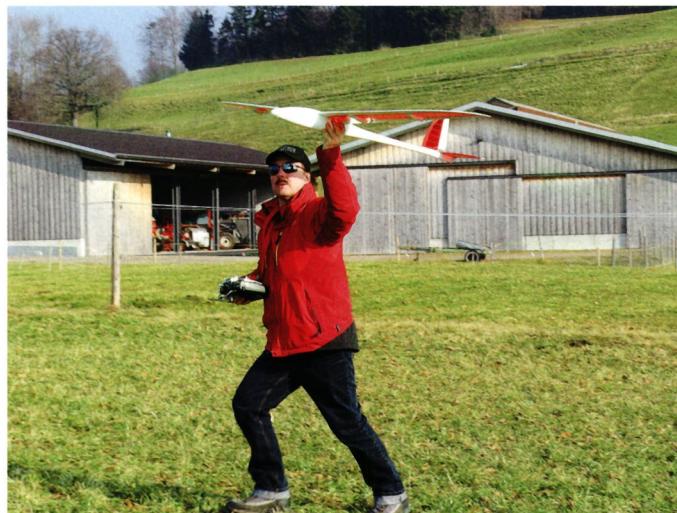
Check the center of gravity again, adjust it precisely to the specified 70 mm, and check the rudder and flaps: Now nothing stood in the way of the maiden flight. With a clean hand launch, the Rada is released into the air and climbs vigorously. Once a safe altitude was reached, the engine was shut off, and after a few clicks to trim it, the Rada began its smooth glide. It quickly picks up even weak thermals and is able to gain altitude from them beautifully. Everyone who was at the airfield on that pleasant Saturday in January wanted to take the Rada for a spin. A week later, the Rada also got to show what it can do on the slope. Launched with a brief burst of engine power, the Rada can be flown to the horizon even with little wind. With a slight dip, it quickly picks up speed and is a joy to maneuver through loops and rolls. In inverted flight, you really have to push the elevator down hard. The butterfly position works wonderfully and slows the Rada down nicely during landing.
In short, a great model that’s a lot of fun and, thanks to its detachable wing, is also super easy to transport.
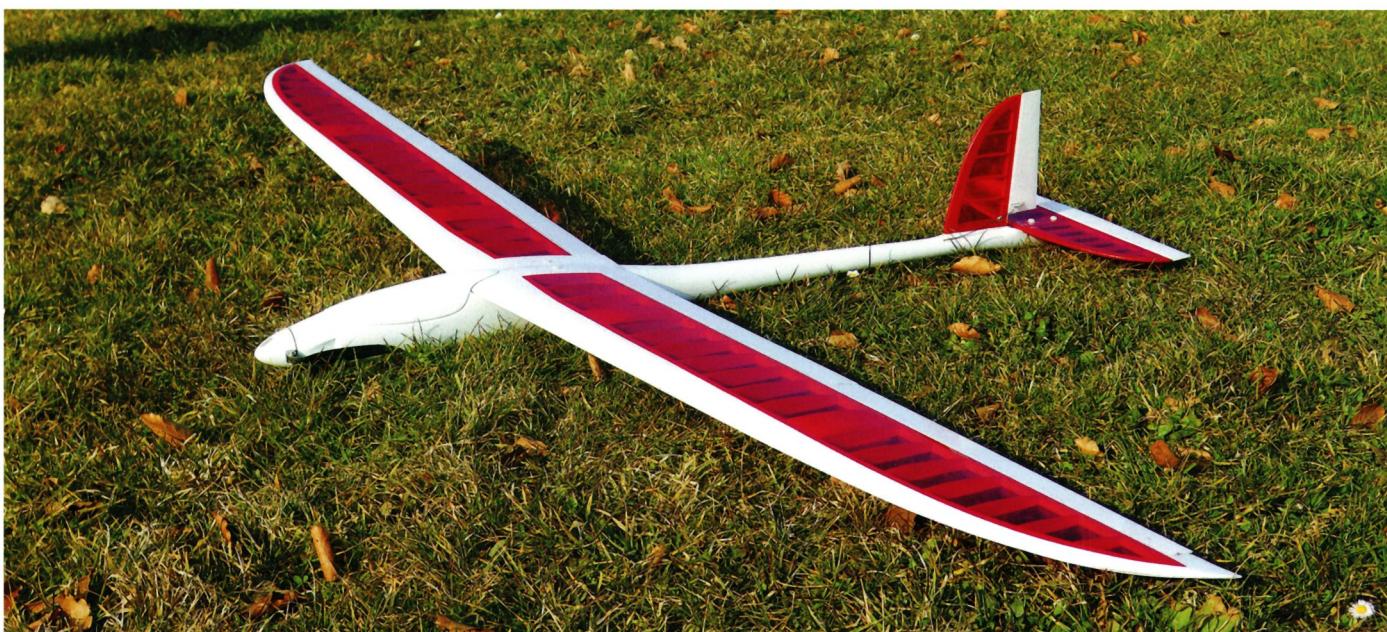
A handy little glider that I could take with me anywhere had been on my wish list for quite some time. So I settled on the Renny from net-RC.ch. The weight needed to be as low as possible so it could stay aloft even in weak thermals. I planned to equip the fuselage with “unused” parts from my stash. But I soon realized that the servos and the outrunner motor I had on hand were much too large for the delicate fuselage.
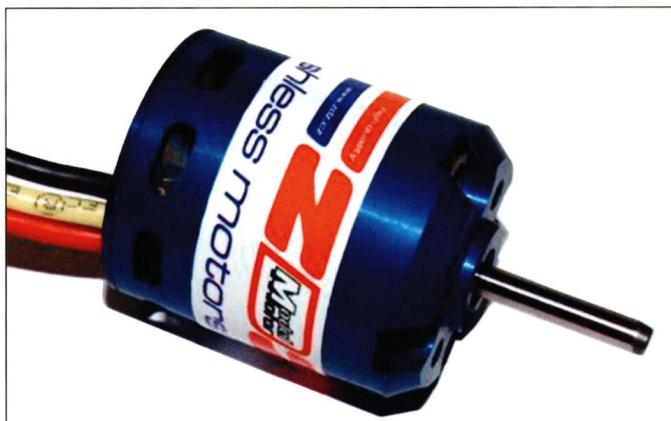
ZDZ-Modelmotor.cz—known to many as a manufacturer of gasoline engines for larger models—now also produces electric motors. The sealed outrunner motors have the major advantage that nothing rotates and the cables exit from the rear. I chose the 200W model. Weighing just 88 grams, it fits perfectly in the nose of the Renny. Powered by a 3S LiPo with 1300 mAh and a CAM 9.5×5 propeller, the motor provides a runtime of 3 minutes, and with a climb angle of over 45 degrees, a substantial number of climb flights are possible.
The ZDZ Roton 200W motor, also available from net-RC.
Now that we have the right mounting parts, construction of the Renny is moving along quickly. The motor mount is already installed in the fiberglass fuselage. The four threads for attaching the wings need to be cut. The steel wires in the fuselage and the servo cables in the wings had already been threaded through. The
| Technical Specifications | Rada | Renny 2M E |
| Wingspan | 1,800 mm | 2000 mm |
| Fuselage length | 1,010 mm | 1,050 mm |
| Wing area | 26.5 dm² | 39.5 dm² |
| Wing profile | MH32 | MH32 |
| Empty weight | approx. 430 g | approx. 450 g |
| Takeoff weight | 960 g | 800 g |
| Powerplant | EP 2217-KV1050 | ZDZ 200W |
| Controller | EP33L ECO BEC | Jeti Advance 30 |
| Folding propeller | Aeronaut 10×8 | Aeronaut 9.5×5 |
| LiPo | 3S 2500 mAh | 3S 1300 mAh |
| Servos | ||
| Elevator + Rudder | 2× EP 13-2513 | 2× Futaba S3114 |
| Aileron Servos | 2× EP 13-2513 | 2× Robbe FS40 |
| Servos for flaps | 2× EP 15-3615MG | 2× Futaba S3150 |
| Receiver | Futaba R617FS | Futaba R617FS |
The V-tail made of balsa wood is covered with film and can be secured with tape. I glued it together with 5-minute epoxy—better safe than sorry. The wing is equipped with a sturdy D-box, and the rib section is covered with film. Four fiberglass-reinforced plastic control horns are included for gluing into place for the aileron linkage, and two plastic parts for screwing in are provided for the V-tail. The wing connector is made of carbon fiber composite. Once it was finished, the first thing I did was weigh it, and I was quite surprised when the display showed exactly 800 g. With that much wing area, it should sail like a dream.
With the specified settings, the Renny flies beautifully and, thanks to its low wing loading, always stays in a comfortable range. I haven’t flown this much in a long time—not even this winter. Although the glider looks so delicate, even flying in strong Bise winds didn’t faze it. Flights rarely lasted less than an hour—unless the pilot’s fingers were nearly frozen off. Even the slightest thermal can be exploited. The Renny is a real blast. One thing is already certain: the Renny will be coming along on my next summer vacation! 


TEAM MANAGER "THIS" BOSSHARD
 Rodito Nussbaumer

SUMMER FUN 2026 AT MG USTER
Martin Wunderli
52. 2026 ALPS CUP
 Emil Giezendanner

ATOM, THE NEW DOUBLE-DECKER FROM CPLR
 Matthias Bosshard

INSIGHTS INTO THE HISTORY OF SEAPLANES

34th HAHNENMOOS ALPINE MODEL AIRPLANE CAMP
Res Dauwalder
CORSAIR F4U – A WARBIRD WITH A MEMORABLE LOOK
Jürgen Rosenberger, Jürgen Prinz
SMALL, MODEL-LIKE SAILBOATS
Res Dauwalder
F3A EUROPEAN CHAMPIONSHIPS IN ST-MACAIRE, FRANCE
Matthias Bosshard
What's New at Leomotion.com

HORIZON HOBBY/LEMACO NEWS: MICRO OV-10 BRONCO 645 MM BY E-FLITE

PRIDE AND GOOD IDEAS
 Markus Nussbaumer

News from HEBU

BY YOUTH, FOR YOUTH
Lorena Betschen
YOU KNOW WHAT I MEAN? 125 YEARS OF THE SWISS AERO CLUB
Emil Giezendanner
TRY-OUT DAY AT MFV WETTINGEN
Urs Keller
FREE FLIGHT IN THE MIDDLE OF SUMMER
Urs Muntwyler
THE PC-21 STORY
Emil Giezendanner
TWIN TOWN PARTNERSHIP
Wolfgang Voeller
EURO CONTEST GLIDER ACRO TOUR AUSTRIA 2026

WELCOME, NEW MEMBER!
Andrea Bolliger
COUPE DES ALPES – OBSERVE AND LEARN
Rodito Nussbaumer
NEWS FROM HEBU
 Julia Bucher

FROM 0 TO 100
Markus Nussbaumer
MEMORIES
Wolfgang Völler
NOS REGION – A HUB FOR ELECTRIC AVIATION
Emil Giezendanner
Have you almost forgotten about aircraft that take off and land vertically?
Emil Giezendanner
70 YEARS OF THE NIDWALDEN MODEL AIRPLANE CLUB
Martin Barmettler