
Model Jets: What Safety Considerations Should Be Taken Into Account?
It is fascinating and exciting to build and fly a model airplane equipped with a working jet engine. If you approach the project and its operation with sufficient seriousness and precision, you will derive great pleasure from it and be able to enjoy many successful flights.
Meanwhile, numerous experienced manufacturers offer engines that perform well. These range from jet engines that generate the necessary thrust to twin-shaft turboprop engines that drive a propeller via a gearbox using exhaust gas pressure. This is a true turbine that requires expertise, discipline, regular servicing, and routine maintenance. These engines perform well as long as they are installed properly and maintained correctly during operation.
There are also various safety-related measures that must be strictly observed. This begins with the installation of the various components. The operation of a jet engine generates very high rotational speeds, high temperatures, vibrations, and forces that should not be underestimated. Under certain weather and runway conditions, these models—which are usually made of plastic—can also generate enormous electrostatic charges.
It is also recommended to program the individual components of the jet model correctly. For example, the “failsafe” behavior.
Important equipment and supplies related to the model should not be overlooked either. These include, for example, fire extinguishers, hearing protection, checklists, etc.
The RPM ranges on average from 30,000 (idle) to 130,000 (full throttle). Just imagine,
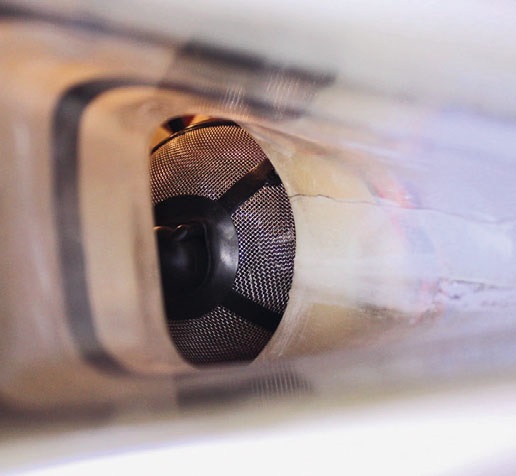
The temperature at the turbine housing reaches up to 600 °C, and up to 800 °C at the exhaust jet. Appropriate structural measures are necessary to prevent damage to the model and to safely and reliably vent the hot gases. For this purpose, a suitable thrust tube is used, which, when installed correctly, directs the exhaust gases through a Venturi—
What an enormous force (Coriolis force) acts on the bearings during tight maneuvers.
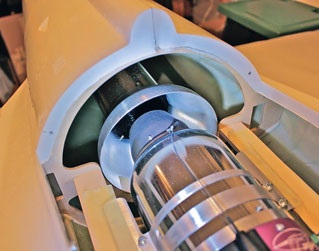
It cools the exhaust and diverts it away from the fuselage. And by the way, the exit velocity of the hot exhaust plume is well into the supersonic range as it leaves the engine...
The vibrations generated during the operation of a jet engine differ significantly from those of a piston engine. They are high-frequency, barely perceptible, but should not be underestimated. They are certainly capable of loosening screws that are not tightened sufficiently and/or not secured, without anyone noticing. Regular inspections on the test stand are definitely worthwhile.
Even when rolling at walking speed on the ground, electrostatic charges can build up, causing the throttle channel of the ECU (Engine Control Unit) to stop functioning or even fail completely. Appropriate design measures, such as installing the ECU in an isolated location or using suitable materials for the wheels, can largely resolve this problem.
When flying a jet model, you’re often covering a lot of ground, traveling fast, and dealing with a lot of mass and flammable materials. That’s
failsafe programming is a “must.” To prevent the model from continuing to move uncontrollably at full throttle in the event of a loss of radio signal, it is recommended to set the system so that the control surfaces remain in their current positions and the power is significantly reduced.
Checklists: A simple tool, but very effective and helpful.
Example 1: Before leaving for the site, check to make sure everything has actually been loaded.
| J-4094 Equipment Checklist | ||
| Fuselage | ||
| 2x wings | ||
| 2x horizontal stabilizers | including spars | |
| 2x wing spars | ||
| Transport case: | Battery | Charged |
| Tools | ||
| Charging cable | ||
| Flight log | ||
| Metal box: | Pitot tube | |
| Engine Battery | Charged | |
| 2x main spars | ||
| Tripod | ||
| Transmitter | Charged | |
| Kerosene – Gas Station | ||
| Fire extinguisher | ||
| Trestle | with top piece | |
| Umbrellas | ||
| Rain cover | ||
| Folding chairs |
Example 2. Before takeoff
| J-4094 | |
| Before Takeoff Checklist | |
| Preflight Check | Performed |
| Fuel Tank | Full |
| Air Pressure | Checked |
| Receiver Battery | Checked |
| Engine Battery | Checked |
| Transmitter: | J-4094 |
| Battery | |
| Antenna | |
| Checked | |
| Checked | |
| in position | |
| Flaps | Takeoff |
Before every engine start, even if only for testing purposes, a fully functional CO2 fire extinguisher with at least 2 kg of extinguishing agent must be kept nearby.
There are various reasons why you might need to use it. For example: If the ignition fails or the starter malfunctions during the start-up process, the fuel pump may have already delivered fuel. On the next attempt,
fuel in the thrust tube or beneath the engine may ignite. An excessively high injection volume can also lead to the same result. If a cabin heating system is installed, ensure that no residual fuel oil remains in the thrust tube before starting the engine. There is a very real risk that this could ignite during the startup process.
Various fuels can be used. Kerosene, petroleum, etc., are used, with approximately 5% oil added. To prevent static buildup in the fuel system, it is recommended to add an antistatic additive to the fuel (some manufacturers that offer engine oil already include this additive).
People or animals must maintain the following minimum safety distances from a turbine model:
- In front of the turbine: 1.0 m
- To the side of the turbine: 12.0 m
- Behind the turbine: 10.0 m
- (Source: JetCat) →
To prevent hearing damage, it is recommended to wear hearing protection when operating turbines.
Before the maiden flight, check the failsafe behavior. Place the aircraft on the stand, start the engine, set it to normal power or even full throttle => turn off the transmitter. The engine should throttle back to the desired reduced power.
With a jet model, you can cover considerable distances very quickly in flight. This makes it all the more important to perform a range test correctly. Careful attention must also be paid to the correct installation of the receivers and their antennas during construction.
The range test must be conducted from a reasonable distance and, above all, with the model in various positions. And if you want to do it right, repeat the entire test with the engine running (recommended by JetCat).
A jet model flies differently than a glider or a propeller-driven aircraft. The engine’s power must be sufficient for safe operation (takeoff, flight, and landing). With today’s engines, throttle response is remarkably fast, but still slightly delayed.
With a jet, you tend to travel quickly and over a wide area, and you should never lose visual contact with the model.
For this reason, it is recommended to always fly a jet model with an assistant who monitors the airspace and surroundings during flight, alerts the pilot to other aircraft and/or people and animals in the area, and ensures that the runway is clear for the upcoming landing. And should any problems arise with the model or during flight, the assistant can provide valuable and useful information and tips.
A personal briefing (or one with the assistant) is highly recommended. When should I abort takeoff, if necessary? Where do I have the option for a field landing in the event of an engine failure?
I must make sure that I am always within the designated and defined airspace. It is generally difficult to estimate the distance to a model airplane—and even more so with a jet model that flies over a wide area.
Also, depending on the jet, the noise level can be considerable. Noise-sensitive areas should be avoided. It’s also important to keep in mind that there are people who aren’t sensitive to noise but are more likely to be afraid of it,
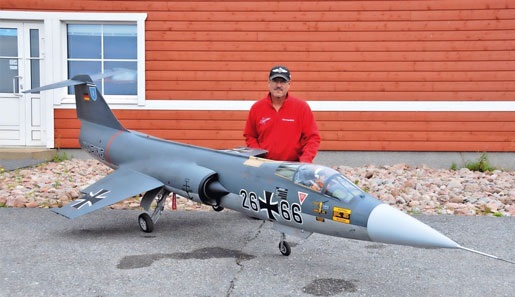
when a jet like that comes near you.
Full throttle is actually rarely necessary. Flying at reduced power is a very effective way to protect the environment. And the engine also appreciates not being operated too abruptly. Thermal and mechanical stress increases dramatically at full power and during abrupt changes in power output. It’s also advisable to slightly reduce the maximum RPM, which is barely noticeable and has a positive effect on the engine’s service life.
All these measures help reduce the likelihood of an engine failure in flight and increase reliability.
A model aircraft with a turbine engine achieves significantly higher flight speeds than, for example, a model with an impeller engine, due to the higher exhaust velocity at the same static thrust. The achievable flight speeds (> 300 km/h) are usually above the speed range permitted for a standard model aircraft. There is therefore a risk of control surface flutter or mechanical overload on the airframe and servos.
A model that gets out of control can cause significant injury and property damage.
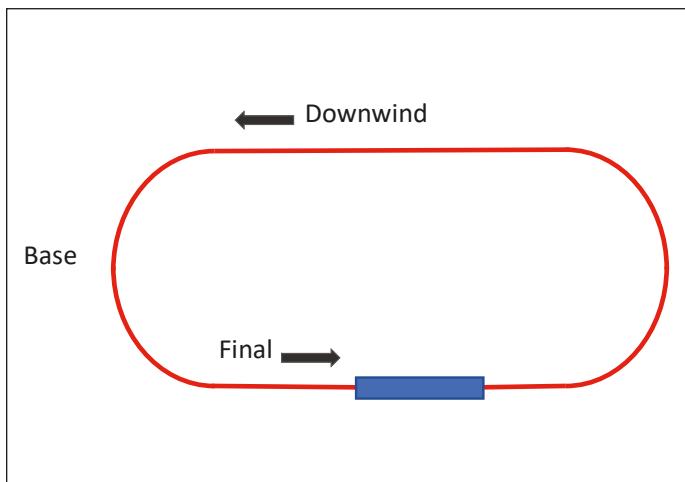
Flying a landing turn provides a controlled preparation for the upcoming landing. This applies to all aircraft, but especially to
the jet. The correct throttle setting during the approach is crucial for a smooth and safe landing. It should be noted that throttle response varies depending on the engine. And as a general rule (even in recreational flying), the more mass you’re moving, the higher up everything needs to be in order.
The go-around. It’s a very effective way to abort a botched approach to prevent something worse from happening. It’s also a recurring topic in everyday aviation. The go-around is a standard maneuver, but one that is rarely used. And when commercial considerations come into play (time constraints, delays, connecting passengers, additional fuel consumption...), the threshold for performing a go-around is significantly higher.
In model aviation, too, there are many situations where a go-around can prevent a number of problems. You just have to decide to do it in time. With regard to model jets, it’s important to note that, depending on the engine, the required power may be available with a slight delay.
*Alfred Doppelhofer,
April 2023*
**Report in French**
<https://www.modellflug.ch/FR/home>
**Report in Italian** <https://www.modellflug.ch/IT/home>


TEAM MANAGER "THIS" BOSSHARD
 Rodito Nussbaumer

YOU KNOW WHAT I MEAN? 125 YEARS OF THE SWISS AERO CLUB
 Emil Giezendanner

F3A EUROPEAN CHAMPIONSHIPS IN ST-MACAIRE, FRANCE
 Matthias Bosshard

News from HEBU

SUMMER FUN 2026 AT MG USTER
Martin Wunderli
TRY-OUT DAY AT MFV WETTINGEN
Urs Keller
52. 2026 ALPS CUP
Emil Giezendanner
BY YOUTH, FOR YOUTH
Lorena Betschen
ATOM, THE NEW DOUBLE-DECKER FROM CPLR
Matthias Bosshard
CORSAIR F4U – A WARBIRD WITH A MEMORABLE LOOK
Jürgen Rosenberger, Jürgen Prinz
SMALL, MODEL-LIKE SAILBOATS
Res Dauwalder
What's New at Leomotion.com

TWIN TOWN PARTNERSHIP
Wolfgang Voeller
EURO CONTEST GLIDER ACRO TOUR AUSTRIA 2026

INSIGHTS INTO THE HISTORY OF SEAPLANES

34th HAHNENMOOS ALPINE MODEL AIRPLANE CAMP
Res Dauwalder
HORIZON HOBBY/LEMACO NEWS: MICRO OV-10 BRONCO 645 MM BY E-FLITE

COUPE DES ALPES – OBSERVE AND LEARN
Rodito Nussbaumer
PRIDE AND GOOD IDEAS
 Markus Nussbaumer

FREE FLIGHT IN THE MIDDLE OF SUMMER
Urs Muntwyler
THE PC-21 STORY
Emil Giezendanner
WELCOME, NEW MEMBER!
Andrea Bolliger
NEWS FROM HEBU
 Julia Bucher

FROM 0 TO 100
Markus Nussbaumer
MEMORIES
Wolfgang Völler
NOS REGION – A HUB FOR ELECTRIC AVIATION
Emil Giezendanner
Have you almost forgotten about aircraft that take off and land vertically?
Emil Giezendanner
70 YEARS OF THE NIDWALDEN MODEL AIRPLANE CLUB
Martin Barmettler