
1975 World Championship and Elite Qualifying Flights in Pfäffikon
As is well known, our country’s three World Championship participants in the RC aerobatics category qualify based on three official championships: the two Swiss Championships held prior to the World Championships and a third competition, the World Championship qualifier. The worst finish from these three championships is discarded. Rankings are determined using reverse ranking points; that is, the first-place finisher receives 20 points, the second 19 points, the third 18, and so on. In the event of a tie, the better discarded result determines the ranking. Foreign competitors are not included in this ranking.
For the 1975 national team, the rankings are as follows:
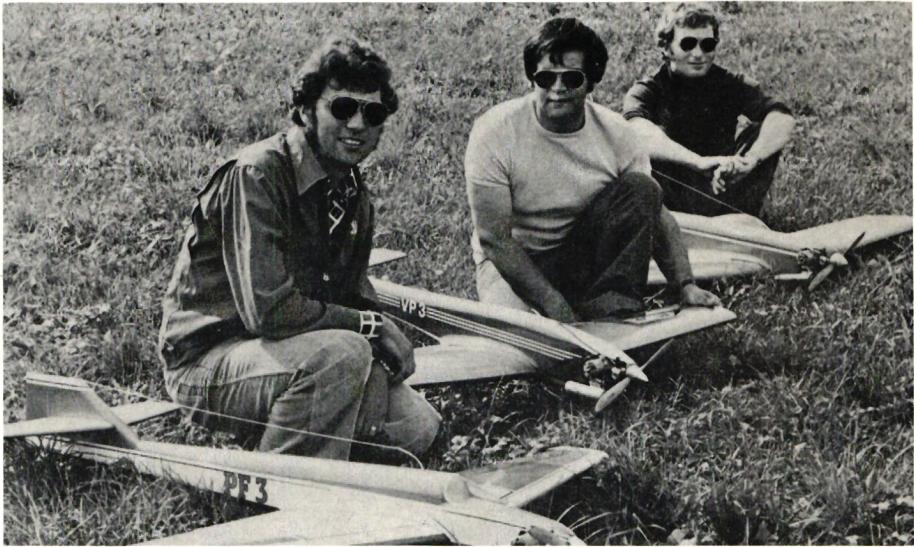
| Official National Team | |||||||
| 1. Bruno Giezendanner, Pfäffikon | 1. | 20 | 1. | 20 | 1. | 20 | 40 |
| 2. René Schumacher, Visp | 2. | 19 | 2. | 19 | 2. | 19 | 38 |
| 3. Emil Giezendanner, Pfäffikon | 3. | 18 | 3. | 18 | 3. | 18 | 36 |
| Reserve Pilot | |||||||
| 4. Kurt Schnyder, Frauenfeld | — | — | 4. | 17 | 4. | 17 | 34 |
| The top five in the rest of the standings | |||||||
| 5. Roland Rebmann, Oberwil | 4. | 17 | — | — | 5. | 16 | 33 |
| 6. Kurt Nünlist, Glattal | — | — | 5. | 16 | 9. | 12 | 28 |
| 7. Zwingli Hansruedi, Thal | 8. | 13 | 7. | 14 | 10. | 11 | 27 |
| 8. Werner Schnyder, Menziken | 9. | 12 | — | — | 6. | 15 | 27 |
| Anton Zehnder, Wettingen | — | — | 8. | 13 | 7. | 14 | 27 |
No noise measurements had actually been taken at Swiss model aircraft championships before, even though we’re not in Gorizia, Saudi Arabia, or even the Nevada Desert. What may sound like fantastic music (molto rabiato con eccesso) to Italian ears is unbearable to an established Swiss person, who, aside from the jingle of coins and the rustle of banknotes, no longer has any musical ear at all. This circumstance must be taken into account to a greater extent. Since measuring instruments are generally more objective than bitter noise opponents with ears that are too large or protrude excessively, petition drives and noise-related hysteria must be countered with hard data.
During the World Championship and Elite Qualifying Flying Competition in Pfäffikon, Canton of Zurich, a highly sensitive measuring instrument was put to use. Measurements were taken ten meters away, directly perpendicular to the runway, during takeoff. Since this runway in Pfäffikon is very short and narrow by today’s standards (55 x 35 m), pilots have no choice but to take off at full throttle. The measurement data were recorded on a data sheet issued for each model. During the model inspection, special attention was also paid to the muffler.
Incidentally, the total wing area and wing loading were determined in a matter of seconds using a small computer. Each pilot received a copy of his inspection sheet.
The measurements clearly demonstrated the differences between various types and brands of mufflers. Readers can form their own opinion based on the table. However, to increase the significance of this data, such a table would also need to include the RPM of each engine. Numerous “specialists” still haven’t grasped that very high RPMs are not at all necessary in aerobatics. It would be interesting to know how many model airfields have fallen victim to this obsession with RPMs.
As is well known, the 1975 World Remote-Control Aerobatics Championship will take place at Belpmoos in Bern (see VW Information in MFS issues 5/74, 6/74, and 1/75). Bruno Giezendanner of Pfäffikon, René Schumacher of Visp, and Emil Giezendanner of Pfäffikon have qualified for this most important event in the RC category. Kurt Schnyder of Frauenfeld will initially participate in training as a reserve pilot until the registration deadline, so that he can step in if a pilot is unable to compete. After the registration deadline, the RC Championship does not allow for substitute pilots or proxy starts.
As soon as the national team begins its official training, we will provide detailed coverage of the team on the World Championship information page, including presentations of their models, technical details, experiences with motors, RC systems, and more.
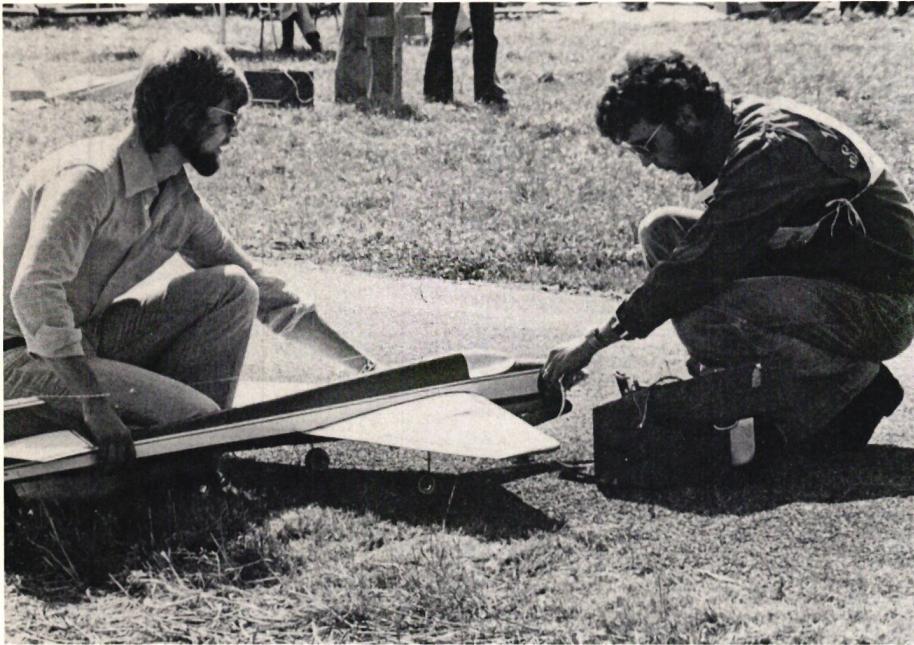
Since this year marks the first time the new promotion and relegation system is being implemented in RC aerobatics, the qualifying competition for the top division (F3A Elite) was held last year in conjunction with the World Championship qualifying rounds. Contrary to some opinions and rumors, only those pilots who qualified through this event or who earned promotion to the top league via the F3A Swiss National Championship 75 will be eligible to compete in this year’s FAI-class Swiss Championship.
The following pilots have definitively qualified for the Swiss Championship 75:
1. Bruno Giezendanner, Pfäffikon
2. René Schumacher, Visp
3. Emil Giezendanner, Pfäffikon
4. Ferdinand Schaden, Olten*
5. Kurt Schnyder, Frauenfeld
6. Roland Rebmann, Oberwil
7. Werner Schnyder, Menziken
8. Anton Zehnder, Wettingen
9. Christof Hug, Sulzer-Winterthur
10. Longo Silvano, Neuchâtel*
11. Kurt Nünlist, Glattal
The following pilots will compete in the repechage (promotion flight) against the top three finishers of the F3A Swiss National Championship:
12. Ulrich Gärtner, Olten*
13. Hansruedi Zwingli, Thal
14. Karl Kistler, Basel
15. Sven Wiesendanger, Diessenhofen
* = Foreign pilots
The three winners of this qualifying round (plus foreign pilots) will be promoted to the Elite division and will compete in the Swiss Championship immediately following this event. The remaining pilots will be relegated to the F3A National category for the coming year.
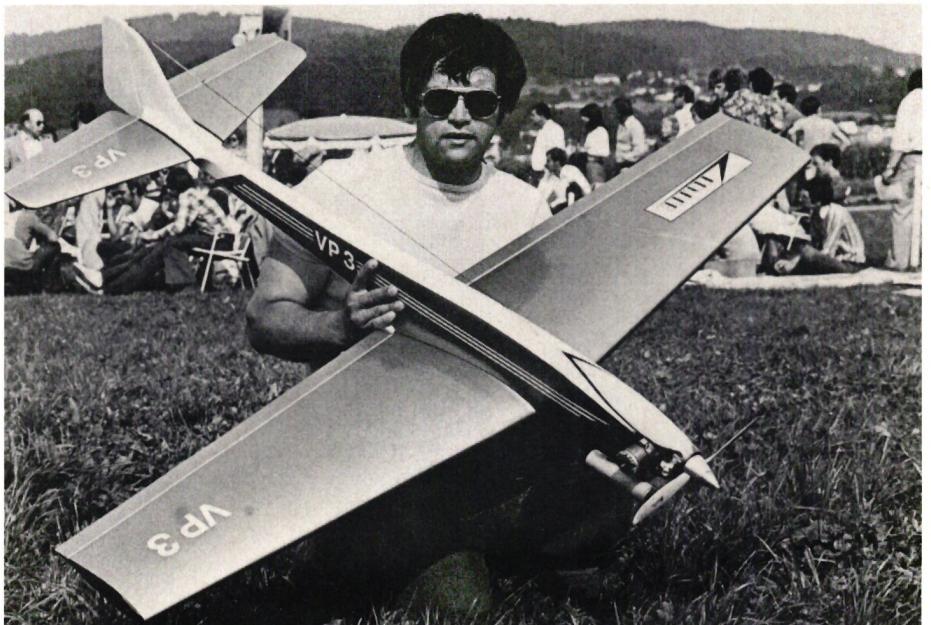
Whether a model—as is often stated in many building plans— is “fully aerobatic-capable,” how reliably and powerfully a motor runs, the quality of a servo, and the reliability and sturdiness of a retractable landing gear, etc., will be ruthlessly put to the test, especially under the rigorous conditions of championship pilots. An RC system may look wonderful in brochures or store windows with its computer-generated graphics and may even function perfectly on a nice Saturday afternoon. But in situations where frequent and intensive training is required, the demands placed on it are far greater—and it is precisely here that service can make all the difference. A competition pilot can never wait three months (it happens!) for a control unit sent in for repair, because by then the season would be over. That’s why we’re publishing a detailed list of the materials used below. This table is far more useful to model airplane enthusiasts than the brochures and price lists that are sent to club presidents by the kilo every week.
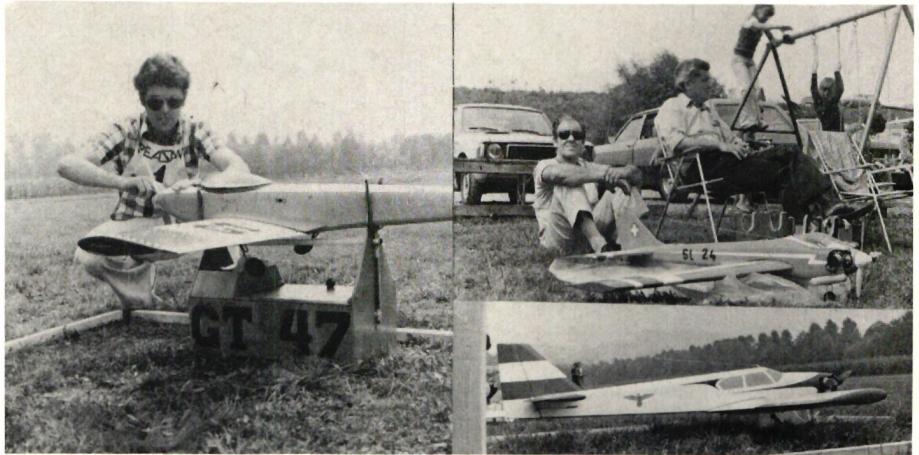
| Rank | Name | Model Aircraft Club | Points | Model | Wingspan (millimeters) | Weight (fully fueled) in grams | Wing loading , g/dm² | RC system | Motor | Carburetor | Propeller | Muffler | Maximum noise level (dB) |
| 1. | Bruno Giezendanner | Pfäffikon | 14,240 | Scorpion | 1,600 | 3,320 | 58.0 | Digi-Fly | Webra Speed | Webra | Top Flite 11 x 7 3/4 | Kö-Super | 68 |
| 2. | René Schumacher | Visp | 12,915 | Condor | 1,580 | 3,710 | 65.3 | Simprop | Webra Speed | Webra | TF 11 x 7 3/4 | Kö | 70 |
| 3. | Emil Giezendanner | Pfäffikon | 12,750 | Marabu | 1,680 | 3,520 | 55.2 | Digi-Fly | Webra Speed | Webra | TF 11 x 7 3/4 | Kö-Super | 66 |
| 4. | Ferdinand Schaden | Olten | 12,630 | Condor | 1,650 | 3,650 | 57.6 | Digi-Fly | HP | HP | Graupner 11 x 7 | HP | 72 |
| 5. | Kurt Schnyder | Frauenfeld | 11,950 | Pirol | 1,630 | 3,880 | 69.7 | Digi-Fly | HP | HP | Robbe 11 x 8 | HP | 71 |
| 6. | Roland Rebmann | Oberwil | 11,775 | Marabu | 1,690 | 3,900 | 61.7 | Multiplex | HP | HP | Robbe 11 x 8 | HP | 72 |
| 7. | Werner Schnyder | Menziken | 10,645 | Pirol | 1,630 | 4,050 | 63.8 | Digi-Fly | Rossi | Perry | Robbe 11 x 8 | Kö | 73 |
| 8. | Zehnder Anton | Wettingen | 10,430 | Marabu | 1,550 | 4,010 | 63.5 | Digi-Fly | Webra Speed | Webra | Graupner 11 x 7 | Minivox | 67 |


TEAM MANAGER "THIS" BOSSHARD
 Rodito Nussbaumer

SUMMER FUN 2026 AT MG USTER
Martin Wunderli
TRY-OUT DAY AT MFV WETTINGEN
Urs Keller
52. 2026 ALPS CUP
 Emil Giezendanner

ATOM, THE NEW DOUBLE-DECKER FROM CPLR
 Matthias Bosshard

INSIGHTS INTO THE HISTORY OF SEAPLANES

34th HAHNENMOOS ALPINE MODEL AIRPLANE CAMP
Res Dauwalder
CORSAIR F4U – A WARBIRD WITH A MEMORABLE LOOK
Jürgen Rosenberger, Jürgen Prinz
SMALL, MODEL-LIKE SAILBOATS
Res Dauwalder
F3A EUROPEAN CHAMPIONSHIPS IN ST-MACAIRE, FRANCE
Matthias Bosshard
What's New at Leomotion.com

HORIZON HOBBY/LEMACO NEWS: MICRO OV-10 BRONCO 645 MM BY E-FLITE

PRIDE AND GOOD IDEAS
 Markus Nussbaumer

News from HEBU

BY YOUTH, FOR YOUTH
Lorena Betschen
YOU KNOW WHAT I MEAN? 125 YEARS OF THE SWISS AERO CLUB
Emil Giezendanner
FREE FLIGHT IN THE MIDDLE OF SUMMER
Urs Muntwyler
THE PC-21 STORY
Emil Giezendanner
TWIN TOWN PARTNERSHIP
Wolfgang Voeller
EURO CONTEST GLIDER ACRO TOUR AUSTRIA 2026

WELCOME, NEW MEMBER!
Andrea Bolliger
COUPE DES ALPES – OBSERVE AND LEARN
Rodito Nussbaumer
NEWS FROM HEBU
 Julia Bucher

FROM 0 TO 100
Markus Nussbaumer
MEMORIES
Wolfgang Völler
NOS REGION – A HUB FOR ELECTRIC AVIATION
Emil Giezendanner
Have you almost forgotten about aircraft that take off and land vertically?
Emil Giezendanner
70 YEARS OF THE NIDWALDEN MODEL AIRPLANE CLUB
Martin Barmettler