
Slope Gliding 70 Years Ago
In 1943, I was able to participate in the “National Competition” in Laufen for the first time. On Saturday afternoon, September 11, we looked at the motor-powered models and the few rubber-powered models (rubber was hard to find...). Back then, the “VM Handicap” models flew with a 30-second motor runtime. A 1-second overrun resulted in a 5-point deduction. Clockwork-powered models didn’t come along until later.
In the evening, after the “Landsgemeinde,” we slept on straw in the gym. Early in the morning, we ran to Blauen. The starting point is located above the village on the Blauenweid.
Four categories are evaluated:
- Standard models built to plans (BP)
- Original designs (EK)
- Special designs: flying wings, ducks, tandems (SK)
- Models with automatic control (AK)
For all categories, flight duration (1 s = 5 points) and distance flown (1 m = 1 point) were measured. Of every 3 flights, 2 were evaluated. Distance is determined using military maps. This rule favored models with stable flight paths.
In the Aero-Revue report, our senior expert Arnold Degen expressed regret that too many model aircraft enthusiasts were using BP (kit) models to achieve good rankings, rather than building EK (self-designed) models to participate in our joint development efforts. The MFK (AeCS Model Flying Commission) will take action: At the next National Competition (1945, high-launch), only EK models will be permitted!
The AK models: Four with compass control and one with pendulum control were at the starting line. The winner, Walter Egloff, flew 591/576 seconds and covered a distance of
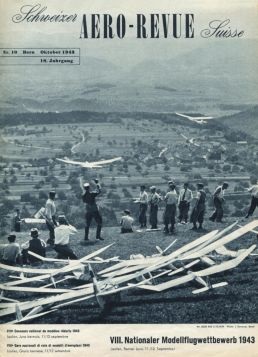
Kurt Sempert launches his model.
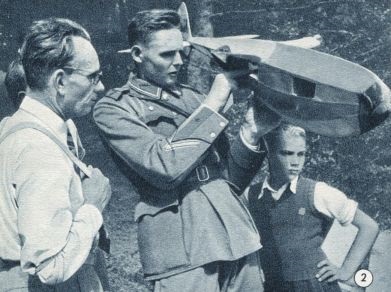
from 5,375/3,800 meters and scored 15,010 points. The best EK scored 5,135 points, while the winner, BP, scored 6,185 points.
Today’s slope flyers would protest. It is very difficult to spot models clearly with binoculars at distances up to 2,000 meters. In 1943, during mobilization, it was possible to request support from the army—specifically, from communications teams equipped with radios. Observation posts were thus set up on the plains to report the landing times and locations of the individual AK models.
The control systems of that time consisted of a carbon steel magnet, a servo, and a battery. The circuit was activated by contacts when the magnet rotated. Since eddy current brakes were not yet common, the models flew in a zigzag pattern. ■
Maurice Bodmer


News from HEBU

TEAM MANAGER "THIS" BOSSHARD
 Rodito Nussbaumer

SUMMER FUN 2026 AT MG USTER
Martin Wunderli
SMALL, MODEL-LIKE SAILBOATS
Res Dauwalder
TRY-OUT DAY AT MFV WETTINGEN
Urs Keller
What's New at Leomotion.com

52. 2026 ALPS CUP
 Emil Giezendanner

BY YOUTH, FOR YOUTH
Lorena Betschen
ATOM, THE NEW DOUBLE-DECKER FROM CPLR
 Matthias Bosshard

INSIGHTS INTO THE HISTORY OF SEAPLANES

YOU KNOW WHAT I MEAN? 125 YEARS OF THE SWISS AERO CLUB
Emil Giezendanner
34th HAHNENMOOS ALPINE MODEL AIRPLANE CAMP
Res Dauwalder
CORSAIR F4U – A WARBIRD WITH A MEMORABLE LOOK
Jürgen Rosenberger, Jürgen Prinz
F3A EUROPEAN CHAMPIONSHIPS IN ST-MACAIRE, FRANCE
Matthias Bosshard
HORIZON HOBBY/LEMACO NEWS: MICRO OV-10 BRONCO 645 MM BY E-FLITE

PRIDE AND GOOD IDEAS
 Markus Nussbaumer

EURO CONTEST GLIDER ACRO TOUR AUSTRIA 2026

FREE FLIGHT IN THE MIDDLE OF SUMMER
Urs Muntwyler
THE PC-21 STORY
Emil Giezendanner
TWIN TOWN PARTNERSHIP
Wolfgang Voeller
WELCOME, NEW MEMBER!
Andrea Bolliger
COUPE DES ALPES – OBSERVE AND LEARN
Rodito Nussbaumer
NEWS FROM HEBU
 Julia Bucher

FROM 0 TO 100
Markus Nussbaumer
MEMORIES
Wolfgang Völler
NOS REGION – A HUB FOR ELECTRIC AVIATION
Emil Giezendanner
Have you almost forgotten about aircraft that take off and land vertically?
Emil Giezendanner
70 YEARS OF THE NIDWALDEN MODEL AIRPLANE CLUB
Martin Barmettler