
22nd F3B World Championship 2019 in Jeseník, Czech Republic
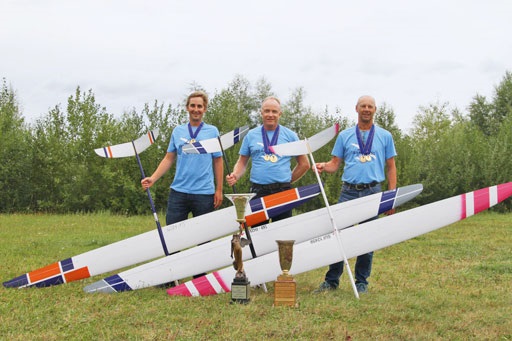
Gold: Andreas Böhlen, Bronze: Thomas Kübler, Gold: Team Competition
In F3B, the oldest of the four FAI gliding classes, pilots must complete three different flight tasks with the same model, with only the addition of ballast permitted. The high launch is performed using an electric winch 200 m away from a pulley. This launch alone is quite a challenge, as everyone tries to reach the greatest possible altitude (200–330 m depending on weather conditions) with optimal model settings. A mere 5-meter difference in altitude compared to a competitor accounts for at least one length during the cross-country flight. Afterward, each round consists of either a 10-minute endurance flight with a precision landing, a distance flight between two markers 150 m apart, or a speed flight covering four lengths, again flying as quickly as possible between these markers. These varied tasks make competition flying in this category challenging, but also exciting.
This is the fourth time the Czech Republic has hosted an F3B World Championship. Due to the organizational effort required for an F3B World Championship, it is becoming increasingly difficult to find a host. Jan Stonavsky, an experienced F3B pilot, served as the organizer and competition director. At the Mikulovice glider airfield, we had a perfect—though thermally challenging—flying area. On Sunday evening after the preliminary competition, the World Championship was officially opened with a simple ceremony, featuring 45 pilots from 16 nations. Based on the preliminary competition, the German and Austrian teams emerged as the favorites.
As expected at a World Championship, there are highs and lows, and a bit of luck is also needed for success. We, too, had our share of setbacks; in the first round, Niklaus received a zero-point score due to contact with a ground crew member. Resu lost his Device model in a collision during the high launch on the second cross-country flight, but things went fairly well from then on. The German team also experienced its own scandal. Two team members reduced the resistance on Martin Weberschock’s winch without his knowledge, intending to gain a few more meters of high-start altitude. This resulted in a 1,000-point penalty for Martin, and he had to forget about a top finish. The tension remained until the 7th and final round. Below is an excerpt from the World Championship daily report on the final speed round 7—you can really feel the intense excitement:
After lunch, the decisive speed round began in reverse order of the standings. The situation was still the same as the previous day: in the individual standings, Resu led by about 130 points over Thomas Frank (D), and in the team standings, we were also in the lead by 180 points. Resu had the discard with a time of 16.7 from Round 4, and Niklaus had the best time from Round 6.
We watched our competitors’ flights with bated breath, since our three pilots weren’t scheduled to fly until the last 20. The best time so far was 14.57, set by the Japanese pilot. We calculated that if Thomas Frank flew a 14.0, a 16.0 would be enough for Resu to win the title; if he flew a “Verwender,” the 16.7—which had been our discard score up to that point—would be enough for second place. The tension mounted. Niklaus was the first of our team to take his turn; he flew a safe 16.41—perhaps he still had the disqualification from Round 6 on his mind. After that, Gerhard Flixeder (A) flew a 15.28, and our team was still narrowly on track for the World Championship. Shortly after that, Hans Rossmann (A) flew a 15.29, and our team title was gone. Now it was our Thomas’s turn, and he conjured up a 13.91 over the course—great, we were back in the lead in the team standings. Now there were four pilots left, including Resu. Bernhard Flixeder (A), the 2017 World Champion, clocked a 14.66, which meant Thomas Kübler was third in the individual standings—he could hardly believe it when I told him. Thomas Frank (D) blasted a 13.74 in
| Pilots: | Andreas Böhlen, Niklaus Huggler, Thomas Kübler |
| Team Support: | Angi Böhlen, Käti Böhlen, Paul Böhlen, Fredy Bühlmann, Hänne Lüthi |
| Team Manager: | Hansruedi Zwingli |
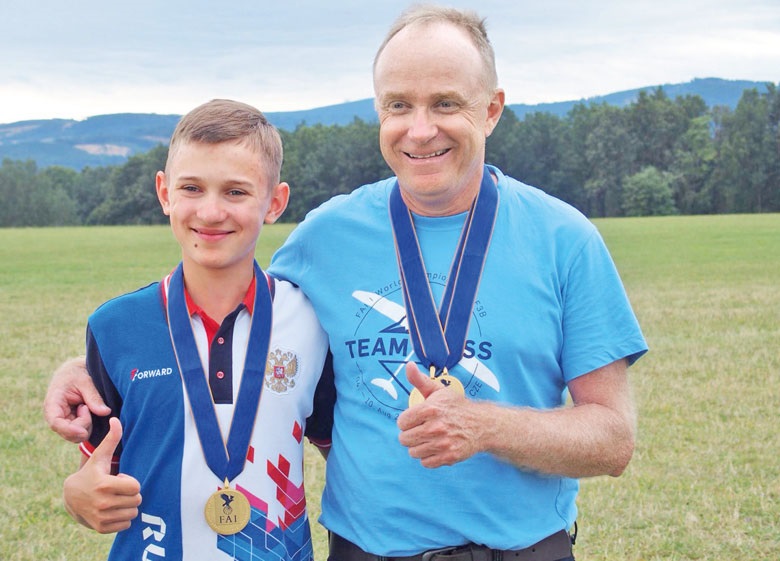
The run—that was the best time so far—and the Germans were cheering along the A-line. Resu was the last to take off; spurred on by the cheers of the German team, he flew “full throttle”—all or nothing—and set a new best time of 13.05. Cheers from the Swiss team: Andreas Böhlen became F3B World Champion for the third time in 2019, following his victories in 2003 and 2005; Thomas Kübler—who even had tears in his eyes from sheer emotion—took a superb third place and the bronze medal; Niklaus Huggler, unfortunately, finished 19th.
In terms of equipment, there’s nothing new—everyone relied on tried-and-true models like the Device, Pike 2 Precision, Freestyler 5, and Pitbull.
A perfect setup is the most important factor and requires an enormous amount of tuning time; moreover, the improvements in new designs compared to the current models are very minor.
We’d like to extend our heartfelt thanks to everyone who supported us.
*Hansruedi Zwingli*
<https://www.f3b.de/sites/default/files/2019-08/Jesenik-WCh-2019.pdf>
<http://www.f3b-wc-2019.com/data/Jesenik-WCh-2019.pdf>


TEAM MANAGER "THIS" BOSSHARD
 Rodito Nussbaumer

SUMMER FUN 2026 AT MG USTER
Martin Wunderli
52. 2026 ALPS CUP
 Emil Giezendanner

ATOM, THE NEW DOUBLE-DECKER FROM CPLR
 Matthias Bosshard

INSIGHTS INTO THE HISTORY OF SEAPLANES

34th HAHNENMOOS ALPINE MODEL AIRPLANE CAMP
Res Dauwalder
CORSAIR F4U – A WARBIRD WITH A MEMORABLE LOOK
Jürgen Rosenberger, Jürgen Prinz
SMALL, MODEL-LIKE SAILBOATS
Res Dauwalder
F3A EUROPEAN CHAMPIONSHIPS IN ST-MACAIRE, FRANCE
Matthias Bosshard
What's New at Leomotion.com

HORIZON HOBBY/LEMACO NEWS: MICRO OV-10 BRONCO 645 MM BY E-FLITE

PRIDE AND GOOD IDEAS
 Markus Nussbaumer

News from HEBU

BY YOUTH, FOR YOUTH
Lorena Betschen
YOU KNOW WHAT I MEAN? 125 YEARS OF THE SWISS AERO CLUB
Emil Giezendanner
TRY-OUT DAY AT MFV WETTINGEN
Urs Keller
FREE FLIGHT IN THE MIDDLE OF SUMMER
Urs Muntwyler
THE PC-21 STORY
Emil Giezendanner
TWIN TOWN PARTNERSHIP
Wolfgang Voeller
EURO CONTEST GLIDER ACRO TOUR AUSTRIA 2026

WELCOME, NEW MEMBER!
Andrea Bolliger
COUPE DES ALPES – OBSERVE AND LEARN
Rodito Nussbaumer
NEWS FROM HEBU
 Julia Bucher

FROM 0 TO 100
Markus Nussbaumer
MEMORIES
Wolfgang Völler
NOS REGION – A HUB FOR ELECTRIC AVIATION
Emil Giezendanner
Have you almost forgotten about aircraft that take off and land vertically?
Emil Giezendanner
70 YEARS OF THE NIDWALDEN MODEL AIRPLANE CLUB
Martin Barmettler