
The Agony (After) the Election
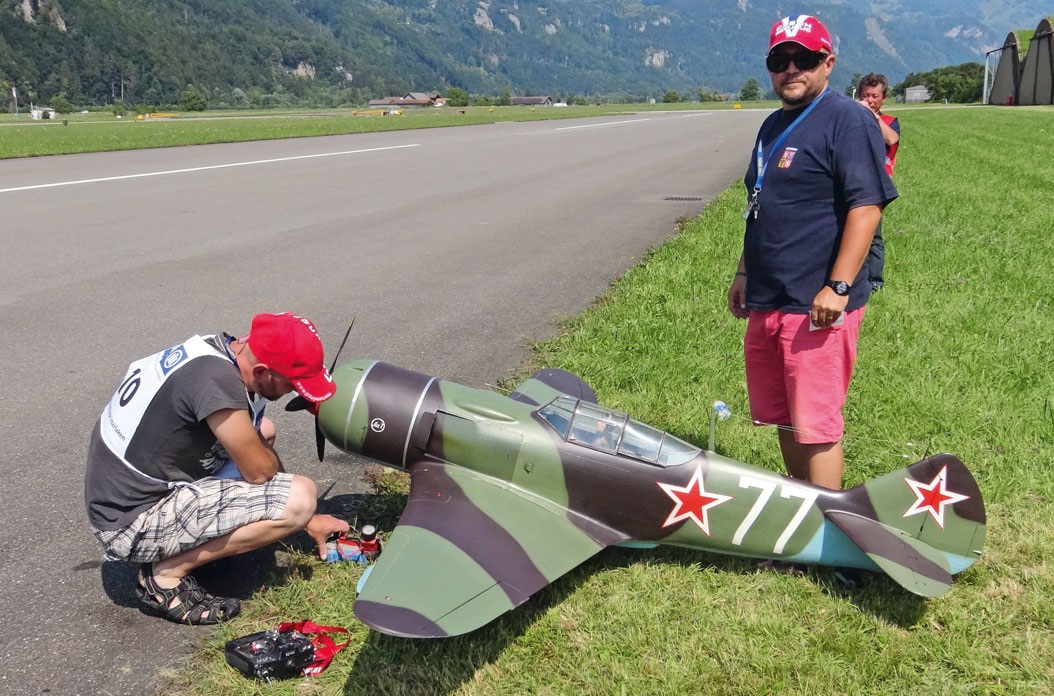
After the Lavochkin La-7 and the Hawker Sea Fury, which I flew at the 2018 Scale World Championships in Meiringen, it was time to build a new, more perfect, and more complex model for the F4C model competitions.
Choosing a new aircraft is always difficult—I have to like it, and I have to be able to find decent materials for it so I can build it as true to the original as possible. It’s very important to have the opportunity to get close to an actual aircraft so I can photograph it in great detail.
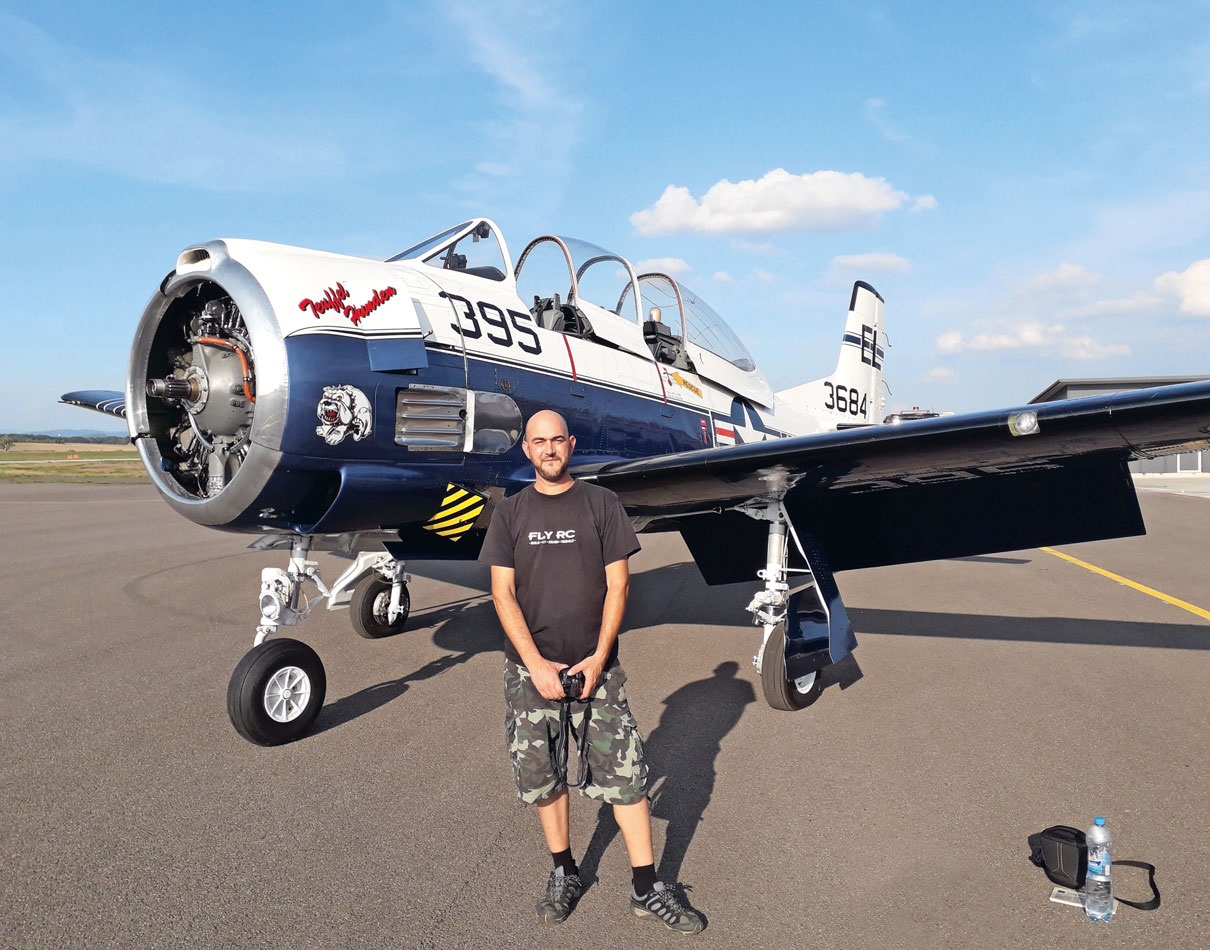
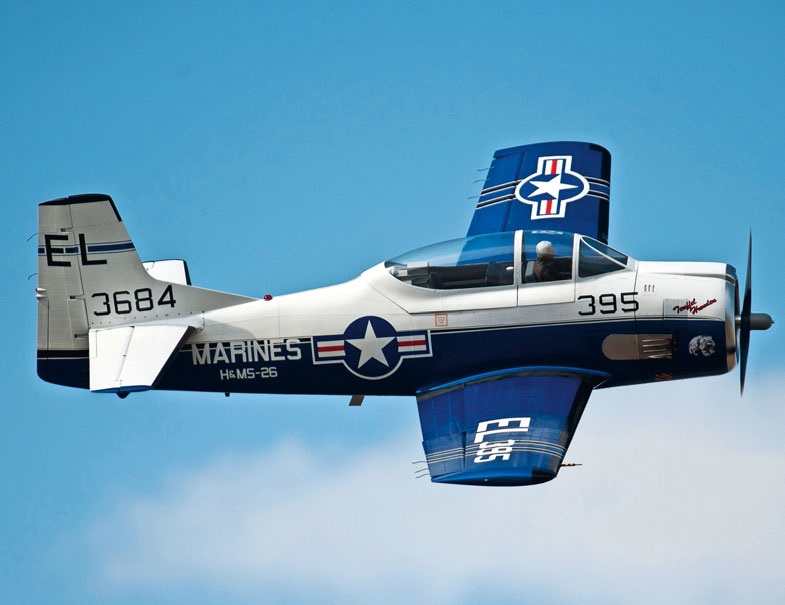
So my colleague David Kopal recommended a model he considered both beautiful and complex: the Trojan. His choice piqued my interest so much that I began looking into how I could obtain detailed information about such an aircraft.
By chance, I learned that a Trojan was parked at the Mnichovo Hradiště airport, where I took photos of the aircraft. My first reaction was—it’s a giant; I can’t do this...
It’s not the Trojan everyone knows, but the Nomad, a modified Trojan designed for civil aviation.
So much for the introduction; now for a summary of some special features during assembly.
Fuselage, canopy, and engine cowling: The base consists of partitions (frames) made of cardboard plywood that are as lightweight as possible, connected by 6×6 spruce and balsa beams. The fuselage is built as the upper half, covered with 2×50 mm balsa, and bonded with SOP. Next comes the canopy, which consists of 3 mm plywood, balsa wood, and extruded polystyrene. This is roughly sanded into shape. After gluing the frames and covering the lower half of the fuselage, the engine cowling was constructed. The front radius of the cowling is made of extruded polystyrene, and the entire structure is laminated. Next came the construction of the engine nacelle, which—made from 4 mm-thick aircraft-grade plywood—was adapted to the fuselage and connected to the mounting for the front landing gear mechanism. The Fiala 85B2 engine only fit into the engine cowling by sanding the balsa wood around the cylinder heads down to the outer laminate. Another of the many problems was that the engine cowling wouldn’t fit over the cylinder heads when I made a mock-up of the exhaust ports. The solution was simple—trim the cowling and leave an opening in the mock-up. The lower section is slid onto two Dural bolts and secured to the chassis bed at the front with an M4 screw. The upper section is slid onto two 12-mm Dural tubes and glued through the engine bulkhead using a laminate sleeve. The side-opening covers are hinged on MPJ flat hinges and secured on each side by a pair of cabin locks, which are connected by a pull rod and unlocked by a wire routed next to the model’s motor.
Wings: The airfoil is the same as on the original. The frames for mounting the landing gear are made of poplar plywood with fabric reinforcement. The main spar consists of 6×6-mm spars and is reinforced—except for the landing gear area—with glued poplar plywood embedded with fiberglass mesh. From the landing gear to the wing tip, there is 3 mm of balsa between the spars, with vertical struts. The wing is assembled as a whole and then cut into three sections: the center section extending to the lift flaps and the wing tips, each approximately 500 mm long, connected by a 25×1 duralumin tube woven into the spar. The wing tips are sanded and laminated from extruded polystyrene. After cleaning, the ailerons and flaps were cut from the assembly; both feature a canopy made of extruded polystyrene.
Leading edge and are laminated. After cutting and gluing the landing gear shafts, the wing is attached to the fuselage and covered with 50 g fabric. Due to the complex transition between the fuselage and the wing, the entire wing must extend into the front landing gear shaft, which is secured with 4 × M6 steel screws. The rear connection between the wing and the fuselage is covered by a functional aerodynamic brake.
Flight: This was followed by the model’s first flight, though only in its unpainted, unfinished state, to save me the trouble in the event of an unfortunate incident (crash). Nothing went wrong during the first flight—quite the opposite, in fact; the Nomad exceeded all expectations on its maiden flight. The model was smooth and stable in all flight attitudes. Landing the Trojan is a real treat, so my little soul was satisfied and ready for the final touches...
Finish: After wet-sanding the entire surface of the model, I marked out the fairings and metal panels. I used some of the rivets cut from the plotter (on the wing from the nose to the main spar and on the engine cowling); the rest are rivets moistened with dispersion adhesive. Various caps and covers are made from 0.3 mm printing plate and fastened with small screws with a 1.5 mm head diameter. There are about 1,000 of them; some are countersunk, while others have a half-round head. All the preparation for the surface finish was a terribly long and tedious task, but I think it was worth it. The entire model is painted with a glossy 2K clear coat.
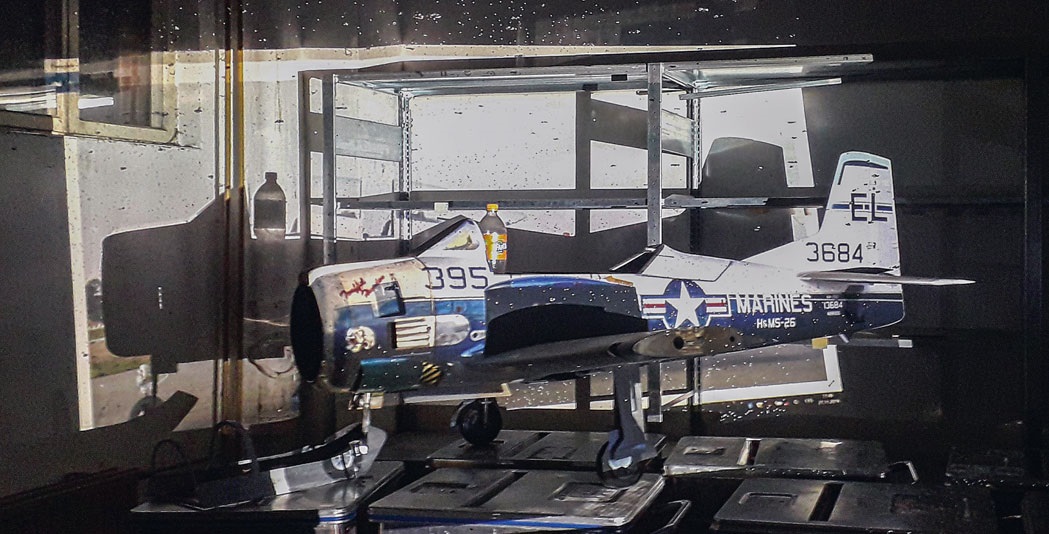
For the motor, I chose the Fiala 85B2, which turned out to be very powerful and really takes off. Unfortunately, after taking the model’s overall weight into account, it turned out that I was 200 g over the 15-kg limit required for the F4C/H category. Since there was no way to shed any weight at the last minute before the first competition, I had to take a big step back and install a DLE60 boxer engine; unfortunately, no other engine fits in there—even though the model is really big, the space is very tight.
With the new engine and a little fuel in the tank, I reached a nice 14,500 g. All I had to do was relocate all the electronics inside the fuselage so I wouldn’t have to use too much trim lead. After the first test run with the new engine, it turned out that the power was sufficient—only the sound… well, that’s just how it is with a two-stroke.
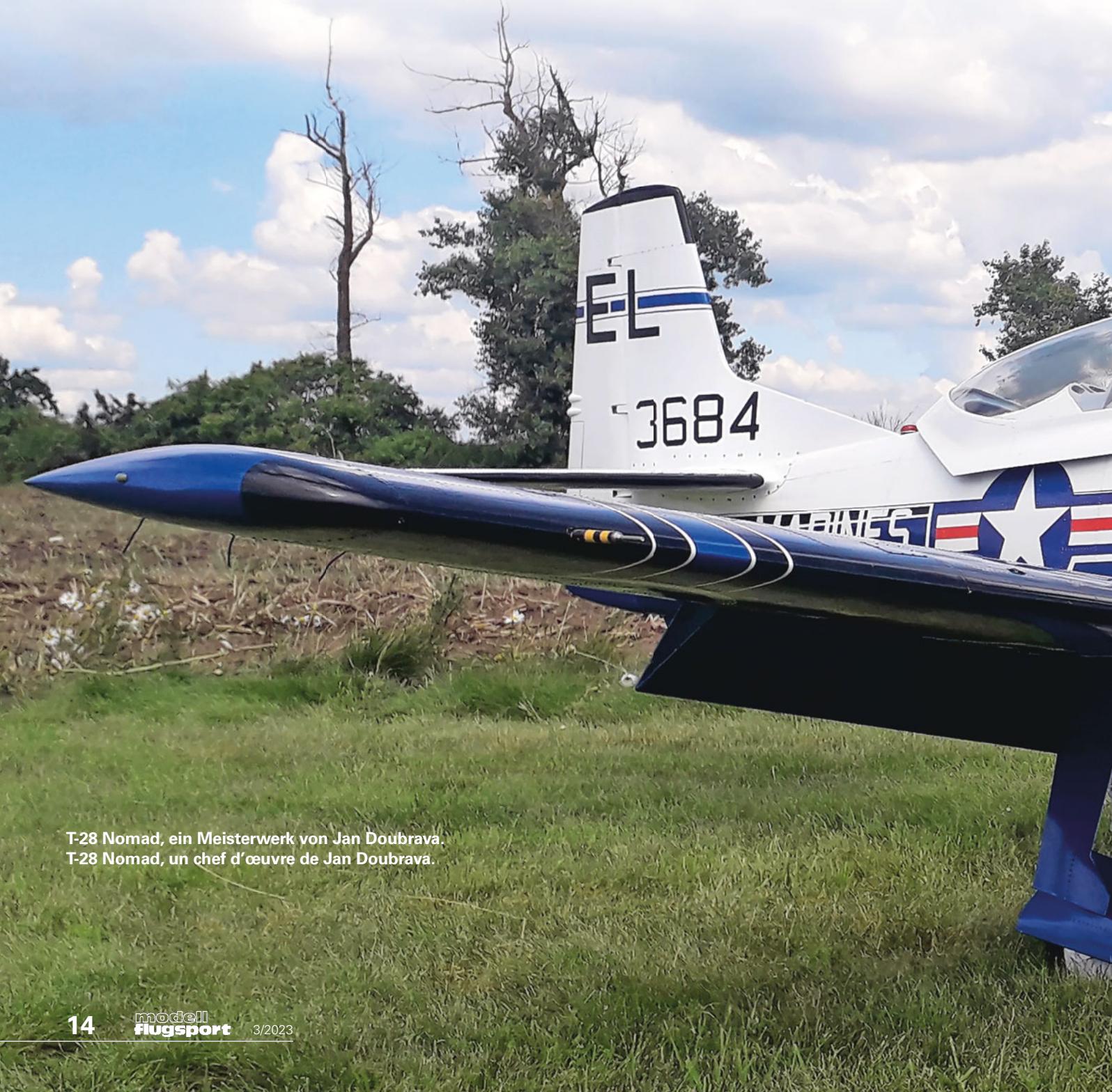
| Wingspan | 2,600 mm |
| Weight | 14.5 kg |
| Engine | DLE60 60 ccm boxer engine/Fiala 85B2 (initially) |


TEAM MANAGER "THIS" BOSSHARD
 Rodito Nussbaumer

SUMMER FUN 2026 AT MG USTER
Martin Wunderli
52. 2026 ALPS CUP
 Emil Giezendanner

ATOM, THE NEW DOUBLE-DECKER FROM CPLR
 Matthias Bosshard

INSIGHTS INTO THE HISTORY OF SEAPLANES

34th HAHNENMOOS ALPINE MODEL AIRPLANE CAMP
Res Dauwalder
CORSAIR F4U – A WARBIRD WITH A MEMORABLE LOOK
Jürgen Rosenberger, Jürgen Prinz
SMALL, MODEL-LIKE SAILBOATS
Res Dauwalder
F3A EUROPEAN CHAMPIONSHIPS IN ST-MACAIRE, FRANCE
Matthias Bosshard
What's New at Leomotion.com

HORIZON HOBBY/LEMACO NEWS: MICRO OV-10 BRONCO 645 MM BY E-FLITE

PRIDE AND GOOD IDEAS
 Markus Nussbaumer

News from HEBU

BY YOUTH, FOR YOUTH
Lorena Betschen
YOU KNOW WHAT I MEAN? 125 YEARS OF THE SWISS AERO CLUB
Emil Giezendanner
TRY-OUT DAY AT MFV WETTINGEN
Urs Keller
FREE FLIGHT IN THE MIDDLE OF SUMMER
Urs Muntwyler
THE PC-21 STORY
Emil Giezendanner
TWIN TOWN PARTNERSHIP
Wolfgang Voeller
EURO CONTEST GLIDER ACRO TOUR AUSTRIA 2026

WELCOME, NEW MEMBER!
Andrea Bolliger
COUPE DES ALPES – OBSERVE AND LEARN
Rodito Nussbaumer
NEWS FROM HEBU
 Julia Bucher

FROM 0 TO 100
Markus Nussbaumer
MEMORIES
Wolfgang Völler
NOS REGION – A HUB FOR ELECTRIC AVIATION
Emil Giezendanner
Have you almost forgotten about aircraft that take off and land vertically?
Emil Giezendanner
70 YEARS OF THE NIDWALDEN MODEL AIRPLANE CLUB
Martin Barmettler