
MPX Dogfighter
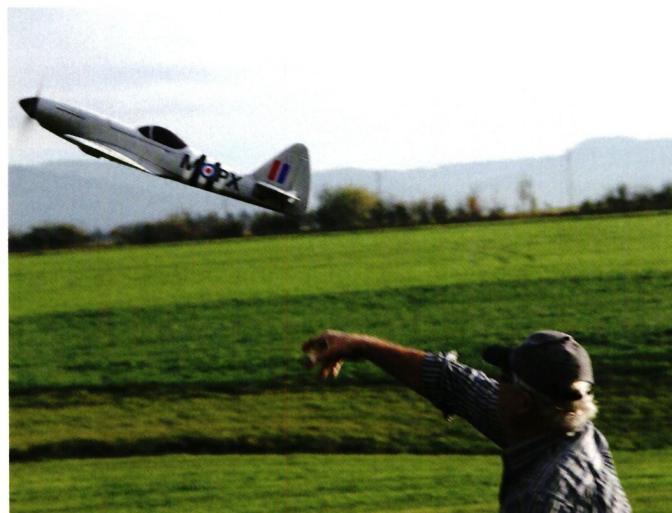
Looking at the pictures, you'd hardly guess that this plane is Multiplex's little dogfighter.
You don’t look a gift horse in the mouth—a colorful Styrofoam box or something like that, two large rolls of stick-on decals, and an instruction manual in every language. But upon closer inspection, I notice that a motor, two aileron servos, and an elevator servo are already installed. Wow, there’s nothing left to do! If there’s no work to be done, then we’ll just have to find some.
Styrofoam and decals—that sounds to me like french fries with whipped cream; I’m definitely not just going to stick those on the plane like that. The model’s silhouette reminds me of the Spitfire MK18, a further development of the legendary Spitfire that was manufactured from 1946 to 1948 after World War II. Back then, the elliptical wing was modified and the cockpit was mounted on top of the fuselage. So it’s a fighter plane, and it should look the part. With two spray cans from Migros—black and white aluminum—and a felt-tip pen, the whole thing already looks much better. There’s no need for white, since that’s the color of the Styrofoam. The D-Day stripes also make the plane much more visible in the sky, and once the whole thing was finished, I used my little airbrush to add some extra exhaust smoke to the 1,600 PS V12 engine. I finished the plane by applying the cut-out national emblems and a light coat of clear coat from a spray can, and I think the result is quite impressive.
From a design standpoint, there’s hardly anything to improve. I highly recommend the option to install an additional rudder linkage. However, after cutting out the Styrofoam wedge in the lower part of the rudder, a rudder hinge should be glued in place. This improves the stability of the rudder blade’s attachment. Around the canopy, I glued a thin piece of plywood into each of the finger cutouts, and I cut out a small section of the Styrofoam to accommodate them. The purpose of this five-minute job was simply to prevent the canopy from being dented in this area.
The initial jitters were quickly over. Using the control deflections recommended in the assembly instructions, I ventured out on my first flight. With expert dogfighting advice from Männi Kistler, I tried out all kinds of maneuvers right away and adjusted the control surfaces accordingly after landing. In short: The plane flies great!! Using the rudder, the plane can be controlled quite well in a side-slip, and it can also be kept neatly on course with the appropriate rudder corrections. Whether flying slowly or at high speed, the model is easy to control and handles very well during the landing approach as well. The motor, propeller—everything right out of the box fits perfectly. A well-balanced design with plenty of fun potential. I think this plane will also prove itself in dogfights. I hope you have a lot of fun fighting.


TEAM MANAGER "THIS" BOSSHARD
 Rodito Nussbaumer

52. 2026 ALPS CUP
 Emil Giezendanner

ATOM, THE NEW DOUBLE-DECKER FROM CPLR
 Matthias Bosshard

INSIGHTS INTO THE HISTORY OF SEAPLANES

34th HAHNENMOOS ALPINE MODEL AIRPLANE CAMP
Res Dauwalder
CORSAIR F4U – A WARBIRD WITH A MEMORABLE LOOK
Jürgen Rosenberger, Jürgen Prinz
SUMMER FUN 2026 AT MG USTER
Martin Wunderli
F3A EUROPEAN CHAMPIONSHIPS IN ST-MACAIRE, FRANCE
Matthias Bosshard
What's New at Leomotion.com

HORIZON HOBBY/LEMACO NEWS: MICRO OV-10 BRONCO 645 MM BY E-FLITE

PRIDE AND GOOD IDEAS
 Markus Nussbaumer

News from HEBU

BY YOUTH, FOR YOUTH
Lorena Betschen
YOU KNOW WHAT I MEAN? 125 YEARS OF THE SWISS AERO CLUB
Emil Giezendanner
SMALL, MODEL-LIKE SAILBOATS
Res Dauwalder
TRY-OUT DAY AT MFV WETTINGEN
Urs Keller
FREE FLIGHT IN THE MIDDLE OF SUMMER
Urs Muntwyler
THE PC-21 STORY
Emil Giezendanner
TWIN TOWN PARTNERSHIP
Wolfgang Voeller
EURO CONTEST GLIDER ACRO TOUR AUSTRIA 2026

WELCOME, NEW MEMBER!
Andrea Bolliger
COUPE DES ALPES – OBSERVE AND LEARN
Rodito Nussbaumer
NEWS FROM HEBU
 Julia Bucher

FROM 0 TO 100
Markus Nussbaumer
NOS REGION – A HUB FOR ELECTRIC AVIATION
Emil Giezendanner
MEMORIES
Wolfgang Völler
Have you almost forgotten about aircraft that take off and land vertically?
Emil Giezendanner
70 YEARS OF THE NIDWALDEN MODEL AIRPLANE CLUB
Martin Barmettler