
Coaches for Young and Old
For years, our model aircraft club has been organizing a one-day model-building workshop for middle school students as part of the spring break activities. For about four hours, participants mold, sand, and paint their models, and then in the afternoon, they take the little planes for a test flight at the model airfield with expert guidance. During this event, club members also demonstrate their models in flight and offer the opportunity to fly using dual controls. To this end, I’ve been searching for quite some time for a suitable trainer model for beginners—one that’s electrically powered, can perform reliably for several hours, and can handle all the abrupt and unintended control inputs from beginners as gracefully and robustly as possible. I’d like to introduce you to two models that perfectly fulfill this purpose.
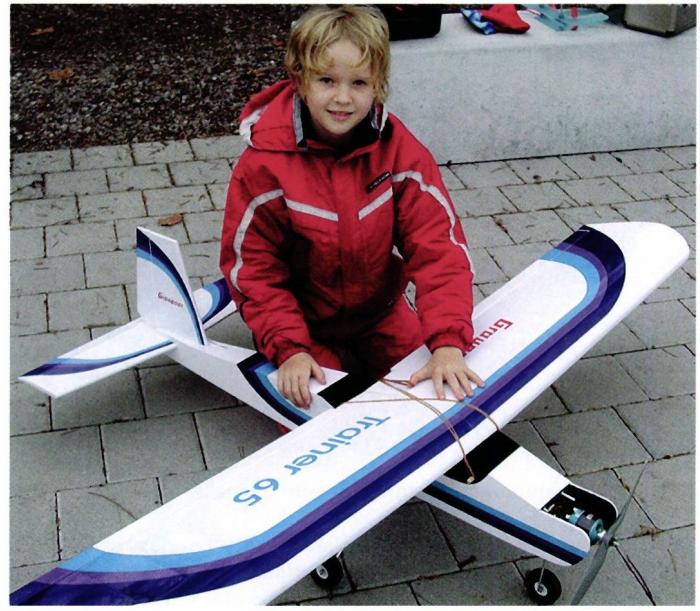
With a wingspan of about 170 cm and a profile depth of 18%, you can tell at first glance that it’s easy to fly. The ready-to-build kit leaves nothing to be desired in terms of wood quality and fabric covering. This is my first ready-to-build model where I didn’t have to reach for the heat gun right away!
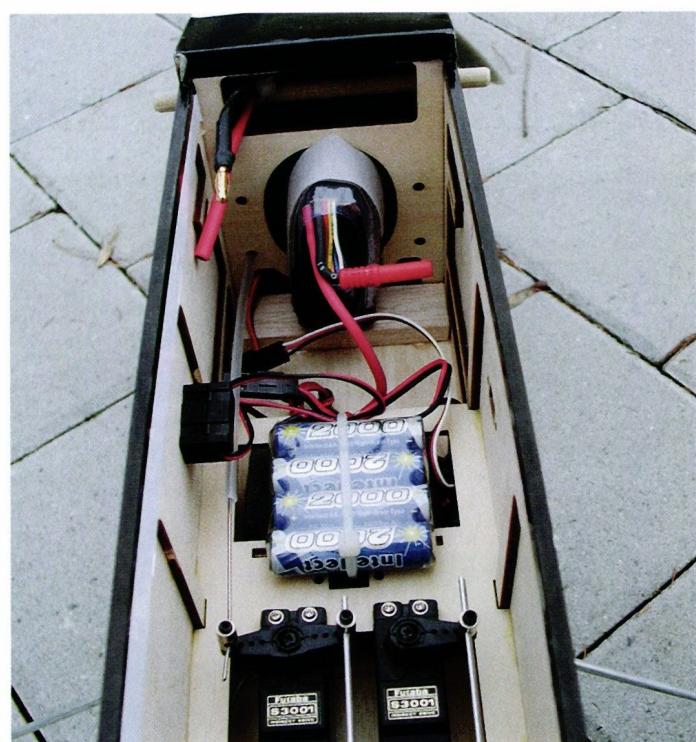
The Trainer has a sturdy build and can be fully assembled in about five hours. You can see how to install the Axi motor and the LiPo battery in the photos. The takeoff weight is approximately 3,000 g.
The flight characteristics are absolutely trouble-free. The model handles well even in inexperienced hands and is forgiving of almost any mistake. Its primary purpose is clearly basic training, including takeoff and landing practice. During simple aerobatics, the heavily cambered, thick airfoil has a noticeable negative effect, especially during inverted flight. However, loops and turns can be flown without any problems. The only drawback was the wing attachment using the included rubber bands. Although six to eight rubber bands were used, the wing would pop out of its intended position during sudden loads; however, this resulted in only a slight shift in the center of gravity and angle of attack. Even so, the model can still be landed without any problems. Mounting the wing using a round beech rod and nylon screws resolved this minor issue as well.
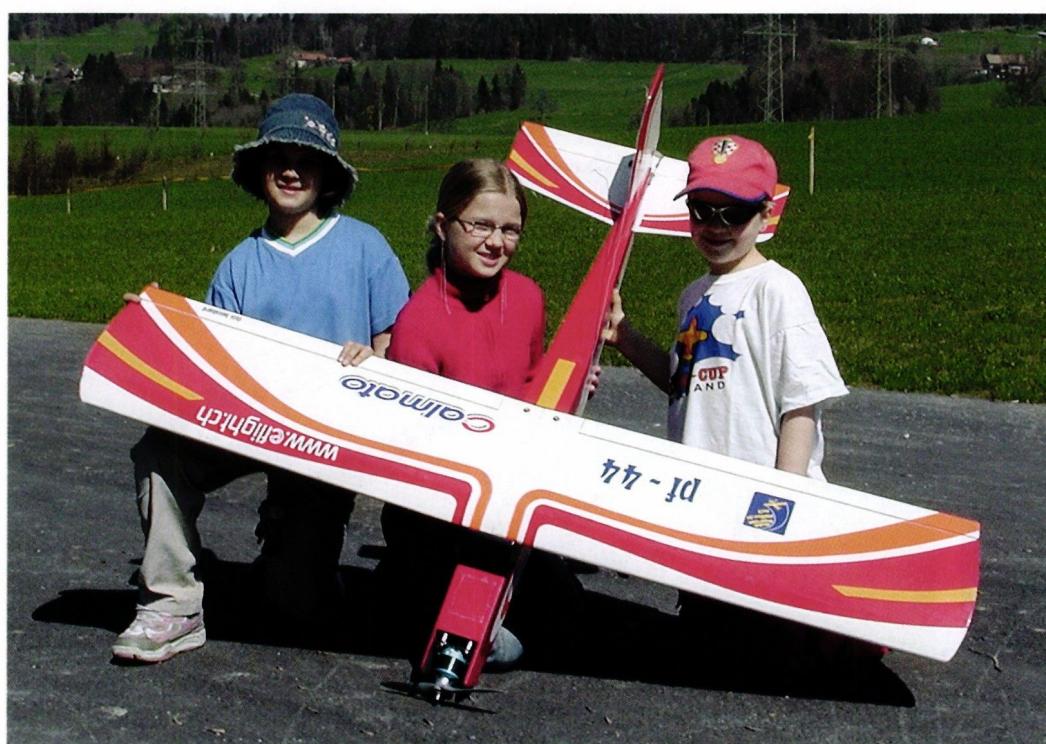
The Calmato is slightly smaller (160 cm) and more delicate. It is available in high-wing and low-wing configurations. With this kit as well, the buyer receives a high-quality product that can be assembled in just a few hours. The wood is slightly lighter than that used in the Trainer 65, resulting in a flight weight of 2,500 g. The Calmato really shines in basic aerobatic training. Its thinner airfoil performs slightly better here, and flying inverted is also no problem. Its stall characteristics remain very forgiving.
Both models were equipped with the same propulsion system.
- Axi 4120/14 motor with an APC 13×7" propeller
- Kontronik Jazz ESC
- Thunderpower 5S/5300mAh LiPo battery
- Standard servos and FM receiver
With this power setup, approximately 40 minutes of uninterrupted instructor-student flight operation is possible. (One-third to half throttle to maintain a constant altitude.) Neither the motor, the ESC, nor the battery gets any warmer than body temperature. Optimal cooling for the externally mounted motor is ensured. The electric powertrain proves particularly effective during landing training. Throttle can be reduced continuously without fear of stalling, and power delivery is instantaneous.
I’m already looking forward to the model-building course next spring. In any case, my fleet of trainer models is ready for the next generation (by the way, my test students for the Trainer 65 ranged in age from 10 to 76).
Models and power systems can be purchased at: www.scamora.ch and www.eflight.ch


News from HEBU

F3A EUROPEAN CHAMPIONSHIPS IN ST-MACAIRE, FRANCE
 Matthias Bosshard

What's New at Leomotion.com

YOU KNOW WHAT I MEAN? 125 YEARS OF THE SWISS AERO CLUB
 Emil Giezendanner

52. 2026 ALPS CUP
Emil Giezendanner
PRIDE AND GOOD IDEAS
 Markus Nussbaumer

HORIZON HOBBY/LEMACO NEWS: MICRO OV-10 BRONCO 645 MM BY E-FLITE

EURO CONTEST GLIDER ACRO TOUR AUSTRIA 2026

BY YOUTH, FOR YOUTH
 Lorena Betschen

TEAM MANAGER "THIS" BOSSHARD
Rodito Nussbaumer
SMALL, MODEL-LIKE SAILBOATS
Res Dauwalder
TRY-OUT DAY AT MFV WETTINGEN
Urs Keller
34th HAHNENMOOS ALPINE MODEL AIRPLANE CAMP
Res Dauwalder
CORSAIR F4U – A WARBIRD WITH A MEMORABLE LOOK
Jürgen Rosenberger, Jürgen Prinz
SUMMER FUN 2026 AT MG USTER
Martin Wunderli
WELCOME, NEW MEMBER!
Andrea Bolliger
FREE FLIGHT IN THE MIDDLE OF SUMMER
Urs Muntwyler
THE PC-21 STORY
Emil Giezendanner
TWIN TOWN PARTNERSHIP
Wolfgang Voeller
ATOM, THE NEW DOUBLE-DECKER FROM CPLR
Matthias Bosshard
COUPE DES ALPES – OBSERVE AND LEARN
Rodito Nussbaumer
INSIGHTS INTO THE HISTORY OF SEAPLANES

NEWS FROM HEBU
 Julia Bucher

FROM 0 TO 100
Markus Nussbaumer
MEMORIES
Wolfgang Völler
NOS REGION – A HUB FOR ELECTRIC AVIATION
Emil Giezendanner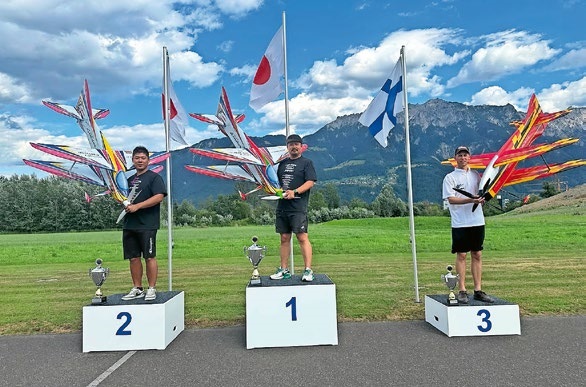
A SPECTACULAR F3A WORLD CUP IN THE PRINCIPALITY OF LIECHTENSTEIN
Emil Giezendanner
DO YOU KNOW WHAT I MEAN IN THE LAND OF SMILES?
Emil Giezendanner