
From Vacation Fun to Lasting Enjoyment
What does a passionate model airplane enthusiast take on vacation? It’s obvious: it has to be something small, quiet, affordable, and easy to handle—something you can fly almost anywhere. This review shows what a beginner in slow-fly and fun-fly flying can experience.
For a longtime “internal combustion engine pilot” who enjoys the musical “sound of four-stroke” and loves getting his hands greasy, the switch to electric is more of a mental challenge than a financial one. That’s why I was able to resist the slowflyer bug for quite a while. The cost—that is, shelling out at least 500 to 700 Swiss francs for a little clunker made of Styrofoam with all the bells and whistles—was simply too high for me —since I’m not a top executive who can pay myself a couple of million extra at the end of each year—was simply too high.
But then vacation time was approaching, and for the windless days of my windsurfing vacation in
southern France, a slowflyer would be just the thing! Plus, my surfing buddies had been pestering me for quite some time to finally bring a slowflyer along on vacation. It was clear to me that, as a “Lipo beginner,” I would need a complete set of equipment from A to Z—including LiPo cells, a special charger, a brushless motor, a brushless ESC… and… and…
Since, as the editor of the online magazine www.avguide.ch, I’m online all day anyway, it made sense for me to take a closer look at some slow-flyer offers through this medium. I hadn’t had any good experiences with online stores in Germany so far, so I only considered Swiss sites. I eventually ended up at www.top-model.ch and was amazed by the exceptionally low prices. In addition to an incredible number of other models in all price ranges, you can also choose from about 10 so-called “slow flyers” with a wingspan of 80 cm
wingspan for just 39 francs (!). These include very interesting models such as classic aerobatic planes, as well as a GeeBee, various warbirds, biplanes, and so on. I did a rough calculation of the total and came up with about 450 francs. That would still be within my budget—after all, I don’t treat myself to anything else...
But would the items I was ordering online actually go together?
That’s when I needed some advice! But on the “top-model” online store, you can add a comment to your order. So I let the store know that they should make sure everything in my order would go together and that any missing items—like cables, plugs, etc.—would be included in the shipment.
Almost immediately, I received a message that the order had been processed and that the following items would be delivered to me: Champion model (CHF 39.–). Drive
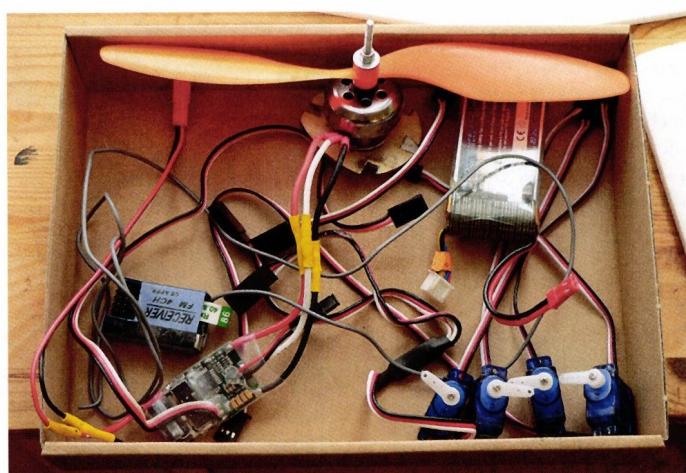
power system consisting of a 42/08 brushless motor (CHF 39.00), an SBR-15 brushless ESC (CHF 39.00), 2 Slowflyer propellers, 20 cm (CHF 3.50 each), and two three-cell LiPo batteries with 1,050 mAh (CHF 42.00 each). Swallow charger (CHF 89.–) and micro receiver (plus crystal, CHF 50.–). Added to this were a cell balancer (CHF 32.50), Styro instant glue (CHF 7.90), a charging cable (CHF 7.00), and a BEC jack with cable (CHF 2.80). The total came to 456.80 francs.
The items arrived just under three days after the initial contact. And sure enough: everything was there. Nothing was missing, and everything fit together. But even in the best of families, a ESC might not work properly. Within about two days, I had a working replacement.
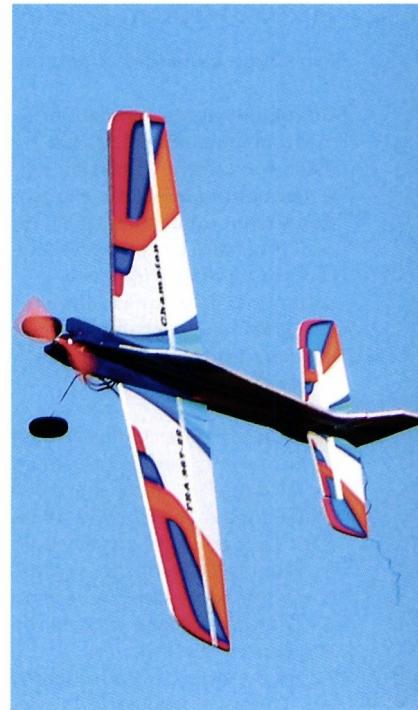
The Champion model is a classic aerobatic aircraft in terms of design and is available as a “budget version,” meaning without special—
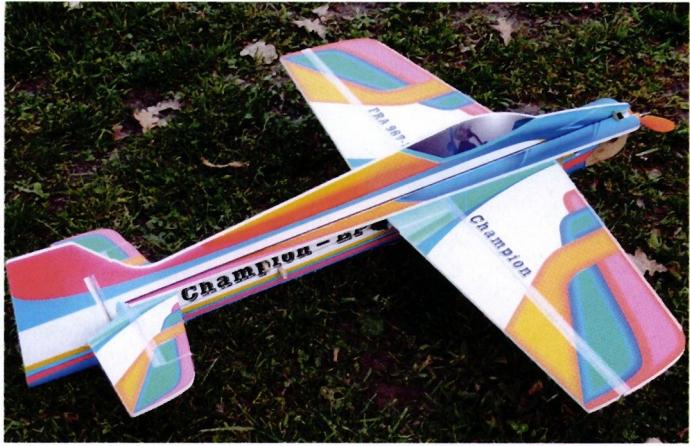
Specifically, nice but sturdy packaging for mailing. This little bird has a wingspan of 80 cm and weighs—as measured on my wife’s “high-precision” kitchen scale—120 grams on its own, that is, without anything attached. Now everyone can decide for themselves how much weight they want to attach to the model. In my case, it was a “brutal” 200 grams! That brings the total weight to around 320 grams. Of course, slow-
fly experts will indignantly write that this no longer has much to do with a real slow-flyer. And they’re right. A model of this size and weight belongs more in the category of fun or park flyers than among the competitive, ultralight slow-flyers for indoor use.
The Champion is made of special EPS foam sheets about 5 mm thick, which are coated on both sides
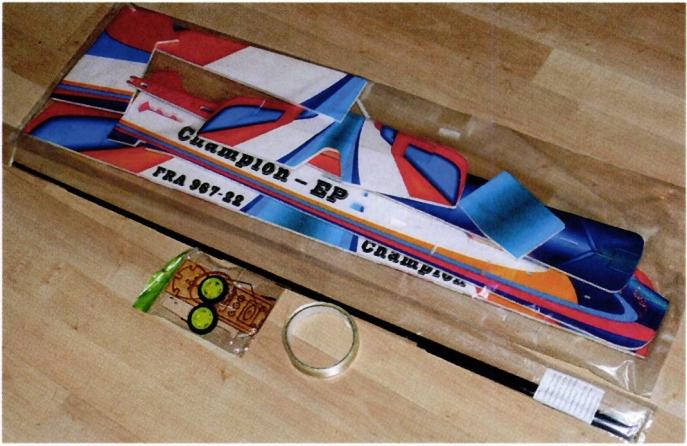
are coated with a plastic film and, depending on your skill level, can be built in 2 to 5 hours. According to the supplier, the model is supposed to be “practically indestructible.” But we’ll see...
Strangely enough, the assembly instructions make no mention of a center of gravity. If you use the existing mounting holes for the servos and place the battery in the specified location, the center of gravity should
work out on its own. And indeed, this worked perfectly on this model, which is completely unaffected by variations in the center of gravity.
The included chassis—which is relatively rigid but attractive, made of ultralight carbon fiber rods—and the included mini wheels are certainly perfectly fine for indoor use, but for rough outdoor use on gravel surfaces
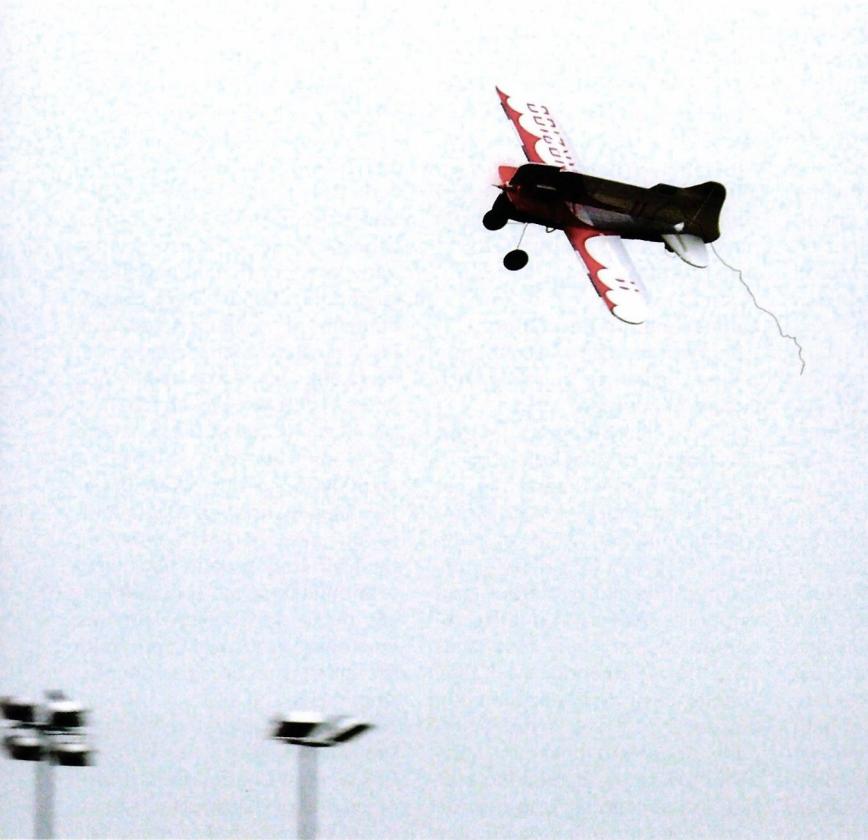
or meadows—but, as it unfortunately turned out, they were unsuitable. So there were plenty of minor annoyances at first, and once again the question arises: why is it that when landing on unkempt meadows and gravel-covered areas, you always seem to hit the biggest pebbles and holes?
As expected, the Champion—equipped with the aforementioned powerplant—wasn’t a typical ultralight slow flyer capable of performing the most incredible maneuvers while hovering nearly “still,” but rather a nimble fun flyer—indeed, a proper little aerobatic aircraft with ideal motorization. The well-tuned combination of propeller, ESC, and LiPo cells delivered a maximum static thrust of a remarkable 500 grams (!) with fully charged batteries, and when you subtract the model’s weight of 320 grams, there’s still a considerable margin left that you can use, for example, to shoot straight up into the sky—and even accelerate while doing so. Given this performance, reinforcing the front section around the motor is highly recommended. This thing can do just about anything: chugging around slowly, sharp knife-edge flight without veering off course, hovering, and pulling off some seriously (!) daring maneuvers. The only limits are the pilot’s skills. Practicing hovering is made easier by the fact that, if the model starts to tilt sideways,
by briefly giving it a quick burst of throttle to pull it back up...
If you plan to spend most of your time hovering and applying torque at half throttle—and occasionally at full throttle—a 1050-mAh battery will give you a flight time of about 9 minutes. Those who take it easier can easily fly for over 12 minutes. At full throttle, the small motor draws up to 14 amps (!), which the power system—including the ESC—handled without any problems during a test period of about 4 months involving dozens of flights.
To transport it to the south of France, the model was simply placed on top of the surf gear, but care was taken to ensure that no surfboards would slide around and damage the zar-
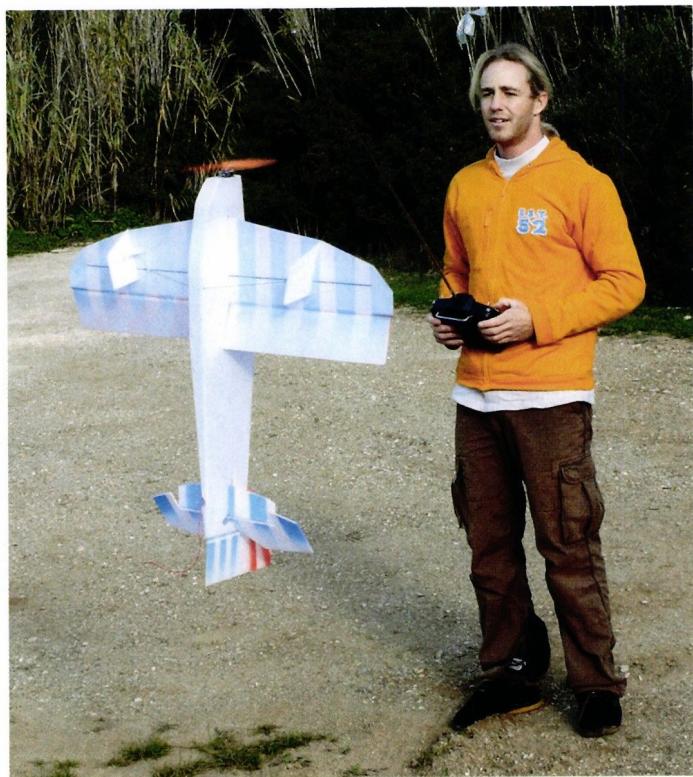
could put an early end to the little birds’ fun. And as expected, four days of calm winds dominated the scene in this surfing paradise. While others walked around looking glum, my colleague Dom Escher (silver medalist at the 2006 Swiss Windsurfing Freestyle Championship) and I were beaming, because we had our Fun-Flyers with us, and an unused, roughly graveled parking lot, surrounded by 3-meter-tall bamboo, was available as a flying field.
Unlike me, who’s an online shopper, my colleague Dom is a true and dedicated
slow-flyer expert. Of course, he designs and builds all his models himself and even winds a brushless motor with his own hands every now and then! It’s no wonder, since he’s a newly certified and degree-holding shop teacher.
With his latest model—which has a wingspan of about 80 cm, weighs 80 grams empty and just 170 grams ready to fly, and is equipped with SFGs (Side Force Generators)—he hovers and performs torque maneuvers in one spot for minutes on end or glides while hovering across the entire campground. He launches it from his hand and, as befits a slow-fly expert, lands it—also while hovering—right back in his hand. He amazes the audience with knife-edge loops and roll circles that he performs so low that the wingtips occasionally touch the ground for just a split second! While Dom celebrated the typical slow-flyer style in the tightest of spaces, I paid homage to the more expansive, model-like aerobatics. Of course, we also practiced the obligatory hovering and torque maneuvers, which I wisely practiced—and still practice—not just a few millimeters above the ground, but at a height of several meters. But I’m slowly starting to wonder whether these maneuvers—which are, in and of themselves, a bit crazy—shouldn’t be reserved for helicopters instead. →
Since my Champion wasn't as attractive anymore after I repaired it with makeshift materials over the holidays, I decided to replace it.
It takes a bit of madness to offer the legendary GeeBee racer as a slow-flyer. And that’s exactly what tempted me to spend another 39 francs on an absolutely extraordinary little bird with a wingspan of 80 cm as well. Pictures of the model showed that, viewed from directly above or from the side, it looks amazingly “scale.” The wide fuselage would contribute significantly to the lifting force, and side-slip flight could also be top-notch thanks to the huge lateral surface area.
So off it went into the shopping cart, and before long, a new little model was ready to strike fear into the pilot’s heart. For the landing gear, I decided not to use the pretty and extremely lightweight carbon-fiber landing gear, but rather a replaceable little system made of 1.5 mm steel wire that I copied from the company Hacker.
But where should the center of gravity be? That wasn’t clear from the included CD-R, which contained assembly instructions for models other than the GeeBee (!). What’s more, my 24/08 motor was about 10 grams lighter than the 24/10 recommended by top-modell. So I decided to shift the center of gravity quite far forward and see what happened.
And sure enough, at first the GeeBee bucked wildly and was almost impossible to control. It would either shoot straight up or plummet straight down. Only with the throttle almost completely closed could the model be barely steered. I would strongly recommend that top-model.ch specify the center of gravity for all their fun flyers! This is especially important for exotic models like the GeeBee, where the fuselage surface provides a lot of lift and where flying on its side is also top-notch thanks to the huge lateral surface area.
It's important to know which one applies. Only when you know the center of gravity can you use components of different weights. But maybe I'm the only fool who thinks that...
And finally, the long-overdue crash test took place! After a rough landing from a height of a few meters onto the mowed grass, the wing showed slight creases, and the fuselage had a few small cracks. So you shouldn’t just take at face value the description on top-model calling it “nearly indestructible.” That meant spending a few minutes (!) at home patching it up without making the model any heavier—and, most importantly, shifting the center of gravity further forward. As a result, the battery was moved forward and upward, which was intended to counteract the weight of the landing gear. And lo and behold: with the center of gravity exactly 3 cm behind the leading edge of the wing, the initially mischievous little thing flew as docile and tame as a little angel.
It’s now a real treat to play around with this odd little thing. Just like the Champion, it has an enormous surplus of power. But in my view, this model isn’t a typical slow-flyer either—it’s a genuine small and speedy aerobatic machine that can still
can also cruise around quite slowly. I heard comments from my colleagues like, “I can’t believe that weird thing even flies!” or “Where did you buy that?”—exactly the kind of things you really want to hear.
The BeeGee also survived a rough vacation outing. The consequences of minor mishaps were fixed relatively quickly with 5-Min-Epoxy, which seems better suited to me for rough gluing than the special, styrofoam-friendly superglue from Top-Model, which does take some time to harden completely.
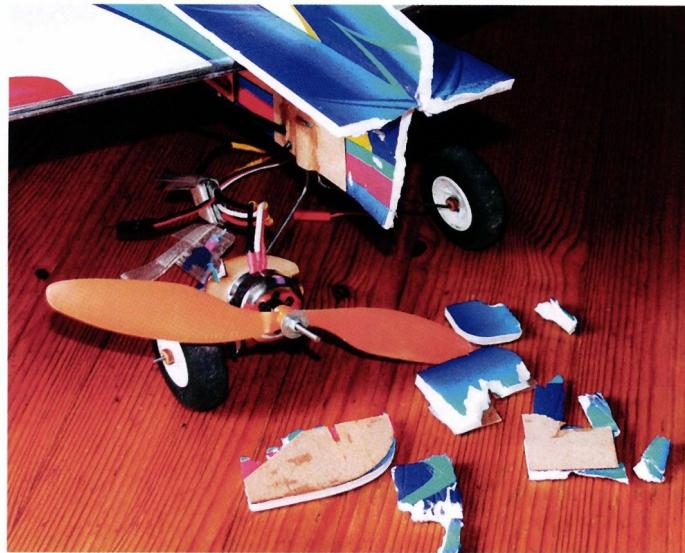
By then, my son Benjamin had also caught the Fun Flyer fever, and based on my positive experience, he treated himself to the Champion with exactly the same equipment. His Champion also flew flawlessly, but had an unpleasant encounter with a flagpole. Our photo shows what a Champion looks like after this unfair battle. As a consolation, Beni got my GeeBee—which wasn’t exactly new anymore but was still 100% airworthy—until his Champion’s wounds had healed.
And I, who felt quite lonely without a Fun-Flyer, was able to focus entirely on a new model for 49.– francs that I’d been eyeing for some time! About two days after placing the order online at topmodel.ch, a cute biplane fluttered into my home via the mail.
I expected this model to deliver the “Föifer” and “s’Weggli”—that is, even better slow-flight characteristics—with only a negligible increase in weight. This kit weighs just 130 grams, which is only 10 grams more than the mid-wing Champion! It didn’t take long to build the model, install the existing powerplant, and reinforce the nose section with 0.7 mm plywood based on my previous experience. I adopted the landing gear design from the
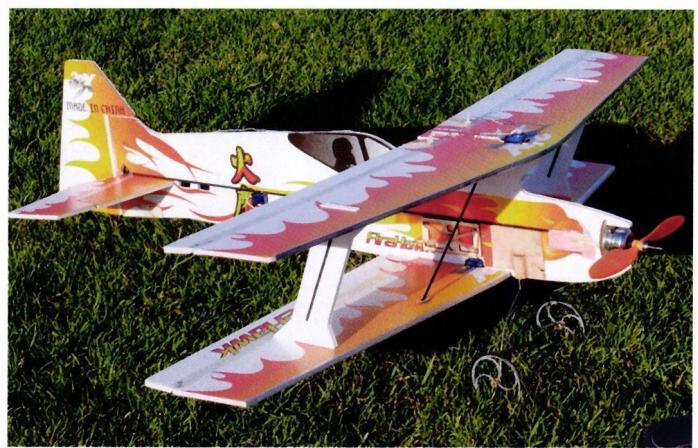
GeeBee and equipped it with ultra-light Slowflyer wheels (62 mm in diameter), also available from top-model. This allows for smooth takeoffs and landings even on a moderately well-mowed lawn or from a relatively coarse gravel surface without rolling over. Tip: It’s best to glue the rubber tires to the rims right away using instant adhesive! Here, too—just like with the GeeBee—I installed the slightly lighter and tried-and-true 24/08 motor instead of the 24/10 model recommended by top-model, which is about 10 grams heavier. The center of gravity isn’t specified for the Firehawk either, which I find absolutely unforgivable! But I’d learned my lesson by then and mounted the aileron and elevator servos not in the designated cutouts at the very rear of the model, but much further forward. Still, I had a queasy feeling in my stomach...
So off to the maiden flight! And almost the same thing happened as with the GeeBee: I’d fallen into the center-of-gravity trap again, just like a beginner! The model bounced up and down and was hard to control. But the god of model aviators showed mercy once again. I managed to turn the model into the light wind and make a soft landing just before a fence (!).
I suspect that the designers of this model used a fairly heavy motor with a hefty propeller and very light tail servos for ailerons and elevator during their test flights. As a result, the battery was moved significantly forward, and the center of gravity now lies exactly 10.3 cm behind the leading edge of the upper wing. This way, the model flies at a 0-degree angle of attack without needing to push the elevator back even slightly during inverted flight. The second—
The flight made up for all the hassle and turned out to be a real treat. This thing is perfectly powered and climbs rapidly straight up to the horizon. It has an extreme speed range, from extremely slow to quite fast. With lateral support, it turns almost on the spot. This thing really does everything you ask of it and hovers flawlessly. Overall, it fully met my expectations.
What started out as just a bit of vacation fun has turned into a lasting pleasure. So from now on, along with my heavyweight tow plane, the Robin Schleppkahn, I’ll be packing a little fun flyer into the car. It’s just the thing for really letting loose again after the serious business of towing precious large-scale models. And if it crashes again, I’ll either patch it up quickly or treat myself to something new for 39 francs...


News from HEBU

F3A EUROPEAN CHAMPIONSHIPS IN ST-MACAIRE, FRANCE
 Matthias Bosshard

What's New at Leomotion.com

YOU KNOW WHAT I MEAN? 125 YEARS OF THE SWISS AERO CLUB
 Emil Giezendanner

52. 2026 ALPS CUP
Emil Giezendanner
PRIDE AND GOOD IDEAS
 Markus Nussbaumer

HORIZON HOBBY/LEMACO NEWS: MICRO OV-10 BRONCO 645 MM BY E-FLITE

EURO CONTEST GLIDER ACRO TOUR AUSTRIA 2026

BY YOUTH, FOR YOUTH
 Lorena Betschen

TEAM MANAGER "THIS" BOSSHARD
Rodito Nussbaumer
SMALL, MODEL-LIKE SAILBOATS
Res Dauwalder
TRY-OUT DAY AT MFV WETTINGEN
Urs Keller
34th HAHNENMOOS ALPINE MODEL AIRPLANE CAMP
Res Dauwalder
CORSAIR F4U – A WARBIRD WITH A MEMORABLE LOOK
Jürgen Rosenberger, Jürgen Prinz
SUMMER FUN 2026 AT MG USTER
Martin Wunderli
WELCOME, NEW MEMBER!
Andrea Bolliger
FREE FLIGHT IN THE MIDDLE OF SUMMER
Urs Muntwyler
THE PC-21 STORY
Emil Giezendanner
TWIN TOWN PARTNERSHIP
Wolfgang Voeller
ATOM, THE NEW DOUBLE-DECKER FROM CPLR
Matthias Bosshard
COUPE DES ALPES – OBSERVE AND LEARN
Rodito Nussbaumer
INSIGHTS INTO THE HISTORY OF SEAPLANES

NEWS FROM HEBU
 Julia Bucher

FROM 0 TO 100
Markus Nussbaumer
MEMORIES
Wolfgang Völler
NOS REGION – A HUB FOR ELECTRIC AVIATION
Emil Giezendanner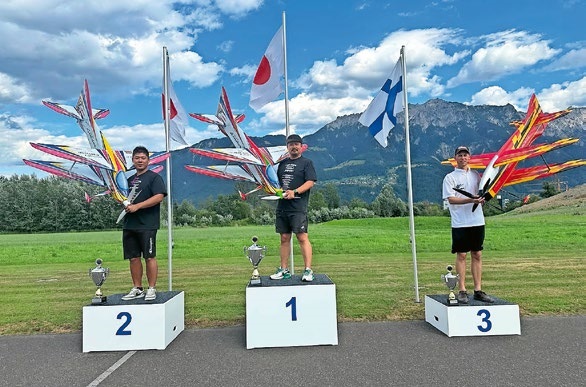
A SPECTACULAR F3A WORLD CUP IN THE PRINCIPALITY OF LIECHTENSTEIN
Emil Giezendanner
DO YOU KNOW WHAT I MEAN IN THE LAND OF SMILES?
Emil Giezendanner