
Tethered Flight: Electric Speed Exceeds 300 km/h for the First Time—That's Our Story!
One day we’ll fly under 12 seconds. That was our goal!
At the Swiss F2G Electric Speed Championship in Breitenbach on September 19, 2020, we reached the magical speed of 300 km/h with two perfect flights—a world first in this category.
Engine ON...! The propeller starts spinning, the plane is released, it accelerates rapidly, and then takes off.
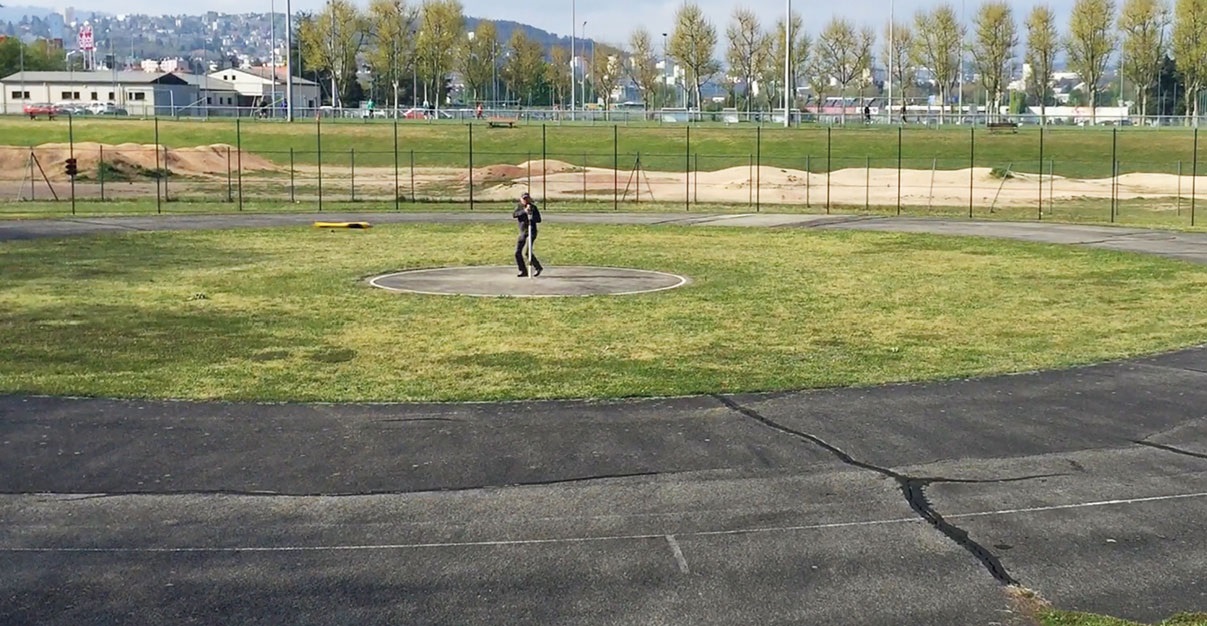
Flying in a circle, when we reach 80 m/s at full speed, that’s when it happens—the pilot’s eyes are fixed on the model, and everything else fades away and disappears into a swirling landscape. At that very moment, there’s no more room for error; you have to breathe, fly, and complete the 9 laps (1 km total) so that the stopwatch—the sole judge—can deliver its verdict.
One day, someone asked us why we do tethered flight. We replied: “In model flying, it’s the only discipline that allows us to,
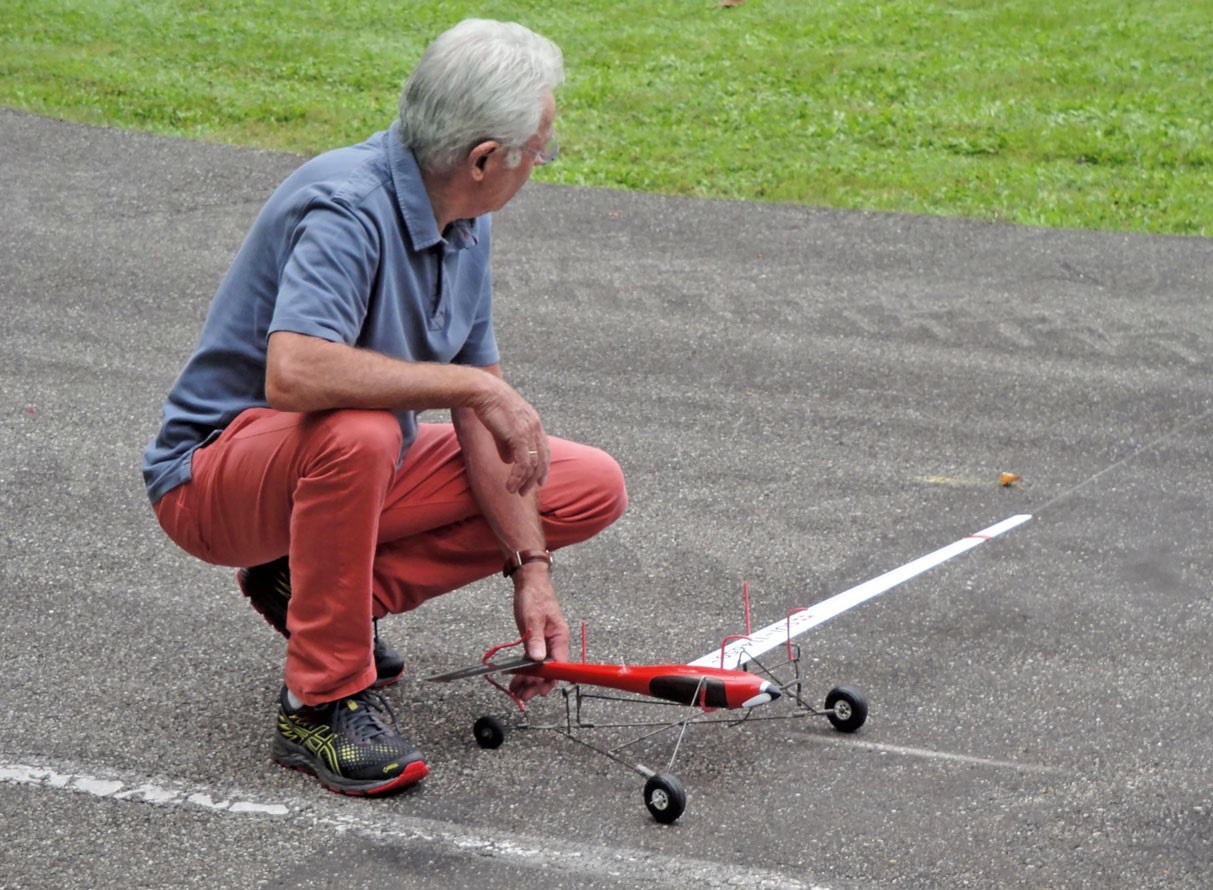
"To feel the plane in flight. The cables transmit its acceleration and vibrations to us—yes, it speaks to us." When asked what motivates us so much in the speed category, our answer was "... 12 seconds—300 km/h!"
At the 2020 Swiss Championship, the moment had finally arrived: With two perfect flights, we surpassed the magical speed of 300 km/h—the 12 seconds were clocked. Guy Ducas, at 300.03 km/h (11.998 seconds per 1 km), and Daniel Rota, at 302.7 km/h (11.89 seconds), set a new speed record for the category. These achievements represent the culmination of work that began 7 years ago and mark a new era for Elektro-Speed F2G.
Don’t think that “electric” is synonymous with “simple.” There are a hundred questions to answer on this topic, and when it comes to speed, it’s even more delicate. Our models are the Formula 1 of the skies. They are little marvels, distillations of knowledge and expertise. Every component is utilized to the fullest. You also have to consider how to manage the energy stored in the batteries. Because in the end—during the race—there’s no room for error!
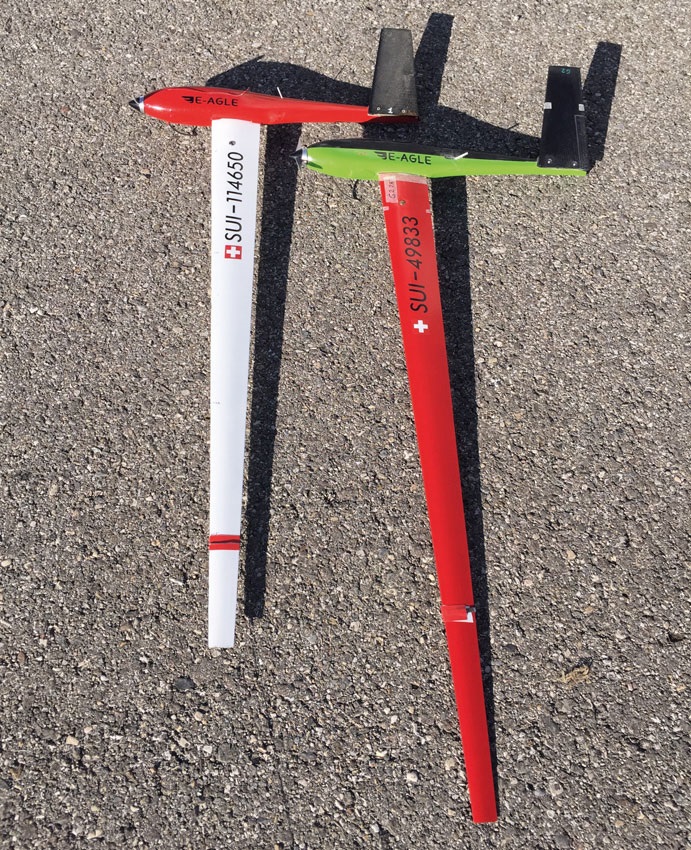
The evolution of our daily lives leads us every day to new solutions that utilize electric drives. Model building aligns perfectly with the emergence of new technologies in motors and batteries, offering applications that were impossible just yesterday.
Seven years ago, the small team of Guy Ducas and Daniel Janan (F) had to reinvent everything from scratch. To that end, they met with Marco Cantoni (EPFL Lausanne) to learn the fundamentals of motors, and with Patrick Constant (F) for mechanics and design. Jon Mayo and Daniel Rota also joined the team to handle electronics and aerodynamics—not to mention the help provided by several other people. A true team effort.
Despite frequent setbacks, missed launches, damaged engines, exploded controllers, swollen batteries, and moments of doubt and discouragement, they finally succeeded finally achieve a basic setup in 2018 that took us a technological step forward with speeds of around 270 km/h.
In 2019, we continued to work on the engine ignition management to facilitate takeoff and the transition into the pylon, as well as on increasing the power drawn by the engines.
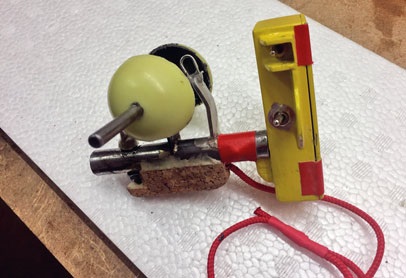
| Motor | Diameter: 29 mm; kV: 2600 Leo L3025 or 3031 |
|---|---|
| Batteries | 6S, 1100 to 1300 mAh , minimum 70C , Tattu – Thunder-Power |
| ESC | Castle Phoenix Edge Lite 50 A , Timing 0 to 5, Frequency 8 kHz |
| Propeller | APC 4.75x4.50 = approx. 230 km/h APC 4.75x4.75 = approx. 250 km/h PC 5.0x5.0 = + 260 km/h |
A question we’ve been asking ourselves for quite some time has now become crucial to our future progress: How can we improve the flight quality of our aircraft? That’s why, while working during the winter of 2019—and with a calculator in hand—we defined new settings for the aircraft for the 2020 season.
As required by COVID-19 restrictions, we didn’t resume flights until May 2020. And the results were good. The work we did over the winter paid off. Finally, the aircraft flew much better; they had gained in maneuverability and stability, resulting in a very impressive level of flight comfort. Great!
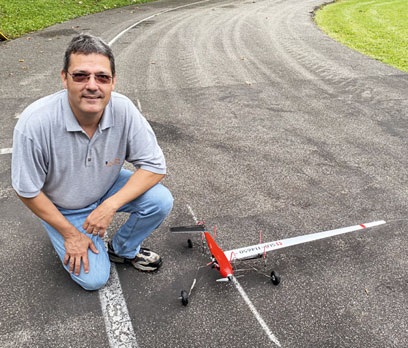
With electronics in mind, watts in the batteries, and impressive speeds—2019 in Lugo (Italy): 297 km/h—we headed to the Swiss Championship in Breitenbach at the end of the 2020 season. And we pulled off a major coup!
The F2G movement began 7 years ago with a Swiss team. Today, various countries have joined the movement: France, England, Spain, Germany, Austria, and Poland.
Are there limits to progress? We don’t think so, and we’ll continue working to make the aircraft more reliable by further optimizing their flight characteristics and making the engines more robust, ultimately enabling more efficient flight.
We’re also considering a project to promote the category by developing a simple F2G speed model that’s accessible to all pilots who want to give it a try. We look forward to seeing you flying in the tethered flight circle. And don’t forget—at speeds over 80 m/s, it’s nothing short of magical!
Section 4 – Aeromodelling/Volume F2/ Control Line Model Aircraft 2020 Edition/Annex 4K – Class F2G CL Electric Speed, Page 109


TEAM MANAGER "THIS" BOSSHARD
 Rodito Nussbaumer

YOU KNOW WHAT I MEAN? 125 YEARS OF THE SWISS AERO CLUB
 Emil Giezendanner

F3A EUROPEAN CHAMPIONSHIPS IN ST-MACAIRE, FRANCE
 Matthias Bosshard

News from HEBU

SUMMER FUN 2026 AT MG USTER
Martin Wunderli
TRY-OUT DAY AT MFV WETTINGEN
Urs Keller
52. 2026 ALPS CUP
Emil Giezendanner
BY YOUTH, FOR YOUTH
Lorena Betschen
ATOM, THE NEW DOUBLE-DECKER FROM CPLR
Matthias Bosshard
CORSAIR F4U – A WARBIRD WITH A MEMORABLE LOOK
Jürgen Rosenberger, Jürgen Prinz
SMALL, MODEL-LIKE SAILBOATS
Res Dauwalder
What's New at Leomotion.com

TWIN TOWN PARTNERSHIP
Wolfgang Voeller
EURO CONTEST GLIDER ACRO TOUR AUSTRIA 2026

INSIGHTS INTO THE HISTORY OF SEAPLANES

34th HAHNENMOOS ALPINE MODEL AIRPLANE CAMP
Res Dauwalder
HORIZON HOBBY/LEMACO NEWS: MICRO OV-10 BRONCO 645 MM BY E-FLITE

COUPE DES ALPES – OBSERVE AND LEARN
Rodito Nussbaumer
PRIDE AND GOOD IDEAS
 Markus Nussbaumer

FREE FLIGHT IN THE MIDDLE OF SUMMER
Urs Muntwyler
THE PC-21 STORY
Emil Giezendanner
WELCOME, NEW MEMBER!
Andrea Bolliger
NEWS FROM HEBU
 Julia Bucher

FROM 0 TO 100
Markus Nussbaumer
MEMORIES
Wolfgang Völler
NOS REGION – A HUB FOR ELECTRIC AVIATION
Emil Giezendanner
Have you almost forgotten about aircraft that take off and land vertically?
Emil Giezendanner
70 YEARS OF THE NIDWALDEN MODEL AIRPLANE CLUB
Martin Barmettler