
An innovative spirit fuels the competition
In 1973, the Pfäffikon Model Aircraft Club held its first electric flight meet. It was an experiment that was largely met with skepticism—a simple competition featuring glider models, consisting of endurance flights and landings. Year after year, not only did new participants join, Soon, some of them demonstrated that, with powerful cobalt motors from Heinz Keller, aerobatic models—and even large gliders with a 5-meter wingspan—could achieve astonishing feats. So competitions featuring small and large gliders emerged, and aerobatic programs were created. Solar-powered models also appeared as early as the 1980s, and the first solar competitions followed. Pylon racing with heavy Ni-Cd cells. All the competitions at home and abroad were initially less driven by a fixation on rankings and much more by a tremendous urge to explore new horizons. Almost everything had to be developed and built from scratch. Speed controllers, propellers and propeller adapters, soldering fixtures for the cells. Interestingly, wherever the optimization of propulsion systems took on almost scientific proportions, participant numbers quickly declined. On the other hand, very simple gliders quickly gained astonishing popularity.
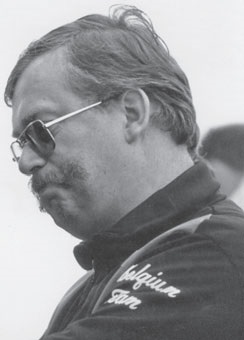
The event, named personally by Fred Militky, became known far beyond Europe as a leading force in electric
model aircraft flying. Visitors from Japan and the U.S., as well as staff from various trade magazines, were regular attendees. In its heyday, over a hundred participants were registered for the various competitions.
The events included: small gliders (6 cells), medium-sized and large gliders, pylon racing—and, a little later, “Schnuppi.” Aerobatics were also part of the program.
The prominent ambassador to the FAI was the Belgian Peter Bloomart. As a CIAM delegate in the early 1980s, he succeeded in having the two electric flight classes (F3E)—glider models (now F5B) and aerobatics—recognized as official FAI disciplines. The first FAI European Champions—
It didn't take long for competitions in gliding and aerobatics to follow. The fantastic 1984 event in Belgium featured gliding and aerobatics. Just two years later (1986), the first World Gliding Championships took place. Unfortunately, the opening event in Lommel, Belgium, was severely hampered by bad weather. At the second European Championships in gliding and aerobatics in 1987, gold and silver went to the local Giezendanner brothers. Two years later at the F5B World Championships in St. Louis (USA), where Urs Leodolter first made a name for himself with his second-place finish, the atmosphere was all the more lively. In addition to the glider class—first called F3E, then F5B—numerous so-called “provisional classes” emerged, such as F5A aerobatics, F5C helicopters, F5F 6-cell gliders, F5G large gliders, and F5E solar-powered models. However, following the discovery of the advantages of electric propulsion in F3A aerobatics and F3Chelicopter aerobatics, the F5A and F5C classes were quickly abandoned, and eventually F5D pylon racing was also incorporated into the F3D combustion-engine pylon class.
For decades, the most popular category of electric flight was the high-speed F5B glider. Impressive climb rates, super-
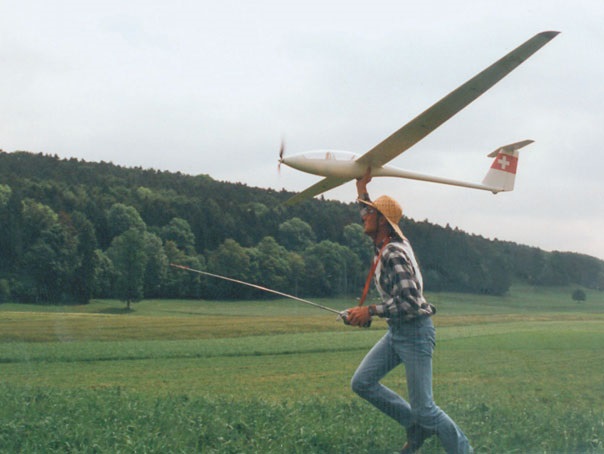
Fast cross-country flying and 10-minute glide flights with minimal engine or energy consumption—not to mention the precision landing. It is a technically and aeronautically challenging and attractive sport. Unfortunately, a certain stagnation has set in in recent years, as the top European teams compete too infrequently outside their home countries, thereby undermining international competition and, consequently, the sport’s appeal. The situation is quite different in the newest gliding class, F5J. Here, competitions across the entire continent—as well as overseas—are attended in large numbers.
Challenges similar to those in F5B can be found in the two new classes, F5A-GPS and F5E-Solar Flight. Here, too, the focus will once again be primarily on experimentation. There are no ready-made solutions—and certainly no one-size-fits-all models. It would be great if some people would delve into these new classes. After all, as we know, interest grows with practice.
After all, as we all know, interest grows as we take action. ■
Emil Giezendanner


TEAM MANAGER "THIS" BOSSHARD
 Rodito Nussbaumer

SUMMER FUN 2026 AT MG USTER
Martin Wunderli
52. 2026 ALPS CUP
 Emil Giezendanner

ATOM, THE NEW DOUBLE-DECKER FROM CPLR
 Matthias Bosshard

INSIGHTS INTO THE HISTORY OF SEAPLANES

34th HAHNENMOOS ALPINE MODEL AIRPLANE CAMP
Res Dauwalder
CORSAIR F4U – A WARBIRD WITH A MEMORABLE LOOK
Jürgen Rosenberger, Jürgen Prinz
SMALL, MODEL-LIKE SAILBOATS
Res Dauwalder
F3A EUROPEAN CHAMPIONSHIPS IN ST-MACAIRE, FRANCE
Matthias Bosshard
What's New at Leomotion.com

HORIZON HOBBY/LEMACO NEWS: MICRO OV-10 BRONCO 645 MM BY E-FLITE

PRIDE AND GOOD IDEAS
 Markus Nussbaumer

News from HEBU

BY YOUTH, FOR YOUTH
Lorena Betschen
YOU KNOW WHAT I MEAN? 125 YEARS OF THE SWISS AERO CLUB
Emil Giezendanner
TRY-OUT DAY AT MFV WETTINGEN
Urs Keller
FREE FLIGHT IN THE MIDDLE OF SUMMER
Urs Muntwyler
THE PC-21 STORY
Emil Giezendanner
TWIN TOWN PARTNERSHIP
Wolfgang Voeller
EURO CONTEST GLIDER ACRO TOUR AUSTRIA 2026

WELCOME, NEW MEMBER!
Andrea Bolliger
COUPE DES ALPES – OBSERVE AND LEARN
Rodito Nussbaumer
NEWS FROM HEBU
 Julia Bucher

FROM 0 TO 100
Markus Nussbaumer
NOS REGION – A HUB FOR ELECTRIC AVIATION
Emil Giezendanner
MEMORIES
Wolfgang Völler
Have you almost forgotten about aircraft that take off and land vertically?
Emil Giezendanner
70 YEARS OF THE NIDWALDEN MODEL AIRPLANE CLUB
Martin Barmettler