
F3K: High-Performance Model Aviation with Versatile After-Work Models
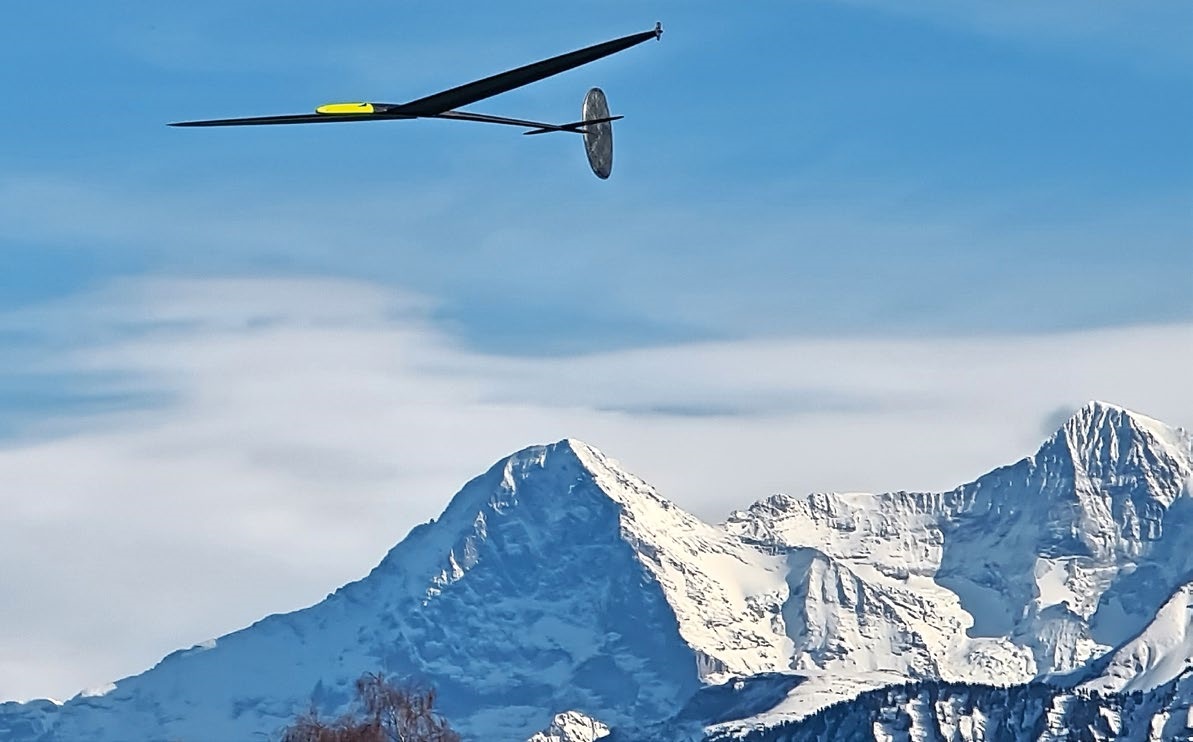
Many people are familiar with the DLG models, which are often colloquially referred to as “Schmeissgeier.” The name isn’t just made up: You grab the model by the wingtips and toss it into the sky with a spinning throw. Once airborne, these models—weighing about 230 g and with a wingspan of 1.5 m—take advantage of even the slightest updrafts and circle like vultures. DLGs are quite widespread because their small size and light weight make them great “take-anywhere” models—perfect, for example, for a quick flight after work. With a discus throw, you can reach a good starting altitude without any aids, from which you can very often find thermals and fly off. DLGs also perform superbly as all-rounders, whether
thermal flying on the plains in the same thermal as red kites, in the mountains when exploiting the first thermals after sunrise, or even ballasted while edge-polishing in strong winds on a local slope.
What’s often forgotten is that DLG models are actually high-performance competition gliders! They are the stars of the F3K class, a modern, sport-oriented, yet still family-friendly competition category. In competition, the focus is on goal-oriented flying and completing specific time-based tasks, which has a special appeal compared to purely recreational flying. When you’re trying to fly a target time of five minutes alongside seven fellow competitors on a day with weak thermals—and you know that the pure glide time might be two and a half mi-
minutes, you’re naturally very tense at first. But when you somehow stumble into a thermal and manage to hit the five-minute mark, it’s an amazing feeling—and it leaves you wanting more. In competitions, you learn to fly your model closer to its optimal performance, which ultimately makes you a better pilot.
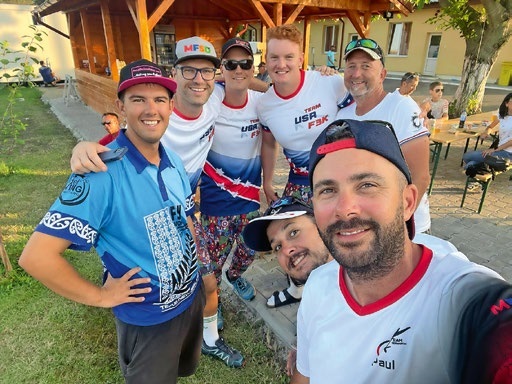
Switzerland has an active competition scene, where around 20 pilots currently compete in about four competitions each year in a friendly atmosphere. There’s something for everyone: While the beginners’ competition in Eschlikon, TG—held at the end of September—is designed for newcomers and their first competitive experiences, top pilots from across Europe also gather in early September for the Stockhorn Trophy in Thun, BE. The atmosphere at all competitions is very friendly
and family-like. Everyone helps each other, and that’s what makes the F3K class truly unique.
When experienced pilots launch their models to astronomical heights—top throwers reach ~90 m!—it often looks elegant and effortless. Unfortunately, when you find yourself in the situation of trying to launch your F3K model into the air with your first few throws, you’re often in for a bit of a reality check. A clean throw requires a certain degree of coordination between your arm, body, and legs. That’s why the question of launch technique is one of the first things experienced F3K pilots are asked at model airfields. The key to success is to stay calm and not try to reach the launch height through sheer force alone.
Before we can even think about throwing, there are a few important—
Points to note. As a rule, the best flight heights are achieved not by throwing the DLG straight up toward the sky, but rather when the throwing rotation occurs in a plane parallel to the ground and the glider is released toward the horizon. This allows significantly more energy to be imparted to the DLG. However, to ensure the DLG then transitions into a vertical flight path, we program a separate flight phase for takeoff in the transmitter, known as the “takeoff mode.” When this is activated, a small elevator deflection of just a few millimeters is applied. It makes sense to assign this function to a switch that can be easily operated by the hand holding the transmitter during launch. This launch mode is activated during the rotation and remains active until the model, after the horizontal release, has completed the arc to the desired angle of climb. Now you can deactivate the launch position and let the model climb in the “speed” position (wings slightly deflated) until the forward momentum has almost disappeared, at which point you use an elevator input to transition the model into normal flight.
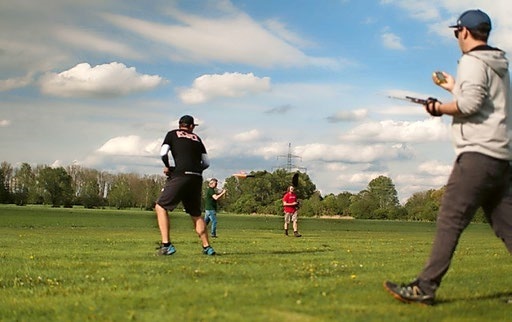
Back to the actual throw. We grip the model by the launch pin with the tips of our index and middle fingers, extend our arm, and twist our upper body slightly (we take a swing). Then we begin to run forward and start the spin. For right-handed people, the turn often begins with the left foot. During this process, keep your arm extended and continue to pull your body back so that you’re coiled like a spring. Just before the legs have completed a full rotation, we begin to release our upper body—along with the outstretched arm—from the pre-tension and the model
Accelerate horizontally until we can release the model against the wind. When practicing, it’s important to perform the turn cleanly and smoothly at first—using force tends to be counterproductive until you’ve mastered the basic technique. The launch procedure can be practiced very effectively without the model or transmitter to get a handle on the coordination between your legs, body, and arms. It’s also highly recommended to film yourself while throwing and then compare your technique with that of experienced pilots. Improving your technique will quickly result in greater launch height. As soon as you can reliably throw the model in a planned direction, you’re more than welcome to join a competition!
An F3K competition consists of several rounds, each with a specific time limit, during which one of 14 different tasks is flown. That sounds complicated, but there are basically two types of tasks. In the first type, there is a target time that must not be exceeded (e.g., a 5-minute target time within a 7-minute time limit). Usually, there is some time left over here, allowing you to
restart after a failed first attempt in order to, ideally, reach the 5-minute target. In the second type, the total maximum flight time equals the time limit (e.g., 5 flights of 2 minutes each within a 10-minute time limit). Here, the goal is to spend as little time as possible on relaunching during the intermediate landings. Experienced pilots no longer land their models on the ground here, but instead catch them directly by the launch pin, getting back in the air within a second—which looks very impressive. The number of rounds to be flown depends on the number of participants. In Switzerland, this often amounts to 7–9 rounds per day, which means you get to fly quite frequently. Thanks to the variety of tasks, the competition remains exciting and varied in every round. If all this sounds a bit complicated: Don’t worry—during the competition, you’ll have an assistant by your side to help you.
You learn the most by competing. That’s why we recommend that anyone interested simply go to a competition and
ask the experienced pilots if they can help out (and vice versa, if you can help them). The beginner’s competition in Eschlikon, TG, is particularly well-suited for this, as the upcoming task and possible strategies are explained between each round. In addition, every beginner is paired with an experienced pilot as a helper to tackle the day as a team. This is extremely educational and serves as an ideal introduction to the F3K class. At the same time, the competition marks the end of the F3K season, and the social gathering over a festive meal and cake plays an important role.
As with model flying in Switzerland as a whole, participant numbers in F3K have unfortunately declined since the pandemic began. However, we believe that, thanks to its sporting aspect, F3K could be an interesting competition class for young pilots as well, and that many pilots have a suitable model but are unaware that there are great competitions for it. For this reason, a WhatsApp community has been launched to make it easier for interested parties to connect, exchange tips and tricks, and share information about competitions. The community is open to everyone, whether you’re simply interested, a DLG recreational pilot, or an F3K competition pilot. We hope this will foster a lively exchange of ideas. During the European and World Championships, the F3K national team will also use this channel to keep the community up to date, providing quick and easy access to the latest developments.
Model aircraft flying has a long tradition in Switzerland. With the increasing shift of model aircraft product sales to the Internet,
With the decline of traditional specialty retailers, it’s becoming increasingly difficult to connect people with different sports categories. That’s why it’s a stroke of luck for us that Julia Bucher from HEBU’s management team visited her team pilots at the 2023 F3K Swiss Championship. This led to a project born out of the conviction that personal advice and support are essential for the survival of such wonderful classes
of our hobby. HEBU will begin distributing an F3K product line later this year. This includes a 1-meter entry-level glider (Hawk 2 by Nikolai Gorban) and a high-end F3K competition model (Falcon 2 by Nikolai Gorban). Rounding out the lineup is the top-of-the-line F3K model “D1 – The One DLG” by multiple F3J and F5J world champion Arijan Hucaljuk, which will initially
be available in very limited quantities. The carefully curated selection, paired with comprehensive support and expertise from the F3K network, is designed to assist F3K enthusiasts of all skill levels—from the initial purchase through to successful participation in F3K competitions. This is likely to
be unique in Switzerland, and we hope that this will help reach a broader audience and inspire enthusiasm for the fantastic model aviation category known as F3K. See you soon at a competition!
Authors: Cederic Duss and Stefan Fluck


News from HEBU

TEAM MANAGER "THIS" BOSSHARD
 Rodito Nussbaumer

YOU KNOW WHAT I MEAN? 125 YEARS OF THE SWISS AERO CLUB
 Emil Giezendanner

F3A EUROPEAN CHAMPIONSHIPS IN ST-MACAIRE, FRANCE
 Matthias Bosshard

HORIZON HOBBY/LEMACO NEWS: MICRO OV-10 BRONCO 645 MM BY E-FLITE

PRIDE AND GOOD IDEAS
 Markus Nussbaumer

ATOM, THE NEW DOUBLE-DECKER FROM CPLR
Matthias Bosshard
SUMMER FUN 2026 AT MG USTER
Martin Wunderli
52. 2026 ALPS CUP
Emil Giezendanner
TWIN TOWN PARTNERSHIP
Wolfgang Voeller
CORSAIR F4U – A WARBIRD WITH A MEMORABLE LOOK
Jürgen Rosenberger, Jürgen Prinz
SMALL, MODEL-LIKE SAILBOATS
Res Dauwalder
TRY-OUT DAY AT MFV WETTINGEN
Urs Keller
WELCOME, NEW MEMBER!
Andrea Bolliger
What's New at Leomotion.com

COUPE DES ALPES – OBSERVE AND LEARN
Rodito Nussbaumer
EURO CONTEST GLIDER ACRO TOUR AUSTRIA 2026

BY YOUTH, FOR YOUTH
Lorena Betschen
INSIGHTS INTO THE HISTORY OF SEAPLANES

34th HAHNENMOOS ALPINE MODEL AIRPLANE CAMP
Res Dauwalder
FREE FLIGHT IN THE MIDDLE OF SUMMER
Urs Muntwyler
THE PC-21 STORY
Emil Giezendanner
NEWS FROM HEBU
 Julia Bucher

FROM 0 TO 100
Markus Nussbaumer
MEMORIES
Wolfgang Völler
NOS REGION – A HUB FOR ELECTRIC AVIATION
Emil Giezendanner
DO YOU KNOW WHAT I MEAN IN THE LAND OF SMILES?
Emil Giezendanner
Have you almost forgotten about aircraft that take off and land vertically?
Emil Giezendanner